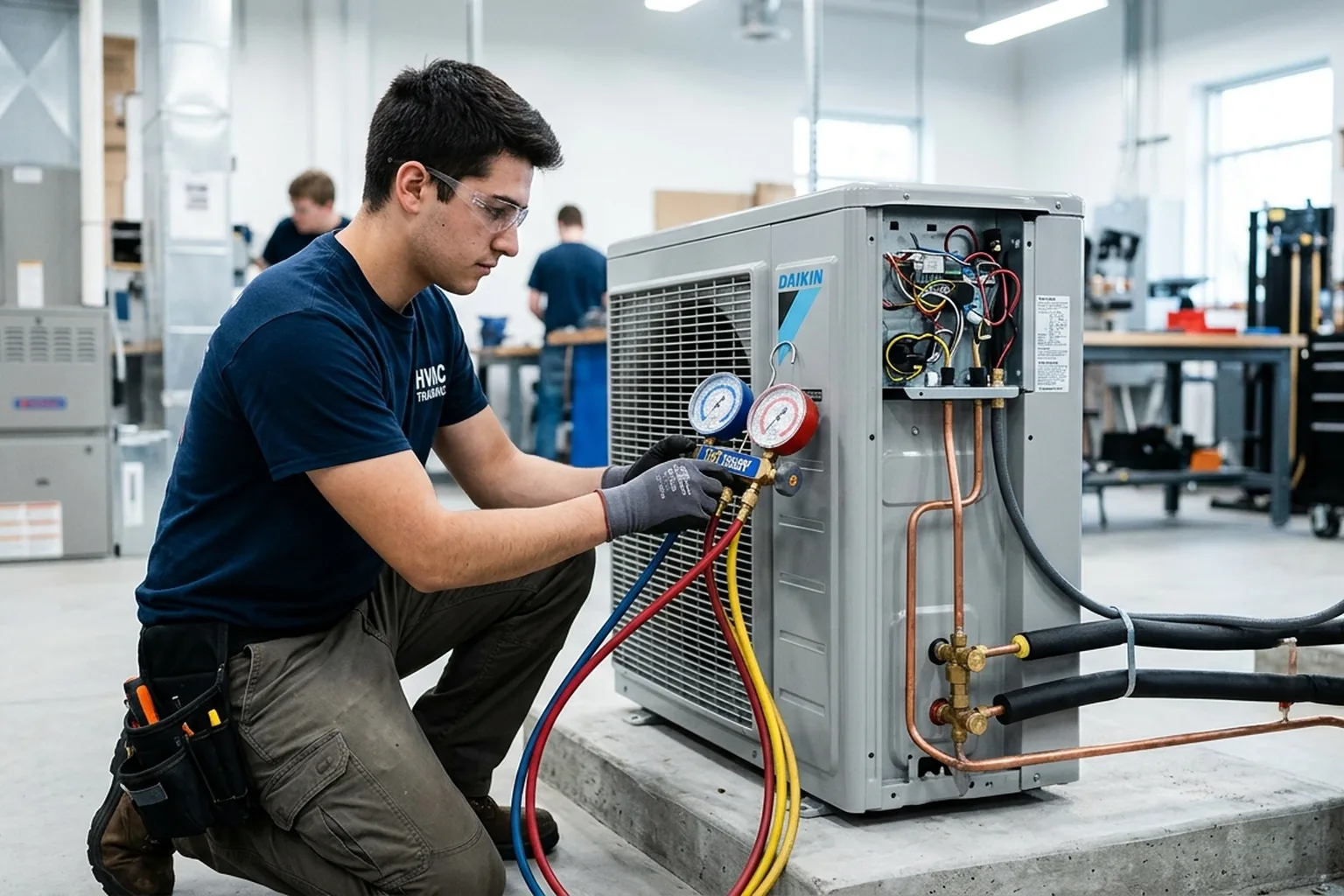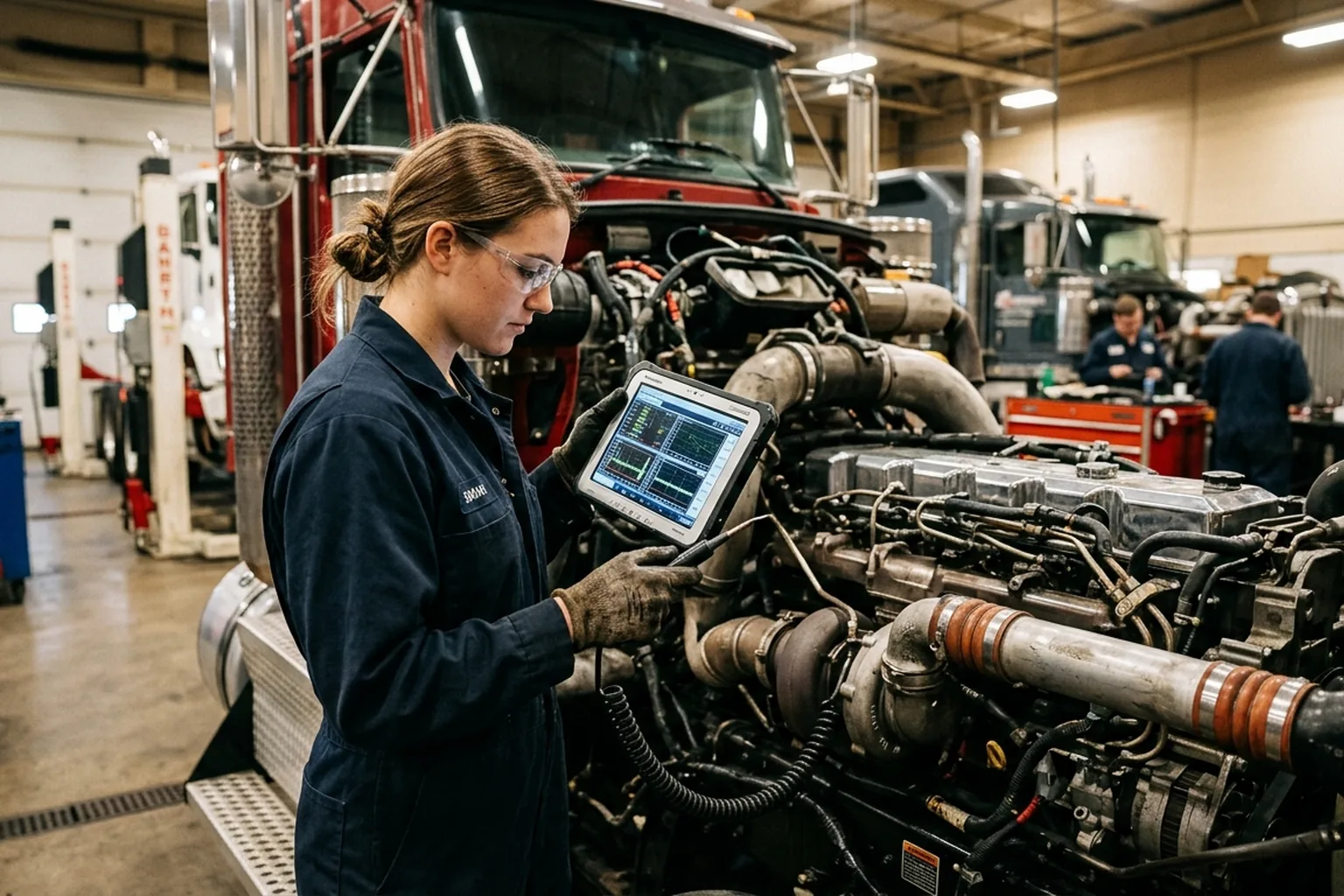

A data-driven ranking for prospective diesel technicians.
TL;DR
- Big career, bigger gap: Diesel service technicians earn a median of $60,640/year across 319,900 jobs nationally, per the BLS Occupational Outlook Handbook.
- The industry is short-handed: The American Transportation Research Institute found 65.5% of diesel shops were understaffed in 2025, with nearly 1 in 5 positions unfilled.
- But training quality varies wildly: Over 30% of training-program graduates were rated unqualified in core skill areas by the diesel shops that hire them, according to ATRI’s 2025 report.
- So school choice is the most important decision a prospective tech will make. Below are the top 10 US diesel mechanic schools ranked on completion rate, retention, program productivity, and trade scale.
The diesel mechanic career in 2026 by the numbers
Before comparing schools, it’s worth grounding the ranking in what the job actually pays and how much room there is in the field. The BLS Occupational Outlook Handbook is the authoritative reference for both.
| Metric | Value |
|---|---|
| Median annual wage (May 2024) | $60,640 ($29.15/hour) |
| Lowest 10% of diesel techs | Less than $41,670 |
| Highest 10% of diesel techs | More than $85,980 |
| Total US employment (2024) | 319,900 jobs |
| Projected growth, 2024–2034 | 2% |
| Projected annual openings | About 26,500 |
Those numbers describe a stable, high-volume trade with roughly 26,500 openings a year through the mid-2030s — most from workers leaving or retiring rather than pure job growth, which is why training capacity matters so much. For a full career guide, see our diesel mechanics career opportunities article.
Why school choice matters more than ever
Demand is not the problem. The problem is that most of the people showing up to diesel shops today aren’t ready to do the work — and the shops know it.
In August 2025, the American Transportation Research Institute published Addressing the Shortage of Qualified Diesel Technicians, a landmark study that surveyed shops, technicians, and training programs across the industry. The findings quantify a workforce crisis that’s been building for years:
- 65.5% of diesel shops were understaffed in 2025, with an average of 19.3% of positions unfilled across the sector.
- 61.8% of new technicians enter the workforce without any formal training, which forces shops to invest roughly 357 training hours and $8,211 in trainee wages per hire to get them to baseline competency.
- Over 30% of graduates from diesel training programs were rated unqualified in 20 core skill areas by the shops that hired them.
- Average technician turnover hit 16.5% in 2024, climbing to 18.1% at understaffed shops versus 7.8% at fully staffed ones — evidence that short-staffed shops burn out the techs they do have.
- Roughly 44% of current trucking technicians are considering leaving the industry, which would deepen the gap even further.
Robert Braswell, Executive Director of the American Trucking Associations’ Technology & Maintenance Council (TMC), summed the situation up for TruckingInfo: “With a lack of qualified techs and stiff competition from other industries, tech employment in trucking is not keeping pace with demand.”
The takeaway is blunt. More than 30% of training-program graduates show up unable to do the job — and that number is exactly why this ranking exists. If you pay for a program, pay for one whose graduates get hired, stay hired, and earn the full BLS salary band. Picking a top-ranked school is the single most important decision a prospective diesel tech can make.
The top 10 best diesel mechanic schools in the US (2026)
The schools below come from the tradecolleges.org national diesel mechanic rankings, which score US schools on four weighted factors: completion rate (25%), retention rate (20%), trade productivity (35%), and trade scale (20%). Completion and retention measure whether students actually finish the program; productivity and scale measure how much diesel-specific output the school is producing and at what concentration. Each school’s name links to its full profile page.
#1 WyoTech — Laramie, WY
Composite score 99. 85.2% completion rate, 89% retention, 476 diesel trade completions, 1,206 total enrollment.
WyoTech is the nation’s highest-ranked diesel-focused school — and demand is outstripping supply. In August 2025, WyoTech launched the Kenworth NextTech Program partnership, which brought four new Kenworth diesel trucks, three donated PACCAR MX-11 engines, and one PACCAR MX engine to campus for diagnostics and repair training, plus free access to Kenworth Essentials dealer technician training and certification modules. WyoTech President Jim Mathis told the Wyoming Tribune Eagle the welding program was “sold out until April 2026” — a strong signal that any student considering WyoTech should apply well in advance.
#2 Universal Technical Institute of Arizona — Avondale, AZ
Composite 98.4. 71.1% completion, 291 diesel completions, 1,791 enrollment.
The flagship UTI campus, with large-scale manufacturer partnerships and some of the biggest diesel throughput in the country. UTI’s parent reported 15.1% Q3 FY2025 revenue growth ($204.3M) and 12.7% growth in average full-time active students — evidence that demand is still accelerating.
#3 Universal Technical Institute of Northern California — Sacramento, CA
Composite 95.4. 69.3% completion, 142 diesel completions, 1,107 enrollment.
The primary UTI campus serving the Bay Area and northern California freight corridors, at the intersection of the I-5 and I-80 Class 8 freight routes.
#4 Universal Technical Institute-Dallas Fort Worth — Irving, TX
Composite 95.2. 66.2% completion, 160 diesel completions, 1,661 enrollment.
In October 2025, UTI announced an expansion of the Dallas campus under the company’s “North Star” strategy, which calls for opening two new campuses annually between 2026 and 2029. For prospective students in Texas, the Dallas expansion means more program capacity and more manufacturer partnerships coming online just as enrollment demand continues to climb.
#5 Universal Technical Institute of California — Rancho Cucamonga, CA
Composite 93.4. 60.8% completion, 125 diesel completions, 1,484 enrollment.
UTI’s southern California campus sits within reach of the Port of Los Angeles and the Inland Empire’s enormous logistics footprint — one of the densest diesel-tech labor markets in the country.
#6 UTI Auto Motorcycle & Marine Mechanics Institute-Orlando — Orlando, FL
Composite 93.2. 64.4% completion, 139 diesel completions, 866 enrollment.
UTI’s Florida campus and southeastern anchor of the network — the only top-10 school with a dedicated marine mechanics track running alongside its diesel program, useful for students interested in marine-diesel work along the Gulf Coast and Atlantic seaboard.
#7 Universal Technical Institute of Pennsylvania — Exton, PA
Composite 93.1. 68.2% completion, 127 diesel completions, 1,004 enrollment.
Exton sits in the Philadelphia-to-New York freight corridor and posts among the stronger completion rates in the UTI network at 68.2%.
#8 Lake Area Technical College — Watertown, SD
Composite 91.7. 62.9% completion, 89 diesel completions, 2,179 enrollment.
The only public community college in the top 10 — a notable low-cost alternative to the proprietary UTI campuses. For students who want a nationally-ranked diesel program without the for-profit tuition, this is the standout pick, and consistently strong outcomes have made it one of the most respected two-year colleges in the Midwest.
#9 Universal Technical Institute of Texas — Houston, TX
Composite 91.4. 62.8% completion, 176 diesel completions, 1,823 enrollment.
UTI’s Houston campus serves the Texas Gulf Coast logistics corridor — heavy petrochemical freight, port operations, and one of the largest concentrations of Class 8 trucking in North America. With 176 annual diesel completions, Houston is among the highest-output diesel training locations in the country.
#10 New York Automotive and Diesel Institute — Jamaica, NY
Composite 88.7. 50.5% completion, 50 diesel completions, 448 enrollment.
The top-ranked diesel-focused school on the East Coast outside of Pennsylvania. Smaller in scale than the UTI campuses, but the only entry in the top 10 based in the New York metropolitan area — relevant for students who need to stay local to the Northeast.
The industry demand outlook for diesel techs
Rankings matter because the underlying demand isn’t going anywhere. The American Trucking Associations’ American Trucking Trends 2025 report projects that trucking will haul 64.6% of US freight tonnage in 2026, with the Class 8 fleet reaching roughly 3.98 million trucks. Freight tonnage is forecast to grow 28.6% over the ATA’s forecast horizon — and every one of those trucks needs a trained diesel technician to keep it running.
The obvious question is whether electrification will eat into that demand before a student’s career even starts. The data suggests no — at least not for the next decade of heavy-duty trucking.
The IEA’s Global EV Outlook 2025 shows that electric heavy-duty trucks remain a small share of global heavy-duty sales despite rapid growth, and adoption is heavily concentrated in specific regions and duty cycles. More importantly for US students, the Department of Energy projects that zero-emission medium- and heavy-duty electric trucks won’t reach cost parity with diesel until 2035.
For a student enrolling in a two-year diesel program in 2026, that means nine-plus years of a diesel-dominant heavy-duty market ahead — plus an enormous legacy fleet that will still need diesel-trained techs long after cost parity arrives. EV and hybrid powertrain skills are a nice supplement, but the core diesel skillset is the durable one.
What to look for in a diesel program
Beyond the ranking, a few program characteristics separate great schools from mediocre ones. When evaluating diesel mechanic programs — even ones outside the top 10 — check for the following:
- ASE Education Foundation accreditation. This is the industry-standard accreditation for automotive and diesel programs. The ASE Education Foundation’s 2025 annual report shows 125,297 students enrolled across 1,812 accredited automotive and diesel programs nationwide, and new Medium/Heavy Truck Program Standards took effect July 1, 2025.
- Manufacturer partnerships. Programs with OEM relationships (Kenworth, PACCAR, Cummins, Detroit Diesel, Caterpillar, John Deere) give students hands-on access to current equipment and branded certification pathways. WyoTech’s Kenworth NextTech partnership is a textbook example.
- Hands-on shop hours and bay ratios. Ask specifically about the student-to-bay ratio and total shop hours required for completion. If a program can’t give you a clear number, that’s a red flag.
- ASE certification prep. Quality programs prepare students for the medium/heavy truck ASE certification tests (T1–T8), not just general coursework.
- Job placement transparency. Ask for gainful employment disclosures and placement rates broken out by program, not school-wide averages that get diluted by other majors.
For a deeper framework on evaluating any trade program before you enroll, see how to evaluate a trade school.
What diesel techs earn
The BLS Occupational Employment and Wage Statistics table for SOC 49-3031 is the best place to look up state-level diesel mechanic wages. The BLS OOH puts the national range between $41,670 (lowest 10%) and $85,980 (highest 10%), with a median of $60,640. State-level numbers vary considerably depending on local freight density, union presence, and specialty demand.
Specialty and geography matter. Marine diesel work in port regions, heavy equipment service in mining and construction markets, and Class 8 over-the-road fleet maintenance along major freight corridors all tend to pay above the national median. Dealership service managers, master technicians with full ASE certification, and mobile field service techs with travel compensation are typically in the upper quartile.
The fundamental dynamic is worth repeating: when nearly two-thirds of shops are understaffed and a third of new grads can’t do the work, the techs who can do the work have real leverage — and that leverage shows up in wages.
Where to start
- Browse all 214 ranked diesel mechanic schools
- Diesel mechanic program pages across the country
- Read the full diesel mechanic career guide
- Compare schools side by side
- Take the 2-minute trade career quiz
Sources
- Bureau of Labor Statistics — Diesel Service Technicians and Mechanics: Occupational Outlook Handbook — Accessed April 2026
- Bureau of Labor Statistics — Occupational Employment and Wage Statistics 49-3031 — Accessed April 2026
- American Transportation Research Institute — Addressing the Shortage of Qualified Diesel Technicians (PDF) — August 2025
- American Transportation Research Institute — New ATRI Research Addresses Shortage of Qualified Diesel Techs in Trucking — August 2025
- TruckingInfo — ATRI: Trucking’s Technician Shortage Is Getting Worse — August 2025
- Kenworth — Kenworth and WyoTech Partner to Launch Kenworth NextTech Program to Address Diesel Technician Shortage — August 2025
- Wyoming Tribune Eagle / Laramie Boomerang — Powering Careers with Diesel: WyoTech, Kenworth Launch Partnership with NextTech Program — August 2025
- Universal Technical Institute — FY2025 Third Quarter Results — August 6, 2025
- Universal Technical Institute — Announces Expansion of UTI Dallas Campus — October 8, 2025
- Vehicle Service Pros — ASE Education Foundation Releases Its 2025 Annual Report — 2025
- American Trucking Associations — American Trucking Trends 2025 — 2025
- Transport Topics — Freight Volumes Projected to Grow 29% Through 2026, ATA Report Says — 2025
- International Energy Agency — Global EV Outlook 2025 — Trends in Heavy-Duty Electric Vehicles — 2025
- US Department of Energy — DOE Projects Zero-Emissions Medium- and Heavy-Duty Electric Trucks Will Be Cheaper Than Diesel — Accessed April 2026