
Walk past a power plant, a Gulf Coast refinery, or an LNG export terminal, and the work that keeps those facilities running is largely invisible. Inside are miles of pipe, racks of pressure vessels, industrial boilers the size of houses, and heat exchangers built to withstand enormous temperature swings. Someone has to fabricate, install, and maintain all of it.
That someone is usually a boilermaker.
It’s one of the highest-paying trades in construction and industrial maintenance, with a median wage above $73,000 — yet it barely appears in trade school brochures or career counselor handbooks. If you’ve heard of it at all, you probably picture someone shoveling coal into a Victorian furnace. The reality in 2026 is considerably more interesting.
TL;DR
- Strong median pay: Boilermakers earned a median $73,340/year in May 2024. Top earners (highest 10%) bring in more than $107,600. Source: BLS OOH.
- Steady openings despite modest growth: BLS projects about 800 openings per year through 2034 — driven almost entirely by retirements, not layoffs. Source: BLS OOH.
- 4-year earn-while-you-learn apprenticeship: The Boilermakers National Apprenticeship Program (BNAP) requires 6,000 hours of on-the-job training. You’re paid while training — no tuition debt.
- Nuclear and LNG are creating new demand: Coal decline is real, but nuclear plant construction and life extensions and LNG infrastructure expansion are absorbing displaced demand.
- Union wages, pension, and benefits: New CBAs include structured raises — the Southeast Area’s 2025 contract locks in $9/hour in wage increases over three years.
What Does a Boilermaker Actually Do?
The name is a misnomer in 2026. While boilermakers do work on boilers, the trade has expanded far beyond that. The core skill set is fabricating, assembling, installing, and maintaining large-scale industrial vessels that hold gases, liquids, or solids under pressure or extreme temperatures.
In practice, that means:
- Boilers and pressure vessels in power plants, industrial plants, and manufacturing facilities
- Storage tanks for oil, gas, chemicals, and water treatment systems
- Heat exchangers in refineries and petrochemical plants
- Vats and processing containers in food, pharmaceutical, and cement manufacturing
- Air pollution control equipment like scrubbers and precipitators
- Ship hulls and marine equipment in shipyards
Most of the work falls into two categories: construction (fabricating and installing new equipment at a job site) and maintenance (inspecting, repairing, and replacing components in existing facilities during planned shutdowns called “turnarounds”).
Turnarounds are a significant part of the boilermaker life. When a refinery or power plant schedules maintenance, boilermakers are often called in for compressed two-to-six week stints — intense work, long hours, and premium pay. For workers who like the rhythm of focused project work followed by downtime, it suits them well.
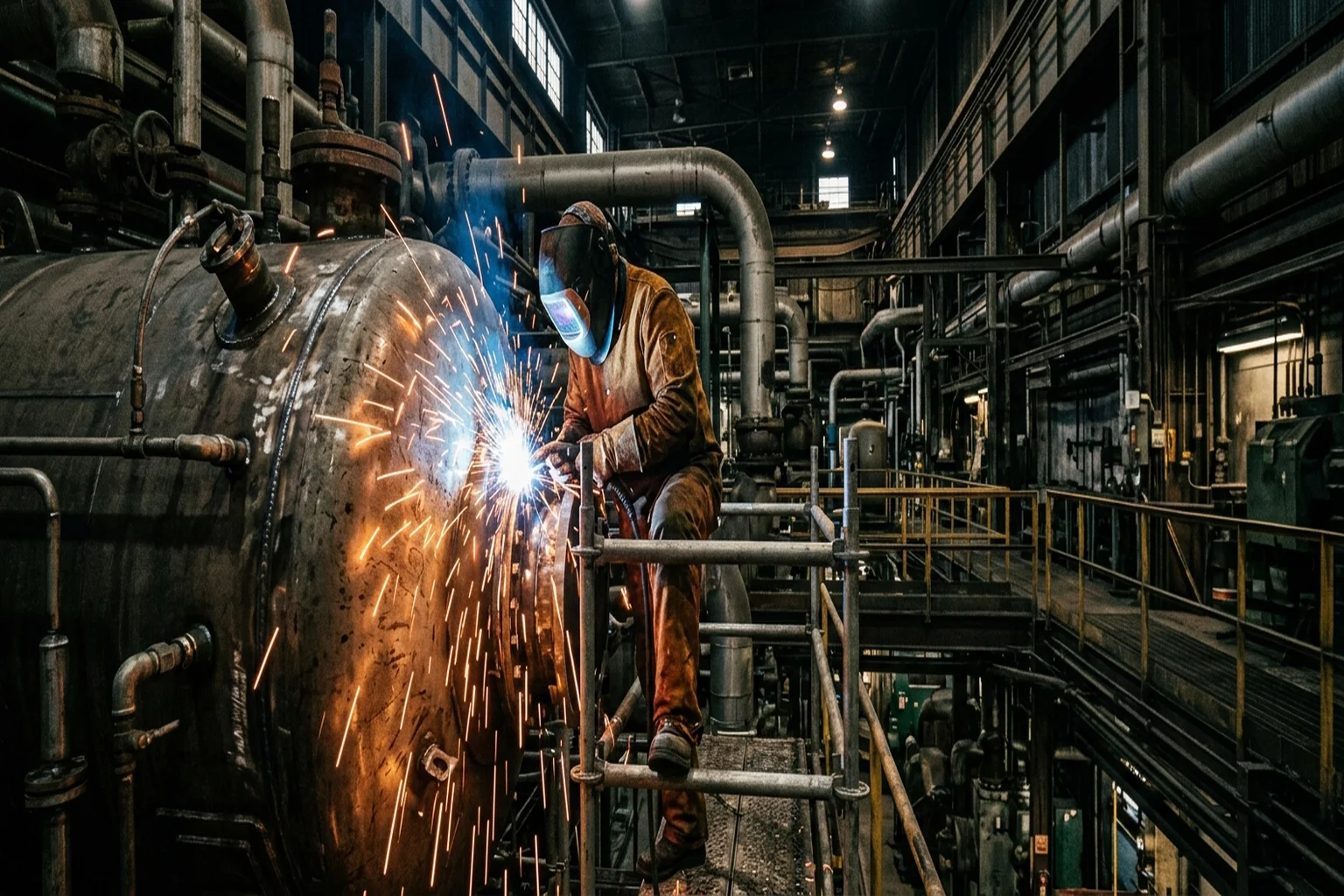
The job involves welding, rigging, operating cranes and hoisting equipment, working at heights, and sometimes working in confined spaces. Physical fitness matters, as does a comfort level with travel — job sites are wherever the industrial infrastructure is, which may or may not be near home.
Boilermaker Salary: What You Can Realistically Earn
The Bureau of Labor Statistics puts the median annual wage for boilermakers at $73,340 as of May 2024. That places it comfortably above the national median for all occupations, and well above most associate-degree-level jobs.
The spread is wide:
| Percentile | Annual Wage |
|---|---|
| Lowest 10% | Below $48,390 |
| Median | $73,340 |
| Highest 10% | Above $107,600 |
Entry-level apprentices earn less — apprenticeship wages typically start at 50–60% of the journeyman rate, stepping up as you progress through the program. But you’re earning from day one with no student loan payments dragging on the back end.
Union contracts set clear wage floors. The International Brotherhood of Boilermakers’ Southeast Area negotiated a new collective bargaining agreement in 2025 that runs through September 2028 and includes $9 per hour in total wage increases across three years. That’s $3/hour annually — compounding into a meaningful pay bump for workers already at journeyman rates.
Geographic variation is significant. Industrial hubs — the Texas Gulf Coast, Louisiana’s petrochemical corridor, the Great Lakes, Pacific Northwest shipyards — tend to pay more than the median. Remote site work often carries additional per diems and travel pay on top of base wages.
Job Outlook: Is This a Dying Trade?
BLS projects a 2 percent decline in boilermaker employment from 2024 to 2034. That number needs context, because it tells an incomplete story.
The decline is almost entirely attributable to the ongoing closure of coal-fired power plants. Coal’s share of US electricity generation has dropped sharply over the past decade, and that trend continues. Fewer coal plants means less demand for the large-scale boiler maintenance those facilities required.
But coal is not the whole picture.
Nuclear: The US nuclear industry is seeing its first sustained resurgence in decades. New reactor designs, federal clean energy tax credits, and data center electricity demand are driving investment in both new construction and life extensions for existing plants. As WTW’s 2024 analysis of the nuclear power renaissance notes, nuclear construction requires specialized welders and pressure vessel workers — exactly the boilermaker skill set. Nuclear-rated welding certifications command a premium on top of standard journeyman wages.
LNG infrastructure: The United States became the world’s largest LNG exporter, and new export terminals continue to come online along the Gulf Coast. LNG facilities require extensive pressure vessel work, and their construction and ongoing maintenance create steady boilermaker demand.
Petrochemicals: The Gulf Coast petrochemical build-out — ethylene crackers, processing plants, storage terminals — remains active. Refineries also require regular turnaround maintenance regardless of energy transition timelines.
Replacement demand: BLS projects roughly 800 boilermaker job openings per year through 2034 despite the overall employment decline. Most of those openings come from retirements. The existing boilermaker workforce is aging, and replacements are needed whether or not total employment grows.
The honest picture: this is not a high-growth trade. But 800 annual openings in a specialized field with a $73K median and a 4-year earn-while-you-learn training path is a reasonable career bet, particularly for someone drawn to industrial and energy work.
How to Become a Boilermaker
There are three primary paths into the trade.
Path 1: Union Apprenticeship (BNAP)
The Boilermakers National Apprenticeship Program is the primary entry route. It’s a four-year program requiring 6,000 hours of on-the-job training combined with classroom instruction — the standard earn-while-you-learn structure that most skilled trades apprenticeships follow.
Basic requirements:
- At least 18 years old
- High school diploma or GED
- Willingness to pass drug testing
- Reliable transportation (sites may be distant)
Selection is competitive. Applicants with existing welding qualifications move to the front of the line — SMAW (Shielded Metal Arc Welding, also called stick welding) is the foundational welding process in the trade. If you’re considering boilermaking, getting a welding certification before applying is a concrete way to strengthen your application.
Apprentices start at a percentage of the journeyman wage — typically around 50–60% — and step up through the program. By year four, most apprentices are earning close to full journeyman rates. The program is registered with the U.S. Department of Labor, and completion earns a Journeyman Card recognized across the industry.
Path 2: NCCER Credentials → Apprenticeship Entry
NCCER (the National Center for Construction Education and Research) offers a standardized boilermaking curriculum with industry-recognized credentials. This path is useful for people who want to build foundational skills before entering a union apprenticeship, or who are in areas where union locals aren’t actively recruiting. NCCER credentials can support entry into non-union boilermaker positions in industrial maintenance.
Path 3: Community College Program
Some community colleges offer boilermaker apprenticeship technology programs that provide academic credit alongside OJT. Ivy Tech Community College in Indiana, for example, offers both an AAS degree and a technical certificate in Apprenticeship Technology — Boilermaker, with coursework structured around DOL apprenticeship standards. These partnerships allow apprentices to earn academic credentials while completing their hours.
What Skills Do You Need?
Boilermaking draws from a specific cluster of technical abilities. Here’s what matters:
Welding — The core skill. SMAW is primary, but MIG, TIG, and flux-core welding appear depending on the material and code requirements. Nuclear and pressure vessel work requires weld procedure qualifications. If you’re already a capable welder, you’re partway there. See our welding career guide for more on the skill fundamentals.
Rigging and crane operation — Boilermakers routinely lift and position heavy equipment. Rigging — attaching loads safely to cranes and hoists — is a core part of training.
Blueprint reading — Fabrication and installation work requires reading technical drawings, schematics, and code specifications.
Applied math — Pressure calculations, geometric layout, material measurements. Not calculus, but competence with algebra and spatial reasoning matters.
Physical fitness and adaptability — The work involves lifting, climbing, working in confined spaces, and spending extended periods at elevation. Comfort with heights is not optional.
Travel readiness — Turnaround work especially may take you away from home for weeks at a time. This is a real lifestyle consideration, not a minor footnote.
Union vs. Non-Union Boilermakers
The majority of boilermakers are represented by the International Brotherhood of Boilermakers (IBB), one of the AFL-CIO’s oldest craft unions. Membership runs to roughly 50,000 members across the US and Canada, organized into local lodges that negotiate wages, benefits, and working conditions for their geographic territory.
Union membership typically means:
- Defined wage scales with annual increases
- Pension and health insurance coverage
- Structured apprenticeship with recognized credentials
- Access to job referrals through the local hall
Non-union boilermakers exist — industrial maintenance contractors sometimes hire directly without union affiliation. Pay can be competitive, but benefits and job security vary considerably. If you’re weighing the trade-offs more broadly, our union vs. non-union trades guide covers the key considerations for any trade.
Is Boilermaking Right for You?
Boilermaking suits a specific kind of worker. It’s a good fit if you:
- Already weld or want to make welding the core of your career
- Like variety — every job site is different, every turnaround is a new facility
- Are comfortable with industrial environments: noise, heat, heights, and confined spaces
- Can handle travel and project-based rhythms rather than a fixed daily commute
- Want a union-scale income without a four-year degree
It’s a harder sell if you want a stable local routine, work close to home consistently, or are uncomfortable with physical hazards. The trade demands respect for safety protocol — boilers and pressure vessels contain enormous stored energy, and complacency is dangerous.
If you’re drawn to similar work with more local stability, HVAC is worth comparing — similar industrial knowledge base, more residential and commercial work closer to home. Pipefitters and ironworkers work the same heavy industrial sites and share much of the project-based culture.
Getting Started
The most direct path is to build your welding fundamentals first, then contact your regional boilermaker local to ask about apprenticeship openings. BNAP locals don’t recruit on a constant cycle — openings appear when industrial projects ramp up in the region. Timing matters.
If you want to browse trade schools and programs while you’re building your welding base, our best trade colleges rankings can help you find accredited programs near you.
The trade doesn’t advertise itself. That’s probably why there’s still room in it.
Sources
- U.S. Bureau of Labor Statistics — Occupational Outlook Handbook — “Boilermakers” — May 2024 — https://www.bls.gov/ooh/construction-and-extraction/boilermakers.htm
- Boilermakers National Apprenticeship Program (BNAP) — “Training” — https://www.bnap.com/
- International Brotherhood of Boilermakers — “Apprenticeship Program” — https://boilermakers.org/apprenticeship
- International Brotherhood of Boilermakers — “Southeast Area Secures New Three-Year CBA” — 2025 — https://boilermakers.org/news/headline-news/southeast-area-secures-new-three-year-cba
- WTW — “Nuclear Power Renaissance: Opportunities and Challenges for the Construction Industry” — November 2024 — https://www.wtwco.com/en-us/insights/2024/11/nuclear-power-renaissance-opportunities-and-challenges-for-the-construction-industry
- NCCER — “Boilermaking Craft Catalog” — https://www.nccer.org/craft-catalog/boilermaking/