
The U.S. hit a record 1.3 million electric vehicle sales in 2024 — 8.1% of all cars sold. But there’s a workforce problem the auto industry is only beginning to grapple with: of more than 229,000 technicians certified by the National Institute for Automotive Service Excellence (ASE), only about 3,100 — roughly 1.4% — hold EV-specific certifications.
That math creates a clear opening. As millions more electric vehicles join U.S. roads each year, demand for technicians who can diagnose battery systems, repair high-voltage components, and service charging infrastructure is growing faster than training programs can keep up. For anyone weighing a career in the trades, EV technology is one of the most strategically timed specializations available right now.
This guide covers what EV technicians actually do, what the pay looks like, how to get trained, and which certifications carry the most weight.
Why EV Technicians Are in Demand Right Now
The fleet is outgrowing the workforce
Cox Automotive reported that 2024 was a record year for U.S. EV sales, with electric vehicles accounting for 8.1% of all new car sales — up from 7.8% in 2023. That fleet of 1.3 million new vehicles will eventually need battery inspections, software diagnostics, high-voltage system repairs, and charging equipment service.
The technician pipeline has not kept pace. According to Automoblog, there are currently about 807 EVs for every technician holding an EV-specific certification — already a tighter ratio than the existing gap in traditional auto repair, where roughly 1,270 ICE vehicles share each ASE-certified tech.
Dealerships are openly underprepared
A Cox Automotive study on dealer preparedness found that only 32% of technicians at dealerships that service EVs are actually trained to work on them. More than half of dealerships reported they are not fully prepared to handle EV service needs.
This is not a hypothetical future shortage — it’s a skills gap that exists at the service counter today. Technicians who specialize in EV work aren’t waiting for the market to develop; they’re stepping into roles that employers are struggling to fill.
For a broader look at how the entire automotive trade is changing, see our guide to automotive technology career opportunities.
What EV Technicians Actually Do
EV technician work overlaps with traditional auto repair in some areas and diverges sharply in others. The biggest differences come down to high-voltage systems and software.
Core tasks
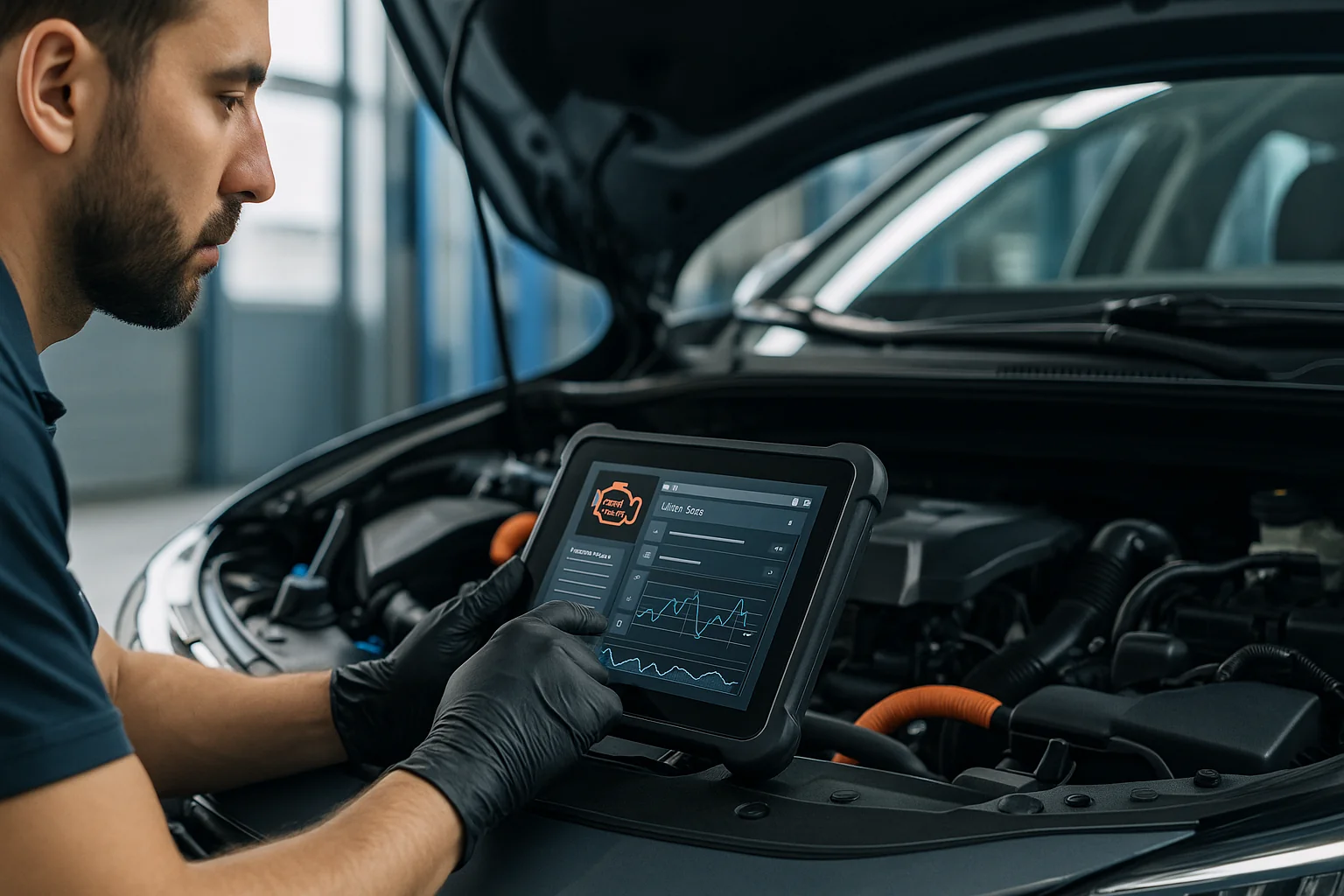
- Battery system diagnosis and inspection: Assessing state of charge, state of health, cell balance, and thermal management. This includes identifying degraded modules and advising on replacement schedules.
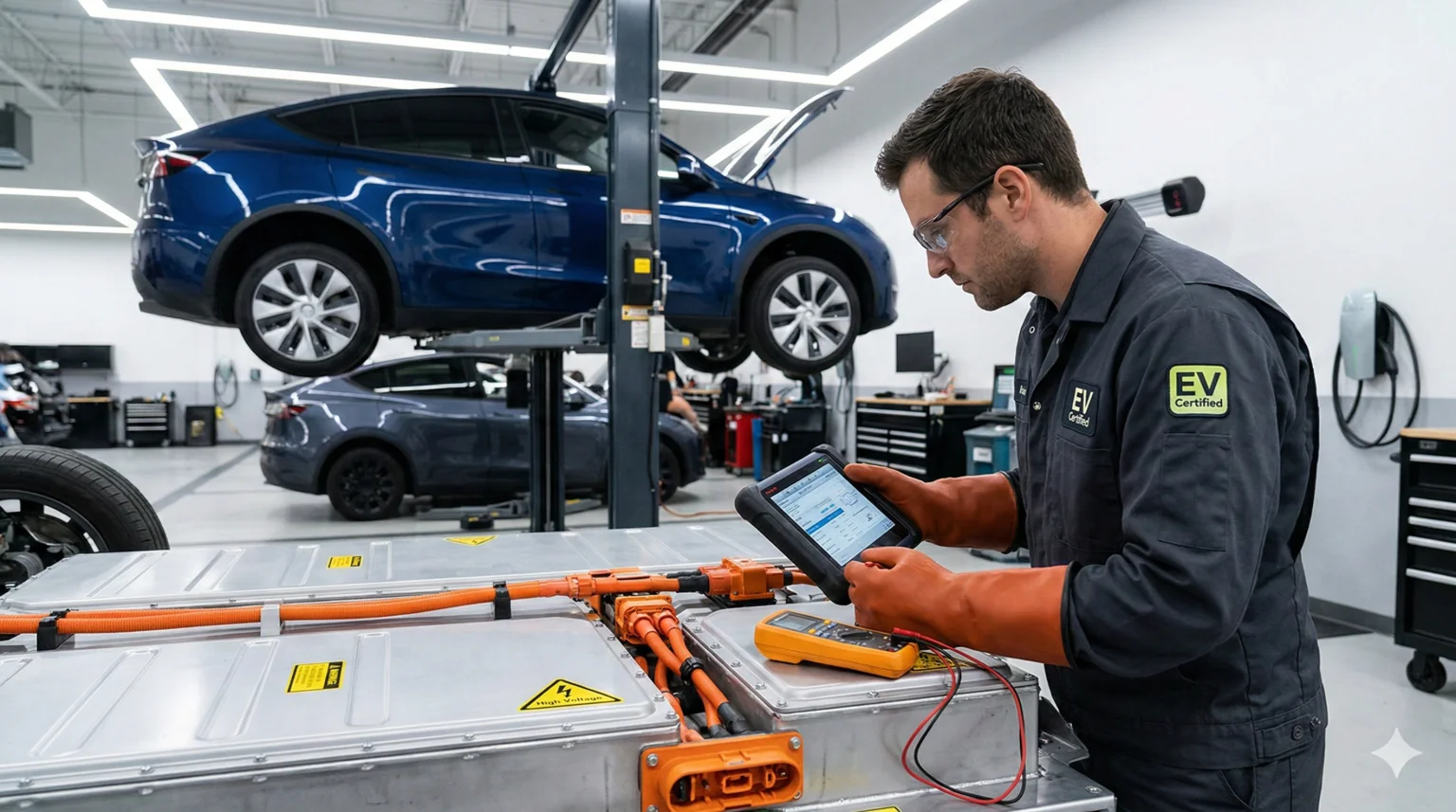
- High-voltage system service: Working safely around systems that operate at 400–800V. This requires strict de-energizing procedures and specialized personal protective equipment (PPE) — insulated gloves, face shields, and high-voltage-rated tools.
- Charging system repair: Diagnosing onboard chargers, DC fast charging ports, and charging control modules. As EV adoption spreads, charging infrastructure service is becoming a specialty in its own right.
- Regenerative braking systems: EV and hybrid braking systems recover kinetic energy to recharge the battery. Diagnosing faults requires understanding both the mechanical and electrical sides simultaneously.
- Software and firmware updates: EVs are software-defined vehicles. Many repairs involve over-the-air update failures, module resets, or reprogramming after component replacement.
- Thermal management: Battery and motor cooling systems require service distinct from conventional coolant work.
How this compares to traditional auto repair
Unlike internal combustion vehicles, EVs require no oil changes, no spark plugs, and have simpler drivetrain mechanics with far fewer moving parts. What fills that gap is higher-complexity electrical diagnosis. Technicians who excel here tend to be comfortable with diagnostic software, multimeters, and electrical schematics — skills that overlap considerably with electrical trade work.
Salary and Career Outlook
What EV technicians earn
Salary data for EV technicians specifically reflects a meaningful premium over the general auto tech field. Glassdoor data for 2025 puts the average EV technician salary at $64,511 per year, with a typical range of $53,621 to $78,168 depending on employer, location, and experience.
That compares favorably to the Bureau of Labor Statistics median of $49,670 for all automotive service technicians as of May 2024. The EV specialization is already commanding roughly a 30% premium over the broader field median.
Geography matters: California ($68,272) and Massachusetts ($67,363) trend higher than the national average, tracking closely with EV adoption rates in those states.
Overall job market
BLS projects 4% growth for automotive service technicians overall from 2024 to 2034, in line with average for all occupations, with approximately 70,000 job openings per year across the field. As EVs take a growing share of new car sales, a larger portion of those openings will require EV competency — making the certification a competitive differentiator even within the broader auto tech labor market.
How to Become an EV Technician: Training Paths
There are three realistic paths into this specialty, depending on whether you’re starting from scratch or adding to an existing automotive background.
Path A: Trade school or community college certificate
This is the most direct route for someone new to the trade. Alternative fuel vehicle technology programs are now offered at community colleges and technical schools across the country, covering EV fundamentals, battery systems, high-voltage safety, and charging infrastructure. Programs typically run 6 months to 2 years and result in a certificate or associate degree.
Institutions with dedicated EV programs include Saddleback College in California, San Juan College in New Mexico, and the University of Houston-Downtown — each offering EV-specific credentials that lead directly into the ASE certification pathway.
No prior automotive experience is required at most programs. Entry typically requires a high school diploma or GED.
Path B: Upskilling from an automotive mechanics background
If you already hold training in automotive mechanics technology, the fastest route to EV specialization is adding the ASE L3 certification (covered in the section below). Many employers will sponsor continuing education for existing staff who want to add EV credentials.
For those who want a more engineering-forward role — working on EV powertrain development and systems testing rather than hands-on service — automotive engineering technology programs bridge the gap between trade work and technical engineering.
Path C: Manufacturer-sponsored programs
Tesla’s START Program is a 12-week capstone offered at partner colleges nationwide. Students earn a $9.46/hour stipend during training, and graduates are automatically qualified to apply for Level I, II, or III technician positions at any Tesla Service Center in North America. The program integrates into existing automotive curricula as a final-semester capstone, making the transition from school to employment unusually direct.
Ford runs a parallel program through its established ASSET (Automotive Student Service Educational Training) initiative, adding dedicated EV coursework to its community college network.
Certifications That Matter
ASE L3: Light Duty Hybrid/Electric Vehicle Specialist
The ASE L3 is the industry-standard credential for EV service. According to the 2025 ASE L3 Study Guide, earning it requires:
- Prerequisites: You must first hold both the ASE A6 (Electrical/Electronic Systems) and A8 (Engine Performance) certifications
- Exam: 55 questions (45 scored), 2-hour time limit
- Content areas: High-voltage battery systems, HV safety procedures, drive system diagnostics, power electronics, and hybrid supporting systems
- Recertification: Every 5 years
The prerequisite structure is intentional — the L3 is built on a foundation of electrical knowledge. Technicians who lack solid grounding in automotive electrical systems tend to struggle with EV diagnosis. Programs covering vehicle maintenance and repair fundamentals that include electrical systems work are solid preparation before pursuing the A6 and A8 exams.
Manufacturer-specific credentials
Tesla START graduates receive a certificate that qualifies them for Tesla service roles regardless of ASE status. Ford’s FACT (Ford Automotive Career Training) program similarly offers brand-specific credentials. These carry the most weight for technicians planning to work at dealerships or brand-authorized service centers.
Career Paths and Advancement
Entry-level
Most EV technicians start in a dealership service department or at an independent EV shop. Entry-level work focuses on routine service, software updates, and assisting senior technicians on battery and drivetrain jobs.
Mid-career
With 3–5 years of experience and EV certifications in hand, technicians move into lead tech roles, shop foreman positions, or fleet maintenance jobs. The fleet path is particularly relevant as commercial operators — delivery companies, transit agencies, municipal fleets — convert to electric vehicles and need dedicated maintenance staff, often with more stable hours than dealership service work.
Advanced paths
- EV infrastructure technician: Installation and maintenance of Level 2 and DC fast charging equipment. This work overlaps with licensed electrical trade work and can open doors to infrastructure contracts and grid-side installations.
- Technical trainer: With EV expertise still rare, experienced technicians are in demand to train other mechanics at dealerships and trade schools — a role that typically commands a salary premium.
- Service manager: The management track from technician through service advisor to service manager is well-established in dealerships, and EV-specific operational knowledge is becoming a distinguishing credential at this level.
- Mobile EV repair: As EV ownership expands beyond metro areas, mobile technician services are emerging as a viable independent business model in markets currently underserved by fixed-location shops.
For the full occupational profile, see the automotive service technicians and mechanics career overview.
Is This Trade Right for You?
EV technician work is a strong fit if you:
- Prefer electronics and diagnostics over purely mechanical work — the job involves more software interaction and less conventional wrench-turning than general auto repair
- Want a specialty that’s early in its growth curve — the certification gap documented above gives skilled EV techs real leverage in salary negotiations right now
- Already have or are building an automotive foundation — EV work is a natural extension of automotive training, not a completely separate field
Be realistic about the demands. High-voltage systems require strict safety discipline — a single protocol error carries genuine risk. Employers take high-voltage safety training seriously, and technicians need to as well.
The field is also evolving quickly. What counts as advanced knowledge today may be standard practice within five years, which means ongoing training is built into the job, not a one-time credential you earn and shelve.
Start Exploring Programs
The most direct path into this field is through a dedicated alternative fuel vehicle technology program at a community college or trade school near you. If you’re coming from the automotive side, adding EV coursework to an automotive mechanics foundation and working toward the ASE L3 is the most efficient upskilling route.
The workforce gap is real. The training infrastructure is in place. The question is whether you get into the pipeline early enough to take advantage of it.
Sources
- Cox Automotive — “Electric Vehicle Sales Jump Higher in Q4, Pushing U.S. Sales to a Record 1.3 Million” — January 2025 — coxautoinc.com
- Cox Automotive — “New Cox Automotive Study: EV Consideration at Record High, but Dealers Feel Unprepared” — coxautoinc.com
- U.S. Bureau of Labor Statistics — Occupational Outlook Handbook: Automotive Service Technicians and Mechanics — May 2024 — bls.gov
- Automoblog — “Are We About To Face an EV Technician Shortage?” — August 2023 — automoblog.com
- ASE — Light Duty Hybrid/Electric Vehicle Specialist (L3) Study Guide — 2025 — ase.com
- Tesla — Tesla START Program — tesla.com
- Glassdoor — Electric Vehicle Technician Salaries — 2025 — glassdoor.com