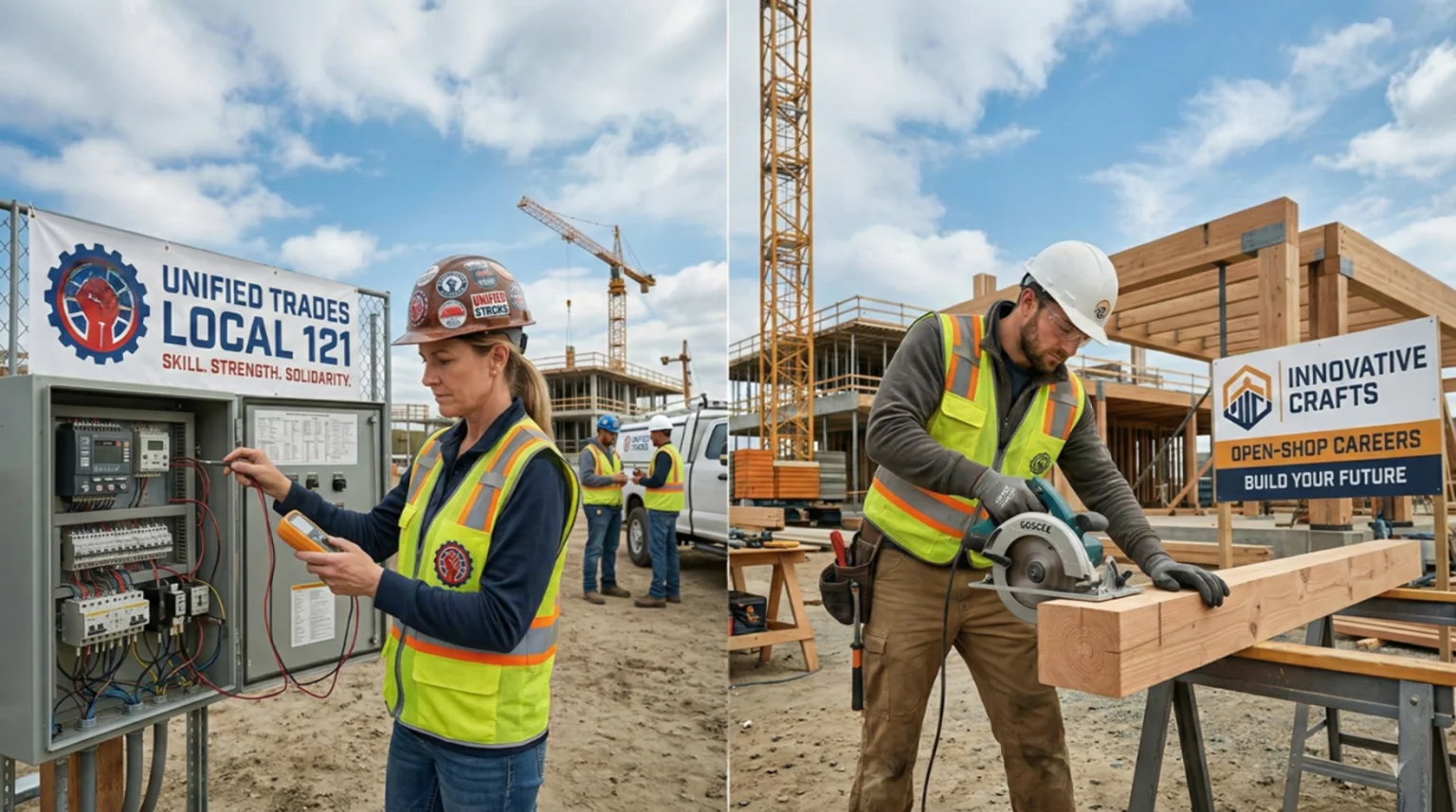

When you start looking at trade programs and apprenticeships, you’ll run into this question quickly: should you pursue a union path or go open shop? It’s one of the most consequential decisions a new tradesperson makes, and most guidance on the topic comes from people who’ve already picked a side.
This article won’t tell you which is better — because neither is universally better. What it will do is lay out the real differences in wages, benefits, training, job security, and flexibility so you can make an informed decision based on your trade, your region, and what you actually want from a career.
How Union Trades Work
A trade union is a labor organization that bargains collectively on behalf of its members — negotiating wages, benefits, working conditions, and dispute resolution with signatory employers. When you work for a union contractor, those terms are set by a collective bargaining agreement (CBA) rather than by individual negotiation.
Joining a Union
You don’t just sign up. Typically, you apply to a local union for entrance into their apprenticeship program. Locals set their own application windows, requirements (usually a high school diploma or GED, valid driver’s license, and for some trades, basic math aptitude tests), and selection processes. Some locals have waiting lists; others accept continuously.
Once accepted, you enter a multi-year apprenticeship — typically four to five years — working under a journeyman while attending related technical instruction. You’re paid from day one, starting at roughly 40–50% of journeyman wages and stepping up every six months until you graduate.
The Major Unions by Trade
- IBEW (International Brotherhood of Electrical Workers) — electricians, telecommunications, utility workers
- UA (United Association) — plumbers, pipefitters, HVAC/refrigeration, sprinkler fitters
- UBC (United Brotherhood of Carpenters) — carpenters, millwrights, floor layers, pile drivers
- LIUNA (Laborers’ International Union of North America) — general construction labor, hazmat, tunneling
- SMART (Sheet Metal, Air, Rail and Transportation Workers) — sheet metal workers, HVAC fabrication, transit workers
Together these and other affiliated unions form NABTU — North America’s Building Trades Unions — which represents over 3 million skilled craft professionals in the U.S. and Canada.
Dues
Union members pay dues, typically 1–2% of gross wages, to their local. Dues fund the local hall’s operations, training facilities, legal representation, and political advocacy. The math: at $35/hour, 1.5% dues runs about $1,100/year. Whether that’s worthwhile depends on what you receive in return — which the wages and benefits section addresses directly.
How Work Gets Dispatched
Many locals operate a hiring hall: employers call the hall when they need workers, and the local dispatches members by seniority and availability. This means you might work for multiple contractors over the course of a year depending on project cycles. Some members find this variety valuable; others prefer the stability of a long-term employer relationship.
How Non-Union (Open Shop) Trades Work
“Open shop” or “merit shop” means a non-union employer hires workers directly. Wages, benefits, and advancement are determined by the employer — sometimes formalized in company pay scales, sometimes negotiated individually. There’s no collective bargaining agreement and no hiring hall.
The major national organization representing open-shop contractors is the Associated Builders and Contractors (ABC), which advocates for the merit-shop model and operates apprenticeship and training programs through its chapters.
Advancement and Flexibility
The term “merit shop” reflects the open-shop argument for its own model: advancement is based on performance and productivity rather than seniority. A skilled worker who impresses their employer can move up faster than a union apprenticeship timeline permits. In practice, this cuts both ways — motivated workers can accelerate, but there’s no floor protecting a slower learner from being passed over or let go.
Non-union workers also move more freely between employers. There’s no dispatch system, no local to notify, no obligation to a particular contractor network. This mobility suits workers who want to diversify their experience across project types, relocate frequently, or work in multiple sectors.
Training in Open Shop
Training pathways vary widely. Some non-union contractors run their own in-house programs. ABC chapters offer registered apprenticeships that have grown significantly in recent years. Community colleges and trade schools provide certificates and associate degrees that feed into non-union employment. The quality and portability of these credentials varies more than in the union system, where a journeyman card from one local is recognized by other locals in the same international.
If you’re considering trade school as your entry point into a non-union career, the trade school financing guide covers Pell grants, Workforce Innovation and Opportunity Act funding, and employer tuition assistance programs that apply to both union and non-union paths.
The Wage and Benefits Gap
This is where the numbers matter most. According to the BLS 2024 Union Members annual release, nonunion full-time workers had median weekly earnings of $1,138, compared to $1,337 for union members — meaning nonunion workers earned 85 cents for every dollar union members earned, as reported by the BLS Economics Daily.
In construction specifically, the gap is wider. The same BLS data shows union construction workers earned a median of $1,530 per week, compared to $1,051 for nonunion workers — a 46% difference.
Total Compensation, Not Just Hourly Rate
The wage gap understates the full picture. Benefits access diverges sharply between union and nonunion workers, according to the BLS Labor Day analysis of wages and benefits:
| Benefit | Union Workers | Nonunion Workers |
|---|---|---|
| Retirement plan access | 95% | 72% |
| Medical benefits access | 95% | 71% |
| Leave benefits (sick, vacation, family) | 97% | 87% |
The retirement contribution gap is especially significant over a career. Union workers receive an average of $4.85 per hour in employer retirement contributions, compared to $1.12 per hour for nonunion workers — a difference that compounds substantially over decades.
The Honest Caveat
These are national medians. In major metro markets with tight labor conditions — think New York, San Francisco, Chicago — non-union specialty contractors often match or exceed union wages to attract talent. The gap is most pronounced in mid-size cities, suburban markets, and rural areas where open-shop wages face less upward pressure. Research local wages in your specific trade and city before drawing conclusions from national figures.
Training and Apprenticeships
Union apprenticeships are structured, paid, and portable. You earn wages from your first day on the job — starting at roughly 40–50% of journeyman scale and stepping up every six months. By year four or five, you’re earning close to full journeyman rates while completing your credential.
NABTU reports that in 2024, the building trades had a record 314,958 apprentices enrolled across nearly 2,000 training facilities nationwide. NABTU affiliates and their contractor partners invest over $2 billion per year — private-sector money — to fund those programs. That scale means the training infrastructure is real: well-equipped facilities, standardized curricula, and instructors who are working tradespeople.
When you complete a union apprenticeship, you earn a journeyman card recognized by every local in that international union. Move from Dallas to Denver? Your IBEW journeyman card works with the Denver local. Credential portability matters for anyone who might relocate.
Non-union apprenticeships through ABC chapters and community colleges are legitimate and growing, but the credential system is less standardized. A certificate from one employer’s program may carry less weight at a different employer than a union journeyman card does. The gap in standardization is narrowing as more states adopt apprenticeship frameworks, but it remains a real consideration.
Job Security, Flexibility, and Work Rules
Union: Protections With Trade-Offs
Union contracts include grievance procedures — if you’re disciplined or terminated in a way that violates the CBA, you can formally contest it. Layoff procedures often follow seniority. These protections provide a meaningful floor, especially during slow periods when employers make workforce reductions.
The trade-off is work rules. Union contracts specify what tasks workers in each classification perform. An electrician doesn’t do a plumber’s work. A journeyman doesn’t typically do tasks classified as laborer work. On large commercial and industrial projects this structure is standard and expected. On smaller projects, rigid jurisdictional boundaries can create friction.
Non-Union: Flexibility in Both Directions
Open-shop workers can be let go more easily — there’s no grievance process and no seniority protection. In a slow market, non-union workers absorb layoffs faster. On the flip side, a skilled open-shop worker can jump to a better employer without navigating union dispatch, and can take on varied tasks across trades on smaller job sites.
Where Each Model Dominates by Project Type
Market share by project type matters for where you’ll actually find work:
- Large public construction, heavy industrial, major commercial: Union labor dominates, partly because prevailing wage laws on public projects often set pay at or near union scale regardless of membership.
- Residential, light commercial, fast-track private construction: Open shop is more common, particularly outside of strongly unionized metro areas.
If your goal is to work on large infrastructure projects, power plants, data centers, or public works, the union path puts you closer to where that work gets done. If residential construction or smaller commercial work appeals to you, open shop may be the more direct entry point.
Which Path Makes Sense for You?
Neither path is universally superior. Here’s a practical framework:
Union likely makes more sense if:
- Structured, paid training from day one is important to you
- You want strong health and retirement benefits without negotiating for them
- Your target trade and region have strong union market share
- You’re planning a long career in commercial, industrial, or public construction
- Credential portability matters — you want to be able to move cities and keep your standing
Non-union likely makes more sense if:
- You want faster entry — some open-shop programs are shorter than 4–5 year union apprenticeships
- Employer flexibility and the ability to advance by performance appeals to you
- Your local market is open-shop dominated and union wages in your area aren’t significantly higher
- You’re entering residential construction, where open shop is the norm
Before choosing, research your specific trade and market. Call both the local union hall and an ABC chapter in your area. Ask what their apprenticeship wages look like at each year, what the benefits package includes, and how long the waiting list is (for unions) or how quickly you can start (for open shop). The right answer almost always depends on local conditions more than national ideology.
For guidance on how to narrow down the right trade in the first place, the choosing the right trade program guide walks through how to evaluate fit, local demand, and training options before committing.
Sources
- U.S. Bureau of Labor Statistics — “Union Members — 2024 Annual News Release” — January 2025 — https://www.bls.gov/news.release/archives/union2_01282025.htm
- U.S. Bureau of Labor Statistics — Economics Daily — “Weekly earnings of nonunion workers were 85 percent of union members’ earnings in 2024” — 2025 — https://www.bls.gov/opub/ted/2025/weekly-earnings-of-nonunion-workers-were-85-percent-of-union-members-earnings-in-2024.htm
- U.S. Bureau of Labor Statistics — Economics Daily — “Labor Day: A closer look at wages and benefits for unionized workers” — 2025 — https://www.bls.gov/opub/ted/2025/labor-day-a-closer-look-at-wages-and-benefits-for-unionized-workers.htm
- North America’s Building Trades Unions (NABTU) — “Building Trades Union Membership in the U.S. Continues to Rise” — 2025 — https://nabtu.org/press_releases/building-trades-union-membership-in-the-u-s-continues-to-rise/
- LumberFi — “Union vs Non-Union Construction Payroll in 2026: Key Differences” — https://www.lumberfi.com/blog/union-vs-non-union-construction-payroll