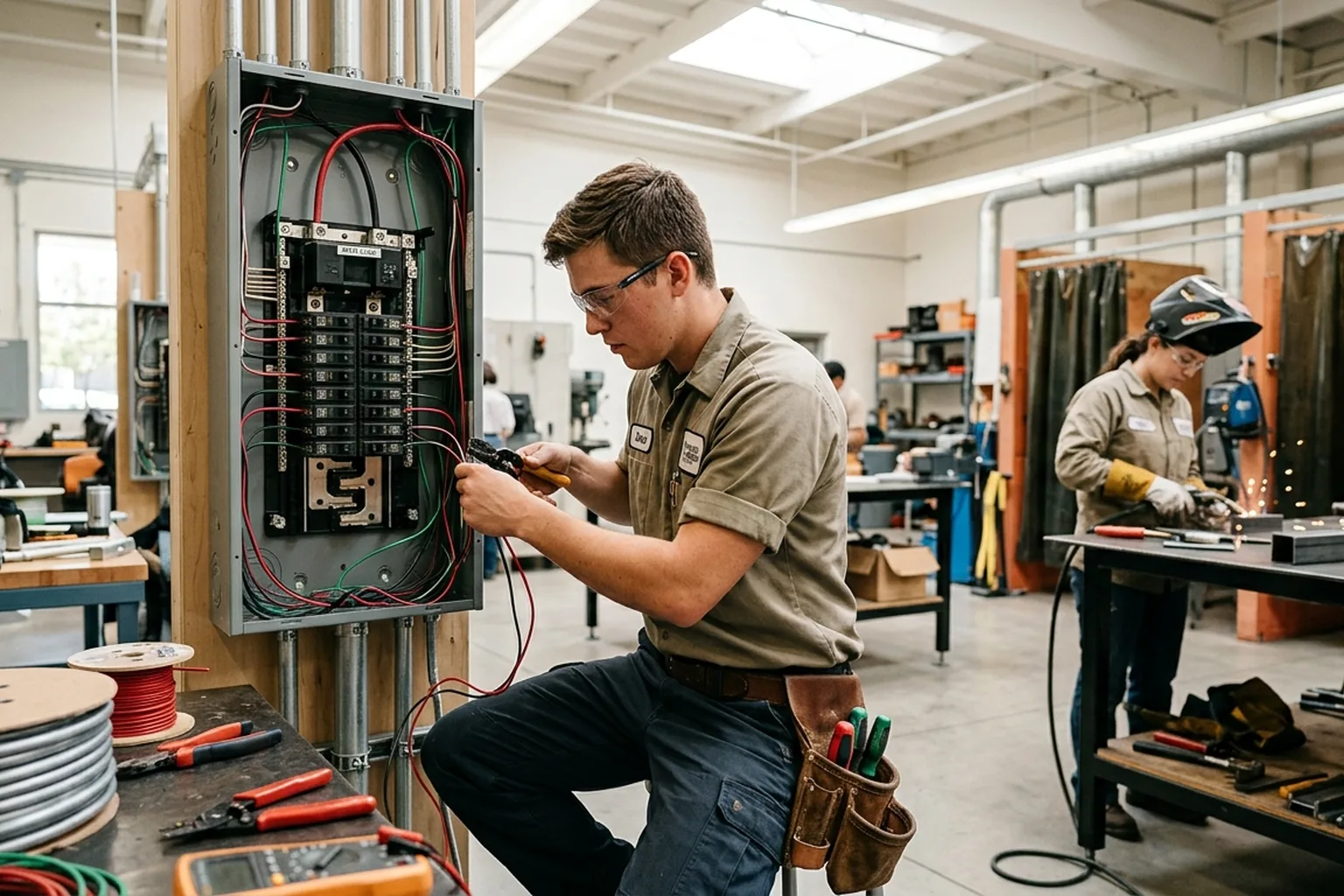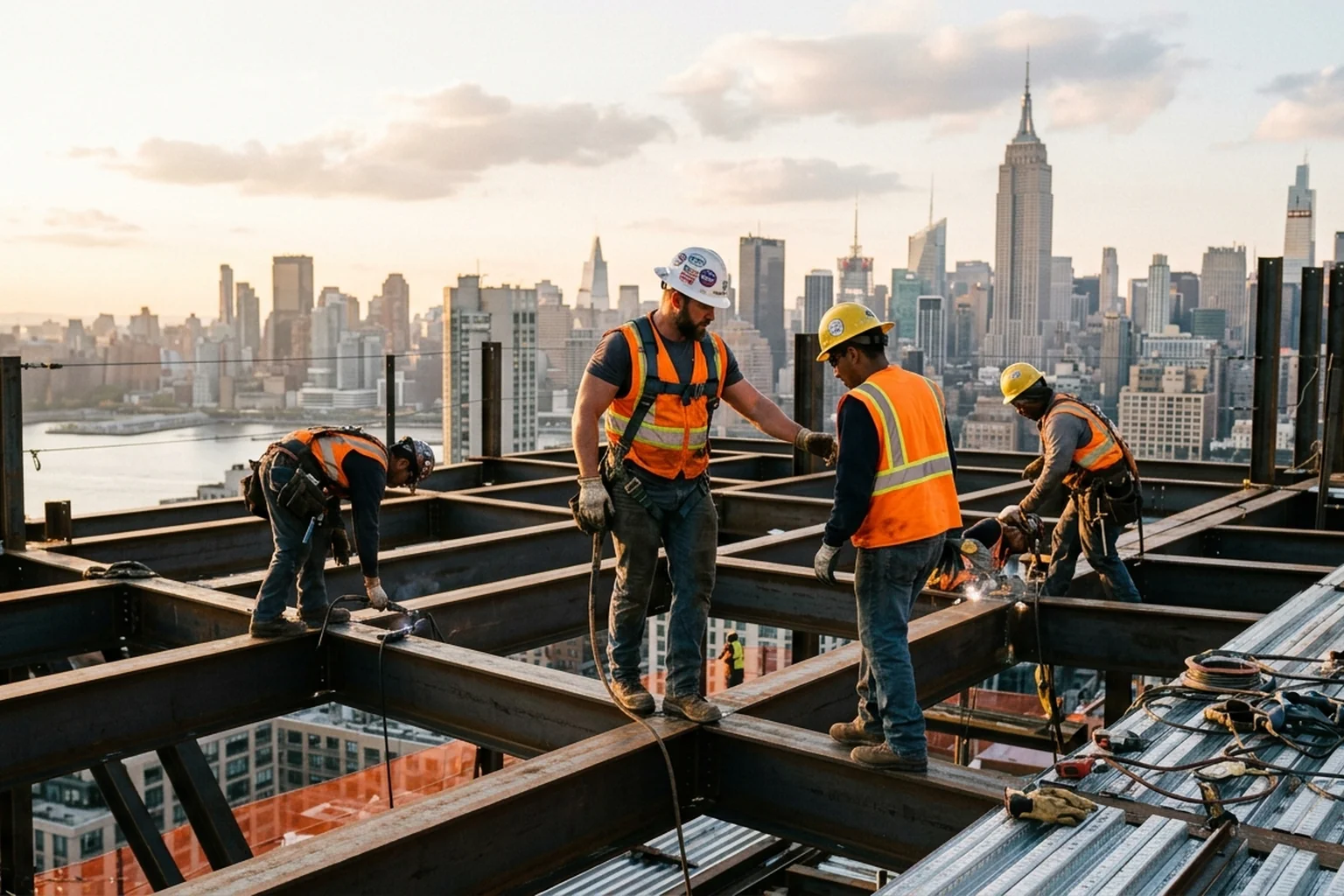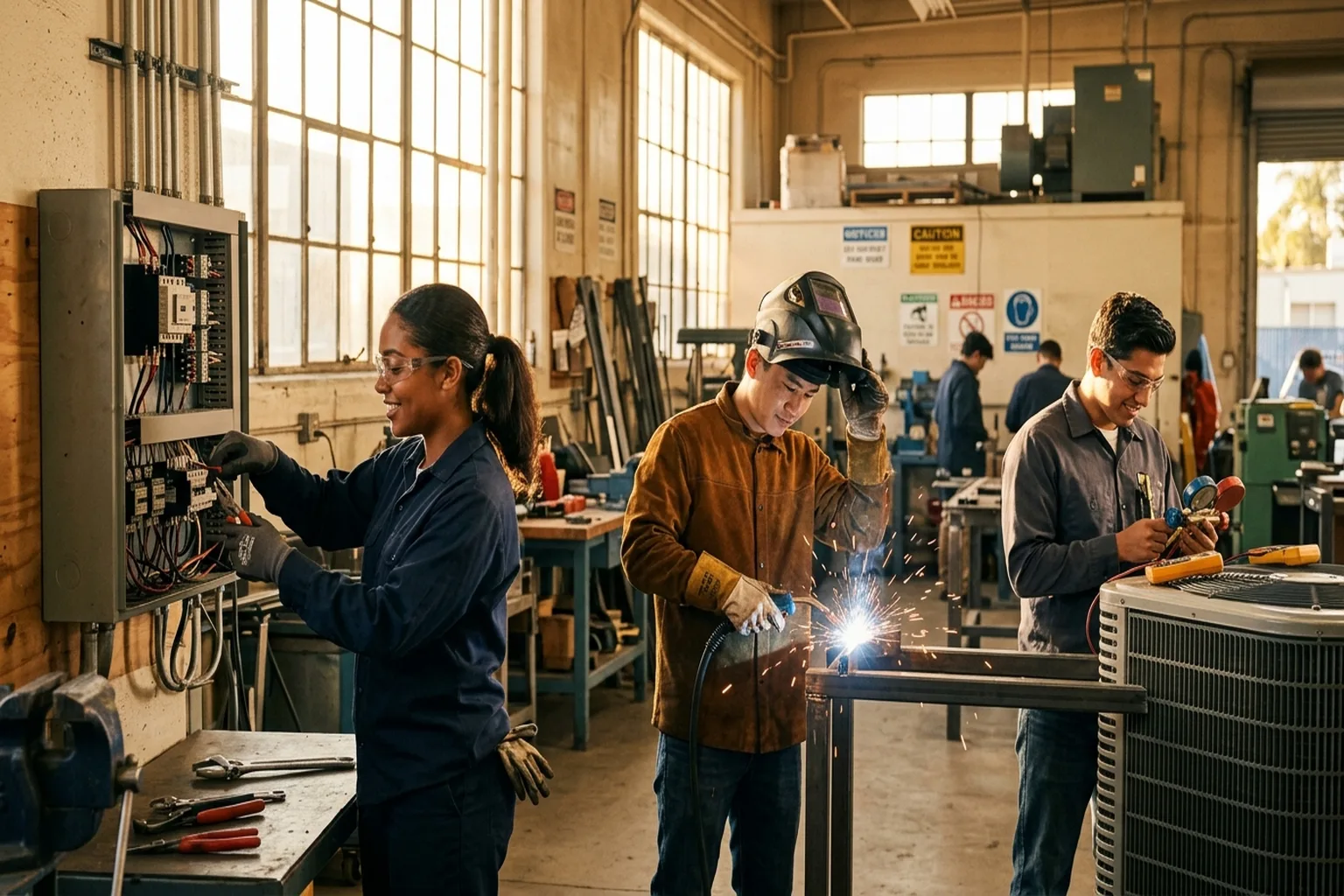

A data-driven guide for anyone considering trade education in New York State.
TL;DR: New York has 148 trade colleges across 82 cities — from CUNY community colleges charging $4,800 a year to specialized private schools in the outer boroughs. NY trade wages consistently run ahead of national medians: electricians here earn a median of $81,340, compared to $62,350 nationally. The state’s construction workforce is near capacity but aging fast, with nearly 40% of skilled workers over 45 — which means sustained demand for anyone entering the trades now. Here’s which schools top the rankings, where the best value is, and what you can realistically expect to earn.
New York by the numbers
| Metric | New York | #1 California | #2 Texas | #4 Florida |
|---|---|---|---|---|
| Trade colleges | 148 | 369 | 237 | 196 |
| Trade programs offered | 449 | 690 | 516 | 198 |
| Cities with trade schools | 82 | 181 | 86 | 87 |
New York trails the largest states on school count but punches above its weight on program depth — 449 programs across 148 schools is a denser program-per-school ratio than most states. That reflects New York’s mix of large CUNY and SUNY community colleges (which run broad program slates) alongside focused private trade schools concentrated in New York City. You can browse all 148 New York trade colleges or see them ranked head-to-head on our best trade colleges in New York page.
What’s driving demand for trades in New York
A retirement wave in the construction trades
The single biggest structural factor reshaping New York’s trade labor market right now is demographics. According to the New York Building Congress’s 2025 Construction Outlook: Workforce Snapshot, New York’s construction workforce of roughly 583,000 has nearly recovered to its pre-pandemic size — but the workforce is getting older faster than it’s being replenished. Nearly 40% of skilled construction workers are now over 45, and in the electrical trades, close to one in five workers is over 55.
That age distribution is not a distant problem. It is a near-term pipeline gap. Workers who entered the trades in the 1990s are now approaching retirement age, and the apprenticeship system has not kept pace with the replacement math. The result is sustained, durable demand for anyone entering the trades in the next five to ten years.
Nationally, the picture looks the same: Associated Builders and Contractors’ January 2026 workforce report projects the industry must attract 349,000 net new workers in 2026 just to meet current demand — a figure rising to 456,000 in 2027 as construction spending accelerates. New York is a disproportionately large piece of that national gap.
Infrastructure investment and the NYC construction market
New York City is in the middle of one of the most capital-intensive infrastructure periods in its modern history. Transit upgrades, offshore wind interconnection projects on Long Island, affordable housing mandates, and commercial-to-residential conversions in Manhattan are all generating electrician, plumber, HVAC, and pipefitter work simultaneously. Unlike markets driven by a single sector, NYC’s demand for skilled tradespeople spreads across multiple industries — which provides more stability and less cyclical risk for workers.
If you’re considering electrical programs or HVAC career paths, the demand signals in New York City specifically are among the strongest in the country.
Why NY trade wages run above the national average
New York’s combination of a high cost of living, strong union presence (IBEW locals, UA plumbers’ locals, Sheet Metal Workers’ International), and consistent infrastructure demand produces trade wages that consistently exceed national medians. According to BLS state occupational employment and wage estimates (May 2024), electricians in New York earn a median of $81,340 — compared to $62,350 nationally, a gap of roughly 30%. The New York State Department of Labor’s occupational wages dashboard provides Q1 2025 figures by trade and labor market region for anyone comparing wages across upstate versus downstate.
The premium is real, but so is the cost of living — especially in the five boroughs. The wage advantage is largest in absolute terms in the NYC metro and smallest in rural upstate regions. For a detailed breakdown of how this plays out career by career, see our trade salary progression guide and our breakdown of union vs. non-union trade pay.
How we rank New York’s trade schools
Our New York rankings use the same national composite scoring system applied to every state — no opinion polls, no self-reported data. If a school appears at the top of a list below, it earned its position on verifiable IPEDS outcomes. You can read the full methodology, browse the New York school directory, or jump straight to the statewide New York rankings.
The composite score weighs:
- Completion rate — how many students who start actually finish
- Retention rate — first-to-second-year student retention
- Program productivity — awards issued relative to program size
- Institutional scale — total enrollment and program breadth
- Trade-specific productivity — for specialty rankings, award volume in that specific CIP area
- Best-value adjustment — for value rankings, tuition and net-price data layer on top of the composite
Top overall-ranked New York trade schools
New York’s highest-ranked schools skew toward focused, purpose-built institutions rather than large community colleges. That pattern mirrors what we see nationally: schools that do fewer things and do them well tend to outperform generalist institutions on completion and retention metrics.
#1 in NY / #187 nationally: New York Automotive and Diesel Institute (Jamaica, Queens). NYADI is the top-ranked trade school in New York on our overall composite and holds the #27 national ranking for automotive and repair programs — the highest of any NY school in a trade-specific category. Located in Jamaica, Queens, it offers automotive, diesel, and related technical programs with an industry-aligned curriculum. For students focused on vehicles and mechanical systems, NYADI is the strongest option in the state. See our overview of automotive technology career opportunities for what the career path looks like.
#2 in NY / #265 nationally: New York School for Medical and Dental Assistants (Long Island City). The NYSMDA campus in Long Island City is a focused allied-health institution with strong outcomes in medical assisting, dental assisting, and related healthcare support programs. If your interest is in healthcare trades rather than construction, this is the top NY option.
#3 in NY / #543 nationally: Nassau Community College (Garden City, Long Island). Nassau CC is the highest-ranked traditional community college in New York on our composite. It offers one of the broadest program slates on Long Island, including construction trades, automotive, computer and information technology, and business programs — all at public community-college tuition rates. It also ranks among the top NY schools in our best-value list.
#4 in NY / #626 nationally: Hudson Valley Community College (Troy). HVCC is the strongest trade school in the Capital Region and the top NY school for construction programs in our trade-specific rankings. Located in Troy, it serves a broad upstate catchment area and offers building trades, HVAC, welding, engineering technology, and automotive programs. For students who don’t want to study in the city, Hudson Valley CC is the upstate benchmark.
Best-value trade schools in New York
New York has one of the most powerful value levers in American higher education: the CUNY system. CUNY community colleges charge a flat $4,800 per year in tuition for in-state students — a figure that is difficult to beat anywhere in the country and dramatically lower than private trade schools charging $15,000–$20,000 for the same category of credential. When you rank New York schools on cost relative to outcomes, the CUNY and SUNY institutions dominate.
-
CUNY Stella and Charles Guttman Community College — #55 nationally for best value. Guttman’s Manhattan campus leads all New York trade schools on our value composite. Small by CUNY standards, it offers a focused program slate and strong student-support infrastructure at the $4,800/year price point.
-
Ulster County Community College — #62 nationally for best value. Located in Stone Ridge in the Hudson Valley, Ulster CC offers trades and technical programs at $5,280/year — strong value for students in the mid-Hudson region who want to avoid the NYC cost of living while staying within range of the metro labor market.
-
CUNY Kingsborough Community College — #80 nationally for best value. The Brooklyn campus covers a broad range of programs including allied health, business, and technical fields. $4,800/year tuition and Brooklyn’s growing construction and infrastructure demand make this a strong pick for outer-borough students.
-
Suffolk County Community College — #100 nationally for best value. Suffolk CC is the largest community college on Long Island and offers construction trades, automotive, nursing, and allied health programs at $5,640/year. For Long Island students who want to enter the trades without relocating, Suffolk CC is the default starting point.
-
Nassau Community College — #106 nationally for best value. Appears on both the overall and value rankings, which is unusual. Nassau CC delivers broad program depth at competitive community-college tuition.
-
CUNY LaGuardia Community College — #117 nationally for best value; #15 nationally for engineering programs. LaGuardia’s Long Island City campus is one of the most compelling community colleges in the country for engineering and technology pathways. Its #15 national ranking in engineering programs — achieved at $4,800/year — makes it an exceptional option for students targeting engineering technology, electronic systems, or advanced manufacturing.
For the full list, see our national best-value rankings.
Trade specialists — where New York stands out
Automotive & Diesel: New York Automotive and Diesel Institute
NYADI is New York’s clear answer for automotive and diesel training. Its #27 national ranking for automotive and repair programs reflects strong completion rates and an industry-aligned curriculum built around ASE certification pathways. Located in the NYC metro, graduates have access to one of the densest automotive employer markets in the country. Read our full overview of automotive technology career opportunities.
Construction Trades: Hudson Valley Community College
Hudson Valley Community College in Troy holds the top NY position in construction trades. Its building trades, HVAC, and welding programs have produced consistent outcomes for Capital Region students entering the construction workforce. The campus sits close to Albany’s infrastructure corridors and connects graduates directly to the regional labor market. See our guide to plumbing career opportunities for more on the construction-adjacent trade paths HVCC offers.
Engineering & Technical Programs: CUNY LaGuardia Community College
LaGuardia’s #15 national ranking for engineering programs at community-college tuition is an anomaly worth calling out explicitly. Few schools in the country deliver engineering-track outcomes at $4,800/year. For students who need to stay close to New York City and want a technical credential that opens doors in the region’s data center, utilities, and manufacturing sectors, LaGuardia sits at the intersection of accessibility and outcomes.
New York’s apprenticeship system
New York State runs one of the most developed registered apprenticeship systems in the country. The NYS Department of Labor’s apprenticeship program covers more than 100 registered occupations across construction, manufacturing, information technology, and healthcare. Apprenticeships in the building trades typically run four to five years, with wages that start at 40–50% of journeyman scale and increase on a fixed schedule as hours accumulate.
The state’s 37 BOCES (Boards of Cooperative Educational Services) serve as the connective tissue between career and technical education and the apprenticeship system. According to the NYS Education Department’s apprenticeship program, BOCES programs are directly linked with local unions and employers — which means completing a BOCES CTE program can put students on a fast track to a registered apprenticeship without starting from scratch.
If you haven’t already, our apprenticeships explained guide covers how the apprenticeship pipeline works in practical detail, including how to find openings and what to expect from the application process.
What to expect to earn — NY trade wages
The table below uses federal wage data for New York and national figures to show the typical premium. For trade-by-trade figures by region — including comparisons between NYC, Long Island, Capital Region, and Western NY — see the NY DOL occupational wages dashboard, which is updated to Q1 2025.
| Trade | NY Median | National Median | NY Premium |
|---|---|---|---|
| Electricians | $81,340 | $62,350 | +30% |
| Plumbers, pipefitters | See NY DOL | $62,970 | Significant |
| HVAC technicians | See NY DOL | $59,810 | Significant |
The NY premium for electricians is documented directly from BLS OEWS May 2024 state estimates. The pattern holds across trades: New York consistently ranks among the top five states for construction trade wages, driven by union density, cost-of-living adjustments, and infrastructure-driven demand. The NY DOL dashboard has occupation-by-occupation breakdowns for anyone doing serious planning.
Where to go from here
New York’s trade education market has three distinct layers: the CUNY/SUNY community college system (accessible, cheap, strong value rankings), specialized private schools (NYADI and others — best for focused programs), and the BOCES-to-apprenticeship pipeline (structured, employer-linked, union-connected). Most students are best served by starting with the CUNY value layer unless they have a specific trade that points toward one of the specialist institutions.
Browse the full New York trade college directory or see every school scored head-to-head on the New York rankings page.
Sources
- Bureau of Labor Statistics — New York State Occupational Employment and Wage Estimates, May 2024
- New York State Department of Labor — Occupational Wages Dashboard, Q1 2025
- New York Building Congress — 2025 Construction Outlook Update: Workforce Snapshot
- New York State Department of Labor — Registered Apprenticeship Programs
- NYS Education Department, ACCES — Apprenticeship Program
- Associated Builders and Contractors — Construction Industry Must Attract 349,000 Workers in 2026, Jan 2026
- Construction Dive — Labor Demand Gap Shrinks to 349,000 in 2026
- SUNY — Tuition and Fees