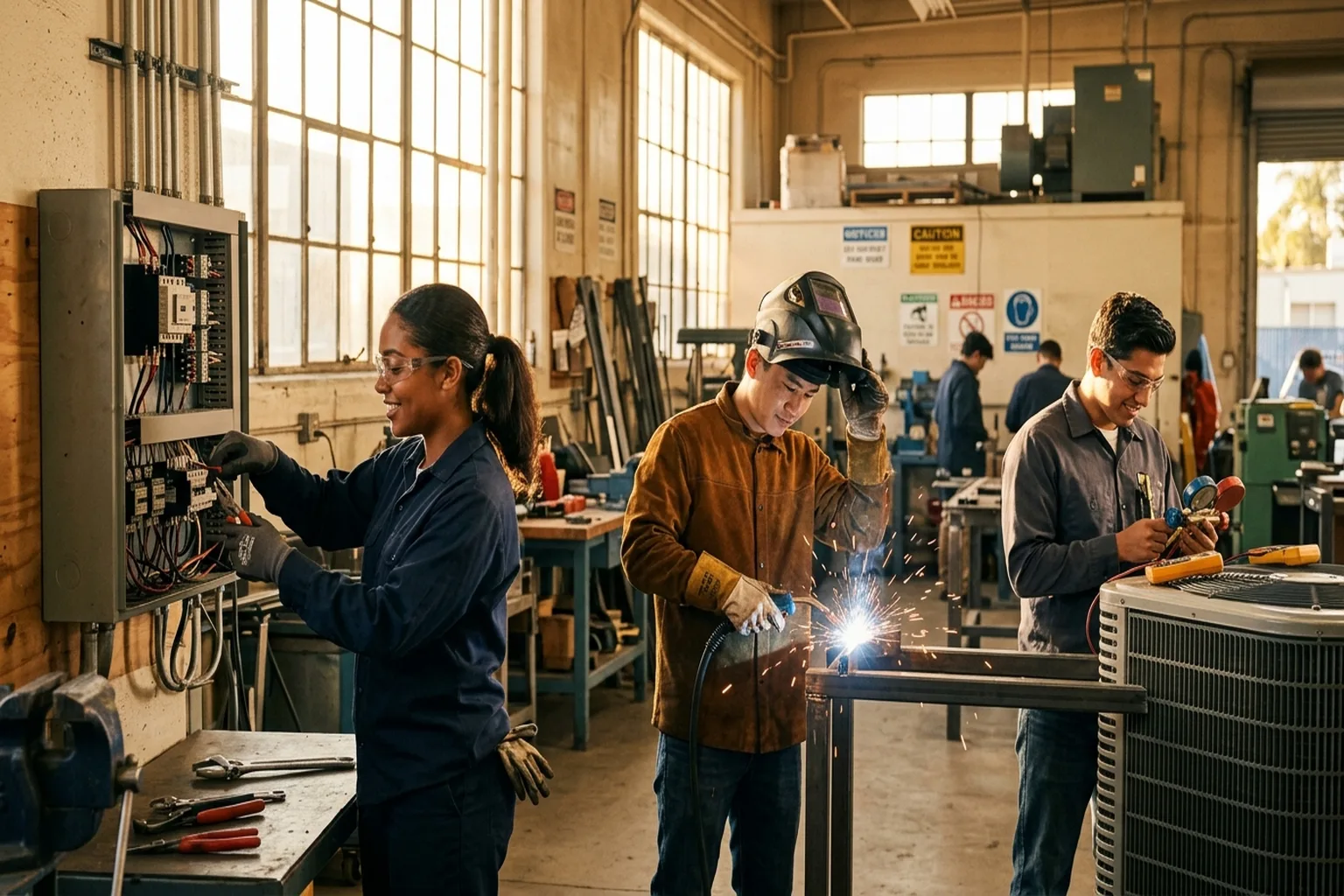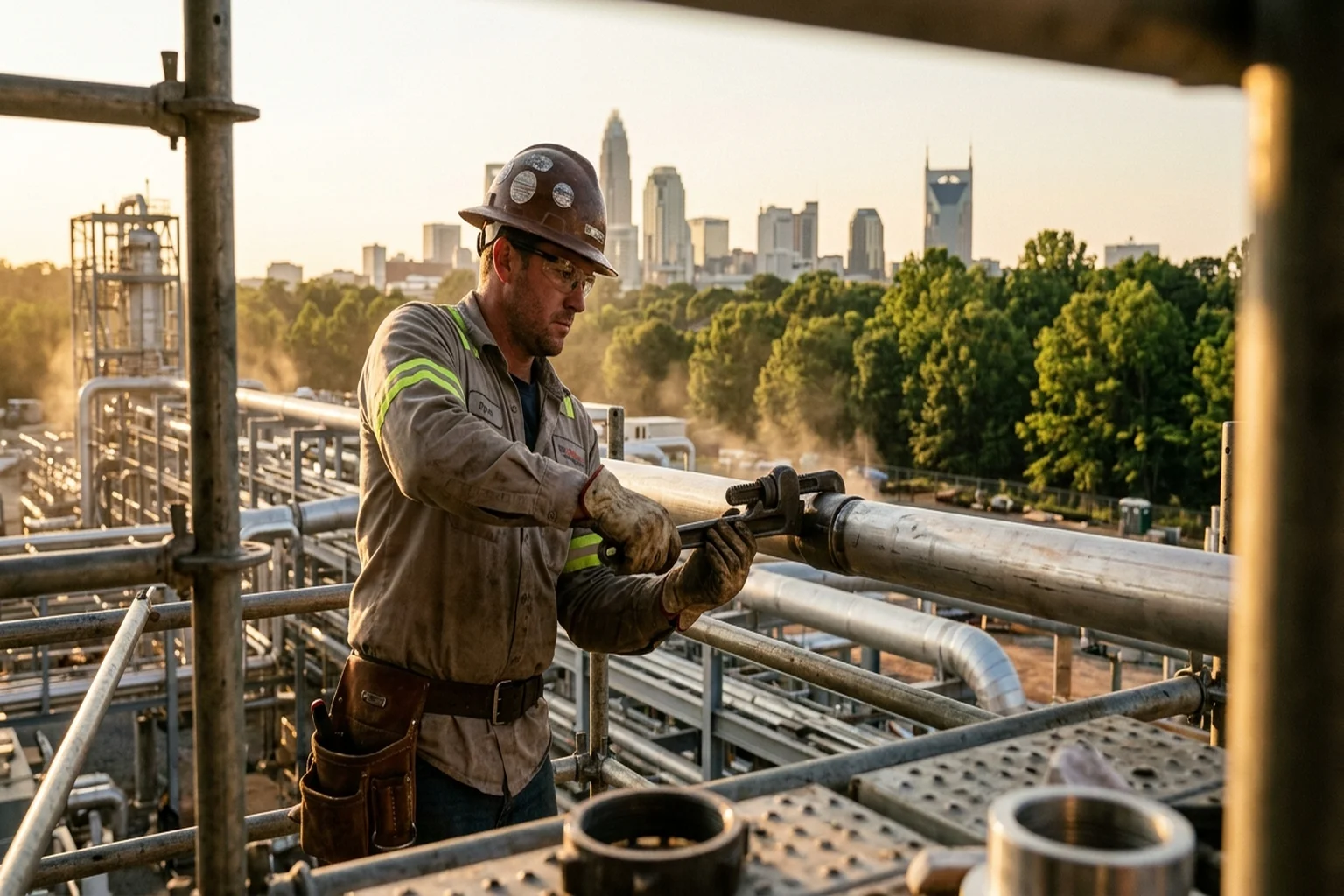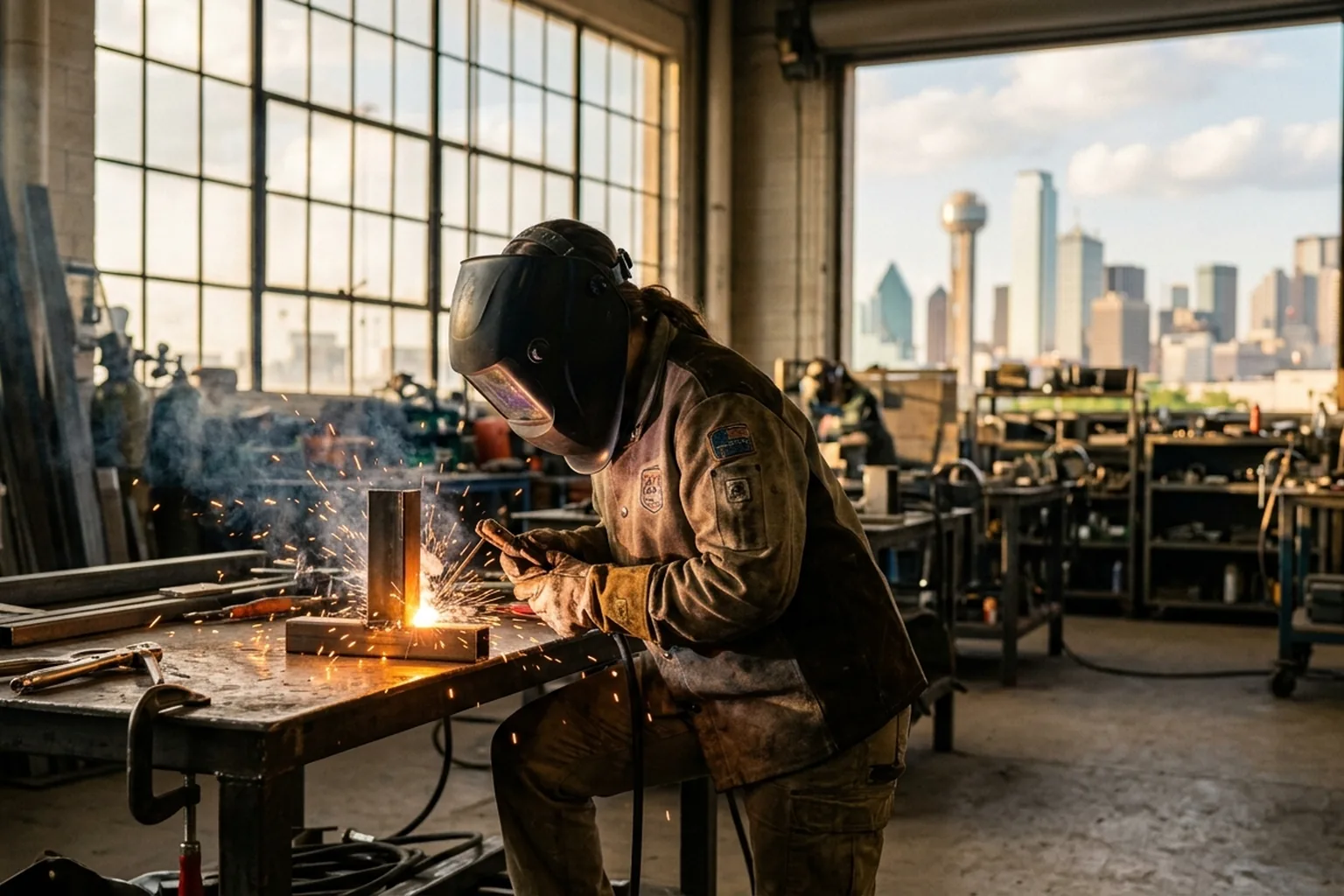

A data-driven guide for anyone considering trade education in Texas.
TL;DR: Texas is the second-largest trade education market in the country and arguably the fastest-moving. With 239 trade colleges across 84 cities, no state income tax, 31 million residents, roughly 1,500 newcomers arriving every single day, the #2 North American data center market in Dallas-Fort Worth, and a Permian Basin oil patch pulling workers back in, demand for electricians, HVAC techs, welders, and diesel mechanics is stacking up faster than schools can graduate them. Here’s what the data says, which Texas trade schools top the rankings, and what you need to know before you enroll.
Texas by the numbers
| Metric | Texas | #1 California | #3 Florida |
|---|---|---|---|
| Trade colleges | 239 | 374 | 195 |
| Trade programs offered | 468 | 652 | 182 |
| Cities with trade schools | 84 | 180 | 85 |
Those figures come from our internal rankings data pulled from federal IPEDS institutional records. Texas trails only California on the absolute count, but on a per-capita basis — and when you factor in the pace of population growth and capital investment flowing into the state — Texas is the more dynamic market right now. You can browse all 239 Texas trade colleges or see them ranked head-to-head on our best trade colleges in Texas page.
What’s driving demand for trades in Texas
Three very different economic engines are firing at once. Together they’ve produced a labor market where trained tradespeople can pick their employer.
AI infrastructure and data centers in Dallas–Fort Worth
Dallas-Fort Worth is now the #2 North American data center market, trailing only Northern Virginia, according to CBRE’s H1 2025 Data Center Trends report. The same report found that of the 365 MW under construction in Dallas, a staggering 89% was already preleased — meaning the facilities are spoken for before a single server rack is installed. CBRE expects DFW’s total operational data center capacity to roughly double by the end of 2026.
The absorption numbers are just as striking. As Data Center Frontier summarized from JLL and CBRE’s H1 2025 reports, Dallas absorbed 575 MW of new capacity in the first half of 2025 alone.
None of this gets built without tradespeople. Data centers are among the most electrically intensive structures in modern construction: redundant power feeds, massive switchgear, UPS systems, precision cooling, and miles of conduit. It’s electrician work, HVAC work, and pipefitter work — not software engineering.
Associated Builders and Contractors spelled out the math in its January 2026 workforce report, projecting that the U.S. construction industry needs to attract 349,000 new workers in 2026 just to keep pace — and it specifically calls out data center construction as one of the sharpest demand signals for electricians. Texas is absorbing a disproportionate share of that demand.
Explore electrician programs or read our overview of HVAC career opportunities to see what training looks like.
Housing and population growth
Texas just keeps growing. The state is home to roughly 31 million people and, according to Texas 2036’s 2025 housing affordability analysis, added 2.1 million residents between 2023 and 2024 alone — roughly 1,500 new Texans every single day. That same report flags a statewide shortage of approximately 320,000 housing units and notes that Texas accounts for about 15% of all new U.S. home permits while housing just 9% of the population.
The permit data tells the story month to month. In November 2025, HBWeekly reported that the Houston, Dallas, Austin, and San Antonio metros combined issued 4,919 new residential building permits with a total construction value exceeding $1.6 billion — in a single month, from just four cities.
Every one of those homes needs framers, electricians, plumbers, roofers, drywallers, HVAC installers, and finish carpenters. Texas’s commercial pipeline — warehouses, logistics hubs, and hospital expansions — is running hot in lockstep.
The Permian Basin oil and gas revival
The third driver runs on diesel and drill bits. According to the Texas Independent Producers and Royalty Owners Association (TIPRO), Texas upstream oil and gas employment reached approximately 204,075 workers in September 2025, with roughly 203,400 employed by December 2025. TIPRO’s same report counted 10,167 active unique Texas oil and gas job postings in its most recent tracking month and explicitly flagged ongoing shortages in petroleum, electrical, and mechanical trades.
Rigzone’s February 2026 update confirmed the trend is still climbing: Texas upstream employment is rising month-over-month even as the rest of the sector nationally has cooled.
The Permian Basin, which sprawls across West Texas and southeastern New Mexico, is the most productive oilfield in the United States. It demands welders, pipefitters, instrumentation technicians, diesel mechanics, crane operators, and industrial electricians — skill sets that community college CTE programs supply directly into the workforce. Permian wages have historically run well above the national average for the same trades, especially for workers willing to log hours in Midland or Odessa.
The no state income tax advantage
One of the simplest reasons trade workers keep moving to Texas: the state doesn’t tax your paycheck. The Texas Comptroller of Public Accounts is explicit — there is no personal state income tax on wages in Texas. AARP Texas’s 2025 state taxes guide confirms Texas is one of just nine U.S. states with no personal income tax at all.
For a skilled tradesperson earning $60,000 a year, that’s thousands of dollars of additional take-home pay compared to a high-tax state like California or New York. A journeyman electrician clearing $80,000 can easily keep $4,000 to $6,000 more per year that would otherwise disappear into state withholding. Over a 30-year career, the gap adds up to a down payment on a house — which, combined with Texas’s lower cost of living in most metros, is one reason relocation to the state has accelerated in the last five years.
Texas is investing in trades training
Texas doesn’t just rely on population growth to fill the pipeline. The state actively funds trades training through two main channels, both administered by the Texas Workforce Commission (TWC).
Jobs and Education for Texans (JET) Grant Program. The JET program provides grants to public junior colleges, public technical institutes, and public state colleges to purchase equipment for career and technical education programs in high-demand occupations. The Texas Legislature allocated $30 million to JET for the FY 2026-2027 biennium. In 2025, Governor Abbott announced more than $14 million in JET training grants across 52 projects, funding new equipment that will train more than 6,500 students in welding, automotive technology, nursing, HVAC, diesel mechanics, and other in-demand trades.
Skills Development Fund. TWC also operates the Skills Development Fund, Texas’s primary customized job training program. It partners businesses directly with public community and technical colleges to build training tailored to the employer’s needs, providing up to $500,000 per business partnership and averaging roughly $2,400 per trainee. For trade students, this often translates to free or heavily subsidized training that comes with a job lead attached.
Together, these two programs mean that if you enroll in a CTE program at a Texas public community or technical college, your school is likely using state-funded equipment and curriculum designed around what local employers are actually hiring for.
Best trade schools in Texas (2026)
We pulled the top Texas schools from our national trade college rankings, which score institutions on completion rates, program breadth, enrollment scale, and trade-specific performance. Each school links to its full profile with programs, tuition, and outcomes data.
-
Lincoln College of Technology-Grand Prairie — Ranked #16 nationally, #1 in Texas. With a 70.4% completion rate and 1,330 enrolled students, this Grand Prairie campus anchors multi-trade training for the Dallas-Fort Worth metroplex, with programs spanning automotive, HVAC, electrical, and welding. It’s the single largest trade school footprint in the country’s second-hottest data center market.
-
The College of Health Care Professions-McAllen — Ranked #29 nationally, #2 in Texas. An 85.9% completion rate across 728 students is among the highest in the state. The McAllen campus specializes in allied health careers and is a major pipeline for the Rio Grande Valley’s growing healthcare sector.
-
Rio Grande Valley College — Ranked #53 nationally, #3 in Texas. Based in Pharr with 883 students and a 79.3% completion rate, RGV College serves the rapidly growing Rio Grande Valley with a mix of trade and allied health programs focused on bilingual workforce development.
-
Lamson Institute — Ranked #56 nationally and #3 nationally for HVAC programs specifically, Lamson’s San Antonio campus is a strong pick for anyone targeting HVAC as a career. With 443 students and a 76.1% completion rate, it keeps a tight focus on a handful of high-demand trades rather than spreading thin across dozens of programs.
-
Pima Medical Institute-Houston — Ranked #58 nationally, #5 in Texas. With 1,019 students and a 76.4% completion rate, Pima’s Houston campus is one of the larger allied health trade schools in the state, feeding graduates into the Texas Medical Center and surrounding hospital network.
-
Pima Medical Institute-El Paso — Ranked #60 nationally, #6 in Texas. The El Paso campus serves West Texas and the borderland region with 667 students and an 84.4% completion rate — the second-highest in this list.
-
Lee College — Ranked #87 nationally, #7 in Texas. Lee is the largest school on this list by a wide margin with 8,143 students. It’s a public community college in Baytown, just east of Houston, making it the primary industrial trades training hub for the Houston Ship Channel petrochemical corridor. Lee’s 50.9% completion rate reflects its scale and open-enrollment mission. Petrochemical employers including Dow, ExxonMobil, and Chevron recruit directly from its programs.
-
Universal Technical Institute-Dallas Fort Worth — Ranked #105 nationally and #4 nationally for diesel mechanics, UTI’s Irving campus offers manufacturer-specific training from partners including Ford, BMW, and PACCAR. With 1,661 students and a 66.2% completion rate, it’s one of the most recognizable auto and diesel tech schools in the country — and UTI announced a Dallas campus expansion in October 2025 to handle demand.
-
Universal Technical Institute of Texas — Ranked #131 nationally and #9 nationally for diesel mechanics. UTI’s Houston campus serves the Gulf Coast industrial market with 1,823 students and a 62.8% completion rate, focusing on automotive, diesel, and industrial applications where Houston’s refinery and logistics economies create constant demand.
-
Auguste Escoffier School of Culinary Arts-Austin — Ranked #127 nationally, #10 in Texas. Austin’s restaurant scene has exploded alongside the city’s tech boom, and Escoffier trains chefs directly into that market. With 372 students and a 67% completion rate, it’s a focused culinary trade school for anyone who wants into Austin’s food economy.
Community college alternative: Alamo Colleges / St. Philip’s College. If you’re based in San Antonio and want to minimize tuition cost, the Alamo Colleges welding program through St. Philip’s College is worth a serious look. Public community college pricing puts it among the lowest-cost welding training options in the region, and the Alamo Colleges district partners directly with TWC Skills Development Fund employers — meaning graduates often leave with a certification and an interview already lined up.
If you want to understand how the paid training route works compared to traditional school, read our guide to apprenticeships explained before you commit to a program.
What Texas trades pay
The most reliable source for Texas-specific wages is the U.S. Bureau of Labor Statistics’ Occupational Employment and Wage Statistics (OEWS) program, which publishes state-level wage tables updated annually. The Texas state wage page and the current OEWS state directory let you pull median, 10th percentile, 75th percentile, and 90th percentile hourly and annual wages for every occupation BLS tracks.
The trade-relevant occupation codes you’ll want to look up on the Texas OEWS table:
- Electricians — SOC 47-2111
- Heating, Air Conditioning, and Refrigeration Mechanics and Installers (HVAC) — SOC 49-9021
- Plumbers, Pipefitters, and Steamfitters — SOC 47-2152
- Welders, Cutters, Solderers, and Brazers — SOC 51-4121
- Bus and Truck Mechanics and Diesel Engine Specialists — SOC 49-3031
BLS publishes sub-state wage data by metro area as well, which matters a lot in Texas — the same trade can pay noticeably more in Midland/Odessa (Permian Basin premium) or the DFW data center corridor than it does in the Rio Grande Valley. Before you pick a region to train in, pull the metro-level numbers for your target trade and compare.
Where to start
Ready to explore your options?
- Browse all 239 Texas trade colleges — filter by city, program, and school type
- See Texas rankings — how Texas schools stack up on completion and outcomes
- Compare schools side by side — put up to 3 schools head-to-head on tuition, graduation rates, and programs
- Take the 2-minute career quiz — not sure which trade fits? Start here
- Explore Texas programs by city — see what’s available near you
Sources
- U.S. Bureau of Labor Statistics — “Occupational Employment and Wage Statistics: Texas (May 2023)” — bls.gov
- U.S. Bureau of Labor Statistics — “OEWS State Directory (Current)” — bls.gov
- Associated Builders and Contractors — “ABC: Construction Industry Must Attract 349,000 Workers in 2026 Despite Macroeconomic Headwinds” — January 15, 2026 — abc.org
- CBRE — “North America Data Center Trends H1 2025 — Dallas-Ft. Worth Market Profile” — 2025 — cbre.com
- Data Center Frontier — “Two Lenses on One Market: JLL and CBRE Show Data Centers in a Pinch” — 2025 — datacenterfrontier.com
- Texas Workforce Commission — “Jobs and Education for Texans (JET) Grant Program” — twc.texas.gov
- Office of the Texas Governor — “Governor Abbott Announces Over $14 Million In Career Training Grants Across Texas” — 2025 — gov.texas.gov
- Texas Workforce Commission — “Skills Development Fund” — twc.texas.gov
- Texas 2036 — “2025 Policy Impact: Improving Housing Affordability” — 2025 — texas2036.org
- HBWeekly — “Texas Residential Construction Activity November 2025” — 2025 — hbweekly.com
- TIPRO — “TIPRO Report Looks at Changing Demographics of the Permian” — 2025 — tipro.org
- Rigzone — “Texas Upstream Employment Rises” — February 4, 2026 — rigzone.com
- Texas Comptroller of Public Accounts — “Taxes” — comptroller.texas.gov
- AARP Texas — “2025 State Taxes Guide” — 2025 — states.aarp.org
- Alamo Colleges — “Welding Program” — alamo.edu