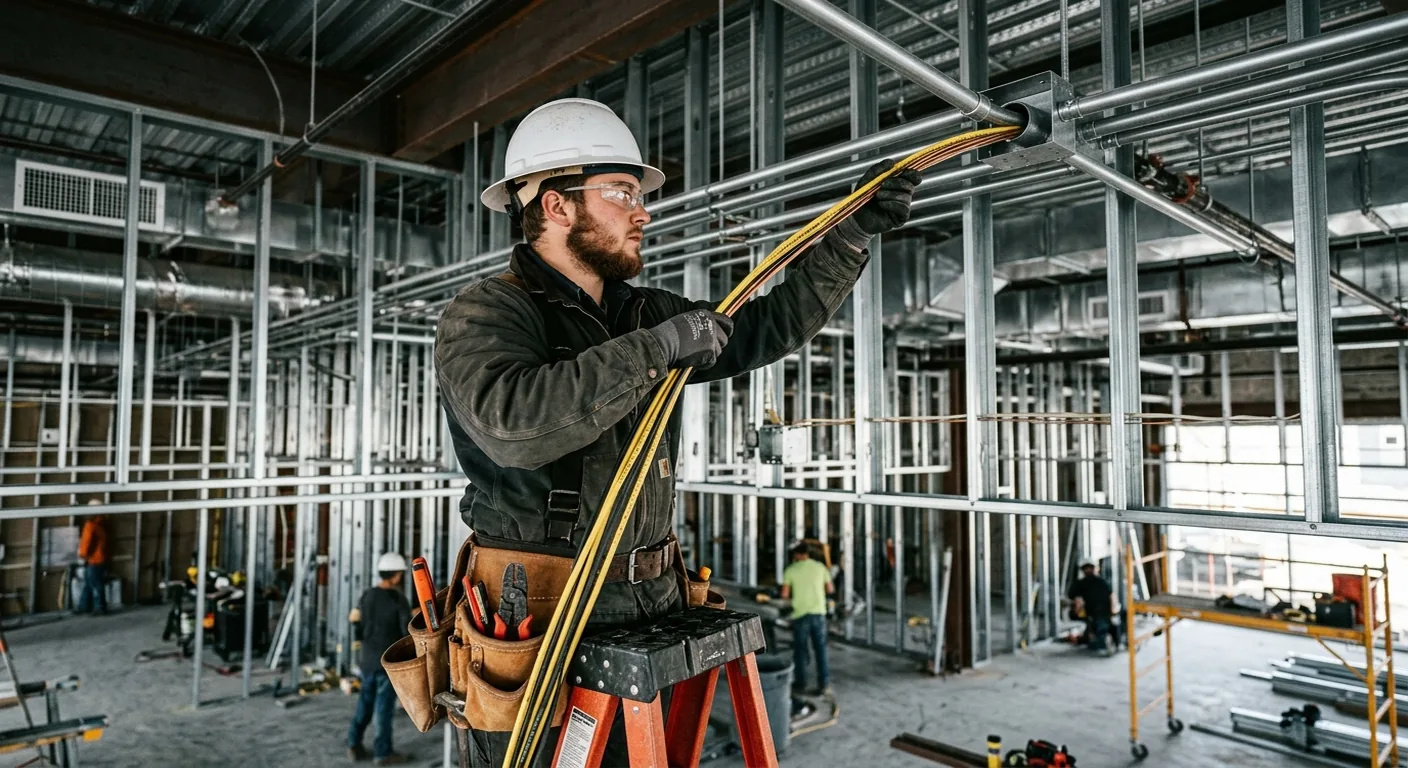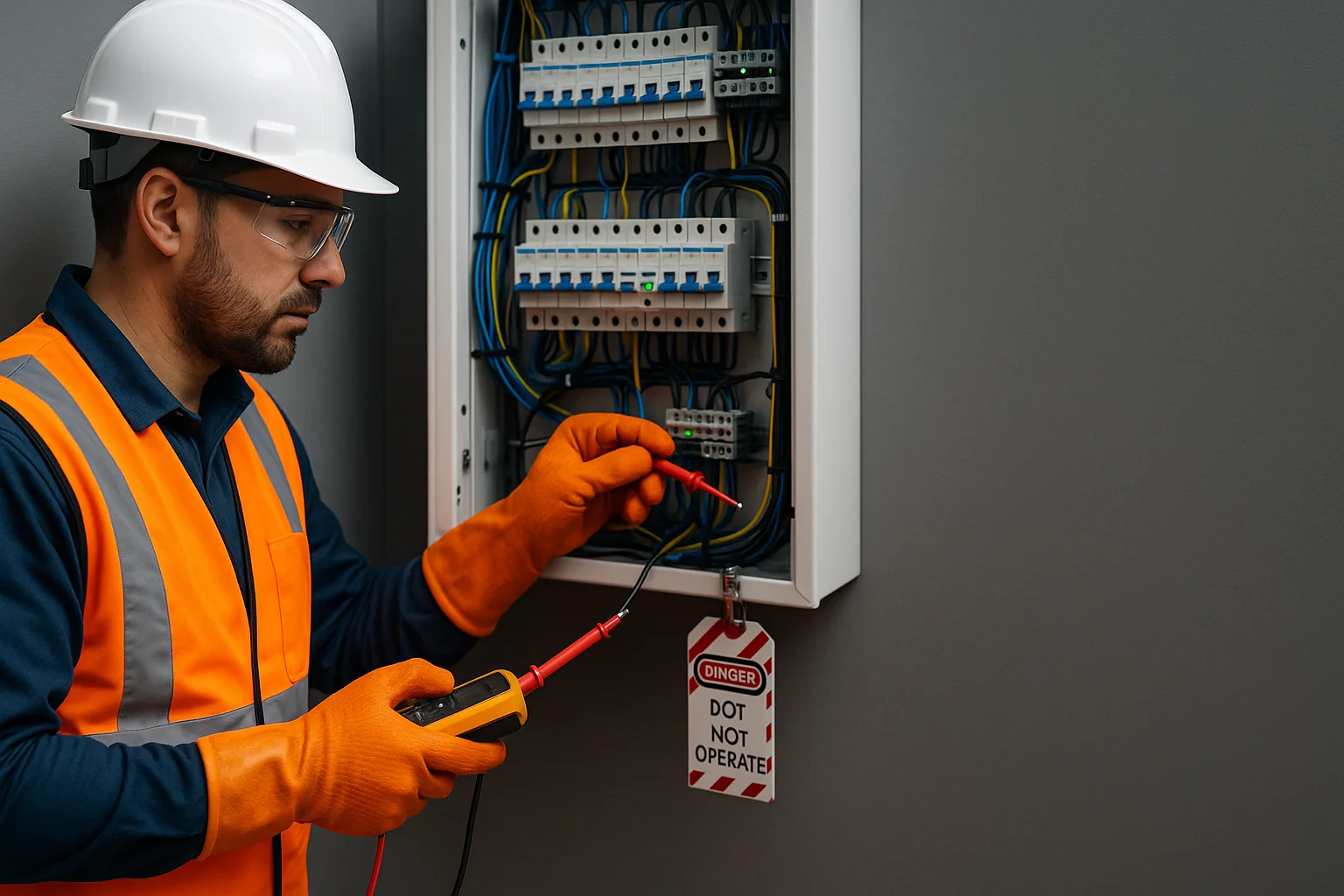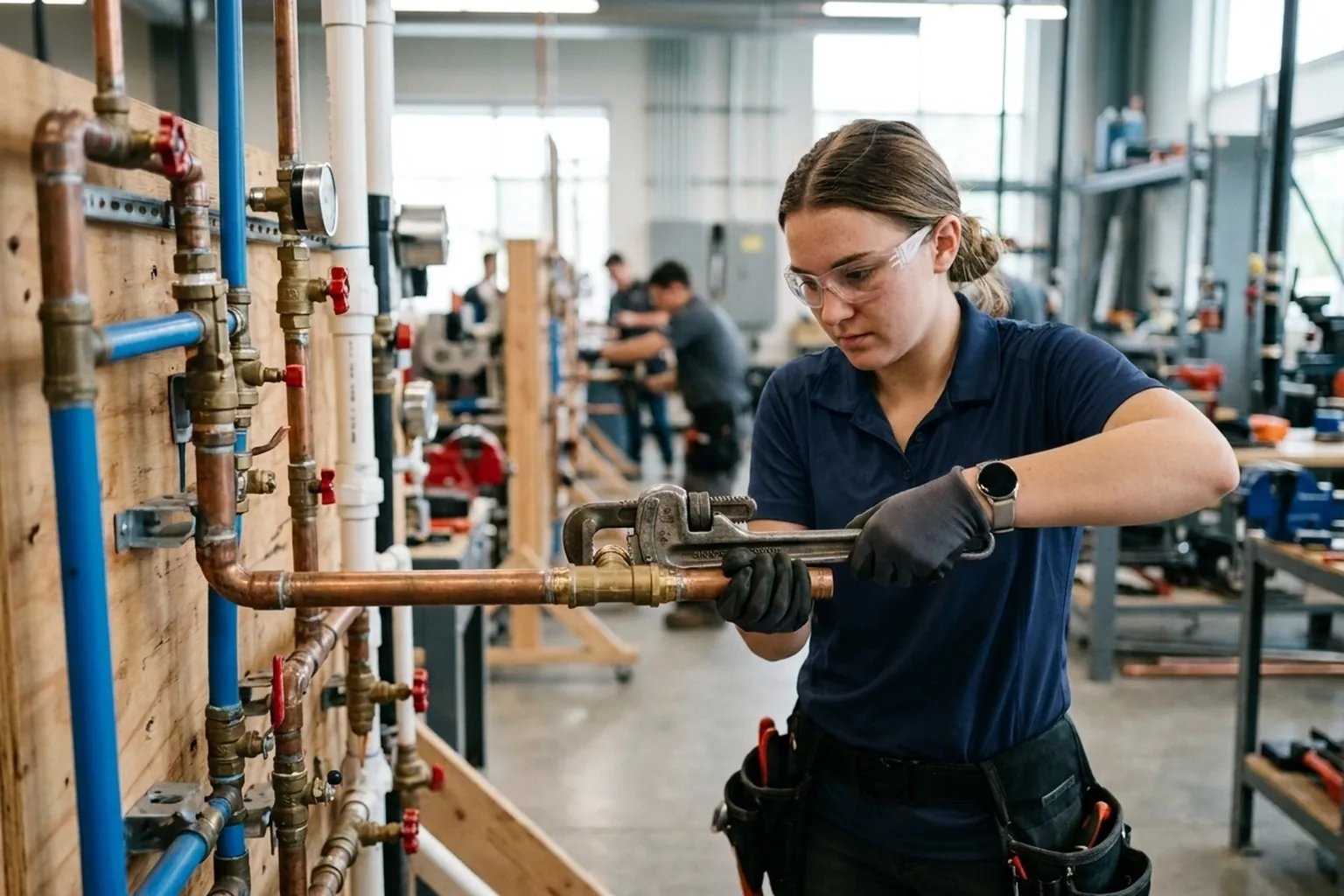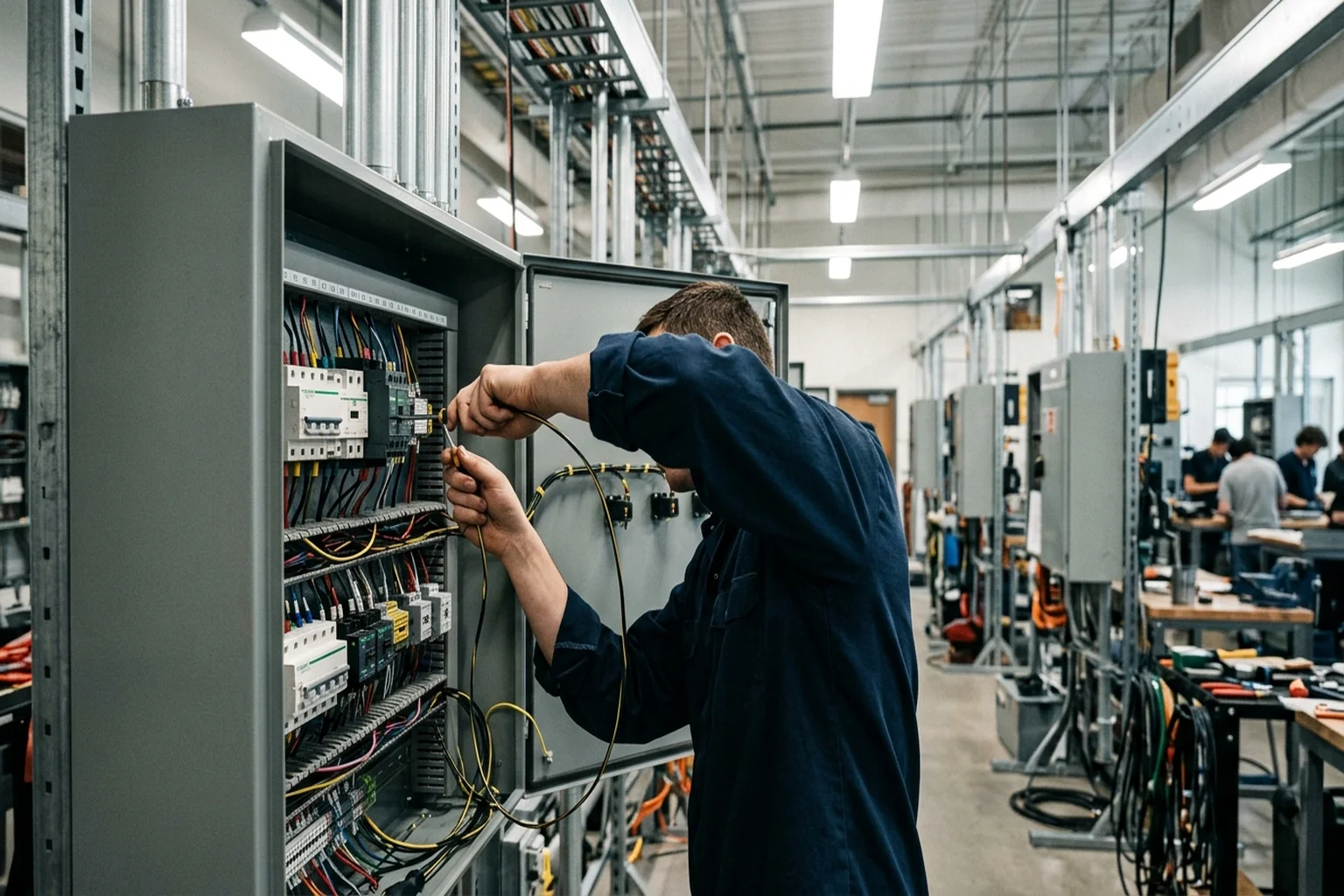

Two electricians turn 28 the same week. They both started training at 23 — same high school, same town. One went the IBEW route through the local Joint Apprenticeship and Training Committee. The other took a six-month trade school program and rolled straight into a non-union shop. Five years in, the union electrician is on a data center crew with a defined-benefit pension, employer-paid health, and a $48/hr journeyman wage. The non-union electrician is making roughly the same hourly take-home, has a 401(k) instead of a pension, has switched shops twice for raises, and runs his own truck on Saturdays for side jobs that the union contract would prohibit. Neither one made the wrong call. They made different calls — and most prospective electricians never get walked through the actual difference.
This is that walk-through.
TL;DR
- Three real paths: IBEW/NECA union apprenticeship (Electrical Training Alliance), non-union ABC or IEC apprenticeship using the NCCER curriculum, or trade school first followed by an apprenticeship. All three lead to a journeyman license. Source: BLS OOH Electricians.
- Pay & demand: Median electrician wage is $62,350 as of May 2024. The top 10% earn over $106,030. BLS projects 9% job growth and ~81,000 openings per year through 2034. Source: BLS OOH.
- The IBEW/NECA scale: The Electrical Training Alliance — a joint NECA-IBEW program — operates roughly 300 training centers with about 55,000 apprentices enrolled at any given time. Standard programs require 8,000 hours of on-the-job training plus 576–900 hours of related classroom instruction over 4–5 years.
- The non-union scale: ABC apprenticeship programs use the NCCER curriculum, are DOL-registered, and run roughly 4 years to journeyman level. Source: ABC Apprenticeship.
- The honest reality: “Best” depends on geography, wage trajectory, and personal preference for collective bargaining vs. shop mobility. There is no single national winner.
The Three Real Paths
Forget rankings clickbait for a moment. Every legitimate route to a journeyman electrician card runs through one of three doors:
| Path | Sponsor | Length | Classroom hrs | OJT hrs | Pay during training |
|---|---|---|---|---|---|
| IBEW/NECA apprenticeship | Joint Apprenticeship & Training Committee (JATC) | 4–5 years | ~900 | ~8,000 | 40–50% of journeyman → 90% by year 4 |
| ABC / IEC non-union apprenticeship | Trade association (NCCER curriculum) | ~4 years | ~600+ | ~8,000 | Varies by contractor; typically 50% → 80% |
| Trade school + apprenticeship | Community college or private school | 6 months–2 years (school) + apprenticeship | Front-loaded | After school | School: tuition required; apprenticeship pays once you start |
The first two are “earn while you learn.” Trade school is the third path because it isn’t really an alternative to apprenticeship — it’s a head start on it. You’ll still need on-the-job hours under a licensed journeyman before any state will issue you a license. Many trade schools market themselves as a four-year-program substitute. They are not. See our How to Become an Electrician guide for the full step-by-step including state licensure rules.
The IBEW/NECA Path: The Electrical Training Alliance
The Electrical Training Alliance (ETA) is the joint training program operated by the International Brotherhood of Electrical Workers and the National Electrical Contractors Association. It is the largest electrical training infrastructure in North America, with roughly 300 training centers and around 55,000 apprentices enrolled at any given time. Each local training center is run by a Joint Apprenticeship and Training Committee — typically called the JATC or sometimes the local Electrical Training Center.
What the program looks like
An IBEW inside-wireman apprenticeship is the most common track and the one most people mean when they say “IBEW apprenticeship.” Programs vary slightly by local but generally require:
- 8,000 hours of paid on-the-job training under a journeyman wireman
- ~900 hours of related classroom and lab instruction (some locals require as little as 480; programs in regions with stricter licensing — Washington, DC requires 10,000 OJT hours per IBEW NECA 252 — go higher)
- 5 years of total program length in most states
- Day-release classroom during years 1–2 (one full day every two weeks is typical)
Pay progression
Apprentices start at roughly 40–50% of the local journeyman scale and step up every 6 to 12 months as they accumulate hours and pass classroom benchmarks. By the fourth year, most apprentices are at 80–90% of journeyman pay. Hourly rates vary dramatically by local — a Boston, NYC, or Bay Area wireman is on a different scale than a wireman in Mississippi — but in every region, IBEW journeymen sit at or near the top of the local electrical wage market.
The benefits package is the part that prospective electricians most consistently underestimate. IBEW members typically get:
- Defined-benefit pension (a true pension, not just a 401(k))
- Employer-paid health insurance (often with no employee premium contribution)
- Annuity / 401(k)-equivalent as an additional retirement vehicle
- Continuing education — funded upgrade classes for certifications (medium voltage, fiber, instrumentation) at no out-of-pocket cost
Over a 30-year career, the pension plus annuity differential is often the single largest financial gap between union and non-union paths.
Getting in
IBEW JATCs select apprentices through a competitive process that typically includes:
- Application window — many locals open intake once or twice per year
- Aptitude test — administered through the Electrical Training Alliance, focused on algebra, functions, and reading comprehension. Practice resources matter; see our apprenticeship aptitude test prep guide
- Oral interview — a panel evaluates motivation, work history, and fit
- Ranking and call — applicants are ranked; calls go out as classes open
The wait between ranking and getting called varies. In hot markets (data centers, semiconductor fabs, infrastructure-bill regions), the call can come within weeks. In slower markets, the wait can stretch a year or more — which is one reason many prospective IBEW apprentices work as construction wireman (CW) helpers, electrical material handlers, or with a non-union shop while waiting for the call.
For deeper detail on what the apprenticeship actually feels like day-to-day, see our apprenticeships explained article.
The Non-Union Path: ABC, IEC, and NCCER
The non-union (or “merit shop” / “open shop”) side of the industry has its own apprenticeship infrastructure — and it’s substantially larger than most union-side electricians admit. The two main vehicles:
- Associated Builders and Contractors (ABC) — the largest merit-shop trade association, with apprenticeship programs registered with the U.S. Department of Labor in most states. ABC programs use the NCCER (National Center for Construction Education and Research) curriculum, which is also widely used in community college construction programs.
- Independent Electrical Contractors (IEC) — a national association focused specifically on electrical contracting, with chapter-run apprenticeship programs that also typically use NCCER.
What the program looks like
An ABC or IEC electrical apprenticeship runs roughly 4 years to journeyman, combining paid on-the-job training (typically 8,000 hours) with classroom instruction (often two evenings per week or day-release). Curriculum is delivered through NCCER’s Contren Learning Series — modular, competency-based, and recognized across all 50 states for portability.
Pay progression mirrors the IBEW model in shape — start low, step up every 6–12 months — but the percentage scale and the journeyman wage at the top tend to be lower than the local IBEW scale in most metro areas. The gap narrows in lower-cost regions and in some Sunbelt states where merit-shop electrical contractors dominate (Texas, Tennessee, Florida, the Carolinas).
Why people choose the non-union path
- Faster start. ABC/IEC chapters typically have shorter waiting lists than competitive IBEW JATCs in the same metro
- Geographic spread. In states without strong union density (most of the South and parts of the Mountain West), ABC and IEC programs are simply more available
- Side work flexibility. Non-union journeymen can run a side business or take cash work without violating a collective bargaining agreement
- Religious or political objection to union membership in some communities
What you give up
- The defined-benefit pension is the biggest single difference
- Employer-paid healthcare is rarer and contribution levels are lower
- Wage rates depend on individual contractor, not on a regional collective agreement — meaning more variation, more job-shopping, and weaker negotiation leverage
Both paths produce a federally-recognized journeyman card. State licensing boards do not distinguish between IBEW-trained and ABC-trained applicants. The credential is the credential. What differs is the career arc that surrounds it.
Trade School First: When It Actually Makes Sense
Trade schools — Lincoln Tech, Universal Technical Institute, regional community colleges, and a long list of for-profit and nonprofit programs — typically offer 6-month to 2-year electrical certificate or associate degree programs. These cost anywhere from $5,000 to over $30,000 depending on the school.
Here’s the honest framing: trade school does not replace an apprenticeship. No state will license you as a journeyman electrician based on classroom hours alone. What trade school can do:
- Front-load classroom theory so the day-release classroom portion of your apprenticeship is easier
- Convert into apprenticeship hours in some JATCs and ABC chapters, shaving up to a year off the OJT requirement (varies by program — always confirm in writing before enrolling)
- Build a basic skill base that helps you land a helper job with a non-union shop immediately, while you wait for an IBEW call or while you stack experience for the ABC application
When trade school is not the right call: if you can get directly into an IBEW or ABC apprenticeship without it, you’re paying tuition for credit you’d earn anyway — and you’d earn that credit while drawing a paycheck instead of taking on tuition debt.
Programs worth evaluating
The “best” trade schools are typically the ones with:
- DOL Registered Apprenticeship pre-apprenticeship status — meaning their hours can transfer to a registered apprenticeship
- NCCER accreditation — important if you’re heading toward an ABC or IEC apprenticeship
- Local employer partnerships — direct hiring pipelines into named contractors
- Published placement rates and journeyman conversion data — be skeptical of schools that won’t share this in writing
Notable national networks include Lincoln Tech (electrical trades programs), and many community colleges offer electrical technology AAS degrees that articulate directly into local apprenticeship hour banks. A program-by-program list is beyond the scope of one article — check our best trade colleges for electricians ranking for current accredited options sorted by completion rate and outcomes.
How to Actually Choose
There is no universally “best” path. There is the path that fits your geography, your finances, and your tolerance for waiting. A practical decision framework:
Pick IBEW/NECA if:
- You live in a metro with significant union density (most major Northeast, Midwest, and West Coast cities)
- You value pension, healthcare, and consistent wage progression over short-term flexibility
- You can absorb a wait of 3–18 months between application and getting called
- You’re willing to commit to the local for the long term — moving across local boundaries means starting over on some seniority benefits
Pick ABC/IEC if:
- You live in a Sunbelt or Mountain West state where merit-shop dominates
- You want to start within weeks rather than months
- You want flexibility to run side work or move between contractors
- You may eventually start your own electrical contracting business
Pick trade school first if:
- You can’t get an immediate apprenticeship slot and want to use the wait productively
- You’re a career changer who needs basic theory before you’d be competitive in an apprenticeship interview
- The school’s hours genuinely transfer (verify in writing before enrolling)
- You’ve calculated that the tuition is justified by the apprenticeship hour credit, not as a substitute for OJT
For broader career-arc context — earnings ceiling, specialization options, the AI data center demand surge — see our Electrical Career Opportunities article.
Red Flags When Evaluating Any Program
Whether you’re considering a trade school, an ABC chapter, or even an IBEW local, ask the same five questions before signing:
- Is the program DOL-Registered? A registered apprenticeship gets you portable, federally-recognized credentials. An unregistered program may get you nothing transferable.
- What’s the journeyman conversion rate? What percent of starters finish and get journeyman cards? Below 60% is a warning sign.
- What’s the published wage progression? Get the dollar amounts in writing for years 1–4, not just percentages of an unstated scale.
- Where do graduates actually work? Named contractors, named jobsites — not stock photos.
- What does the contract bind you to? Some programs require post-completion work commitments or repayment if you leave the trade early. Read carefully.
The Honest Tradeoffs Nobody Mentions
A few things every prospective electrician should hear before picking a path:
- The IBEW wait can be brutal. In oversubscribed locals, you may wait a year or more from application to first call. You can’t pay rent on a ranking number.
- The non-union path’s wage ceiling depends entirely on your contractor. Switching shops every 2–3 years to chase raises is normal and is the main wage-progression mechanism.
- Apprenticeship is not optional, even if a school sells it that way. Every state requires verifiable on-the-job hours. There is no shortcut around this.
- Geography decides more than path. A non-union electrician in Houston earns more than a union electrician in rural Mississippi. Match your training path to where you actually plan to work.
- The career ceiling is high in both lanes. Master electrician licenses, electrical contracting business ownership, six-figure data center work — all of these are achievable from either union or non-union starting points.
Pick the path that gets you working sooner in the geography where you’ll actually live. Then keep training. The credential matters less than the consistency of the next 20 years.
Sources
- U.S. Bureau of Labor Statistics — Occupational Outlook Handbook — “Electricians” — May 2024 data — https://www.bls.gov/ooh/construction-and-extraction/electricians.htm
- NECA-IBEW Electrical Training Center — “FAQ on Apprenticeship Hours and Structure” — accessed 2026 — https://nietc.org/faq/
- IBEW NECA 252 — “Apprenticeship Program Details (Washington DC, 10,000 OJT hours)” — accessed 2026 — https://www.ibewneca252.org/apprenticeship
- IBEW Local 26 — “Electrician Training & Apprenticeships” — accessed 2026 — https://ibewlocal26.org/join-as-individual/training/
- Associated Builders and Contractors — “Apprenticeship and Craft Training” — accessed 2026 — https://www.abc.org/apprenticeship
- ElectricianSchoolEdu — “Guide to IEC and ABC Non-Union Apprenticeship Programs” — accessed 2026 — https://www.electricianschooledu.org/iec-and-abc-open-shop-apprenticeships/