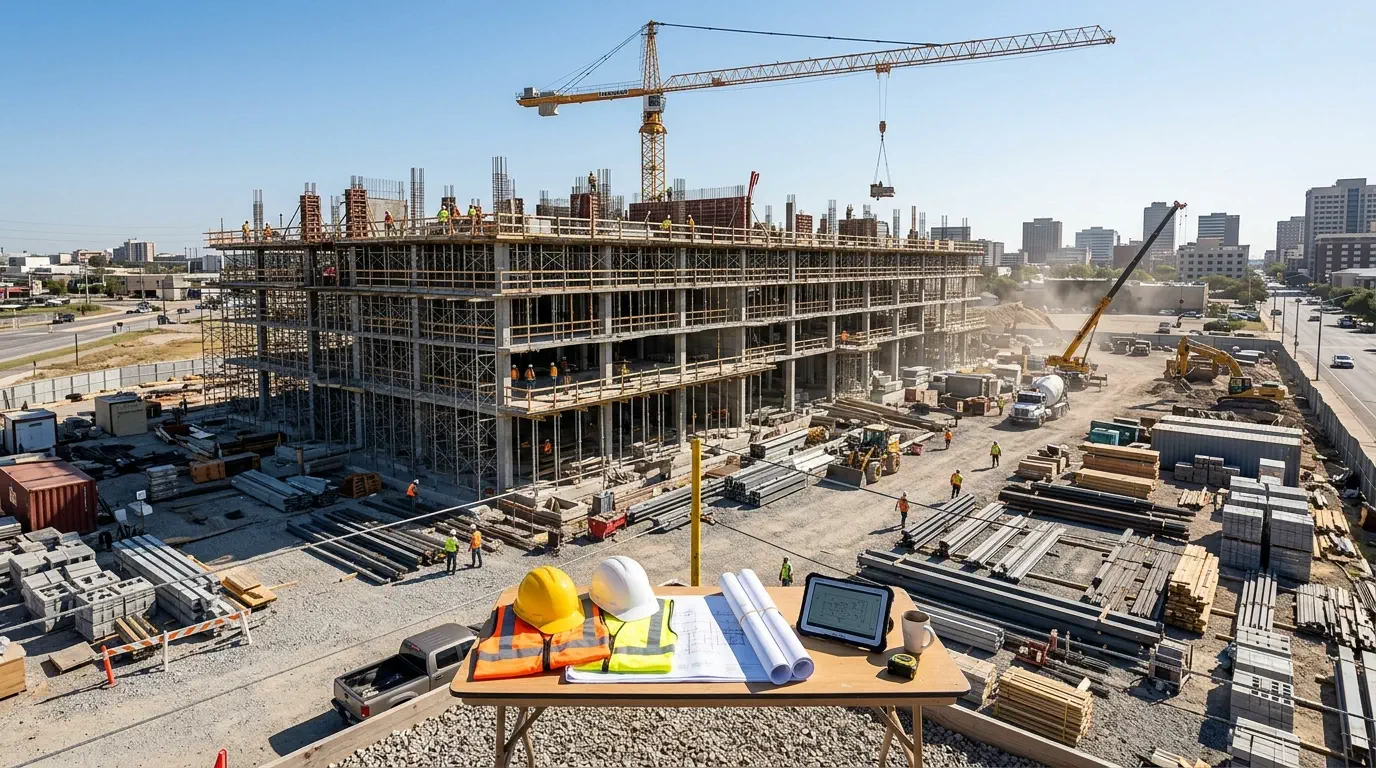

Construction management sits at the intersection of hands-on trade knowledge and business leadership. The people who run job sites — coordinating crews, managing budgets, solving problems in real time — are among the highest-paid professionals in the construction industry. According to the Bureau of Labor Statistics, construction managers earned a median annual wage of $106,980 in May 2024, with the top 10% earning above $176,990. The BLS projects approximately 46,800 openings per year over the coming decade, driven by retirements, transfers, and new positions.
What makes this career distinctive is the pathway into it. Unlike many management roles that require a four-year degree from the outset, construction management is one of the few leadership careers you can enter through field experience in the trades. Whether you start with a hard hat or a textbook, the industry needs people who can lead projects from ground-breaking to completion.
Why Construction Management Is in Demand
A trillion-dollar market with no signs of slowing
The U.S. construction market is expected to grow 5.6% annually to reach $1.27 trillion in 2026, with forecasts projecting the market will climb to approximately $1.59 trillion by 2030. Multiple forces are fueling that growth simultaneously.
The Infrastructure Investment and Jobs Act (IIJA) authorized $1.2 trillion in infrastructure activity, with $550 billion in new investment above baseline levels. Of the $711.8 billion in potential grant funds, 82% became available for obligation between FY2022 and FY2025, and the remaining $131.2 billion is flowing in FY2026. Peak spending on IIJA-funded projects is expected in 2026-2027, meaning the demand for managers who can oversee these projects is intensifying right now.
On top of public infrastructure, the private sector is pouring money into data centers to support AI workloads. Fortune reports that tech companies could invest upwards of $100 billion into U.S. data center construction in 2026 alone. These are complex, high-value projects that require experienced management at every level.
A workforce crisis that keeps getting worse
The labor shortage in construction is not speculative — it is measured and documented. The Associated General Contractors of America (AGC) 2025 Workforce Survey found that 92% of contractors report difficulty filling open positions, and 45% of firms say those shortages are directly causing project delays. Seven out of eight firms have raised base pay to attract and retain workers.
The scale of the gap is substantial. Associated Builders and Contractors (ABC) estimates the industry needs 439,000 net new workers in 2025, and Fortune reports that number could rise to 456,000 by 2027. The NCCER estimates that roughly 41% of the current construction workforce will retire by 2031, taking decades of institutional knowledge with them.
Every worker who retires, every project that breaks ground, and every contract that gets awarded increases the need for qualified construction managers. The math is straightforward: more projects and fewer people equals opportunity.
Construction Manager Career Paths
One of the most appealing aspects of construction management is the variety of routes into the profession. According to ConstructionOwners.com, the typical progression from trades to management spans 10 to 15 years and follows a recognizable ladder.
From the field up
The traditional path starts with hands-on trade work. This is how many of today’s most effective construction managers entered the field — they understand building because they have done the building.
- Apprentice/Journeyman (Years 1-6): Learn a core trade such as carpentry, electrical, plumbing, or heavy equipment operation through an apprenticeship or on-the-job training. Salary range: $35,000-$60,000.
- Foreman (Years 5-10): Lead a crew on specific tasks or phases of a project. About 22% of journeymen advance to foreman roles within five years of completing their apprenticeship. Salary range: $55,000-$80,000.
- Superintendent (Years 8-15): Oversee entire job sites, manage multiple foremen and subcontractors, and coordinate with project managers. This may include an assistant superintendent step. Salary range: $75,000-$110,000.
- Project Manager (Years 10-20+): Manage budgets, schedules, client relationships, and the overall execution of construction projects. This is the role the BLS tracks, with a median salary of $106,980. Top earners exceed $176,990.
Through formal education
The other common path starts with a construction management degree. An associate’s or bachelor’s program in construction management, construction science, or a related engineering field can compress the timeline to management roles. Graduates typically enter as assistant project managers or project engineers and advance from there.
Procore notes that multiple entry points exist — formal education, ascending through the ranks, or a combination of both — and that the most successful managers tend to have hands-on experience combined with business and technical knowledge, regardless of how they started.
Beyond project management
Once you reach the project management level, the career does not plateau. Senior roles include:
- Senior Project Manager / Program Manager: Oversees multiple simultaneous projects
- Director of Construction / VP of Operations: Strategic leadership for a firm’s project portfolio
- Owner / Principal: Start or partner in a construction firm
- Owner’s Representative / Construction Consultant: Advise clients on large-scale capital projects
Education and Certification
Degree programs
The American Council for Construction Education (ACCE) accredits 14 associate’s degree and 72 bachelor’s degree programs in construction management across the United States. These programs cover estimating, scheduling, contract law, safety management, building systems, and project controls.
An associate’s degree (two years) provides foundational knowledge and is often enough to enter the field in a junior management or technical role. A bachelor’s degree (four years) opens doors to project engineer and assistant project manager positions more quickly. Both can be pursued while working in the field, and many programs are available partially or fully online.
The CCM certification
The Certified Construction Manager (CCM) credential, administered by the Construction Management Association of America (CMAA), is the industry’s premier professional certification. Eligibility requires a combination of education and responsible-in-charge (RIC) experience:
- 4-year AEC degree + 4 years of RIC experience
- 2-year AEC degree + 4 years of field experience + 4 years of RIC experience
- 8 years of field experience + 4 years of RIC experience (no degree required)
The certification must be renewed every three years. For those earlier in their careers, CMAA offers the Construction Manager-in-Training (CMIT) program with four sequential stackable credential levels, valid for seven years after issuance. The CMIT provides a structured pathway to the full CCM.
OSHA training
The OSHA 30-hour Construction Outreach Training is an expanded safety course designed specifically for supervisors, foremen, and managers. While technically a voluntary federal program, it is increasingly mandatory in practice — many contractors, unions, and jurisdictions require it as a condition of employment. Some states and cities, including New York City and Nevada, mandate it by law.
For anyone moving into a supervisory role, OSHA 30 is effectively a baseline requirement. The 10-hour course covers orientation-level safety for non-supervisory workers, while the 30-hour version adds depth on hazard recognition, worker training responsibilities, and regulatory compliance.
Technology skills
Modern construction management demands digital literacy. The most important technical competencies include Building Information Modeling (BIM), project management software (Procore, PlanGrid, Bluebeam), scheduling tools (Primavera, Microsoft Project), and increasingly, AI-powered analytics platforms. We will cover the technology shift in detail below.
Technology Transforming the Role
Construction management is undergoing a technological shift that is changing what it means to be effective on the job. Managers who understand these tools have a significant competitive advantage.
BIM is now standard
Building Information Modeling has moved from emerging technology to industry standard. According to Autodesk, BIM usage rates now exceed 70% among U.S. contractors, engineers, and architects. BIM creates 3D digital representations of buildings that integrate structural, mechanical, electrical, and plumbing systems into a single coordinated model. For construction managers, BIM means fewer change orders, better clash detection before construction begins, and more accurate quantity takeoffs for estimating.
AI is reshaping project delivery
The same Autodesk report found that 74% of architecture, engineering, and construction firms are now using AI in at least one phase of their projects. The AI in construction market is expected to grow from $3.99 billion in 2024 to $11.85 billion by 2029 — a compound annual growth rate of 24.31%.
AI-powered platforms are integrating with BIM for automated time tracking, cost forecasting, and subcontractor coordination. Predictive analytics can flag schedule risks before they become delays. Computer vision systems monitor job sites for safety violations. None of this replaces the construction manager — it gives them better information to make decisions faster.
Digital proficiency as a differentiator
The Birmingham Group, a construction staffing firm, reports that employers are increasingly prioritizing candidates who balance field experience with digital proficiency. Project managers with analytics and BIM experience command significant salary premiums. For anyone entering the field now, investing time in technology skills alongside trade knowledge is one of the highest-return career decisions you can make.
Industry Outlook
The numbers tell a consistent story: construction management is a career with strong tailwinds.
Job growth
The BLS projects 9% growth for construction managers from 2024 to 2034, which the agency classifies as “much faster than average” for all occupations. That translates to roughly 46,800 openings annually. The Birmingham Group ranks construction project managers as the most in-demand construction role for 2026, with 11% projected growth — double the national average for all occupations.
Market expansion
The U.S. construction market grew at a compound annual rate of 7.3% from 2021 to 2025 and is forecast to continue growing at a 4.4% CAGR through 2030. CHIPS Act megaprojects, data center buildouts, healthcare facilities, and defense construction are all contributing to sustained demand. Deloitte’s 2026 Engineering and Construction Outlook projects investment in structures to pivot from a 2025 decline to modest growth of approximately 1.8% in 2026, with AI-driven data center construction and energy infrastructure leading sector growth.
The retirement wave
The workforce arithmetic is unavoidable. With an estimated 41% of construction workers set to retire by 2031 and the median age of construction workers now under 42 for the first time since 2011, the industry faces a generational knowledge transfer challenge. Every experienced superintendent or project manager who retires creates an opening for someone ready to step up. For workers entering the industry in their 20s or 30s, the timing is favorable.
How to Get Started
If you are coming from the trades
You already have the most valuable asset in construction management: you understand how things get built. The next steps are about adding business, technology, and leadership skills to your trade expertise.
- Get your OSHA 30-hour certification. It signals supervisory readiness and is often required for advancement.
- Pursue a foreman or lead role. Volunteer for scheduling, coordination, and crew management responsibilities on your current projects.
- Learn the software. Start with the tools your company uses — Procore, PlanGrid, or similar platforms. Procore offers a free professional certificate through a LinkedIn Learning partnership with nine courses covering project management fundamentals.
- Consider a degree program. An associate’s or bachelor’s degree in construction management can accelerate your progression. Many programs are designed for working professionals and can be completed part-time or online.
- Work toward the CCM. With eight years of field experience plus four years of responsible-in-charge experience, you can earn the industry’s top certification without any degree at all.
If you are starting from scratch
Formal education provides the most direct path if you do not have trade experience.
- Enroll in an ACCE-accredited program. The 86 accredited programs across the country range from two-year associate’s to four-year bachelor’s degrees.
- Get field experience during school. Internships, co-ops, and summer jobs on construction sites are critical. Employers consistently value candidates who combine classroom knowledge with practical exposure.
- Earn your OSHA 10 or 30. This is inexpensive, widely available, and demonstrates baseline safety competence.
- Build technology skills early. Take courses in BIM, project scheduling software, and estimating tools. This is increasingly what separates entry-level candidates.
- Enter as a project engineer or assistant PM. These roles provide structured exposure to cost management, scheduling, submittals, and field coordination.
If you want to explore first
Not ready to commit to a full degree or career change? Start with low-risk steps:
- Take the free Procore certificate program to learn industry fundamentals
- Complete an OSHA 10-hour course to understand safety requirements
- Shadow a construction manager on an active project to see the daily reality of the work
- Browse construction management programs to understand the curriculum and time commitment
The Bottom Line
Construction management offers a rare combination: six-figure earning potential, strong and measurable job growth, multiple pathways to entry, and a market that needs more qualified people than it can find. The industry is building more than ever, losing experienced workers to retirement faster than it can replace them, and undergoing a technology transformation that rewards people who can bridge the gap between the field and the front office.
It is not an easy career. Managing a construction project means solving problems under pressure, navigating complex stakeholder relationships, and taking responsibility for budgets and timelines that can run into the hundreds of millions. But for people who thrive on that kind of challenge — whether they come from the trades or from a classroom — the opportunities ahead are substantial and growing.
Sources
- Bureau of Labor Statistics — “Construction Managers: Occupational Outlook Handbook” — Data as of May 2024 — https://www.bls.gov/ooh/management/construction-managers.htm
- Associated General Contractors of America — “Construction Workforce Shortages Are Leading Cause of Project Delays” — August 2025 — https://www.agc.org/news/2025/08/28/construction-workforce-shortages-are-leading-cause-project-delays-immigration-enforcement-affects
- Associated Builders and Contractors — “Construction Industry Must Attract 439,000 Workers in 2025” — January 2025 — https://www.abc.org/News-Media/News-Releases/abc-construction-industry-must-attract-439000-workers-in-2025
- GlobeNewsWire / ResearchAndMarkets — “United States Construction Industry Report 2026” — February 2026 — https://www.globenewswire.com/news-release/2026/02/12/3237332/0/en/United-States-Construction-Industry-Report-2026-CHIPS-Act-Megaprojects-Data-Centers-IIJA-Infrastructure-Spending-Redefine-U-S-Construction-Investments-Forecast-to-2030.html
- Autodesk Digital Builder — “Top 2025 AI Construction Trends According to the Experts” — 2025 — https://www.autodesk.com/blogs/construction/top-2025-ai-construction-trends-according-to-the-experts/
- Fortune — “U.S. Construction Industry Needs Half a Million New Workers” — February 2026 — https://fortune.com/2026/02/07/us-construction-industry-employment-outlook-500000-new-workers-ai-boom-infrastructure-skilled-trades/
- U.S. Department of Transportation — “IIJA Funding Status” — Ongoing — https://www.transportation.gov/mission/budget/infrastructure-investment-and-jobs-act-iija-funding-status