
Most people thinking about a healthcare career picture years of college, mountains of debt, and a very long wait before the first paycheck. Dental assisting flips that script. You can complete an accredited program in as little as nine months, step directly into a clinical role, and earn a competitive wage — all without a four-year degree.
And the timing right now is exceptionally good. According to the American Dental Association’s Health Policy Institute, four out of ten dental practices are actively trying to hire a dental assistant or hygienist in any given month. That’s not a temporary blip — it’s a structural shortage that’s been building for years and shows no sign of closing soon.
This article covers everything you need to know: what dental assistants actually do, how much they earn, how to get certified, and where the career can take you. If you want the full data picture alongside it, our dental assistant career profile has skills breakdowns, work environment details, and long-term outlook figures in one place.
Why Dental Assisting Is a Strong Career Choice Right Now
The Shortage Is Real — and It Creates Opportunity
The dental workforce is in the middle of a genuine staffing crisis. In a February 2025 report, the American Dental Association found that 62% of dentists cited staffing shortages as their biggest challenge heading into 2025 — ranking it above insurance reimbursements, rising costs, and every other operational concern.
“Finding qualified staff has been the single hardest part of running a practice,” said Shane Ricci, D.D.S., Chair of the ADA Council on Dental Practice, in the same report.
That chronic gap translates directly to hiring leverage for people entering the field. Practices that can’t find assistants are willing to hire promptly, offer competitive wages, and in many cases provide on-the-job training for candidates who show up reliable and motivated.
The Job Growth Numbers Back It Up
The U.S. Bureau of Labor Statistics Occupational Outlook Handbook projects employment of dental assistants to grow 6% from 2024 to 2034 — faster than the average for all occupations. That translates to roughly 52,900 job openings per year over the decade, a figure that accounts for both new positions and replacing workers who retire or move on.
As of 2024, approximately 381,900 dental assistants are employed across the United States, making it one of the larger healthcare support occupations.
Retirement Is Accelerating Demand
One factor amplifying the shortage: the dental assisting workforce itself is aging. According to a 2024 DANB workforce survey, one-third of dental assistants (34%) expect to retire within the next five years. That’s on top of already-high turnover — non-certified assistants change jobs at a rate of 24% per year, compared to 14% for certified assistants. Practices must recruit constantly just to stay staffed.
For new entrants, this churn creates opportunity. Entry-level roles open up regularly, experienced assistants move into senior or specialty positions, and clinics are motivated to invest in training and retain good people.
What Dental Assistants Actually Do
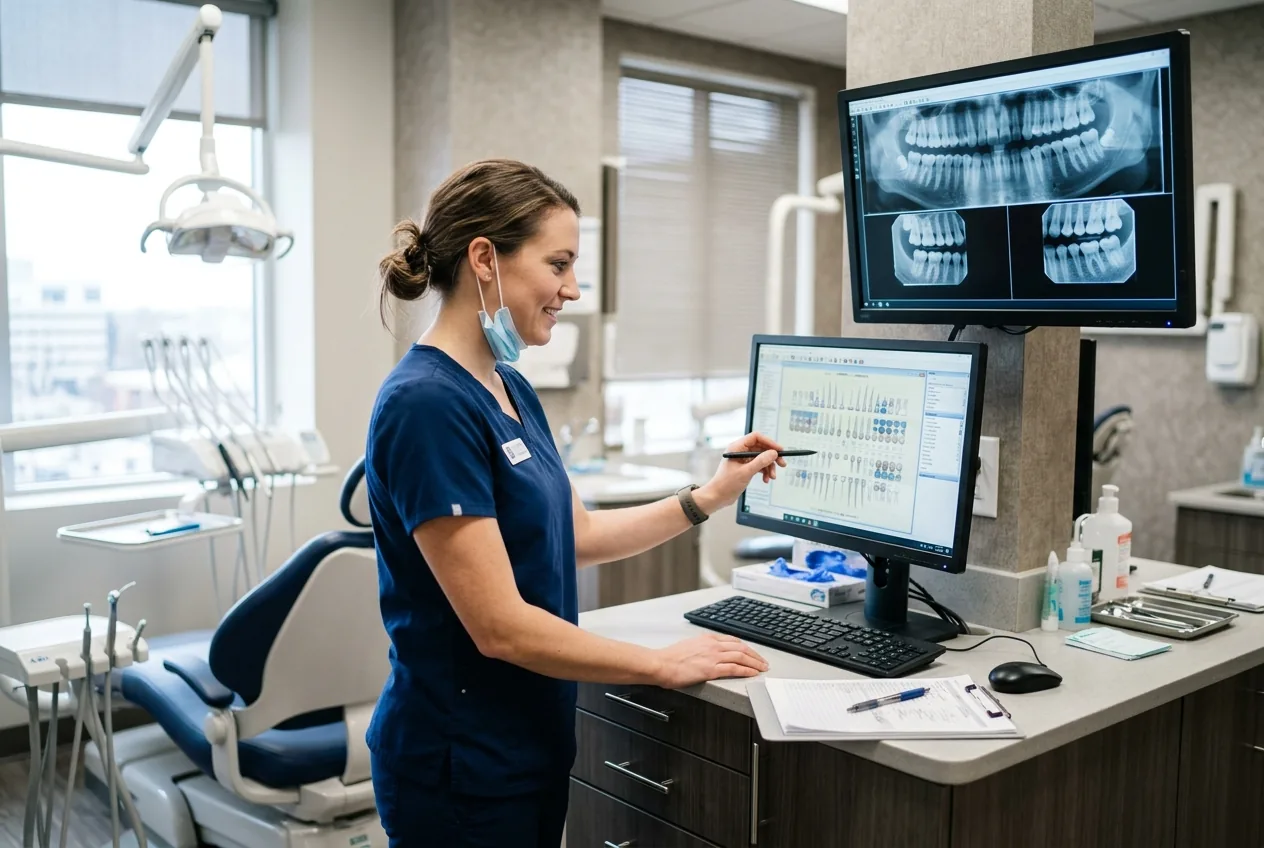
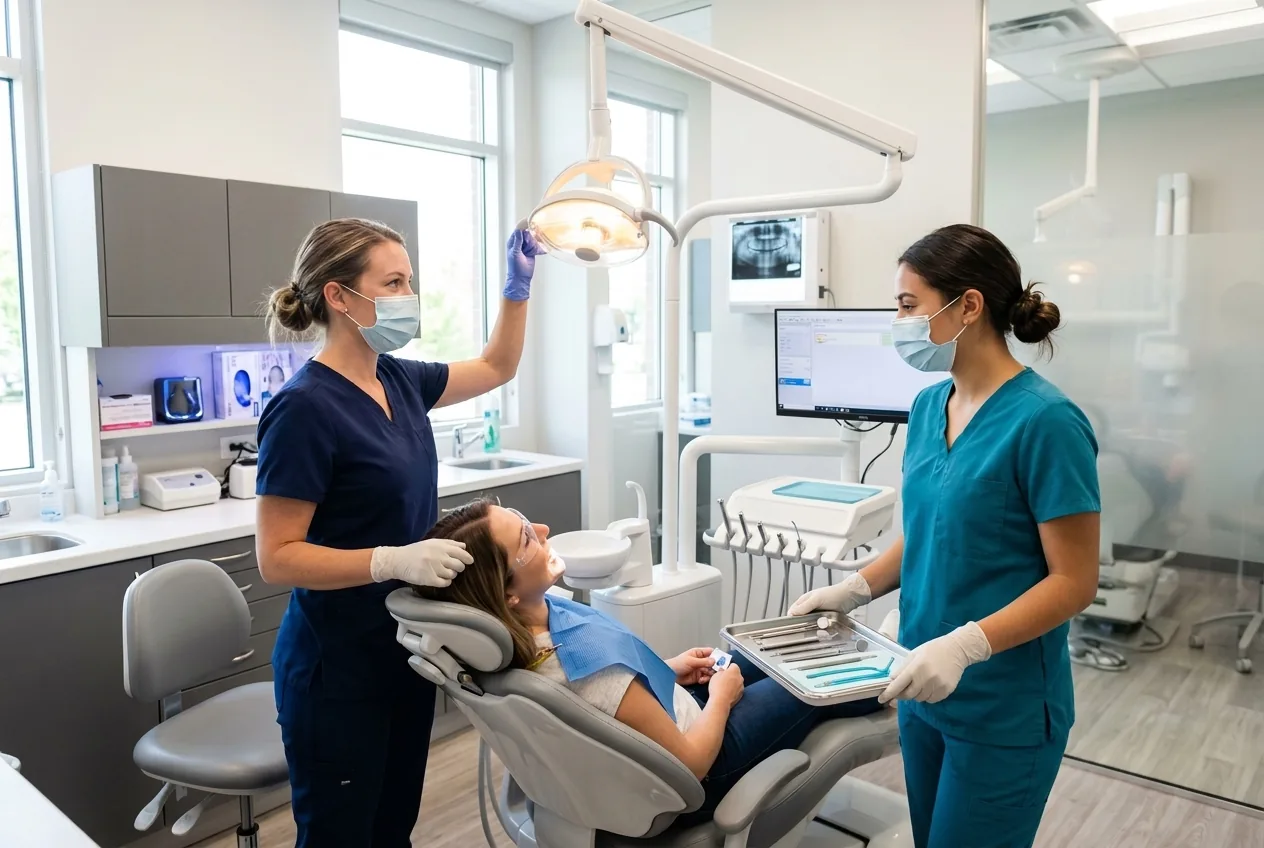
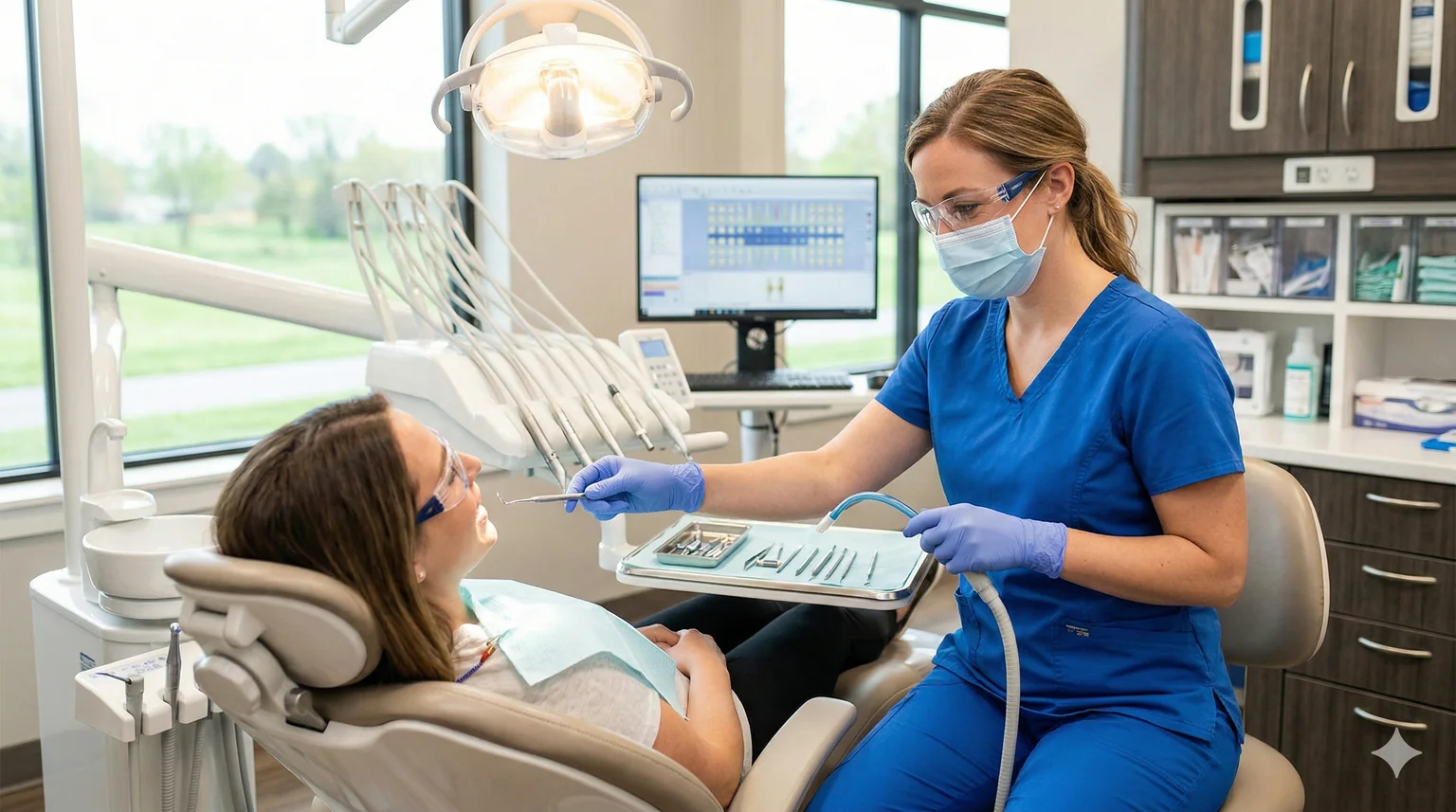
Dental assisting is a hands-on, patient-facing role that covers both clinical and administrative responsibilities. The mix varies by practice type and state law, but a typical day might include:
Chairside Clinical Work
- Preparing patients for procedures — explaining what to expect, seating them, and ensuring comfort
- Passing instruments to the dentist during procedures
- Suctioning, rinsing, and maintaining a clear operating field
- Taking dental X-rays (radiography)
- Placing and removing rubber dams, retraction cord, and matrices
- Preparing and mixing dental materials (impressions, bonding agents, temporary cement)
- Sterilizing and maintaining instruments and equipment
Administrative and Support Tasks
- Scheduling appointments and managing patient flow
- Updating patient records and charting
- Managing supply inventory
- Processing insurance forms and prior authorizations
- Patient education on oral hygiene and post-procedure care
Expanded Duties (Varies by State)
Many states allow dental assistants who hold additional certifications to perform expanded functions. These can include:
- Coronal polishing
- Applying pit-and-fissure sealants
- Placing and carving amalgam and composite restorations
- Taking final impressions
- Administering nitrous oxide monitoring
Expanded Function Dental Assistants (EFDAs) take on more of the clinical workload, freeing dentists for complex procedures and increasing the pace and capacity of the entire practice.
Salary: What You Can Expect to Earn
National Median and Range
The BLS reports a median annual wage of $47,300 for dental assistants as of May 2024, which works out to approximately $22.74 per hour. The bottom 10% earn less than $36,190, while the top 10% earn more than $61,780.
The Certification Pay Premium
Holding the Certified Dental Assistant (CDA) credential from the Dental Assisting National Board (DANB) makes a measurable difference in pay. According to DANB’s 2024 workforce data:
- Certified Dental Assistants (CDAs): $26.00/hr median
- Non-certified assistants: $22.50/hr median
That $3.50/hr gap compounds over a full year to roughly $7,280 in additional annual earnings — a significant return on the time invested in earning the credential. Satisfied CDAs report earning $29/hr median, meaning high performers in good practices can meaningfully exceed the national midpoint.
Specialty and Advanced Roles
Setting and specialization push earnings higher. Dental assistants in the following environments typically earn above the median:
| Role / Setting | Approximate Salary Range |
|---|---|
| Entry-level general dentistry | $36,000 – $45,000 |
| Certified (CDA), general dentistry | $50,000 – $58,000 |
| Orthodontic assistant | $48,000 – $62,000 |
| Oral surgery assistant | $50,000 – $65,000 |
| Expanded Function Dental Assistant (EFDA) | $52,000 – $68,000 |
Specialties like oral surgery and orthodontics tend to pay the most because the procedures are more complex and the assistant’s role is more demanding. EFDAs command a premium because they directly expand the dentist’s productive capacity.
Wages Are Rising
The shortage is pushing compensation up across the board. DANB found that 48% of dental assistants received a raise in the past year, and nearly 80% saw a pay increase within the last two years. Roughly a quarter received raises of 4–6%, and 14% received 7% or more. For new entrants, that trajectory — modest starting pay climbing steadily as certification and experience accumulate — is one of the field’s genuine strengths.
Career Paths and Advancement
Dental assisting is a career with real ladders, not just a single rung. Here are the most common advancement paths:
1. Expanded Function Dental Assistant (EFDA)
EFDAs complete additional training and certification to perform restorative and preventive procedures alongside the dentist. The role commands higher pay, more clinical responsibility, and is in high demand in states where the scope of practice is broad. This is the most direct clinical advancement within dental assisting itself.
2. Specialty Practice
Moving from general dentistry into a specialty practice — orthodontics, pediatric dentistry, periodontics, oral surgery, endodontics, or prosthodontics — brings higher pay, more complex cases, and often a more predictable schedule. Each specialty has its own distinct workflow and skill set, and many assistants find a niche that becomes a long-term career home.
3. Lead Dental Assistant / Office Manager
Senior assistants often move into supervisory roles, overseeing other assistants, managing schedules, and coordinating between clinical and front-office operations. Treatment coordinators — who walk patients through proposed care plans and insurance coverage — are another common transition that leverages clinical knowledge in a patient-facing, communication-heavy role.
4. Pathway to Dental Hygiene
For assistants who want to advance within healthcare, dental hygiene is the most common next step. Dental hygienists earn a median of $89,290 per year and require an associate degree (typically two years). Working as a dental assistant first gives you real clinical exposure, familiarity with the dental environment, and a strong foundation before taking on hygiene coursework. Many hygiene programs actively value applicants with dental assisting experience. See our dental hygienist career profile for a full breakdown of the role, salary progression, and what the transition looks like.
How to Become a Dental Assistant
There are two main routes into dental assisting, and which one applies to you depends largely on which state you live in.
Route 1: CODA-Accredited Dental Assisting Program (Recommended)
The Commission on Dental Accreditation (CODA) accredits more than 1,400 dental assisting programs at community colleges, vocational schools, and technical institutes nationwide. These programs typically run 9 months to 2 years and combine classroom instruction with supervised clinical experience. Costs vary: a community college program might run $8,878–$14,816 total for in-state students — a fraction of what a four-year degree costs.
CODA-accredited programs cover:
- Dental science and anatomy
- Chairside procedures and instrument handling
- Radiography (X-ray) techniques and safety
- Infection control and sterilization protocols
- Patient communication and records management
- Introduction to dental materials
Graduating from a CODA program is the most direct path to sitting for the DANB CDA exam, and many states require accredited training for licensure or registration.
Route 2: On-the-Job Training
Some states — particularly those without formal licensing requirements for dental assistants — allow dentists to hire and train assistants directly in the practice. This route works best if you already have a connection to a dental office willing to invest in training you, or if you’re in a state with minimal regulatory barriers. The trade-off: without formal credentials, your salary ceiling is lower and your job mobility is limited. DANB data shows non-certified assistants earn $3.50/hr less and change jobs at nearly twice the rate.
Radiography Certification
Regardless of your state’s requirements, X-ray certification is one of the most universally valued credentials in dental assisting. Most CODA programs include radiography training, and DANB offers the Radiation Health and Safety (RHS) exam as a standalone credential. Practices strongly prefer — and many require — assistants who can take X-rays independently.
Earning the CDA Credential
The Certified Dental Assistant (CDA) is the gold-standard national credential, issued by the Dental Assisting National Board (DANB). To earn the CDA, you must pass three component exams:
- General Chairside Assisting (GC) — clinical knowledge, procedures, and patient care
- Radiation Health and Safety (RHS) — safe X-ray technique and radiation protection
- Infection Control (ICE) — sterilization, exposure control, and OSHA compliance
Eligibility requires either graduation from a CODA-accredited program or at least two years of full-time work experience under a licensed dentist, plus a current CPR certification. All three components must be passed within a five-year window. The exams are computer-based, offered year-round at testing centers across the country, and results are available immediately after testing.
DANB also offers state-specific credentials that satisfy local licensing requirements — check your state’s requirements before deciding which combination of exams to pursue.
Is Dental Assisting Right for You?
Strong Fit If You…
- Enjoy working directly with patients and want to see the impact of your work every day
- Prefer a structured, predictable environment (most dental offices run on appointment schedules)
- Want to enter healthcare without spending four years in school
- Are comfortable with clinical tasks — instruments, suction, X-rays, materials preparation
- Value job stability and the flexibility of a credential that opens doors in nearly every city in the country
Trade-Offs to Consider
Physical demands. The role involves prolonged sitting in awkward positions at chairside, repetitive hand and wrist movements, and extended periods of precise manual work. Ergonomic awareness and good technique matter for long-term health.
Pay ceiling in general dentistry. The median of $47,300 is solid for a sub-one-year program, but it’s not a high earner by healthcare standards. Reaching the upper ranges of the salary scale typically requires certification, specialty experience, or geographic advantage (urban markets and high cost-of-living areas pay more).
State variation. Scope of practice, licensing requirements, and what expanded duties you’re allowed to perform vary significantly by state. If you’re likely to move, DANB’s national CDA credential travels with you better than state-only registrations.
Retention challenges. The same DANB data that shows 40% of practices are actively recruiting also shows that 40% of assistants who changed jobs cited feeling underappreciated as a reason for leaving. Finding a practice with good culture matters — and the current labor market gives candidates real leverage to be selective.
Getting Started: Your Action Plan
-
Check your state’s requirements. Visit DANB’s state requirements page to understand what your state requires for dental assistant licensure or registration. This determines whether a CODA program is mandatory or optional for you.
-
Find an accredited program. Use CODA’s program finder to locate accredited schools near you. You can also browse dental assisting programs by state in our directory to compare colleges offering dental assisting credentials. To evaluate schools on outcomes, retention, and graduation rates, our Health Sciences college rankings ranks programs in the same CIP family — a useful filter for identifying high-performing programs. Compare program length, cost, and whether they include radiography certification and clinical externships.
-
Look into financial aid. CODA-accredited programs at community colleges qualify for federal financial aid (Pell Grants, subsidized loans). Many states also have workforce development funds through the Workforce Innovation and Opportunity Act (WIOA) that can cover trade-school costs for qualifying students.
-
Aim for the CDA credential. Even if your state doesn’t require it, earning the CDA certification is a career investment that pays. The $3.50/hr wage premium, combined with lower turnover rates and better access to senior roles, makes it well worth the preparation time.
-
Think about your setting. General dentistry is the most common entry point, but if you know you’re interested in orthodontics or oral surgery, seek out practices in those specialties for your externship or first job. Early exposure to specialized work makes you a stronger candidate for those higher-paying positions.
Dental assisting won’t make you rich overnight, but for someone who wants into healthcare, wants to work with people, and wants to start a career faster than a four-year degree allows — it’s one of the most practical, in-demand, and advancement-ready trade paths available today. The shortage is real, the credential is achievable, and the ladder goes somewhere.
Sources
- U.S. Bureau of Labor Statistics — Dental Assistants: Occupational Outlook Handbook — May 2024
- Dental Assisting National Board (DANB) — Dental Assisting Trends and Insights We Saw in 2024 — 2024
- American Dental Association News — Five Years Later: Staffing Shortages Since the COVID-19 Pandemic — February 2025
- American Dental Association Health Policy Institute — Dental Workforce Shortages
- Dental Assisting National Board — Certified Dental Assistant (CDA) Exam
- Commission on Dental Accreditation (CODA) — Find a Program
- U.S. Bureau of Labor Statistics — Dental Hygienists: Occupational Outlook Handbook