Welding is one of the skilled trades where the credential, the skill, and the paycheck are tied tightly together. A “welder” who can’t pass a structural plate test is a helper; a welder who can pass AWS D1.1 6G in all positions is a commodity on every pipeline and shipyard in the country. The pay spread between those two is enormous — and the path from one to the other is faster than most people think, if you sequence the training correctly.
The BLS Occupational Outlook Handbook lists the May 2024 median wage for welders, cutters, solderers, and brazers at $51,000, with the top 10% earning more than $75,850 — and that top number dramatically understates what a multi-certified rig welder or pipeline welder makes, because those roles frequently pull $100,000–$180,000 once per diem and overtime are counted. The trade is projected to grow 2% from 2024 to 2034 (slower than average in percentage terms), but with 45,600 annual openings driven by retirements, there is no shortage of work for welders who can pass the test.
This guide walks the full path: the baseline requirements, the trade school vs. apprenticeship decision, the AWS certification structure, what to expect in year one, and the specialty routes that lead to the highest pay in the field.
What Welders Actually Do (and Where Pay Ranges Come From)
“Welder” describes five different jobs that share a gun-and-a-hood but diverge substantially in pay:
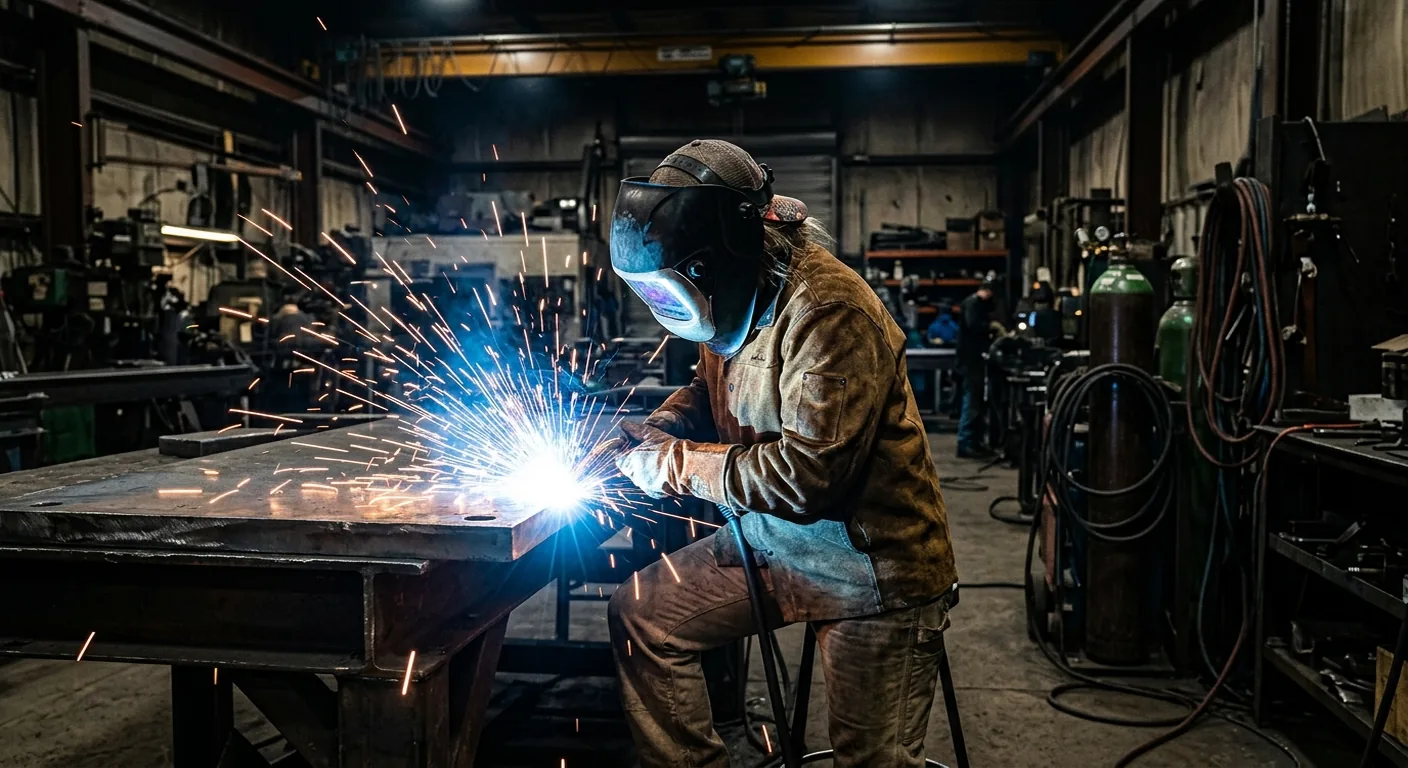
- Fabrication welder (shop-based) — steady shifts, predictable pay, $45,000–$70,000 typical. Most entry-level welders start here.
- Structural welder (commercial/industrial construction) — mobile work, D1.1 certifications required, $55,000–$85,000 typical.
- Pipe welder / pipefitter-welder — union or industrial, typically 6G certified, $70,000–$110,000 with overtime.
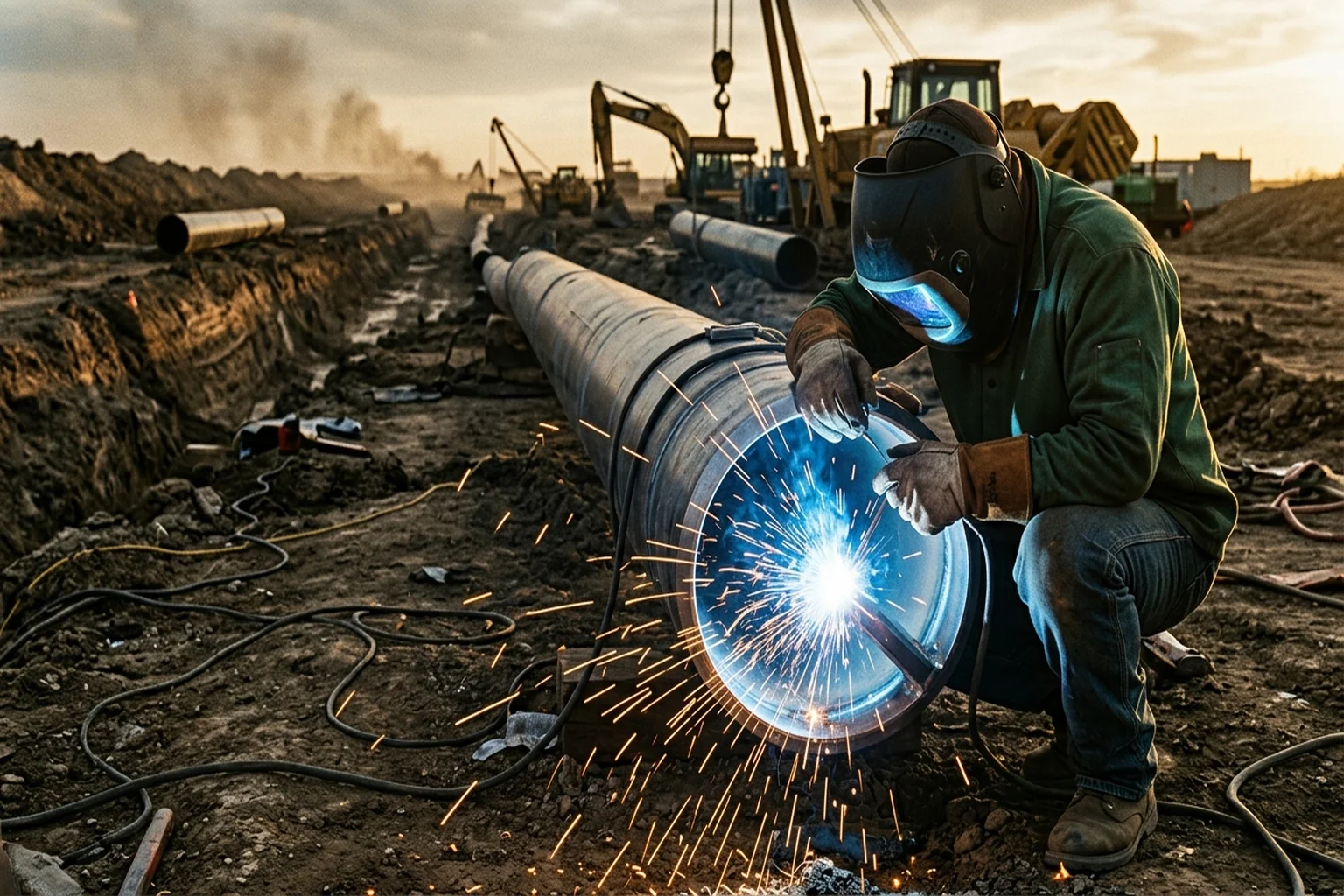
- Pipeline welder — rig welders on cross-country pipelines, per diem included, $100,000–$180,000 during peak seasons; seasonal work.
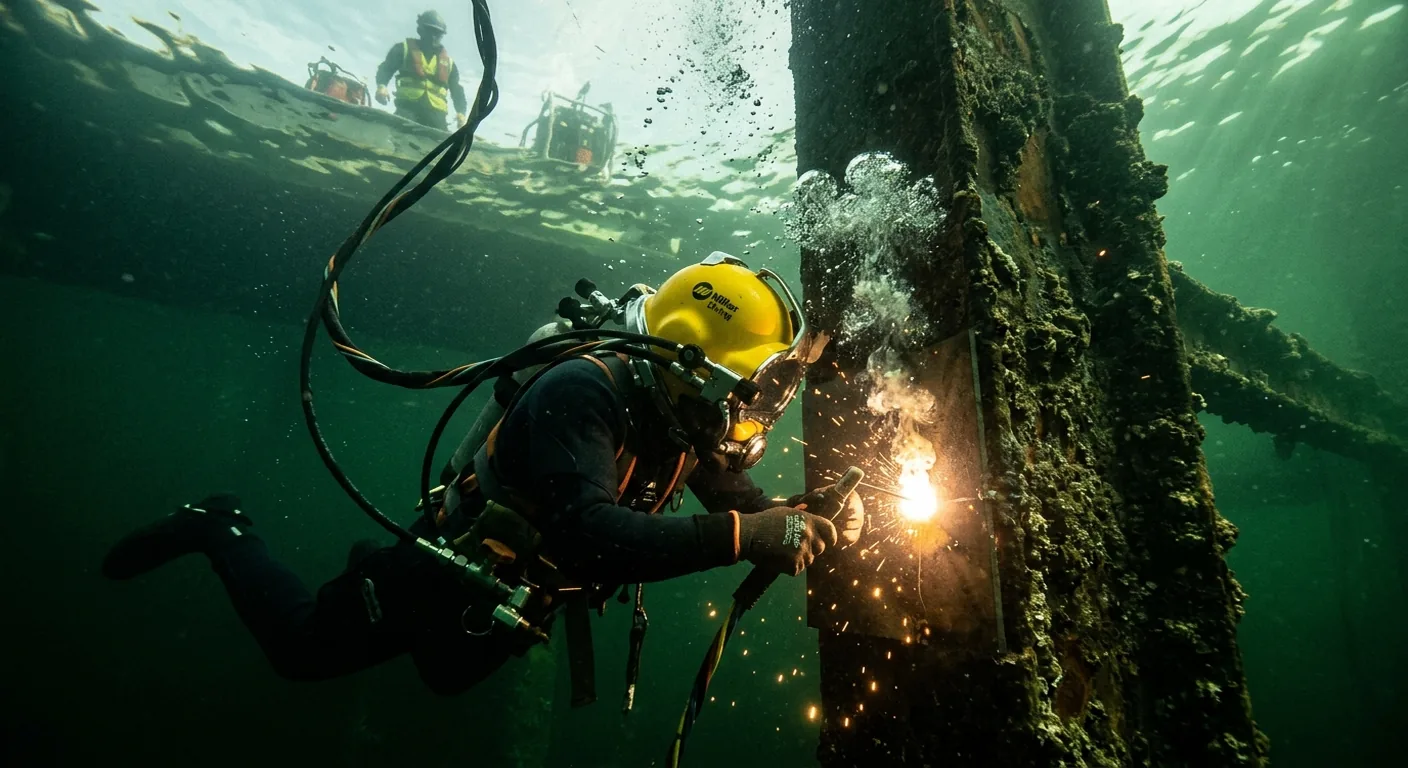
- Underwater / specialty welder — commercial diver with welding certification, $80,000–$200,000+, with real occupational risk.
The common thread is not the arc — it’s the certification test you can pass. Everything in this guide points toward passing tests.
Step 1: Meet the Baseline Requirements
The fixed gates are modest:
- Education: High school diploma or GED for most schools and apprenticeships. Some employer-paid training programs will take you without it.
- Age: 18 for most trade schools and all apprenticeships. OSHA rules also effectively require 18 for many welding jobsites.
- Physical: Hand-eye coordination, steady hands, good near vision (correctable is fine), tolerance for heat and the smell of burning flux. Welders stand, kneel, squat, and lie on their backs all day.
- Color vision: Near-normal. Some welding involves color-coded wiring or oxy-fuel flame reading.
- No active substance concerns: Drug testing is near-universal for industrial and union jobs. Alcohol and heavy impairment during welding is a fireable offense on every jobsite.
- Willingness to get hot: Full leather or flame-resistant clothing + a hood, often in 100°F+ conditions. If you can’t tolerate summer work in heavy PPE, the trade is not for you.
If you wear corrective lenses, prescription welding hoods or magnifying cheaters inside the hood are standard — not a barrier.
Step 2: Pick Your Training Path
There are three realistic on-ramps. They differ more in calendar time and debt than in outcome — welders who pass tests get hired, regardless of how they trained.
Trade School / Welding School (6–18 months)
The fastest route to a certified entry-level welder. Programs run at community colleges, private trade schools (Tulsa Welding School, Lincoln Tech, SOWELA), and high school vocational programs.
Expect:
- Cost: $3,500–$20,000 for a 6–12 month program; $8,000–$30,000 for a 2-year associate degree
- What you learn: SMAW (stick), GMAW (MIG), FCAW (flux-core), GTAW (TIG), and the basics of blueprint reading, metallurgy, and safety. The strongest programs drill plate and pipe test prep explicitly.
- Outcome: Entry-level employable in fabrication work. Some programs include AWS certification; many do not (your shop-level qualification is typically what employers want first anyway).
What to look for:
- AWS-accredited testing facility on campus — means you can earn AWS Certified Welder credentials before graduation
- Employer partnerships with local fabricators, refineries, or union halls
- Hours at the booth — a 600–800 hour program where you spend real time under the hood produces better welders than a 1,500-hour program with heavy classroom time
For a broader framework on evaluating welding and other trade programs, see choosing the right trade program.
Apprenticeship (Union or Non-Union)
Longer calendar (3–5 years) but zero tuition and paid from day one. Union paths:
- Ironworkers (Local 40, 7, etc.) — structural welding alongside rigging and connection work
- Boilermakers — pressure vessel and power plant welding; often the highest-paid path
- Pipefitters / UA — combined pipefitter and welder training; heavy industrial and nuclear work
- Sheet Metal Workers (SMART) — duct, hood, and stack welding
Non-union apprenticeships run through individual contractors, refineries, and shipyards (Newport News, Ingalls, and the Pacific Northwest yards regularly hire welders straight into structured training).
- Year 1 apprentice pay: typically $15–$22/hour depending on market, stepping up every 6–12 months
- Benefits: Health insurance and pension in union paths — typically a larger share of total comp than you’d see in the non-union track
For the full framework on how apprenticeship programs work and what registered vs. unregistered apprenticeships mean for your credential, see apprenticeships explained.
Employer-Sponsored Training / Bootcamps
A third option that has grown in the last few years. Some large fabricators, shipyards, and pipeline contractors run 6–16 week intensive training programs for new hires. You’re paid (modestly) during training and placed into the shop directly. You graduate without the general coursework a trade school gives you, but with one specific certification and a job.
Step 3: Earn Your First AWS Certification
The American Welding Society (AWS) administers the certification structure that most employers in the U.S. use to evaluate welders. A few important distinctions:
- AWS Certified Welder (CW) — an individual welder’s qualification to a specific procedure. Time-limited (typically 6-month renewal) and earned by passing a practical test on a specific Welding Procedure Specification (WPS).
- Shop Welder Qualification — similar in principle, administered by individual employers per their WPS. The most common credential a working welder actually holds.
- AWS Certified Welding Inspector (CWI) — a higher-level credential earned by experienced welders and QC personnel, not a starting credential.
For a new welder, the first credential that signals “employable” is a passing bend test on a D1.1 structural WPS in 1G or 2G position. The D1.1 Structural Welding Code – Steel is the most widely-used structural welding standard in North America. Most fabricators and many trade schools will test to D1.1.
D1.1 Certification Specifics
The AWS D1.1:2025 Structural Welding Code – Steel is the current edition. Practical welder-qualification testing under D1.1 involves:
- A test coupon in a specified position (1G flat, 2G horizontal, 3G vertical, 4G overhead, or all positions)
- Welded to a specific WPS provided by your employer or testing facility
- Destructively tested (typically by bend tests on the weld)
- Pass/fail based on defect-free bends
Position matters for pay:
- 1G / 2G (flat, horizontal) — entry-level; most shop jobs require these
- 3G (vertical) — adds bonus welding jobs
- 4G (overhead) — the “hard” position in plate
- All positions — opens structural field welding
- 6G (45° fixed pipe, all positions) — the specialty pipeline/petrochemical certification that commands the highest pay
Testing costs (per WeldingInfo): $150–$350 per WPS, plus $35–$75 for registration and documentation. Prep courses, if needed, run $200–$1,000. Retests are typically $50–$150.
The “6G Rig Welder” Benchmark
Most pipeline welder listings ask for 6G pipe certification — a test weld on pipe fixed at 45° requiring the welder to weld around it in all positions without repositioning the pipe. It’s the hardest welder-qualification test in common use and the direct credential gate to pipeline work. New welders rarely pass 6G on a first try; it’s typically earned 2–4 years into the field after mastering 2G and 5G (horizontal fixed pipe) first.
Step 4: Understand What You’ll Actually Earn in Year One
The BLS median for the full occupation is $51,000, with the 10th percentile at $38,130 and the top 10% at $75,850. Broken down by entry point:
Fabrication shop, year one (40 hrs + modest OT):
- $36,000–$48,000 typical
- Stable hours, usually 5 days a week with a predictable schedule
Structural/commercial job site, year one:
- $42,000–$58,000 typical with 45–50 hour weeks
- More variety, more travel between sites, more weather exposure
Union apprenticeship year one (Ironworkers / Pipefitters / Boilermakers):
- $32,000–$48,000 base + benefits
- Benefits (pension, health) meaningfully raise total compensation; often equivalent to another $10,000–$20,000 in value
Shipyard / industrial facility (production welder):
- $40,000–$55,000 in year one
- Often union, often with overtime, steady
By year 3–4, the top track within each of these categories roughly doubles. A welder certified D1.1 all-position plus 6G pipe, willing to travel, frequently earns over $100,000 by year 5.
For the broader industry earnings outlook and hiring data by region, see our companion guide on welding career opportunities.
Step 5: Add Specialty Certifications
Year 2–3 is when specialization starts paying. The most valuable specialty credentials, roughly in order of the pay bump they produce:
- AWS D1.1 6G pipe — pipeline, refinery, and power plant work
- ASME Section IX qualifications — pressure vessel and boiler work; often required for power plant and oil/gas
- TIG (GTAW) proficiency on aluminum and stainless — aerospace and food-grade stainless specialty work
- AWS D1.2 (aluminum) — marine, transit, and aerospace structural welding
- Underwater welding + commercial diving — separate training pipeline (commercial diving school + welding qualifications); highest risk/reward combination in the trade
- AWS Certified Welding Inspector (CWI) — transitioning from welder to QC; requires 5+ years of experience for most eligibility pathways; adds $15k–$30k to comp
The underlying principle: if you can pass the test nobody else can pass, you can name your rate.
Step 6: Navigate Jobsite Realities
A few practical items that don’t show up in a school curriculum:
- Your hood and helmet are your own. A quality auto-darkening hood is $200–$500. Budget $1,000–$2,500 for your initial PPE kit: hood, helmet, leathers, gloves, boots, and safety glasses.
- You will buy your own consumables on some jobs. Rod, wire, and grinding disks are sometimes supplied, sometimes billed back at low rates to the welder. Ask during hiring.
- Travel pay matters. Structural and pipeline jobs often pay per diem ($50–$150/day tax-free) to cover hotel and meals. Per diem can easily double the take-home pay on out-of-town work.
- Overtime is where real wages come from. A $28/hour welder at 40 hours earns $58,000/year. At 55 hours (15 hours OT at 1.5x) it’s $79,000. A willingness to work long weeks is the single biggest variable in welder annual income.
- Shutdowns and turnarounds — scheduled maintenance at refineries and power plants — are 6–12 week contract gigs that frequently pay 2–3x standard shop rates for welders who can pass the test and are willing to travel.
Timeline and Cost Summary
For the trade school path:
| Phase | Timeline | Cost |
|---|---|---|
| Research and enroll | 1–2 months | $100 fees |
| 6–12 month welding certificate | 9 months typical | $3,500–$12,000 |
| PPE and starter tools | Throughout school | $1,000–$2,500 |
| AWS D1.1 plate test | End of school | $150–$350 per position |
| First job placement | 1–3 months | — |
| To employable | ~10–14 months | ~$4,800–$15,000 |
For the apprenticeship path, the tuition line is zero but you add 3–5 years of calendar time — compensated throughout at apprentice wages.
Three Mistakes That Slow People Down
1. Paying for a long program without confirming booth hours. A 1,500-hour program that puts you in the booth for only 40% of that time produces worse welders than a 600-hour intensive where you’re under the hood most of every day. Ask specifically what percentage of hours is booth time.
2. Skipping AWS testing during school. Some students wait until after they’re hired to test. But employers will discount your resume if you don’t already have a passing test in hand — and the testing facility at your school is both cheaper and more familiar than a third-party one. Test before you graduate.
3. Trying to jump directly to pipeline welding without shop time first. Pipeline rig welding is lucrative but it demands speed and position mastery that take years of daily practice. A new graduate with a 6G on a bench under calm conditions is not the same as a welder who can run hot passes on a cold January day on the side of a mountain. Work shop or structural for 2–3 years first.
Where This Path Leads
Welding has one of the widest career-ceiling spreads of any skilled trade. Common long-term paths:
- Shop welder / fabricator — steady, union-free or union, modest ceiling but stable work
- Structural field welder — higher pay, mobile, weather-exposed
- Pipeline rig welder — top of the pay scale for production welding; seasonal
- Refinery/power turnaround welder — high-pay contract work; typically 6G certified
- Underwater welder — specialty combining commercial diving; real occupational risk but commensurate pay
- Welding inspector (CWI) — office-based QC role typically moving to $90,000–$130,000+
- Welding engineer — requires additional engineering coursework; moves welding experience into design and procedures
- Owner/operator of a fabrication shop — requires business and capital but leverages your trade skill into higher margins
For the full outlook on the field and where welders are hiring right now, see our companion guide on welding career opportunities. For training programs, see the aggregated welding program directory.
Welding isn’t a trade where credentials are the whole story. It’s a trade where the test is the credential — and the welder who keeps adding passed tests to their resume keeps adding dollars to their paycheck. Every specialty cert, every position mastered, every WPS you can run cleanly, is measurable money on the next job.
Sources
- Welders, Cutters, Solderers, and Brazers — U.S. Bureau of Labor Statistics, Occupational Outlook Handbook — May 2024 wage and employment data — https://www.bls.gov/ooh/production/welders-cutters-solderers-and-brazers.htm
- American Welding Society — “D1.1/D1.1M:2025 Structural Welding Code – Steel” — Current structural welding code — https://pubs.aws.org/p/2264/d11d11m2025-structural-welding-code-steel
- American Welding Society — “Professional Welding Certifications” — Certification structure overview — https://www.aws.org/certification-and-education/professional-certification/
- WeldingInfo — “AWS D1.1 Certification Meaning, Cost, Exam, Benefits” — Testing cost summary — https://www.weldinginfo.org/welding-certification/aws-d1-1-certification-meaning-cost-exam-benefits/
- ANSI Blog — “AWS D1.1:2025 Changes to Structural Welding Code – Steel” — Current revision summary — https://blog.ansi.org/ansi/aws-d1-1-2025-structural-welding-code-steel/