
HVAC is one of the highest-demand skilled trades in the country, and the credentialing path is unusually cleanly defined. The BLS Occupational Outlook Handbook puts the May 2024 median wage at $59,810, projected growth at 8% through 2034, and about 40,100 openings per year. The industry trade association ACCA regularly describes a labor shortage in the range of 80,000 unfilled technician roles — meaning the problem isn’t getting hired, it’s getting trained well enough to get hired at the top of the wage band.
This guide walks the full path from no experience to a fully credentialed HVAC technician: how to choose between school and apprenticeship, how to earn the federally-required EPA Section 608 certification, when NATE makes financial sense, and what you’ll realistically make in years one through five.
What HVAC Techs Actually Do
Before you spend money on training, understand the job. HVAC is four broadly different kinds of work that most techs rotate through in their first few years:
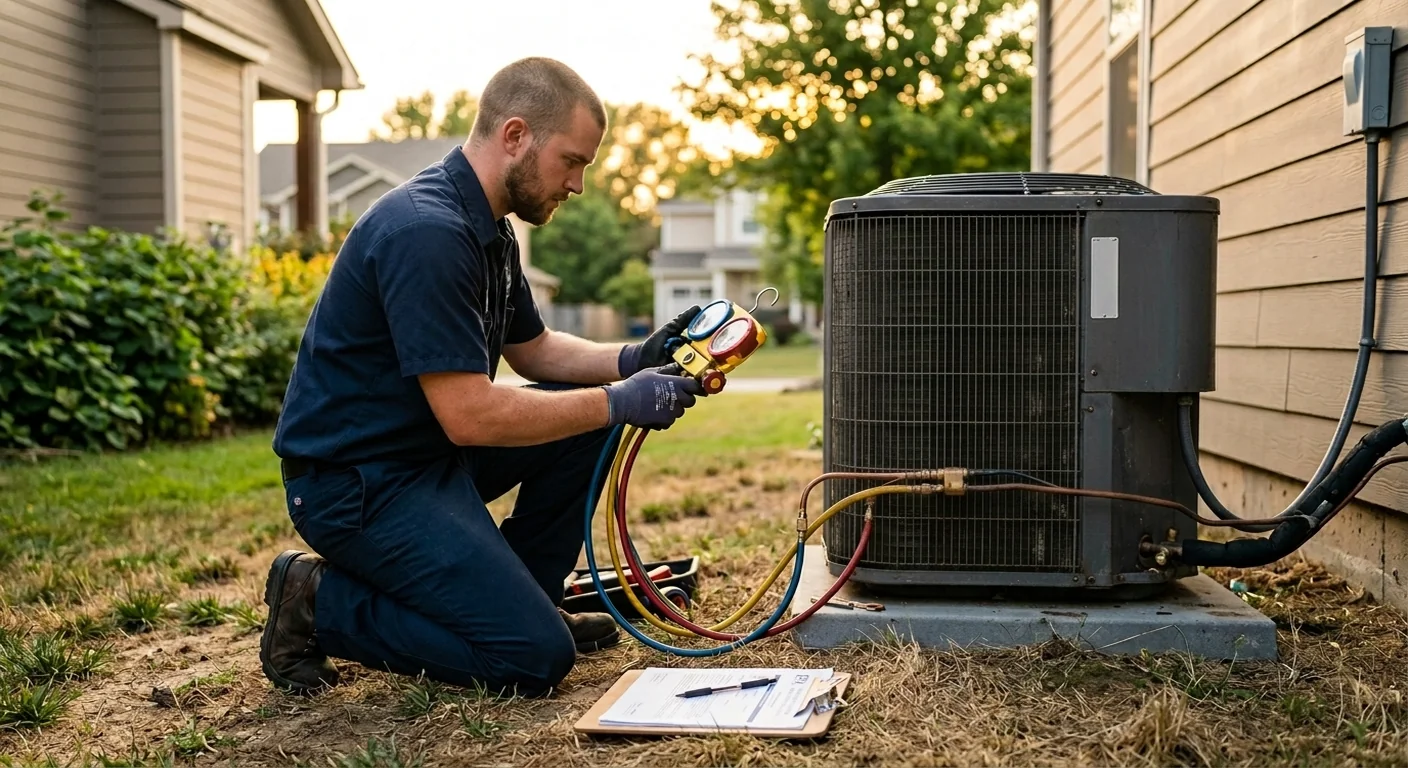
- Residential service — repairing furnaces, air handlers, heat pumps, and split-system air conditioners in customer homes. The bread and butter of the field. Customer-facing.
- Residential installation — putting in new systems, often alongside new construction or HVAC replacement. Physical, with heavy lifting of condenser units, air handlers, and duct. Less customer interaction.
- Commercial / light commercial — rooftop units, package equipment, small chillers, VRF systems in office and retail buildings. Typically higher pay, more scheduled work.
- Refrigeration and large commercial — walk-in coolers, supermarket refrigeration, industrial chillers. Specialized. Highest-paid segment once you have experience.
Most first jobs are residential service or install. Commercial and refrigeration come later.
Step 1: Meet the Baseline Requirements
The fixed gates are modest:
- Education: High school diploma or GED. A handful of states require it; most employers expect it.
- Age: 18+ for most trade school programs and virtually all apprenticeships.
- Driver’s license: Non-negotiable. Service techs drive a company truck to customer sites every day. A clean driving record helps — companies get quoted higher insurance rates for techs with recent violations.
- Physical capability: Ability to lift 75+ pounds, work on ladders and rooftops, and comfort in hot attics and cold mechanical rooms. The job is physical year-round.
- Background check: Routine. Drug testing is near-universal at hire, and random testing is common at union contractors.
- Math basics: Algebra, basic geometry, and the ability to read technical specs. You don’t need to be strong at math to start — but you need to not avoid it.
If you’re color-blind, confirm with a prospective school: electrical work within HVAC relies on color-coded wiring, and some employers screen for it.
Step 2: Pick Your Training Path — School or Apprenticeship
There are three realistic on-ramps, and the right one depends on how much structured learning you want versus how fast you want to earn.
HVAC Trade School or Community College
The most common path. Programs run 6 months to 2 years and cost $1,500 to $15,000 for certificate programs, or $3,000 to $20,000 for an associate degree.
- Certificate programs (6–12 months): Focused on getting you to entry-level employable status quickly. Typically include EPA 608 prep and the exam itself.
- Associate of Applied Science (2 years): Broader coverage, better for employers who want technicians who understand commercial controls and building systems. Often required to move into commercial/industrial work faster.
Look for programs accredited by HVAC Excellence or PAHRA (Partnership for Air-Conditioning, Heating, and Refrigeration Accreditation). Accreditation matters for transferability and for employer perception.
For a curated list of quality programs, see our guide to best HVAC schools.
Direct-Entry Apprenticeship
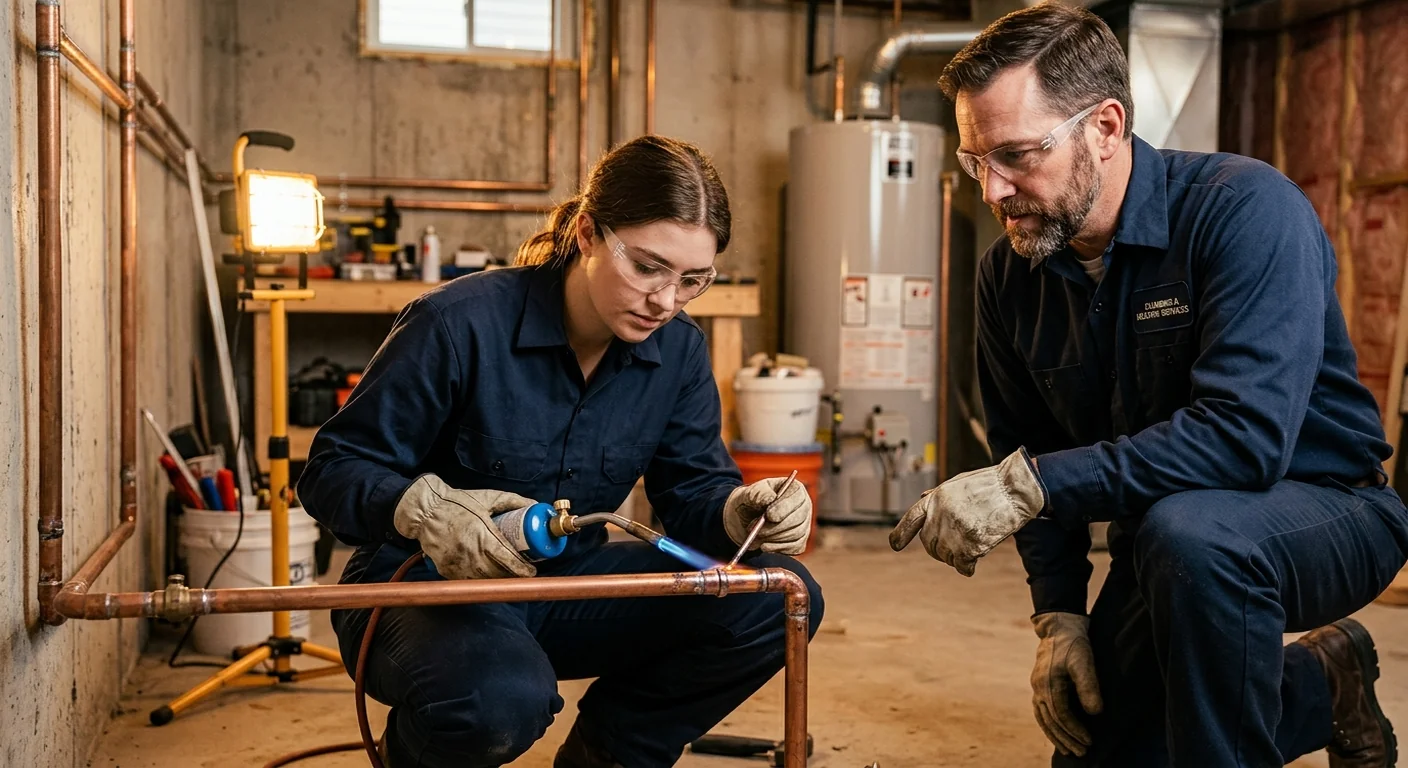
Some contractors hire “helper” roles directly and provide on-the-job training, often alongside a community college HVAC course one or two days a week (registered apprenticeship). Union apprenticeships through the UA (United Association of Journeymen and Apprentices) or the Sheet Metal Workers (SMART) run 4–5 years and combine 8,000+ hours of on-the-job training with classroom instruction.
The apprenticeship path pays you from day one (typically 40–50% of journeyman wages in year one, rising every six months). You finish with a journeyman credential rather than a certificate or degree, but zero tuition debt.
For the full framework on how apprenticeships work, see our guide on apprenticeships explained.
Manufacturer-Affiliated Academies
Some HVAC manufacturers (Carrier, Trane, Lennox) run short intensive academies in partnership with their dealer network. These are typically reserved for existing employees of a dealer or for recent graduates entering a specific training pipeline. They’re not a starting point — they’re a supplemental credential.
Step 3: Earn Your EPA Section 608 Certification
This is the federally-mandated credential to handle refrigerants, and there is no way around it. The EPA Section 608 technician certification requirements apply to anyone who services, installs, or disposes of equipment containing regulated refrigerant — which is effectively every HVAC job.
The Four Types
- Type I — Small appliances (5 lbs refrigerant or less): window units, domestic refrigerators, vending machines
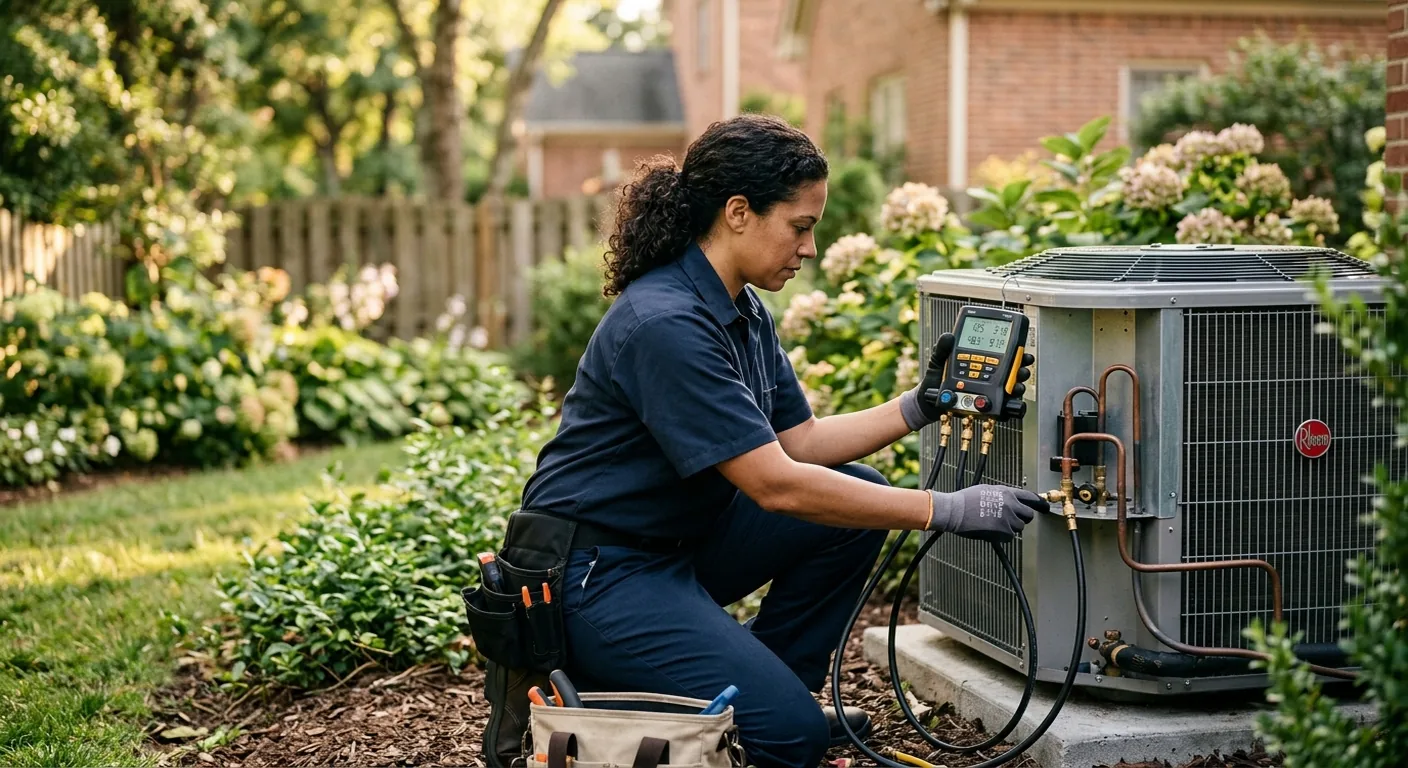
- Type II — High-pressure systems: most residential and light-commercial air conditioning and heat pumps
- Type III — Low-pressure systems: large commercial chillers
- Universal — Core + Types I, II, and III, covering all regulated equipment
To earn Universal, you pass a Core exam plus all three Type exams. Critically, Universal certification requires the Core exam to be taken in a proctored setting — open-book online Core exams cannot qualify for Universal status.
Cost and Format
EPA 608 testing is administered by EPA-approved certifying organizations (ESCO Institute, Mainstream Engineering, RSES, and others). Expect to pay $20–$60 per section for online open-book versions, or $50–$100 for a proctored test. Most schools include 608 prep and testing in tuition.
The credential does not expire. Pass once and you are federally certified for life.
If your training program doesn’t include 608 prep, budget 20–30 hours of self-study before attempting the proctored Universal exam. The Core section is mostly regulatory; the Type sections require system-specific knowledge.
Step 4: Land Your First Job — and Understand the Pay Curve
With a certificate (or an apprenticeship offer) and your EPA 608 in hand, you’re employable at entry level. Entry-level HVAC titles include:
- Installer helper — mostly lifting and pulling duct during new installs. Lowest pay, simplest work.
- Service technician (junior) — ride-along with a senior tech, diagnose and repair under supervision
- Maintenance tech — preventive maintenance on service contracts. Lighter diagnostic work, steadier schedule.
BLS data on the full occupation: median $59,810, top 10% over $91,020. That top 10% is effectively senior service techs, commercial/industrial specialists, and small business owners. Apprentice and first-year installer pay tracks well below the median — typically $36,000–$45,000 in year one, rising 10–20% with each subsequent year of experience.
A realistic five-year earnings progression for a residential service track:
| Year | Role | Typical base pay | Total comp w/ overtime |
|---|---|---|---|
| 1 | Apprentice / helper | $36,000–$45,000 | $38,000–$50,000 |
| 2 | Junior service tech | $42,000–$52,000 | $45,000–$58,000 |
| 3 | Service tech | $50,000–$62,000 | $55,000–$70,000 |
| 4 | Senior service tech | $58,000–$72,000 | $65,000–$85,000 |
| 5 | Senior tech + NATE specialty | $65,000–$82,000 | $75,000–$100,000+ |
Commercial and refrigeration tracks pay 10–25% higher at each stage but require more time to ramp.
Step 5: Add NATE Certification (When the Math Makes Sense)
NATE (North American Technician Excellence) is the industry-standard specialty credential. Unlike EPA 608, it’s voluntary — but it’s the credential employers look for when they want to signal “senior tech, not junior.”
Structure
- Core exam — HVACR fundamentals (required)
- Specialty exams — Air Conditioning, Heat Pumps, Gas Heating, Oil Heating, Commercial Refrigeration, Air Distribution, and more
For the standard NATE Professional credential, you take the Core plus one Specialty. Most techs add specialties over time.
Cost and Timing
Per NATE’s certification pages and industry summaries, the Core + Specialty package typically costs $150–$250. Retakes are about $45 each. Certification lasts 2 years and renews with 16 hours of continuing education or a retake.
When to Take It
NATE is most valuable in year 2 or 3, after you’ve accumulated enough field experience to pass the Specialty exam without intensive re-study. Employers in the residential service segment frequently offer a per-hour raise ($1–$3/hr) for NATE-certified techs, and many commercial employers treat NATE as a minimum for senior tech roles. The $200 exam pays itself back in a few weeks once you get the pay bump.
Step 6: Understand Your State’s HVAC License Requirements
Unlike EPA 608 (federal) and NATE (voluntary), HVAC contractor licensing is state-level and varies widely. Some states license at the individual technician level; most license only contractors (the person or company that pulls permits). A rough breakdown:
- No state HVAC license required: Kansas, Missouri, Wyoming, New Hampshire, Vermont, Pennsylvania, and several others — local municipal licensing may still apply
- Technician license required: California, Arizona, Nevada, Texas, North Carolina, Virginia, Florida, and others — with experience, exam, and insurance/bond requirements varying by state
- Contractor-only license: Most remaining states — you need a licensed contractor over you until you go into business for yourself
If your goal is to eventually start your own HVAC business, research your state’s contractor licensing rules before apprenticing. States like California and Florida require documented years of journey-level experience under a licensed contractor before you can sit for the contractor exam.
The IRA Heat Pump Wave — and What It Means for New Techs
A timely detail worth factoring into your plan. The Inflation Reduction Act’s Home Electrification and Appliance Rebates program and tax credits have pushed heat pump installation volume higher. Under the IRA, homeowners can get up to $2,000 in tax credits for qualified heat pumps, and low-income households can qualify for up to $8,000 in point-of-sale rebates in states that have activated their rebate programs. As of early 2025, about a dozen states had begun distributing rebates; some have since exhausted funding.
Net effect for techs: heat pump installation and heat pump service are the highest-growth specialties within HVAC for the 2025–2030 window. Training programs that emphasize heat pump and inverter-driven system diagnostics are positioning graduates better than programs that still focus primarily on conventional split systems. When evaluating schools, ask specifically about heat pump curriculum.
Timeline and Total Cost
A realistic budget and schedule for the school path:
| Phase | Timeline | Cost |
|---|---|---|
| Research and enroll | 1–2 months | $100 fees |
| 6–12 month certificate program | 9 months typical | $2,000–$10,000 |
| EPA 608 Universal exam | During/after school | $50–$100 |
| Apply for jobs, land first role | 1–3 months | — |
| To employable: | ~10–14 months | ~$2,200–$10,500 |
The apprenticeship path has zero tuition and you earn from day one, but the “to journeyman” timeline is 4–5 years.
Three Mistakes That Slow People Down
1. Skipping EPA 608 Universal in favor of just Type II. If you ever want to work on small appliances, chillers, or low-pressure systems, you’ll have to come back and test later. Take the Universal the first time — it’s a 2-hour difference, and the certification is lifetime.
2. Choosing a school that isn’t HVAC Excellence or PAHRA-accredited. Non-accredited programs can still produce good techs, but employers screen on accreditation when stacks of resumes come in.
3. Staying in residential service past year 3 without picking a specialty. The best wages after year 3 come from picking a lane — commercial controls, refrigeration, heat pumps, or a manufacturer’s brand-specific diagnostic certifications. Generalists plateau earlier than specialists.
Where This Path Leads
HVAC is one of the few trades where you can realistically become your own boss within 6–10 years. The common trajectories:
- Senior service technician — top of the W-2 wage band, often with company truck, benefits, and after-hours on-call pay
- Commercial/industrial specialist — chillers, VRF systems, large-building controls
- Service manager or lead tech — supervising a team of 4–10 techs, often compensated on team performance
- Contractor / owner-operator — requires a state contractor’s license in most states, plus insurance and bonding. The path to $150k+ income for top operators.
- Instructor / training role — at community colleges, manufacturer academies, or distributor training centers
For the full outlook on the field, where hiring is strongest, and what salaries look like regionally, see our companion guide on HVAC career opportunities. For an aggregated directory of training programs, see the HVAC program directory.
The demand is real, the wages are livable from year one, and the credentialing path is the most straightforward of any major skilled trade. The techs who pull ahead of the pack in years 3–5 are the ones who added NATE, picked a specialty, and tracked heat pump and inverter technology instead of coasting on what worked in 2015.
Sources
- Heating, Air Conditioning, and Refrigeration Mechanics and Installers — U.S. Bureau of Labor Statistics, Occupational Outlook Handbook — May 2024 wage and employment data — https://www.bls.gov/ooh/installation-maintenance-and-repair/heating-air-conditioning-and-refrigeration-mechanics-and-installers.htm
- U.S. Environmental Protection Agency — “Section 608 Technician Certification Requirements” — Official federal refrigerant handling rules — https://www.epa.gov/section608/section-608-technician-certification-requirements
- North American Technician Excellence (NATE) — “NATE Certificates and Certification Exams” — Core and specialty credential structure — https://natex.org/technician/take-an-exam/nate-certificates-and-certification-exams
- Rewiring America — “Your Guide to the Inflation Reduction Act” — IRA heat pump incentive structure — https://www.rewiringamerica.org/research/ira-guide
- California Energy Commission — “Inflation Reduction Act Residential Energy Rebate Programs” — State rebate rollout status — https://www.energy.ca.gov/programs-and-topics/programs/inflation-reduction-act-residential-energy-rebate-programs