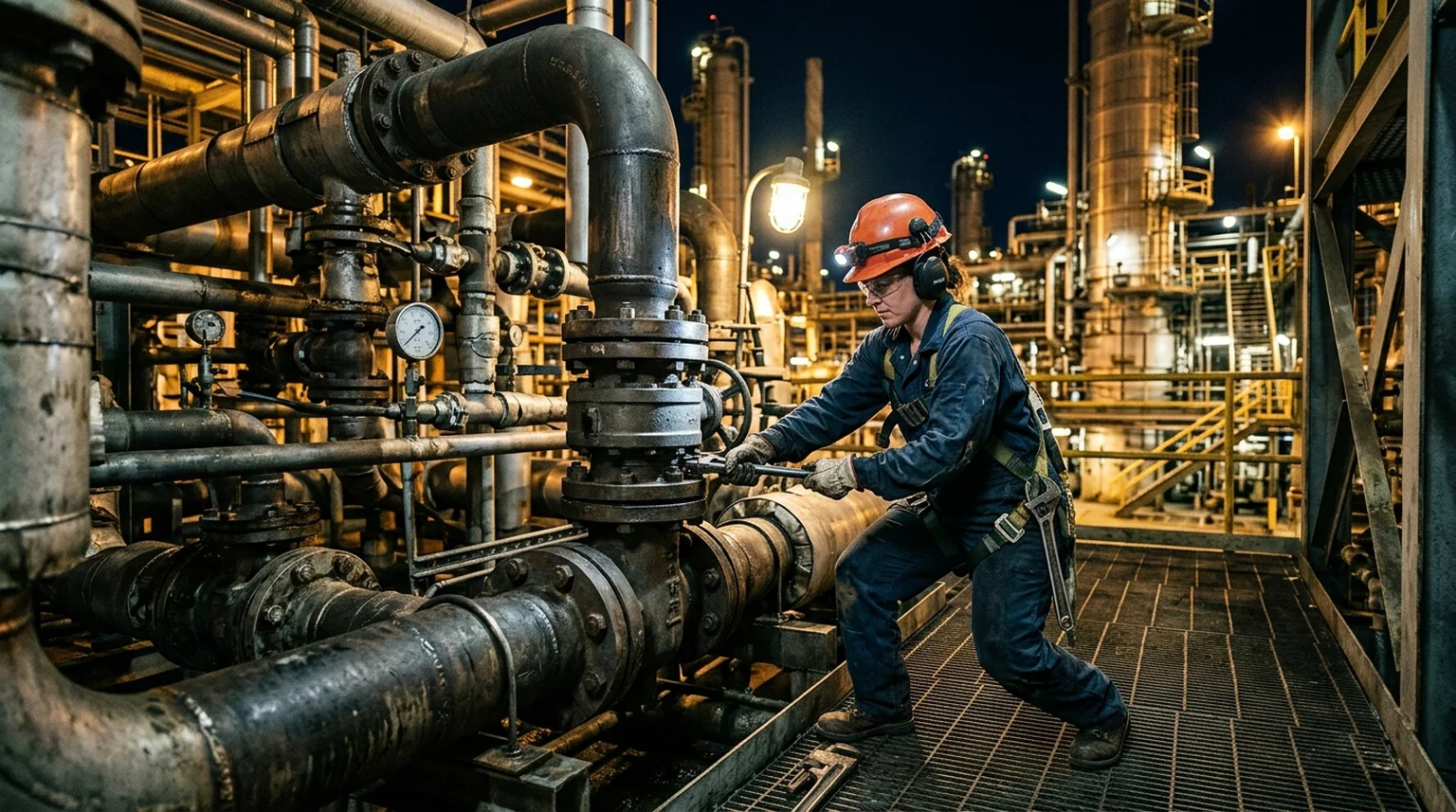

The schedule came in on a Monday: a refinery shutdown in Louisiana, starting Thursday. The crew had six weeks to replace a heat exchanger, reroute a section of high-pressure steam line, and install new isolation valves before the plant came back online. Every hour of delay cost the client tens of thousands of dollars.
The pipefitters on that job arrived with blueprints, precision measurement tools, and the kind of metallurgical knowledge most people associate with engineers. They cut and beveled stainless steel pipe, ran fit-up checks, coordinated with welders, and pressure-tested every joint before the system went back under load. By week five, the plant was ready to restart. By week six, the crew was on their way to the next job.
That’s what pipefitting actually looks like — not fixing a leaky bathroom faucet, but building and maintaining the critical pressure systems that keep refineries, power plants, manufacturing facilities, hospitals, and increasingly, data center cooling infrastructure, running.
It’s also one of the better-paying trades in the country, and one that most career advisors barely mention.
TL;DR
- Solid median wages: Plumbers, pipefitters, and steamfitters — reported together by BLS — earned a median $62,970/year in May 2024, with the highest 10% earning more than $105,150. Source: BLS Occupational Outlook Handbook.
- About 44,000 openings per year: BLS projects roughly 44,000 annual job openings from 2024–2034, driven largely by retirements replacing experienced workers. Source: BLS OOH.
- 5-year earn-while-you-learn apprenticeship: The United Association (UA) offers registered apprenticeships paying from day one — no tuition debt, with healthcare, retirement, and structured raises built in.
- LNG and data centers are creating new demand: INGAA reports North America needs a 39% increase in natural gas pipeline capacity by 2052, part of a $1 trillion midstream buildout — and that requires skilled pipefitters.
- The credential path is clear: UA apprenticeship or NCCER pipefitting certification through a trade school are both legitimate entry points. No four-year degree required.
What Is a Pipefitter? (And How Is That Different from a Plumber?)
The confusion is understandable. Both trades work with pipe. Both require licensing and apprenticeship training. But the work environments, materials, pressure tolerances, and job sites are fundamentally different.
A plumber installs and maintains water supply, drainage, and gas systems — the pipes in your walls, under your floors, and connecting your home to municipal water. The materials are typically copper, PVC, and ABS. The systems operate at relatively low pressure, and the work is usually residential or light commercial.
A pipefitter — sometimes called a steamfitter when the specialty involves high-temperature steam systems — works with the industrial-grade piping that moves steam, chemicals, compressed gases, hydraulic fluids, and process materials through power plants, refineries, factories, chemical plants, hospitals, and large commercial buildings. The materials are metals: carbon steel, stainless steel, chrome-moly alloy, nickel alloy. The systems operate under extreme pressure and temperature. The work is almost exclusively industrial or large commercial.
As Build Your Future describes it: pipefitters install and repair both high- and low-pressure pipe systems used in manufacturing, electricity generation, and the heating and cooling of buildings — working with durable pipe materials like metals that handle high-pressure substances. Plumbers, by contrast, mostly deal with water and water-based systems in residential and commercial settings.
The practical difference shows up in the skills: pipefitters are required to understand metallurgy, welding procedures, pressure testing, pipe stress analysis, and blueprint reading at a level of precision that reflects the stakes of their work. A joint failure on a residential supply line is a flood. A joint failure on a high-pressure steam line is a catastrophic event.
You can explore the career outlook for plumbers, pipefitters, and steamfitters on our site, and if you’re comparing this path to residential plumbing, our plumbing career guide covers that side in depth.
Why This Trade Is Growing
The pipefitting trade isn’t flashy, but the macro forces behind its demand are real and measurable.
LNG infrastructure. The United States has become the world’s largest exporter of liquefied natural gas, and that requires an enormous amount of industrial pipe systems — from wellhead gathering lines to the cryogenic systems at export terminals. In March 2026, INGAA (the Interstate Natural Gas Association of America) released a study finding that North America needs a 39% increase in natural gas transmission capacity by 2052 — roughly $1 trillion in midstream infrastructure, and it noted that member companies are seeing record levels of pipeline capacity inquiries not seen since the shale boom of 2010.
Data centers. AI and cloud computing expansion has produced a secondary demand effect: data centers require enormous amounts of power, much of it gas-fired, and the gas pipeline connecting them to the grid has to be built and maintained. INGAA’s analysis cited an additional 3.3 to 6 billion cubic feet per day of pipeline capacity potentially needed by 2030 just for data center demand.
Industrial maintenance. The existing base of refineries, power plants, and manufacturing facilities requires continuous pipefitting work — scheduled turnarounds, system upgrades, and code compliance retrofits. This is less cyclical than new construction and provides a steady base of employment even when major capital projects slow.
Aging workforce. BLS data shows that a substantial portion of the projected 44,000 annual openings is driven not by industry expansion but by retirements among an aging skilled trades workforce. Someone has to replace those workers, and it takes five years of apprenticeship to produce a journeyman pipefitter.
What the Work Actually Looks Like
Pipefitting is a physically demanding, technically precise trade that operates across several distinct work contexts.
Large-scale construction is what most people picture: massive job sites at refineries, power plants, LNG terminals, or industrial plants, where crews install new piping systems during plant construction. These projects can run for years and require hundreds of fitters working in a coordinated sequence.
Turnarounds and shutdowns are the condensed, high-intensity projects that happen when a facility goes offline for maintenance. A refinery might schedule a two-to-six week shutdown every few years. Pipefitters are brought in to inspect, repair, replace, and reconfigure systems under time pressure. The pay during these periods is often elevated, and the work is exhausting — but many experienced pipefitters prefer this rhythm of focused work and downtime.
HVAC and mechanical systems represent another segment of the trade, particularly for steamfitters. Large commercial buildings — hospitals, universities, sports arenas — use steam and hydronic heating systems that require specialized pipefitting skills to install and maintain. This work is closer to urban commercial construction than industrial site work.
Ongoing maintenance at facilities that run continuously — water treatment plants, paper mills, chemical facilities — provides a steadier schedule for pipefitters employed directly by those companies rather than by contractors.
The physical demands are significant. Pipefitters regularly work at heights, in confined spaces, in extreme temperatures, and with heavy materials. Pipe sections can weigh hundreds of pounds, and positioning them precisely requires teamwork, rigging skill, and spatial awareness. Some pipefitters travel extensively to follow work; others find steady local employment with a single company or union local. Both paths exist.
Pipefitter Pay: What to Expect
The BLS Occupational Outlook Handbook reports a median annual wage of $62,970 for plumbers, pipefitters, and steamfitters as of May 2024. That’s the midpoint across all three occupational groups and all stages of career, from apprentice to journeyman to foreman.
The range is wide. The lowest 10% earned below $40,670 — reflecting early-career workers still in apprenticeship. The highest 10% earned more than $105,150, typically journeyman pipefitters working in high-demand industrial markets, on premium overtime-heavy turnaround crews, or in union positions in high-cost metro areas.
Union membership plays a meaningful role in total compensation. BLS data from 2024 shows that across all occupations, nonunion workers earn roughly 85% of what union members earn in weekly wages — and in the skilled trades, that gap tends to be wider because union contracts also include pension contributions, health insurance, and paid apprenticeship training that nonunion workers often fund themselves.
Within the UA union system, journeyman pipefitters in industrial markets often earn between $40 and $60+ per hour in base wages, plus fringe benefits that can add 40–50% on top of that in effective total compensation. Those figures vary significantly by local market and project type.
A realistic progression looks like this:
- Apprentice (Year 1–2): Earning approximately 40–50% of journeyman scale while learning on the job
- Apprentice (Year 3–5): Wages ramp up in structured steps — typically 5–10% increases annually
- Journeyman: Full scale wages; eligible for foreman, general foreman, and superintendent roles with experience
- Experienced journeyman / foreman: Above-median wages, often $85,000–$120,000+ in active industrial markets
How to Become a Pipefitter
There are two main pathways, and both are legitimate depending on your goals and local opportunities.
The Union Apprenticeship Route
The most recognized path into industrial pipefitting is through the United Association of Plumbers and Steamfitters (UA), which represents pipefitters, plumbers, sprinkler fitters, and HVAC technicians across North America. The UA’s Registered Apprenticeship Program is a five-year program that combines paid on-the-job training with classroom instruction.
Requirements to apply are straightforward: at minimum 18 years of age, a high school diploma or GED, and the aptitude and willingness to learn a skilled trade. From day one of the apprenticeship, you’re employed and paid — wages start at a percentage of journeyman scale and increase each year as you demonstrate competency.
The UA’s steamfitters page describes the trade well: steamfitters are highly trained professionals who fabricate, install, maintain, and repair high-pressure systems that move steam, hot water, and other industrial fluids. The training covers pipefitting fundamentals, welding, blueprint reading, pressure testing procedures, and the metallurgical knowledge needed to work safely with high-pressure systems.
To apply, contact the local UA union hall for your area. Application periods vary by local — some open enrollment annually, others are continuous. Our guide to apprenticeships walks through the broader apprenticeship process if you’re new to how this path works.
The Trade School Route
If you don’t have immediate access to a union local’s apprenticeship program, or want to build foundational skills before applying, trade school pipefitting programs are a practical alternative. NCCER (National Center for Construction Education and Research) offers a structured pipefitting curriculum with stackable credentials — modules covering hand tools, power tools, pipe measurement and fabrication, blueprint reading, and welding fundamentals.
NCCER credentials are recognized industry-wide and can count toward apprenticeship hours in some union programs. They also make candidates more competitive for entry-level pipefitter helper roles that serve as on-ramps to full apprenticeships.
Our site’s pipefitting program directory lists trade schools offering pipefitting and sprinkler fitter programs if you want to compare options in your area.
Key Certifications
Beyond apprenticeship, journeyman pipefitters often pursue additional credentials:
- Welding certifications (ASME, AWS D1.1, D1.6) — critical for industrial pipefitting where pipe welds are X-rayed and pressure-tested
- OSHA 10 and OSHA 30 safety certifications — required on most industrial job sites
- Pipefitter foreman or supervisor credentials through UA or NCCER
- State journeyman license — requirements vary by state; some require a licensed exam after completing apprenticeship
Is This Trade Right for You?
Pipefitting suits a particular kind of person, and it’s worth being direct about both the advantages and the trade-offs.
You’ll likely thrive if you:
- Enjoy precision technical work and problem-solving in three-dimensional space
- Are comfortable working at heights, in tight spaces, and in outdoor industrial environments
- Like the idea of building things that matter — systems that heat hospitals, process fuel, generate power
- Can handle physical labor over long shifts without that being a dealbreaker
- Want to earn a living wage without spending four years in college and accumulating debt
Be honest with yourself if:
- You dislike travel — some pipefitting work, especially industrial turnaround work, requires being away from home for extended periods
- You have significant physical limitations — this is a demanding trade on your body over a long career
- You need schedule certainty — construction and industrial cycles mean layoffs happen, though union pipefitters typically have dispatch systems that help bridge gaps between jobs
- You’re looking for a career that transitions cleanly to a desk — pipefitting doesn’t naturally lead to office-based roles without additional education
The union structure of most industrial pipefitting work means there is a real support system: dispatch halls, healthcare through the union plan, pension contributions, and a peer network of journeymen who’ve navigated the same path. That matters for long-term career stability in a way that non-union trades work often doesn’t provide.
Getting Started
If this sounds like a fit, the practical next steps are:
- Contact your nearest UA local. Find it at ua.org. Ask about the next apprenticeship application cycle and what pre-qualifying steps look like.
- Explore NCCER programs nearby. The NCCER Find a Center tool locates accredited pipefitting programs in your state.
- Look at trade school options. Our pipefitting program directory lists schools offering formal pipefitting training.
- Consider the helper path. Entry-level helper roles on pipefitting crews give you practical exposure while you work toward full apprenticeship eligibility.
Pipefitting is a trade that rewards precision, physical capability, and willingness to keep learning. The pay is real, the demand is durable, and the barrier to entry — a high school diploma and the initiative to apply to an apprenticeship — is lower than most people expect.
Sources
- U.S. Bureau of Labor Statistics — “Plumbers, Pipefitters, and Steamfitters” — Occupational Outlook Handbook — May 2024 — https://www.bls.gov/ooh/construction-and-extraction/plumbers-pipefitters-and-steamfitters.htm
- U.S. Bureau of Labor Statistics — “Weekly earnings of nonunion workers were 85 percent of union members’ earnings in 2024” — The Economics Daily — 2025 — https://www.bls.gov/opub/ted/2025/weekly-earnings-of-nonunion-workers-were-85-percent-of-union-members-earnings-in-2024.htm
- United Association of Plumbers and Steamfitters — “UA Apprenticeship” — ua.org — https://ua.org/apprenticeship/
- United Association of Plumbers and Steamfitters — “Steamfitters” — ua.org — https://ua.org/steamfitters/
- Natural Gas Intelligence — “Natural Gas Pipeline Capacity Must Grow 39% as LNG, Data Center Demand Surge, INGAA Says” — March 2026 — https://naturalgasintel.com/news/natural-gas-pipeline-capacity-must-grow-39-as-lng-data-center-demand-surge-ingaa-says/
- Build Your Future — “Plumber vs. Pipefitter: What’s the Difference?” — byf.org — https://www.byf.org/plumber-vs-pipefitter-whats-the-difference/
- NCCER — “Pipefitting” — nccer.org — https://www.nccer.org/craft-catalog/pipefitting/