
The U.S. economy is projected to add 5.2 million jobs from 2024 to 2034, with total employment growing 3.1 percent over the decade, according to the BLS Employment Projections 2024–2034. That 3.1% is the benchmark. Every trade on this list beats it — most by a wide margin.
Choosing a trade based on growth projections is one of the smartest ways to future-proof a career decision. A trade with strong tailwinds doesn’t just mean more job openings when you graduate — it means better negotiating leverage, more employer competition for your skills, and a lower risk of the career stagnating under you.
This guide covers the 7 fastest-growing trade occupations using BLS 2024–2034 data. For each, we break down the growth rate, median wage, annual job openings, what training looks like, and what the honest trade-offs are.
How to Read These Numbers
Three figures matter most:
- Growth %: Projected change in total employment from 2024 to 2034. The national average is 3.1%.
- Openings/year: Average annual job openings, including both newly created positions and vacancies from retirements and career changes. This often tells more than the growth rate — a 50% growth rate on a small occupation can mean fewer total openings than 9% growth on a large one.
- Median wage: BLS May 2024 data. Half of workers in the occupation earn above this, half below.
With that in mind, here are the trades leading the projections.
#1 — Wind Turbine Technicians: +50% Growth
Wind turbine service technicians hold the title of fastest-growing occupation in the entire U.S. economy — not just among the trades. Employment is projected to grow 50 percent from 2024 to 2034, against a national average of 3.1%. The median annual wage was $62,580 in May 2024, with the top 10 percent earning above $88,090. About 2,300 openings are projected per year on average. Source: BLS OOH — Wind Turbine Technicians.
Why it’s growing: The ongoing buildout of onshore and offshore wind farms is creating new installation demand, while the existing fleet of turbines requires continuous inspection, maintenance, and repair. Demand for technicians compounds as the installed base grows.
Training: Typically a 2-year associate degree or technical certificate in wind energy technology. Some employers offer on-the-job pathways. Programs are available at community colleges in wind-heavy regions.
Honest trade-off: The job base is concentrated in rural and coastal areas where wind farms operate — relocation may be required. The work involves climbing turbines (heights up to 300 feet) and exposure to outdoor weather conditions. The openings count (~2,300/year) is smaller than some other trades on this list, so competition in certain regions can be real.
#2 — Solar Photovoltaic Installers: +42% Growth
Solar PV installers are the second fastest-growing occupation in the economy. Employment is projected to grow 42 percent from 2024 to 2034. The median annual wage was $51,860 in May 2024, with about 4,100 openings projected per year. Source: BLS OOH — Solar Photovoltaic Installers.
Why it’s growing: The cost of solar panels has fallen dramatically over the past decade, making residential and commercial installations increasingly affordable. Federal incentives have sustained and expanded demand across both sectors, with no signs of reversal in the near term.
Training: Entry requirements are lower than most construction trades. Many employers provide on-the-job training; short certificate programs (weeks to a few months) are available at trade schools and community colleges. Electrician crossover skills are valued for more complex installations.
Honest trade-off: Physically demanding outdoor work — roof installations in summer heat are the norm, not the exception. Income can be seasonal in colder climates. Median wage is the lowest of the construction trades on this list, though experienced installers and those with electrical credentials earn significantly more.
#3 — Home Health Aides: +17% Growth
Home health aides occupy a different corner of the trades landscape, but the numbers are too significant to leave out. Employment is projected to grow 17 percent from 2024 to 2034, with 765,800 openings projected per year — by a large margin the highest volume of any occupation on this list. Source: BLS OOH — Home Health and Personal Care Aides.
Why it’s growing: The Baby Boomer generation is aging into its peak years of care need. Long-term care is shifting from nursing homes toward home- and community-based settings, which directly increases demand for aides who work in clients’ homes.
Training: Short certificate programs, often completed in weeks. Some states require formal training through an approved program; others allow on-the-job training. Entry barriers are low.
Honest trade-off: The median annual wage is around $33,000 — significantly below the construction and energy trades. The work is physically and emotionally demanding. For students with interest in healthcare but limited time or funds to invest in training, this is a rapid entry point; however, medical assistant or surgical tech programs offer better long-term earning trajectories for a modest additional investment.
#4 — Medical Assistants: +12% Growth
Medical assistants are projected to grow 12 percent from 2024 to 2034 — four times the national average — with about 112,300 openings per year. Source: BLS OOH — Medical Assistants.
Why it’s growing: An aging population drives higher overall demand for healthcare services. Medical assistants handle both clinical tasks (taking vitals, drawing blood, assisting with procedures) and administrative functions, making them indispensable multipliers of physician productivity as patient volume grows.
Training: Certificate programs run roughly 9–12 months; associate degree programs take 2 years. Both pathways are available at community colleges and accredited trade schools. Certification through organizations like the AAMA (American Association of Medical Assistants) strengthens job prospects.
Honest trade-off: Median wages are in the mid-$40,000 range — solid for a 1–2 year credential, but lower than the skilled construction and energy trades. The work is entirely indoors and patient-facing, which suits many candidates and rules it out for others.
#5 — Electricians: +9% Growth
Electricians grow at 9 percent from 2024 to 2034 — three times the national average — but the headline number understates the opportunity. About 81,000 openings are projected per year, making electricians the highest-volume construction trade on this list by a wide margin. Median annual wage: $62,350 in May 2024. Source: BLS OOH — Electricians.
Why it’s growing: Multiple independent forces are pushing electrical demand simultaneously: the electrification of vehicles and transportation infrastructure, the clean energy buildout (solar and wind installations require electrical work), the AI and data center construction boom driving massive new power infrastructure, and the upgrade of an aging electrical grid. The Associated General Contractors of America reported in August 2025 that 92% of construction firms hiring struggle to find qualified craft workers, with the industry needing 439,000 new workers in 2025 alone.
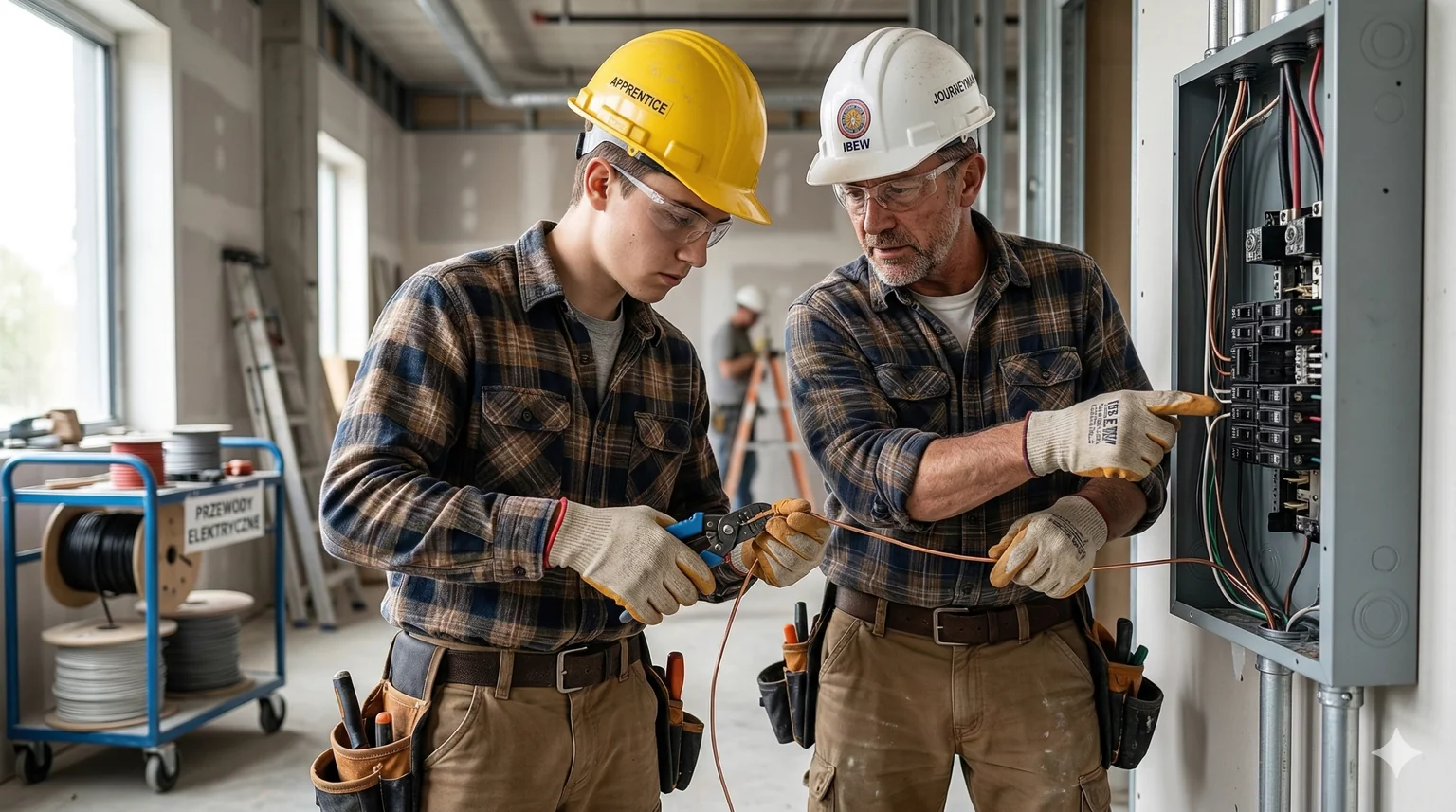
Training: The standard path is a 4–5 year registered apprenticeship (earn while you learn) or a 2-year trade school program followed by on-the-job experience. Journeyman licensure is required in most states. The investment is longer than most trades on this list, but the earning trajectory — journeyman electricians regularly exceed $80,000+ with experience and overtime — reflects it.
Honest trade-off: Longer training timeline than solar or HVAC. Physical and safety demands are real. The payoff in wage growth and job stability is among the strongest of any trade credential available.
#6 — HVAC Technicians: +8% Growth
Heating, air conditioning, and refrigeration mechanics and installers are projected to grow 8 percent from 2024 to 2034, with 40,100 openings per year and a median wage of $59,810 in May 2024. Source: BLS OOH — HVAC Technicians.
Why it’s growing: Green building standards are pushing wider adoption of heat pumps and energy-efficient systems, which require skilled installation and maintenance distinct from traditional HVAC work. Climate change is extending cooling seasons in many regions. The existing stock of commercial and residential systems requires ongoing maintenance regardless of economic conditions, giving HVAC a recession-resistant quality most trades share.
Training: Certificate programs of 6 months to 2 years are available at trade schools and community colleges. EPA Section 608 certification is required for handling refrigerants and is obtained separately. Apprenticeship pathways also exist.
Honest trade-off: Emergency and on-call service work is common — nights and weekends during peak heating and cooling season are part of the job for many technicians, particularly those in residential service roles. Physically demanding work in tight spaces (crawlspaces, attics, rooftops) is routine.
#7 — Plumbers: +4% Growth
Plumbers, pipefitters, and steamfitters grow at just 4 percent from 2024 to 2034 — roughly at the national average — with about 44,000 openings per year and a median wage of $59,880 in May 2024. Source: BLS OOH — Plumbers, Pipefitters, and Steamfitters.
The reason plumbing earns a place on this list despite modest growth: demand is consistently strong, retirement-driven openings are significant, and the shortage of qualified workers makes plumbing one of the highest-leverage trades for negotiating entry wages. Plumbers are needed in every new building and infrastructure project regardless of which sector is booming.
Training: 4–5 year apprenticeship is the standard path; trade school programs of 2 years combined with on-the-job experience are also common. Licensing requirements vary by state.
Side-by-Side Comparison
| Trade | Growth 2024–34 | Median Wage | Openings/Year | Training |
|---|---|---|---|---|
| Wind Turbine Technician | +50% | $62,580 | 2,300 | 2-yr certificate |
| Solar PV Installer | +42% | $51,860 | 4,100 | Weeks–months |
| Home Health Aide | +17% | ~$33,000 | 765,800 | Weeks |
| Medical Assistant | +12% | ~$44,000 | 112,300 | 1–2 years |
| Electrician | +9% | $62,350 | 81,000 | 4–5 yr apprenticeship |
| HVAC Technician | +8% | $59,810 | 40,100 | 6 months–2 years |
| Plumber | +4% | $59,880 | 44,000 | 4–5 yr apprenticeship |
Growth rates above the 3.1% national average signal trades where employer demand is outpacing labor supply — the conditions that push wages up and give workers negotiating power. Every trade on this list meets that bar.
How to Get Started
Growth projections are one input; your interests, working conditions, and timeline for earning matter just as much. Browse our programs directory to compare training options across trades, and check our Best Value college rankings to find accredited schools with strong job placement and reasonable cost.
Financing is often the first question. Our complete guide to financing trade school covers Pell Grants, apprenticeship wages, scholarships, and employer tuition assistance — most students can reduce or eliminate out-of-pocket costs by combining two or three of those sources.
The data is clear about where employers will be competing for workers over the next decade. The question is which of those opportunities fits you.
Sources
- U.S. Bureau of Labor Statistics — Employment Projections 2024–2034 Summary — https://www.bls.gov/news.release/ecopro.nr0.htm
- U.S. Bureau of Labor Statistics — OOH: Wind Turbine Technicians — May 2024 — https://www.bls.gov/ooh/installation-maintenance-and-repair/wind-turbine-technicians.htm
- U.S. Bureau of Labor Statistics — OOH: Solar Photovoltaic Installers — May 2024 — https://www.bls.gov/ooh/construction-and-extraction/solar-photovoltaic-installers.htm
- U.S. Bureau of Labor Statistics — OOH: Electricians — May 2024 — https://www.bls.gov/ooh/construction-and-extraction/electricians.htm
- U.S. Bureau of Labor Statistics — OOH: Heating, Air Conditioning, and Refrigeration Mechanics and Installers — May 2024 — https://www.bls.gov/ooh/installation-maintenance-and-repair/heating-air-conditioning-and-refrigeration-mechanics-and-installers.htm
- U.S. Bureau of Labor Statistics — OOH: Medical Assistants — May 2024 — https://www.bls.gov/ooh/healthcare/medical-assistants.htm
- U.S. Bureau of Labor Statistics — OOH: Home Health and Personal Care Aides — May 2024 — https://www.bls.gov/ooh/healthcare/home-health-aides-and-personal-care-aides.htm
- U.S. Bureau of Labor Statistics — OOH: Plumbers, Pipefitters, and Steamfitters — May 2024 — https://www.bls.gov/ooh/construction-and-extraction/plumbers-pipefitters-and-steamfitters.htm
- Associated General Contractors of America — “Construction Workforce Shortages Are Leading Cause of Project Delays” — August 2025 — https://www.agc.org/news/2025/08/28/construction-workforce-shortages-are-leading-cause-project-delays-immigration-enforcement-affects