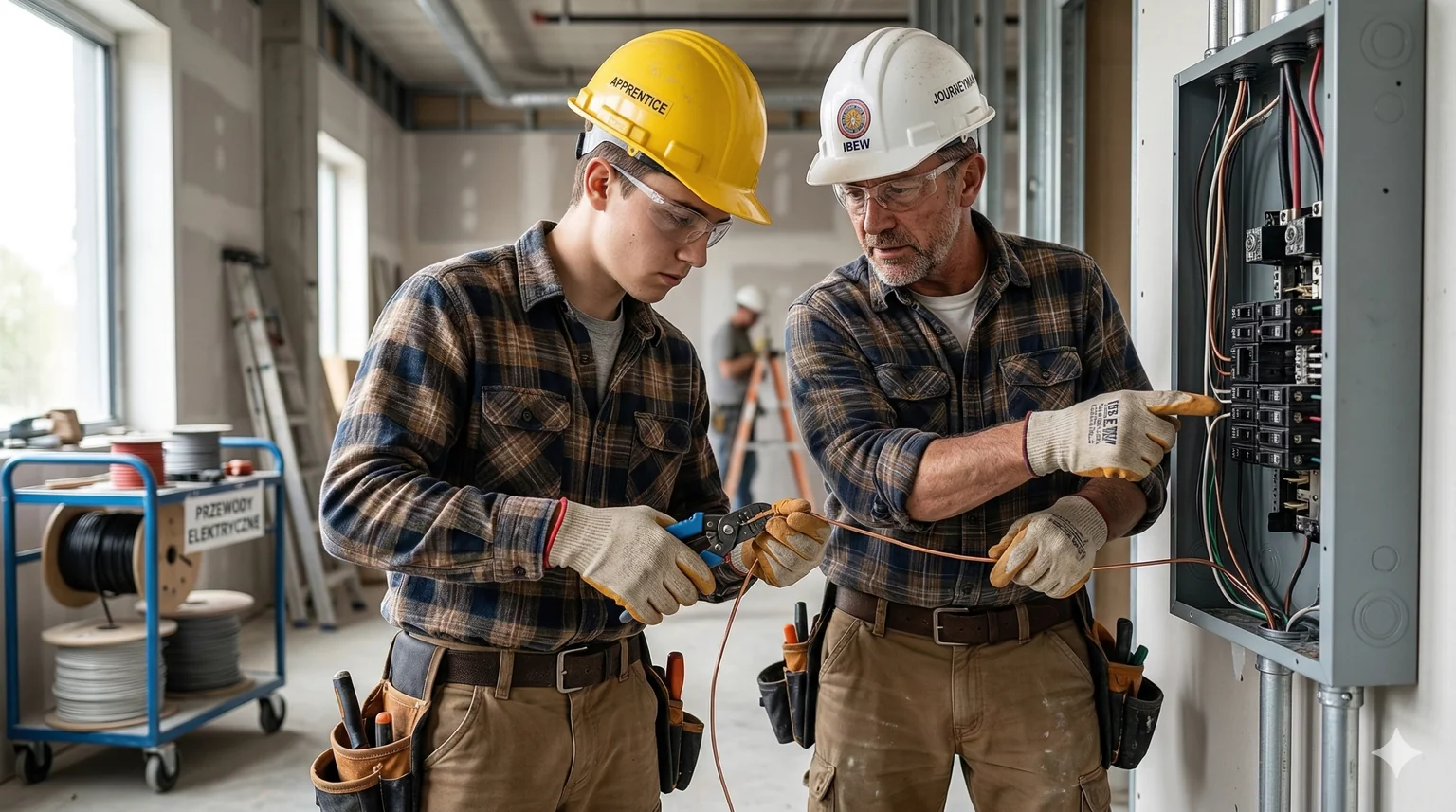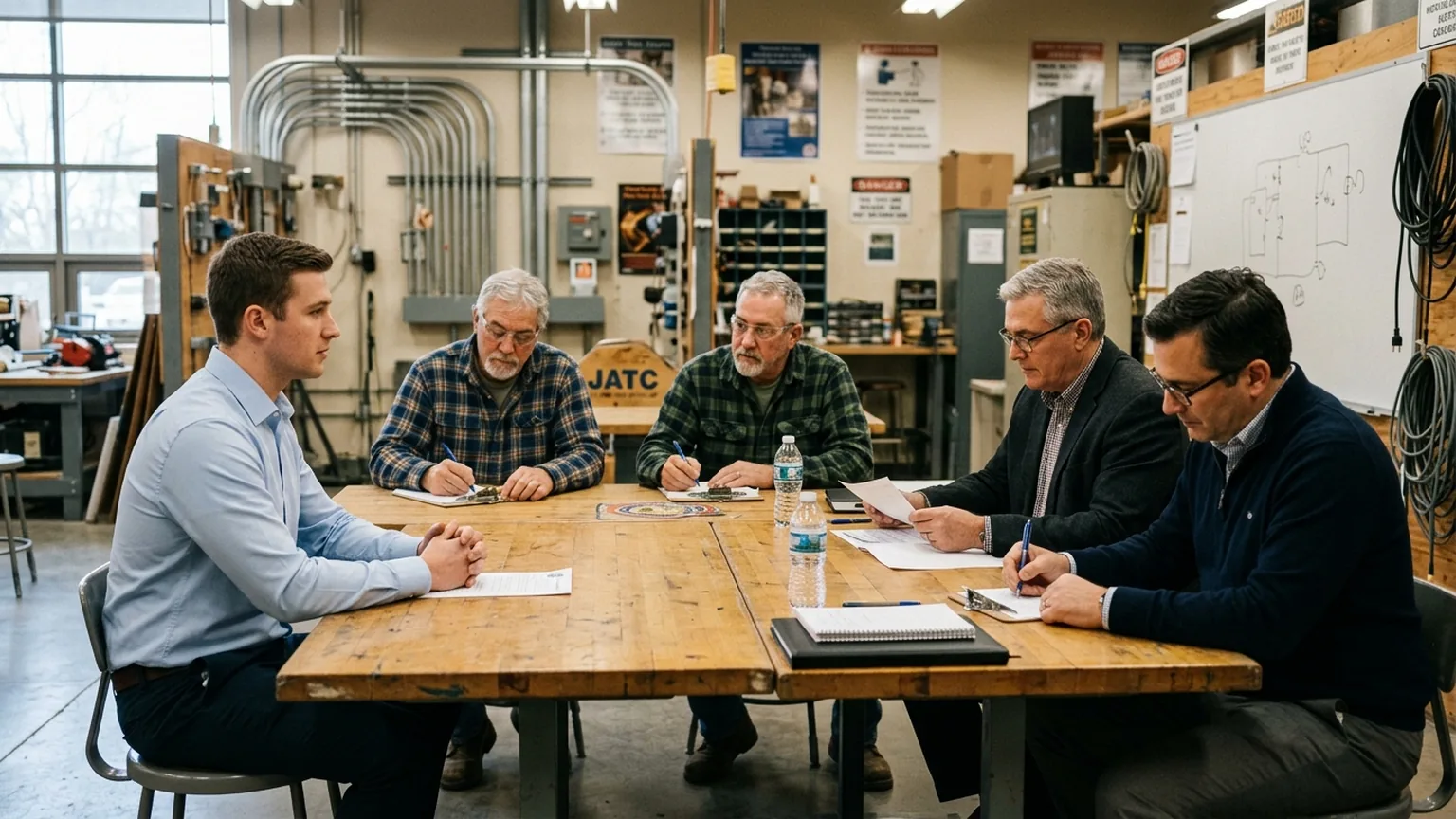

There are four union programs that will take you from active duty into a registered apprenticeship without a trade school in between. All four are free. Three of them start while you are still in uniform.
Most veteran trade-school advice is really benefits advice — how the GI Bill pays, what the housing allowance covers. That is worth understanding, and we cover it separately in using the GI Bill for trade school and veterans and trade school. This guide is about the other half: the pipelines themselves, what your MOS actually buys you, and the parts of the transition that surprise people.
The Four Direct-Entry Pipelines
| Program | Trades | Length | Where it runs | What you get |
|---|---|---|---|---|
| Helmets to Hardhats | All building trades | Rolling — no fixed course | Nationwide, online intake | Matched to a participating local’s apprenticeship |
| IBEW VEEP | Electrical | 6 months, full time | Select bases | Pre-apprenticeship credited toward an IBEW apprenticeship |
| UA VIP | Pipefitting, welding, HVAC-R, sprinkler fitting | 18 weeks | 6 military installations | Guaranteed interview with a UA local on completion |
| SMART Heroes | Sheet metal | 7 weeks | Select bases | Direct pathway into a SMART local’s apprenticeship |
Helmets to Hardhats — the widest net
Run by North America’s Building Trades Unions, Helmets to Hardhats is the umbrella intake for union construction apprenticeships across carpentry, electrical, plumbing, ironwork, masonry, operating engineers, sheet metal, and sprinkler fitting. You build a profile, set trade and geographic preferences, and the program routes you to participating locals. It has placed more than 50,000 veterans since 2003.
It is also the front door to the other three: register here first and the specialist programs surface through it. Use it if you don’t yet know which trade you want.
IBEW VEEP — the most apprenticeship credit
The Veterans Electrical Entry Program, run by the electrical training ALLIANCE (IBEW and NECA), is a six-month full-time pre-apprenticeship during your transition window. Completion is a direct pathway into an IBEW apprenticeship, with the pre-apprenticeship credited toward it — you finish your indenture sooner than someone who walked in off the street.
Confirm the exact credit with the local you’re applying to. Credit policies are set locally and vary.
UA VIP — the shortest path to an interview
UA Veterans in Piping is 18 weeks, delivered free on six military installations by the United Association, covering pipefitting, welding, HVAC-R, and sprinkler fitting. Graduates get a guaranteed interview with a UA local.
Note the precise claim: a guaranteed interview, not a guaranteed job. That distinction matters and some secondhand write-ups blur it. In practice UA VIP graduates place at high rates, but you are still interviewing.
SMART Heroes — sheet metal, seven weeks
The sheet metal workers’ program is the shortest of the four and the least publicised. Same structure: free, on-base, during transition, feeding a SMART local’s apprenticeship. If sheet metal, HVAC ductwork, or architectural metal appeals, this is the fastest of the four routes.
Requirement common to VEEP, UA VIP, and SMART Heroes: you generally need to be on active duty within your transition window when the course runs. Helmets to Hardhats is the fallback if you have already separated.
What Your MOS Actually Transfers
The honest answer: experience, not time. A crosswalk shortens your learning curve. It rarely shortens the apprenticeship.
Run your MOS through the DOD COOL portal — it maps military occupations to the civilian credentials each state recognises. The trades where military experience carries the most weight:
| Trade | Common source MOS/rating | Median wage (BLS, May 2024) |
|---|---|---|
| Electrician | 12R, 3E1X1 | $62,350 |
| Plumber / pipefitter | 12K, UT | $62,970 |
| HVAC technician | 12K, 3E1X1, UT | $59,810 |
| Welder | HT (Hull Maintenance), 91E | $51,000 |
| Sheet metal worker | 2A7X3, aviation structural | $60,850 |
| Diesel technician | 91B, 3521 | $60,640 |
| Heavy truck driver | 88M, 3531 | $57,440 |
| Construction / building inspector | 12-series, Seabee ratings | $72,120 |
| Electrical power-line installer | 12P, 3E0X2 | $92,560 |
| Elevator installer / repairer | any electromechanical rating | $106,580 |
Wages are Bureau of Labor Statistics Occupational Employment and Wage Statistics national cross-industry medians for all workers, May 2024 — not entry wages. Apprentices typically start at 40–60% of journeyman scale and step up annually.
The top line in that table is worth a closer look if you hold an electromechanical rating: our elevator installer career guide covers how IUEC ranks military experience in the application, since the trade is entered through a competitive union apprenticeship rather than a school program.
The one place your service does cut real time
CDL. Most states honour the FMCSA Military Skills Test Waiver for service members and recent veterans who operated comparable vehicles in their MOS. You skip the skills test. This is the cleanest transfer in the trades, and it’s time-limited — apply within the window after separation.
Where it doesn’t
- Electrician and plumber licensing is state-issued and hour-documented. A 12R still serves an apprenticeship; the experience makes you a faster, better-paid apprentice, not a shorter one. Some states have explicit veteran credit policies — check your state’s board, don’t assume.
- HVAC requires EPA Section 608 certification. Veterans with HVAC experience typically pass without formal coursework, but contractor licensing is separate and varies by state.
Assume you will document hours, sit state exams, and meet the same licensing bar as everyone else. Service shortens the path; it does not remove the gate.
The Rank-to-Apprentice Adjustment
This is the part that derails transitions, and it appears in no recruitment material.
You will go from E-5, E-6, or O-3 to first-year apprentice. A journeyman who has never deployed will tell you what to do, when to break, and how to hold a tool you used in service. You will sweep, run material, and be last in line for the high-skill work. If you had specialty pay or BAH at a high-cost station, the first-year pay drop can be real.
What separates the veterans who finish from the ones who quit in year one is entirely framing. “I am acquiring a skill that makes me employable in any region of this country within four years” works. “I outranked the kid telling me what to do” does not. Both are true; only one gets you to journeyman scale.
Three practical adjustments:
- Take the aptitude test seriously. Many locals rank applicants partly on it. Our apprenticeship aptitude test prep guide covers the common formats.
- Don’t lead with rank. Mention service when asked. On a job site, skill on the tools earns standing faster than a military bio.
- Find the veterans in your local. Most have a veterans’ committee or an informal network. They have made this exact adjustment and will shortcut months of friction.
Your Last Twelve Months in Uniform
12+ months out — pick the trade. Run DOD COOL for your MOS. If two or three trades fit, visit a training centre — most locals will host you if you call ahead. Decide before you apply to a program; the programs are trade-specific.
9–12 months out — apply. Register with Helmets to Hardhats regardless, then apply to VEEP, UA VIP, or SMART Heroes if your trade matches. Application windows for the on-base programs are tied to your transition timeline, so late application is the most common way people miss them.
6 months out — start the course, or start SkillBridge. If you’re in VEEP, that’s your six months. If you didn’t land a program slot, DOD SkillBridge lets you intern with a civilian employer during your final 180 days while still drawing military pay — and many trade contractors and union locals participate.
90 days out — line up the indenture. Confirm your apprenticeship start date with the local. Many can indenture you within weeks of separation if the paperwork is ready. This is also when you handle VA education paperwork — see using the GI Bill for trade school for that sequence.
After separation — document everything. Every certification, every hour, every class. It compounds into your journeyman licence application, and reconstructing it two years later is miserable.
Veteran Hiring Preference: Where It Actually Moves the Needle
Federal contractors holding contracts over $150,000 must take affirmative action to employ qualified veterans under VEVRAA. In the trades that means large commercial builders on federal work, utility contractors, and defence facility maintenance contractors. State and municipal employers — building inspectors, public works trades, transit authority technicians — often grant explicit preference points on hiring exams.
It is not a guarantee and it does not substitute for the credential. Applied at the margin between two comparable candidates, it moves decisions consistently. Make your veteran status and any disability rating explicit in your application, and file the SF-15 for federal roles.
Where to Look Next on This Site
Apprenticeships by state and trade — registered apprenticeship sponsors and pay for each trade in your state. If you already know where you’re settling, start here: Texas electrician, Virginia HVAC, Florida ironwork, Georgia welding.
Trade schools by city — many veterans settle near their last duty station, and the big military metros are strong trade-school markets: Virginia Beach, Norfolk, Fayetteville, Colorado Springs, San Antonio.
Compare schools — if you go the trade-school route instead of an apprenticeship, compare on cost, completion, and outcomes. Confirm any school appears in the VA GI Bill Comparison Tool before you enrol.
Sources
- Helmets to Hardhats / North America’s Building Trades Unions — “About Helmets to Hardhats” (50,000+ veteran placements since 2003) — https://helmetstohardhats.org/ and https://nabtu.org/helmets-to-hardhats/
- Electrical Training ALLIANCE / IBEW — “Introducing the Veteran’s Electrical Entry Program” — https://in2veep.com/introducing-the-veterans-electrical-entry-program/
- United Association — “Programs for Veterans” (UA VIP: 18 weeks, six sites, guaranteed local interview) — https://ua.org/career-paths/programs-for-veterans/
- DOD SkillBridge Program, Office of the Secretary of Defense — “Program Overview” — https://skillbridge.osd.mil/program-overview.htm
- Federal Motor Carrier Safety Administration — “Military Skills Test Waiver” — https://www.fmcsa.dot.gov/registration/commercial-drivers-license/military-skills-test-waiver
- U.S. Department of Defense — “Credentialing Opportunities On-Line (COOL)” — https://www.cool.osd.mil/
- U.S. Department of Labor, Office of Federal Contract Compliance Programs — “Vietnam Era Veterans’ Readjustment Assistance Act (VEVRAA)” — https://www.dol.gov/agencies/ofccp/vevraa
- U.S. Bureau of Labor Statistics — “Occupational Employment and Wage Statistics, National, May 2024” — national cross-industry median wages for the occupations in the MOS table — https://www.bls.gov/oes/current/oes_nat.htm