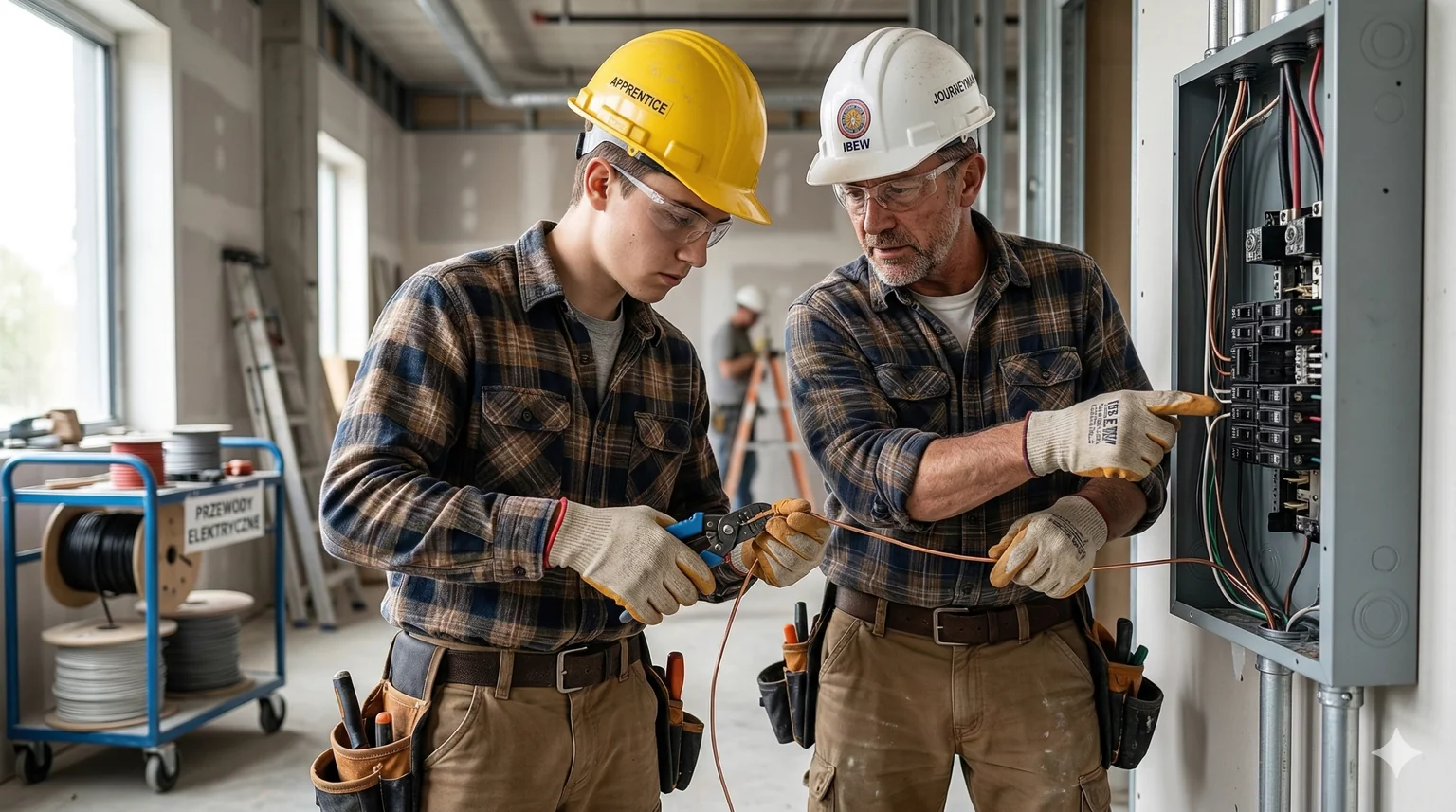

In the skilled trades, what you can prove you know matters just as much as what you actually know. Certifications and licenses are the proof — standardized, portable, and recognized across employers and state lines. And the data backs up their value: according to the Bureau of Labor Statistics, workers with professional certifications or licenses earn roughly 35% more than those without them. The unemployment rate gap is just as striking — 2.5% for certified and licensed workers compared to 5.6% for those holding neither credential.
Whether you are just starting to explore a trade career, currently enrolled in a training program, or already working in the field and looking to advance, this guide breaks down the most important certifications across the major trades. For each one, you will find what it costs, how long it takes, whether it is legally required or voluntarily pursued, and how it fits into your broader career plan.
Why Certifications Matter More Than You Think
The wage and employment advantages of holding a certification are well documented. The BLS Monthly Labor Review found that certified and licensed workers had a median weekly earnings advantage of several hundred dollars over their uncredentialed peers, even within the same occupation. That premium compounds over a career.
But earnings are only part of the picture. Certifications serve three distinct purposes in the trades:
Legal requirements. Some certifications are not optional. You cannot legally handle refrigerants without an EPA Section 608 card. Most states require electricians and plumbers to pass licensing exams. Working on certain construction sites without OSHA training can get both you and your employer fined.
Employer expectations. Even when a certification is not legally mandated, many employers treat it as a baseline hiring requirement. An HVAC company may not be legally obligated to hire only NATE-certified technicians, but in a competitive labor market, that credential often separates the candidates who get callbacks from those who do not.
Career portability. Unlike a reference from a former boss or an internal training program, nationally recognized certifications travel with you. If you move to a new state, switch employers, or pivot within your trade, your credentials remain valid. This portability is especially valuable in construction, where workers frequently move between projects and companies.
If you are still weighing your options for entering a trade, our guide to choosing the right trade program covers how to evaluate training programs — and the certifications those programs prepare you for should be a key factor in your decision.
Safety Certifications Every Trade Worker Should Know
OSHA 10-Hour and 30-Hour
The Occupational Safety and Health Administration’s Outreach Training Program is the most widely recognized safety credential across the trades. There are two levels:
- OSHA 10-Hour is designed for entry-level workers. It covers fundamental hazard recognition — fall protection, electrical safety, personal protective equipment, and common workplace dangers specific to either general industry or construction.
- OSHA 30-Hour is intended for supervisors, foremen, and workers with safety responsibilities. It dives deeper into OSHA standards, workplace inspections, and employer obligations.
The cost ranges from about $100 to $500 depending on the provider and format. Many trade school programs include OSHA 10 training as part of their curriculum, so check whether yours does before paying separately.
One important detail: OSHA cards do not expire. Once you complete the training, your card is valid indefinitely. However, some employers and states require periodic refresher training. New York and Connecticut, for example, mandate OSHA 10-Hour completion for construction workers on public projects. Even where it is not legally required, having that card in your wallet removes a common barrier during the hiring process.
First Aid and CPR
While not a trade certification per se, current First Aid/CPR certification from the American Red Cross or American Heart Association is a near-universal employer expectation on job sites. Many apprenticeship programs require it as a condition of enrollment. The training takes a single day, costs $50 to $100, and certifications are valid for two years. Consider it a checkbox credential — easy to get, awkward to lack.
HVAC and Refrigeration Certifications
EPA Section 608
If you plan to work with refrigerants in any capacity — installing, maintaining, or repairing air conditioning, heat pump, or refrigeration systems — you are legally required to hold EPA Section 608 certification under the Clean Air Act. There are no exceptions for entry-level workers or apprentices working under supervision. If you touch refrigerants, you need the card.
The certification comes in four types:
- Type I — Small appliances (5 pounds of refrigerant or less)
- Type II — High-pressure equipment (most residential and commercial AC systems)
- Type III — Low-pressure equipment (large commercial chillers)
- Universal — All of the above
Most technicians pursuing a career in HVAC should aim directly for the Universal certification. The exam covers refrigerant handling, leak detection, recovery procedures, and environmental regulations. Testing fees range from $20 to $300 depending on the testing organization. Once earned, the certification does not expire and never needs renewal.
Many HVAC trade programs include EPA 608 preparation and testing as part of their curriculum. This is one of the key things to look for when evaluating programs.
NATE Certification
The North American Technician Excellence certification is the leading voluntary credential for HVAC technicians. Unlike the EPA 608, NATE is not legally required — but it carries significant weight with employers and consumers. NATE-certified technicians demonstrate tested competence in specific areas such as air conditioning installation, heat pump service, gas furnace installation, or air distribution.
The exams require a minimum score of 70% to pass. Certification is valid for two years, and renewal requires completing 16 continuing education units (CEUs). Exam fees vary by specialty but generally run $150 to $250 per test. For technicians looking to distinguish themselves in a competitive HVAC job market, NATE certification is one of the most recognized ways to do it.
Construction and Building Trades Certifications
NCCER Credentials
The National Center for Construction Education and Research offers standardized credentials across more than 40 craft areas — from electrical and plumbing to ironworking, pipefitting, and heavy equipment operation. What makes NCCER distinctive is its scale and portability: over 1,000 accredited training organizations deliver the curriculum, and all credentials are tracked in NCCER’s national registry.
NCCER credentials are competency-based and aligned with Department of Labor apprenticeship standards. When you complete a level of NCCER training, your achievement is recorded in a portable database that any employer or training provider can verify. This system eliminates the common frustration of starting over when you move to a new employer or state.
Most workers encounter NCCER through their trade school or apprenticeship program rather than pursuing it independently. When evaluating training programs, check whether they are NCCER-accredited — it is a reliable indicator of curriculum quality and gives your credential immediate national recognition.
State Licensing for Electricians and Plumbers
Unlike certifications, which are generally voluntary credentials awarded by industry organizations, state licenses are legal authorizations to practice. Most states require electricians and plumbers to hold a state-issued license before they can work independently.
Licensing requirements vary significantly by state but typically include:
- Completion of an approved training program or apprenticeship
- A minimum number of supervised work hours (often 4,000 to 8,000 hours, or roughly 2 to 4 years)
- Passing a written exam covering code knowledge, safety, and trade theory
- Ongoing continuing education for license renewal
For aspiring electricians, the typical progression is apprentice license, then journeyman license, then master electrician license. Each level expands the scope of work you can legally perform. Plumbers follow a similar ladder.
The key takeaway: research your specific state’s requirements early. Knowing the licensing path helps you choose the right training program and avoid delays in getting your career started.
Automotive and Diesel Certifications
ASE Certification
The National Institute for Automotive Service Excellence is the gold standard for automotive technicians. ASE offers 52 individual certification tests spanning automobile, medium/heavy truck, collision repair, transit bus, school bus, and advanced engine performance categories.
Here is what you need to know about pursuing ASE certification:
- Cost: $62 per test plus a one-time $34 registration fee, bringing your first test to $96. Subsequent tests in the same registration window are $62 each.
- Prerequisites: Two years of relevant hands-on work experience, or one year of experience plus a two-year degree from an accredited program. This means most technicians pursue ASE certification after completing their training and gaining some shop time — not before.
- Validity: Each certification is valid for 5 years. Recertification requires passing an updated exam.
- Master Technician: Passing all tests in a given series (for example, all 8 automobile tests) earns ASE Master Technician status — a designation that commands premium pay at most dealerships and independent shops.
ASE certifications are voluntary, but the market has made them effectively mandatory for anyone seeking employment at dealerships, fleet operations, or well-established independent shops. Many employers offer pay increases tied directly to the number of ASE certifications a technician holds.
Welding Certifications
AWS Certified Welder Program
The American Welding Society’s Certified Welder (CW) program is a performance-based credential — meaning it is evaluated entirely through hands-on welding tests rather than written exams. You demonstrate your ability to produce quality welds according to specific codes and standards, and your work is examined and graded by certified inspectors.
The CW program is flexible in that you test to specific welding processes (SMAW, GMAW, GTAW, FCAW), positions, and materials. Each test qualification is tied to the code or standard you tested under. This makes the credential directly applicable to your work — employers can see exactly what processes and positions you are qualified for.
Testing is available at AWS Accredited Test Facilities nationwide. Costs vary by facility and the specific tests you take. For students currently enrolled in welding programs, many trade schools serve as accredited test facilities, allowing you to test as part of your training.
AWS Certified Welding Inspector (CWI)
The Certified Welding Inspector credential represents a significant step up in both requirements and career impact. CWIs oversee welding operations, inspect finished welds, and ensure compliance with applicable codes. It is a supervisory-level credential that opens doors to higher-paying positions in quality control, construction inspection, and manufacturing oversight.
The CWI exam has three parts: a fundamentals exam, a practical exam, and a code-specific exam. AWS offers a preparatory seminar that, combined with the exam, costs between $3,970 and $5,100 depending on the format and code book selected. The certification is valid for 9 years (with a renewal at the 3-year mark requiring continuing education or professional development points).
Prerequisites include a combination of education and welding-related work experience. For someone with a high school diploma, 5 years of welding experience is required. A two-year degree in welding technology reduces the experience requirement.
For those interested in the broader welding career landscape, the CWI is consistently cited as one of the highest-return credentials in the trades.
IT and Technology Trade Certifications
The skilled trades increasingly overlap with information technology. Building automation systems, industrial controls, security installations, and telecommunications infrastructure all require technicians who are comfortable with both physical systems and digital networks.
CompTIA A+
CompTIA A+ is the entry-level benchmark for IT support and technical troubleshooting. It validates foundational skills in hardware, software, networking, and security — the baseline knowledge expected of anyone servicing or installing technology systems.
- Cost: $506 total (two required exams at $253 each)
- Prerequisites: None, though CompTIA recommends 9 to 12 months of hands-on experience
- Validity: 3 years, renewable through continuing education or passing the current exam
CompTIA A+ is particularly relevant for trade workers entering fields that bridge physical and digital infrastructure — security system installation, building automation, industrial networking, and telecommunications.
CompTIA Network+ and Security+
For technicians moving deeper into technology roles, CompTIA’s next-level certifications map directly to higher-paying positions:
- Network+ holders working in network support earn a median salary of approximately $68,000, while those advancing to systems administration roles reach median salaries around $90,000.
- Security+ is the entry point for cybersecurity careers, where median salaries reach approximately $112,000 for information security analyst positions.
Each exam costs $253 and requires renewal every 3 years. These certifications are particularly valuable for trade professionals looking to specialize in smart building technology, industrial control systems, or infrastructure security.
How to Choose Which Certifications to Pursue
With dozens of credentials available, the practical question is not which certifications exist but which ones deserve your time and money right now. Here is a framework for deciding:
Start with legal requirements. If your trade requires a license or certification to practice — EPA 608 for HVAC, state licensing for electricians and plumbers — those come first. No amount of voluntary credentials matters if you cannot legally do the work.
Check employer expectations in your market. Before investing in a voluntary certification, look at job postings in your area. If 80% of HVAC job listings mention NATE certification, that tells you the local market values it. If automotive shops in your region specifically advertise ASE-certified technicians, that credential will directly affect your employability.
Match credentials to your career stage. Entry-level workers benefit most from foundational certifications (OSHA 10, EPA 608, CompTIA A+) that remove hiring barriers. Mid-career technicians gain more from specialty certifications (NATE, ASE Master, AWS CW) that command pay premiums. Those aiming for supervisory roles should target advanced credentials (OSHA 30, AWS CWI, master electrician license).
Calculate the return on investment. A $96 ASE test that leads to a $2/hour raise pays for itself in a single week. A $5,000 CWI seminar and exam that qualifies you for inspection roles paying $15-$20/hour more pays for itself in a few months. Compare the cost and time investment against the realistic earning increase in your specific market.
Leverage your training program. Many trade schools and apprenticeship programs include certification preparation and testing as part of their curriculum. If your program offers NCCER credentials, OSHA training, or EPA 608 testing, take full advantage — these are effectively free certifications bundled with your tuition. Our guide to choosing the right trade program covers how to evaluate these inclusions.
Quick-Reference Certification Summary
| Certification | Typical Cost | Time to Complete | Validity | Required or Voluntary |
|---|---|---|---|---|
| OSHA 10-Hour | $100 - $500 | 10 hours | No expiration | Required in some states |
| OSHA 30-Hour | $100 - $500 | 30 hours | No expiration | Required for some supervisory roles |
| First Aid/CPR | $50 - $100 | 1 day | 2 years | Voluntary (widely expected) |
| EPA Section 608 | $20 - $300 | 1 exam session | No expiration | Legally required |
| NATE (HVAC) | $150 - $250 per test | Varies by specialty | 2 years | Voluntary |
| NCCER Credentials | Included in training | Program duration | No expiration | Voluntary (industry standard) |
| State Electrician License | Varies by state | 2 - 4 years supervised work | Renewal required | Legally required |
| State Plumber License | Varies by state | 2 - 4 years supervised work | Renewal required | Legally required |
| ASE (Automotive) | $96 first test, $62 additional | 1 exam session per test | 5 years | Voluntary (effectively expected) |
| AWS Certified Welder | Varies by facility | 1 test session | Varies by code | Voluntary |
| AWS CWI | $3,970 - $5,100 | 1 - 2 weeks (seminar + exam) | 9 years | Voluntary |
| CompTIA A+ | $506 (2 exams) | Self-paced study | 3 years | Voluntary |
| CompTIA Network+ | $253 | Self-paced study | 3 years | Voluntary |
| CompTIA Security+ | $253 | Self-paced study | 3 years | Voluntary |
Sources
- Bureau of Labor Statistics — “Professional Certifications and Occupational Licenses: Evidence from the Current Population Survey” — https://www.bls.gov/opub/mlr/2019/article/professional-certifications-and-occupational-licenses.htm
- OSHA — “Outreach Training Program” — https://www.osha.gov/training/outreach
- EPA — “Section 608 Technician Certification Requirements” — https://www.epa.gov/section608/section-608-technician-certification-requirements
- NATE — “Certificates and Certification Exams” — https://natex.org/technician/take-an-exam/nate-certificates-and-certification-exams
- NCCER — “Credentials and Certifications” — https://www.nccer.org/credentials-certifications/
- ASE — “Certification Tests” — https://www.ase.com/ase-certification-tests
- AWS — “Certified Welder Program” — https://www.aws.org/certification-and-education/professional-certification/certified-welder-program/
- CompTIA — “A+ Certification” — https://www.comptia.org/en-us/certifications/a/