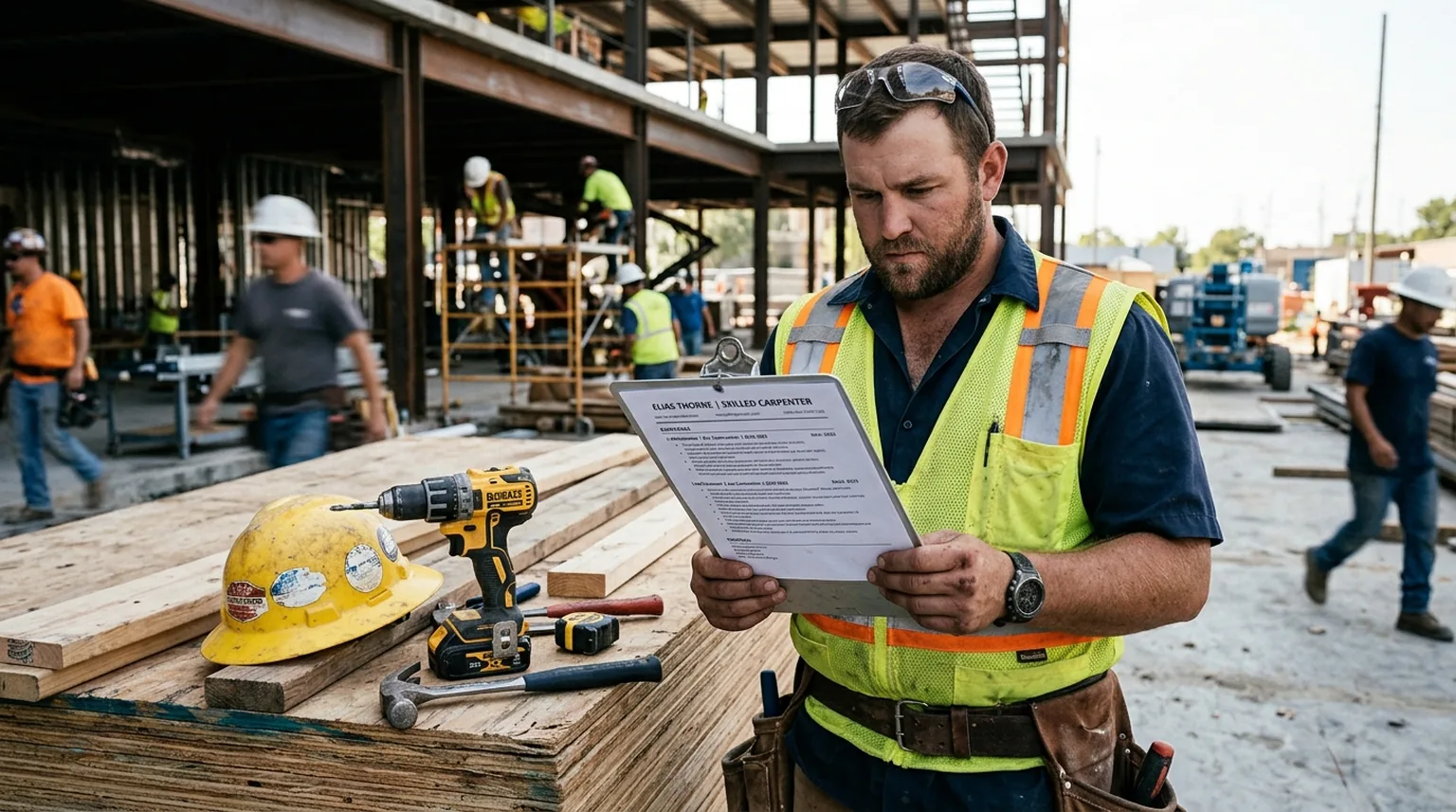

A trade résumé is not a white-collar résumé with the suits-and-ties replaced by hard hats. The structure is different, the keywords are different, and the things employers read first are different. A general-purpose résumé that lists “responsible for various tasks” alongside a high-school diploma will lose to a one-page document that opens with three current cards and a list of specific tools mastered.
This guide covers exactly what to put on a trade résumé to get callbacks for apprenticeships, journeyman positions, and contractor jobs — the right structure, the right certifications section, how to write tool-specific bullets, and the cover-letter format that JATCs and hiring contractors actually read.
Why a Trade Résumé Is Different
White-collar résumés follow an unwritten formula: education first or near-first, job titles with bullet points emphasizing scope and impact, soft skills sprinkled throughout. The implicit signal is “I have a degree from X and I’ve done jobs like the one you’re hiring for.”
Trade hiring runs on a different signal stack. Per Northeast Technical Institute’s analysis of trade résumés, “in trade professions, formal certifications and licenses often carry more weight than traditional education.” Hiring managers — especially Joint Apprenticeship Training Committees (JATCs) and small contractors — scan for three things in roughly this order:
- Cards in your wallet today (current OSHA 10/30, NCCER, state journeyman license, EPA 608, AWS, MSHA, CDL, etc.)
- Documented hours and where you worked (apprenticeship hours, supervised OJT, contractor names)
- Specific equipment you’ve operated and tasks you’ve performed (not “did electrical work” — “ran 1,200 ft of EMT, terminated three 200-amp panels, troubleshot motor controls under journeyman supervision”)
Match this order on the page, and you’ll get more callbacks. Bury it under a generic “Objective” paragraph and you won’t.
For the longer-form companion to a résumé — project documentation, photos, references, and digital badges — see our guide on how to build a trade career portfolio.
The Right Structure for a Trade Résumé
A one-page trade résumé in this order:
- Contact info — name, phone, email, city/state. No street address needed.
- Headline — one line: “Pre-Apprentice Electrician — OSHA 10, NCCER Core, 800 hrs OJT” or “Journeyman Welder — AWS D1.1, 6G TIG Certified”. Skip the “Objective” paragraph.
- Certifications & Licenses — the most important section. Cards, expiration dates, card numbers if you have them.
- Experience — apprenticeship hours, paid trade work, military trade experience, side jobs, supervised volunteer work.
- Tools & Equipment — specific named equipment, software, code books, methods.
- Education — high school, trade school, military training, college coursework if relevant.
- References — “Available on request” is fine; have three lined up before you send anything.
That’s it. One page. If you’re a journeyman with 15 years of jobs, two pages — never three.
The Certifications & Licenses Section
This is the section that gets read first. Format it as a clean bulleted list with specific dates and, when possible, card or license numbers.
What Counts as a Certification or License
Trade-relevant credentials, in rough order of frequency:
- OSHA 10 / OSHA 30 — outreach training program completion cards, issued by OSHA-authorized trainers
- NCCER Core / NCCER craft credentials — National Center for Construction Education and Research certifications
- State journeyman or master license — for licensed trades (electrical, plumbing, HVAC, low-voltage)
- EPA Section 608 — required to handle refrigerants; Universal certification preferred
- AWS welding certifications — D1.1, D1.2, D1.6 etc., with position (1G, 2G, 3G, 4G, 5G, 6G)
- MSHA Part 46 / Part 48 — required for mining and many heavy aggregate sites
- CDL Class A or B — relevant for many trades requiring vehicle/equipment transport
- First Aid / CPR / AED — common requirement on commercial sites
- Forklift / aerial lift / scissor lift — operator certifications
- NFPA 70E — arc-flash electrical safety
- Lead, asbestos, mold abatement — if you have them
- State-specific cards — e.g., CalOSHA, NY Site Safety Training (SST) card
How to List OSHA 10 Correctly
This trips up a lot of new applicants. OSHA’s own Outreach Training Program documentation is explicit: “None of the courses within the Outreach Training Program is considered a certification.” OSHA does not certify workers — authorized trainers issue completion cards.
So don’t write “OSHA Certified” on your résumé. Write the actual course name with the date and trainer info. The correct format:
OSHA 10-Hour Construction Outreach Training — Issued by [Trainer Name], [Issuer Org] — Card #XX-XXXXXXX — Issued [Month YYYY]
Same logic for OSHA 30. Be specific about whether it’s the Construction or General Industry version — they’re different curricula and employers care.
Listing Expiration Dates Matters
Some credentials expire (CPR every 2 years, EPA 608 doesn’t expire but is often re-verified, state licenses on cycles, MSHA refresher annually). Include expiration dates. A hiring manager glancing at your résumé wants to know your current usable credentials, not what you had three years ago.
For a deeper dive on which credentials matter for which trades, see our guide on trade certifications and licenses.
Listing Apprenticeship Hours and OJT Like Real Jobs
If you’ve done any time in a registered apprenticeship, treat it the same as full-time employment. The exact format:
Apprentice Electrician — IBEW Local 26, Washington DC — Mar 2024 to present 1,640 hours OJT under journeyman supervision · Year-1 NJATC classroom complete · Installed and terminated branch circuits in 4 mid-rise commercial fit-outs · Bent and ran 1” and 1¼” EMT, threaded rigid conduit · Pulled service feeders to 200 amps under direct supervision · Maintained daily OJT log signed by JATC-assigned journeyman
Documented hours are your most credible currency. If your local issues hour totals on a quarterly basis, use the most recent figure. If you came out of a non-registered training program, list it but be precise — “completed 540 hours of supervised OJT under [Contractor Name]” is more useful than “trained extensively.”
Per the United Association, UA apprentices “earn upwards of $60,000 a year as an apprentice” — the work is real employment, and a JATC will treat your hours as real work history. So should your résumé.
What If You Have No Trade Experience Yet?
Apply the same logic to anything you’ve done with your hands. Real examples that count:
- Construction labor or general helper work
- Auto repair (paid, hobby, or family business)
- Military trade MOSs (mechanic, construction, electrician, etc.)
- Volunteer construction (Habitat for Humanity, disaster relief, church builds)
- Documented hobby projects (built furniture, rewired a garage, rebuilt a transmission)
- Restaurant or warehouse work showing physical stamina and reliability
Per the NIETC’s interview preparation guidance, interview panels look for “attitude, character, and determination, and some trade-related experience and/or education” — and they explicitly count hobbies and side projects. Put the credible hands-on work on the page.
Tools as ATS Keywords
Larger contractors and most utility companies route résumés through Applicant Tracking Systems (ATS) — software that filters résumés by keyword match against the job posting before any human sees them. For trade applications, the keywords that matter are tool names, equipment models, methods, and codes.
Be specific. “Used welding equipment” matches nothing. “MIG-welded steel using Miller 252, ran flux-core on structural lifts using Lincoln Power MIG 256” matches a dozen real job postings.
Examples by trade:
Electrician: EMT, rigid, IMC, MC cable, 200/400/800-amp panels, NEC 2023, megger, multimeter (Fluke 87V), motor controls, VFDs, PLC basics, Greenlee bender, fish tape, Klein hand tools
Plumber: ProPress, copper sweat, PEX (Uponor, Wirsbo), threaded black iron, PVC/CPVC/ABS, drain camera, sewer snake (K-60, K-7500), pressure testing, backflow assemblies (RPZ, DCV)
HVAC: R-410A, R-32, R-454B, EPA 608 Universal, recovery and reclaim, brazing, pressure testing, manifold gauges, micron gauge, Fieldpiece tools, mini-split installation, package units, RTUs
Welder: GMAW (MIG), GTAW (TIG), SMAW (stick), FCAW (flux-core), 1G/2G/3G/4G/5G/6G positions, AWS D1.1, AWS D1.2, AWS D1.6, ASME Section IX, Miller, Lincoln, ESAB, plasma cutting
Carpenter: Framing, finish carpentry, blueprint reading, transit/laser level, table saw, mitre saw, sliding compound mitre, framing nailer, pneumatic tools, formwork, Simpson Strong-Tie connectors, IRC compliance
You don’t need to list every tool you’ve ever touched. Pick the dozen most relevant to the job you’re applying for, and use the exact terminology from the job posting where possible.
To find programs in your trade and the colleges teaching them, browse our directories for electrician, welding, HVAC, and other trades.
The Cover Letter That Gets Read by JATCs
For apprenticeship applications, a short cover letter is often required and almost always read. Three paragraphs, one page maximum:
Paragraph 1 — Why this trade, why now. One specific reason rooted in your actual life. “I rebuilt the wiring in my grandfather’s garage last summer” is more credible than “I have always loved working with my hands.” Avoid the generic “I am writing to apply for…” opening. Lead with the specific.
Paragraph 2 — What you bring. Hours, certifications, hands-on experience, military service, related coursework. This paragraph mirrors the top of your résumé but in narrative form. End with a specific reference to something you’ve done that proves the trade fits — a project, a job, a class.
Paragraph 3 — Commitment and availability. Confirm you understand the apprenticeship structure (5 years, evening classroom, drug screening, attendance expectations). State that you’re available for the next test cycle, available for the interview, and prepared to start at the bottom. Sign off.
Skip the soft-skill flourishes (“team player”, “passionate about excellence”). Skip the generic gratitude (“thank you for your consideration”). JATC committee members read dozens of these in a week and the specific, concrete ones get noticed.
Common Mistakes That Get Résumés Cut
1. Generic action verbs. “Assisted with” and “responsible for” tell the reader nothing. Replace with specific past-tense verbs that describe what you actually did: installed, terminated, troubleshot, brazed, threaded, calibrated, fabricated, supervised.
2. Missing card numbers and dates. A line that says “OSHA 10” without a date and a trainer name reads as unverifiable. Add the issue date, the trainer’s name or the issuing organization, and the card number if you have it.
3. Padding with non-trade work. A 30-year warehouse career plus a recent welding cert should put the welding cert at the top and the warehouse work in two compressed lines at the bottom. Order by relevance, not chronology, when relevance matters more.
4. Wrong file format. PDF unless the job posting specifies otherwise. Filename should be Lastname_Firstname_Resume.pdf — not resume_final_v3.pdf.
5. Inconsistent formatting. Same font throughout. Same date format throughout (Mar 2024, not “3/24” in one place and “March ‘24” elsewhere). Same bullet style throughout. ATS systems and human readers both punish inconsistency.
6. No references lined up. “References available on request” only works if you actually have three people who will pick up the phone. Line them up before you send the résumé. A strong reference is a journeyman or supervisor who’s seen you work, not a friend or family member.
Sample Bullet Rewrites: Weak → Strong
| Weak | Strong |
|---|---|
| ”Did electrical work on construction sites" | "Pulled and terminated #12 THHN through 1” EMT on commercial fit-outs; landed branch circuits to 200-amp panels under journeyman supervision" |
| "Used welding equipment" | "MIG-welded structural steel (Lincoln Power MIG 256) and TIG-welded stainless food-grade pipe (Miller Dynasty 280); passed 6G qualification on 6” Sched 40 carbon steel" |
| "Helped with HVAC installations" | "Installed 14 mini-split heat pumps (Mitsubishi MSZ-FH series); brazed line sets, pulled vacuum to 500 microns, charged with R-410A; recovered and weighed refrigerant on 22 unit changeouts" |
| "Various plumbing tasks" | "Ran 800 ft of PEX water distribution and 200 ft of copper repipes; soldered DWV copper, glued PVC drain lines, and installed three RPZ backflow preventers” |
The strong versions take twice the words and tell the reader 10x more.
Where to Send Your Résumé
For apprenticeships:
- JATC offices directly during open application windows (each local sets its own schedule; check the local’s website monthly)
- IEC and ABC chapters for non-union electrical, plumbing, and HVAC apprenticeships
- Direct contractor career pages for in-house training programs
- Apprenticeship.gov for the full searchable database of registered programs
For journeyman or experienced positions:
- Direct contractor career pages — often the highest response rate
- Indeed and ZipRecruiter with specific trade keywords
- Craft union hiring halls if you’re a union member
- Local Facebook trade groups — surprisingly active for many regions
- Word of mouth through your network, instructors, or completed-apprenticeship JATC contacts
A targeted résumé sent to ten specific contractors typically beats a generic résumé sprayed across a hundred Indeed postings.
The Bottom Line
A skilled-trade résumé is a single page that says, clearly and in this order: here are my current cards, here are my documented hours and where I got them, here is the equipment I’ve actually used, and here are the references who will back this up. Polish that page until it reads cleanly, line up three solid references, write a specific three-paragraph cover letter when one is asked for, and you’ll already be ahead of most of the applicant pool.
The trade hires on credible signal. Your résumé’s job is to send it efficiently.
Sources
- OSHA — “Outreach Training Program” — Official statement that OSHA 10/30 cards are not certifications; rules for trainer-issued cards — https://www.osha.gov/training/outreach
- NECA-IBEW Electrical Training Center — “Preparing for the Aptitude Test and the Interview” — What apprenticeship interview panels look for in candidates — https://nietc.org/applicants/preparing-to-apply/preparing-for-the-aptitude-test-and-the-interview/
- United Association — “Apprenticeship Career Path” — Apprentice earnings and program structure — https://ua.org/career-paths/apprentice/
- Northeast Technical Institute — “Crafting an Exceptional Resume for Skilled Trade and Technical Careers” — Trade résumé best practices and tool-specificity guidance — https://ntinow.edu/crafting-an-exceptional-resume-for-skilled-trade-and-technical-careers/
- Apprenticeship.gov — Searchable national database of registered apprenticeship programs — https://www.apprenticeship.gov/
- U.S. Bureau of Labor Statistics — Occupational Outlook Handbook — Wage and employment data for skilled trades — https://www.bls.gov/ooh/