
A data-driven guide for anyone considering trade education in Colorado.
TL;DR: Colorado just crossed 6 million residents, and the state’s first-ever climate workforce plan calls for roughly 2,750 additional electricians and 1,110 more wind turbine service technicians by 2030 to hit its clean-energy targets. Statewide trade school enrollment climbed 28.2% between 2019 and 2023, Emily Griffith Technical College now graduates 100% of its students debt-free, and Apprenticeship Colorado registered more than 100 new programs in 2025 alone. Here are the top-ranked Colorado trade schools, what’s driving the boom, and the key numbers you need before you enroll.
Colorado by the numbers
The context for picking a Colorado trade school in 2026 looks very different than it did three years ago — a fast-growing population, a first-of-its-kind climate workforce plan, and a wave of state and federal grant dollars aimed squarely at the skilled trades.
| Metric | Colorado in 2026 |
|---|---|
| State population | Over 6 million (crossed in 2026) |
| Trade school enrollment growth 2019–2023 | +28.2% |
| Top jobs identified in CO Talent Pipeline Report | 163 |
| ScaleUp + BuildUp apprenticeship grants (2025) | $348,803 + $308,376 |
| CDOT Military Access BUILD grant | $18 million |
You can browse all Colorado trade colleges for a full directory, but the short version is that Colorado is putting serious money and policy behind the trades at exactly the moment student demand is surging.
What’s driving trades demand in Colorado
Three forces are converging to make Colorado one of the most interesting states in the country for trade education right now.
The clean energy workforce buildout
On November 19, 2025, the Colorado Energy Office released Colorado’s first-ever Climate Workforce Analysis and Plan, mapping out exactly how many workers the state needs to hit its aggressive climate targets. The numbers are striking.
By 2030, Colorado will need roughly 2,750 additional electricians above the current baseline, 1,710 more construction laborers, and 1,110 more wind turbine service technicians to deliver on its climate commitments. By 2035 those gaps grow further — about 2,950 more electricians, 1,560 more construction workers, and 520 more wind techs above baseline projections. Roughly 67,000 Coloradans already work in clean energy today, but the plan makes clear that existing training pipelines are not on pace to fill the gap.
CPR News covered the release and highlighted the state’s biggest constraint: training capacity, not student demand. In other words — this is a supply-side bottleneck, and it translates directly into opportunity for anyone enrolling in a wind, solar, electrical, or HVAC program over the next five years.
If clean energy careers interest you, our clean energy trades careers guide goes deeper on the trades driving the transition.
Population growth, housing, and construction
Colorado officially crossed 6 million residents in early 2026 — a milestone that framed the entire 2026 legislative session. Lawmakers responded by passing HB 1001 (the HOME Act) and HB 1272 (the Colorado American Dream Act), both designed to accelerate residential construction and expand housing supply statewide.
The fastest-growing counties — Weld, Larimer, and Douglas — also happen to be the counties with the most new housing construction. That means the construction trades demand is heavily concentrated along the Front Range corridor north and south of Denver. For students in Greeley, Fort Collins, Castle Rock, and the surrounding suburbs, it’s hard to imagine a better moment to pick up a framing hammer, a conduit bender, or a plumbing torch.
Military and Colorado Springs infrastructure
In January 2026, the Colorado Department of Transportation launched the Military Access, Mobility and Safety Improvement Project (MAMSIP) — a multi-year infrastructure program funded in part by an $18 million federal BUILD grant. MAMSIP connects Fort Carson, Peterson Space Force Base, Cheyenne Mountain Space Force Station, and Schriever Space Force Base with upgraded roads and safety improvements.
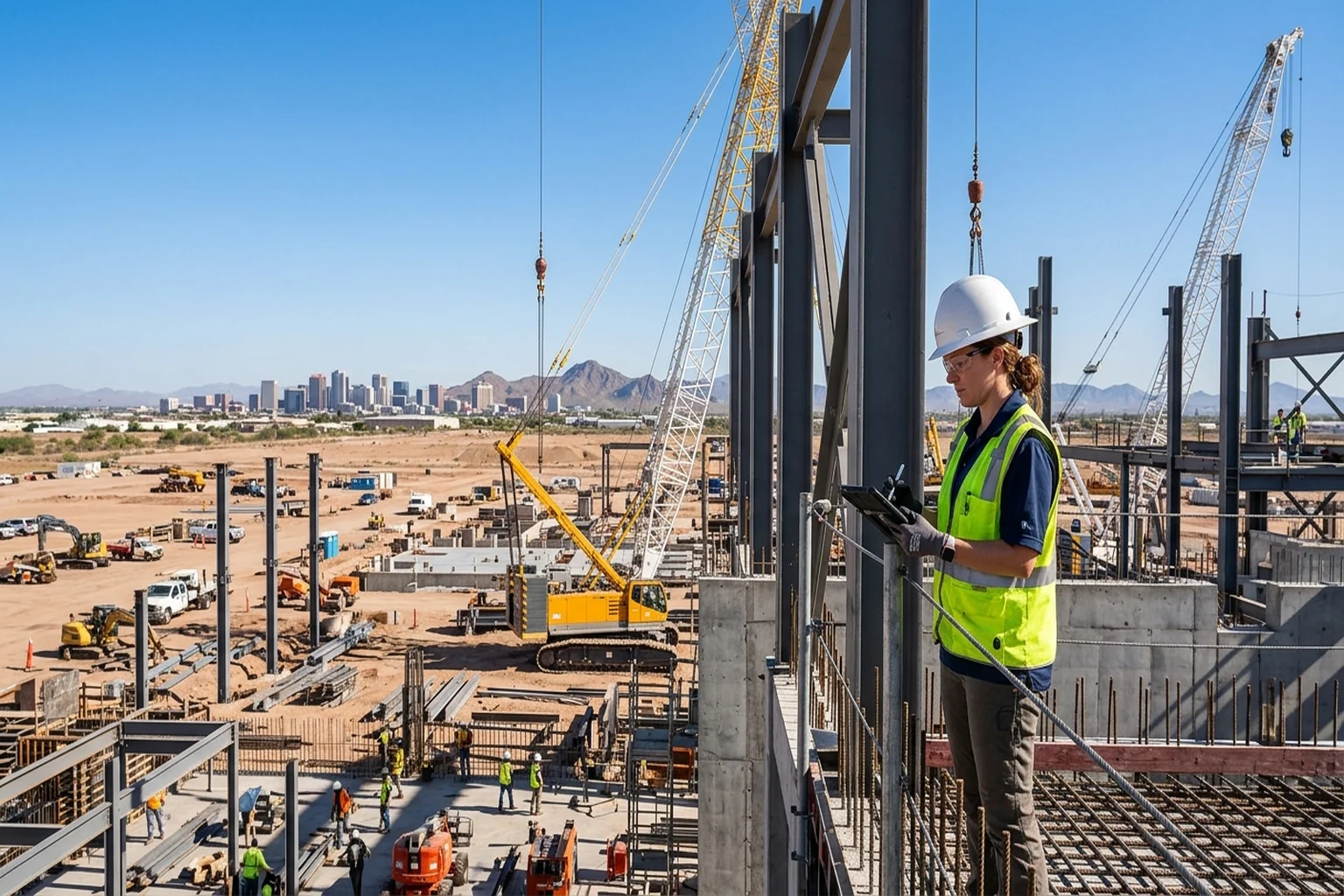
Active construction in 2026 along I-25, CO-94, South Academy Boulevard, and Charter Oak Ranch Road means a steady pipeline of heavy civil, electrical, and highway construction jobs in the Colorado Springs metro for years to come. Combined with the city’s growing aerospace and defense sector, it makes Colorado Springs one of the most trade-friendly mid-sized metros in the Mountain West.
Colorado is putting money behind apprenticeships
Rhetoric about the trades shortage is easy to find in every state. What’s different in Colorado is the scale of actual investment relative to the state’s size.
According to Apprenticeship Colorado’s 2026 Apprenticeship Month announcement from the Colorado Department of Labor and Employment:
- Apprenticeship Colorado registered over 100 new programs in 2025, expanding into healthcare, clean energy, and cybersecurity alongside traditional construction trades.
- The state awarded $348,803 in ScaleUp Grants in fall 2025 to help employers grow existing registered apprenticeship programs.
- A second round of BuildUp Grants worth $308,376 was distributed in January 2025 to launch new programs.
- House Bill 24-1439 authorizes grants of up to $50,000 for employers expanding registered apprenticeships.
- A $12.5 million federal cooperative agreement funds the Future Ready Apprenticeship Center in partnership with CareerWise, designed to scale youth apprenticeship across the state.
The payoff for students is real. Per the Colorado Community College System’s outcomes data, among CTE completers in the CCCS system, 98% enrolled in further postsecondary education, enlisted, or entered the workforce within a year of finishing. Of those who went to work, 80% landed jobs in their chosen CTE field — a placement rate that most four-year programs would envy.
And the runway ahead is long. The Colorado Sun reported in December 2025 that the state’s Talent Pipeline Report identified 163 “top jobs” across Colorado — the Colorado Department of Higher Education publishes the full supply-demand analysis and Top Jobs data — and skilled trades and healthcare occupations dominate the list.
Want to understand how apprenticeships actually work day-to-day? Our Apprenticeships Explained guide walks through pay, hours, and the progression from apprentice to journeyman.
Trade school enrollment is surging — and supply is tight
Students are voting with their feet. Denver7 reported that Colorado trade school enrollment has risen sharply as students increasingly prioritize cheaper, faster pathways to good-paying jobs. Emily Griffith Technical College — the iconic Denver public technical school — saw 14.6% enrollment growth from 2018–19 to 2024–25, surpassing pre-pandemic levels, and the school now reports that 100% of its students graduate debt-free thanks to a combination of scholarships and grants. Statewide, trade school fall enrollment jumped 28.2% from 2019 to 2023 according to U.S. Census and NCES data cited in the same report.
But rising demand is running straight into a supply problem. CBS Colorado reported that Colorado trade schools are facing an instructor shortage even as student applications climb. The dynamic cuts both ways. On one hand, program waitlists are growing at many schools. On the other, students who land a seat at a top-ranked Colorado trade school face less competition for hands-on lab time and a more personalized classroom experience than students at over-enrolled programs in other states.
Which raises the obvious question: which Colorado trade schools are actually worth applying to?
Best trade schools in Colorado (2026)
The rankings below come from tradecolleges.org’s composite scoring model, which weights completion rate, retention rate, program productivity, program breadth, and institutional scale. Each school links through to its full profile with programs, tuition, and outcomes data.
-
#1 Colorado School of Trades — Lakewood National rank #21. Composite score 76.7, 83.2% completion rate, 108 enrollment. The highest-ranked Colorado trade school in our national index — a highly specialized institution best known nationally for its long-running gunsmithing program, which pulls students from across the country.
-
#2 Pima Medical Institute-Denver — Denver National #27. Composite 76.1, 75.1% completion, 764 enrollment. Denver’s top-ranked allied health and medical trades campus, with deep program breadth across nursing, radiography, dental, and veterinary technician training.
-
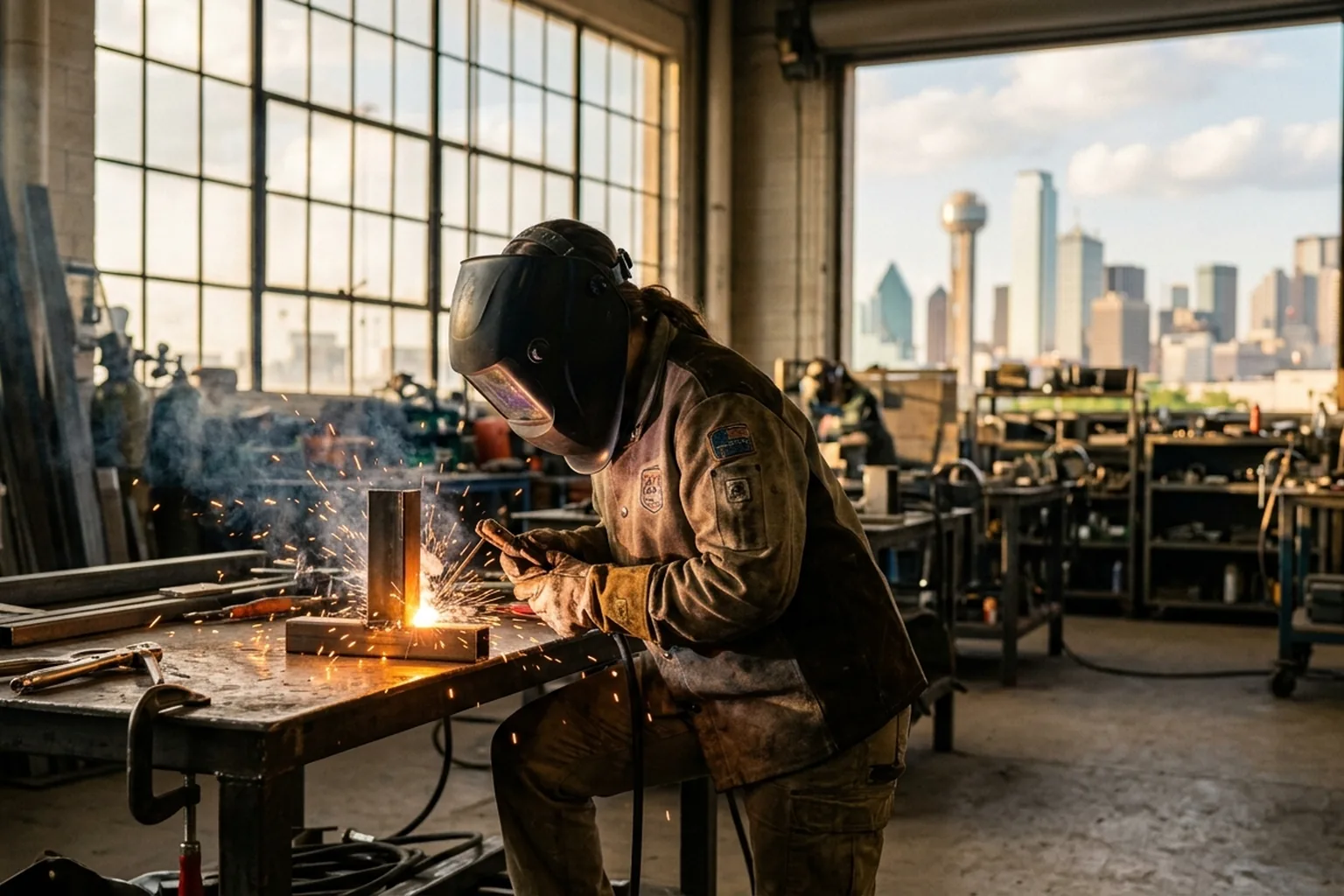
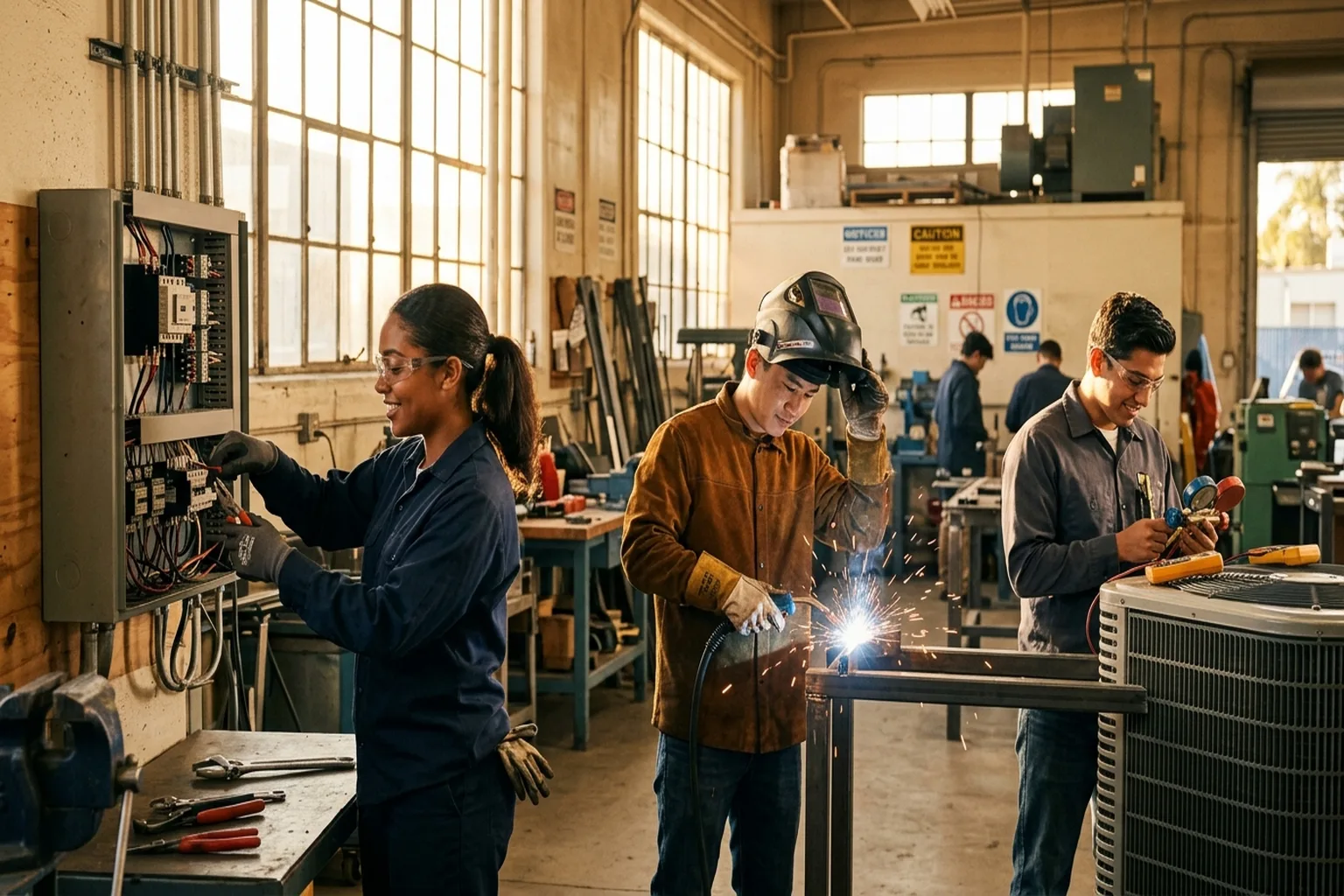
#3 Lincoln College of Technology-Denver — Denver National #32. Composite 75.4, 58.7% completion, 1,104 enrollment. Lincoln Tech is the biggest multi-trade campus serving the Denver metro, with automotive, HVAC, electrical, and welding programs running year-round — a strong pick if you want to train in classic construction trades without leaving the city.
-
#4 Intellitec College-Grand Junction — Grand Junction National #84. Composite 71.6, 71.7% completion, 1,160 enrollment. The highest-ranked Western Slope campus on the list, serving Mesa County and the broader Grand Junction region. If you’re west of the Divide, this is the school to beat.
-
#5 Pima Medical Institute-Aurora — Aurora National #114. Composite 69.9, 76.4% completion, 290 enrollment. A smaller, more intimate Pima campus serving the east Denver metro with allied health programs.
-
#6 Pima Medical Institute-Colorado Springs — Colorado Springs National #124. Composite 69.5, 68.2% completion, 339 enrollment. Serves the Colorado Springs military community with healthcare programs designed around base schedules and spouse-friendly hours.
-
#7 Spartan College of Aeronautics and Technology — Broomfield National #190. Composite 65.8, 69.9% completion, 321 enrollment. Aviation maintenance and aerospace-focused training. Given the Front Range’s growing aerospace cluster and the Colorado Springs Space Force presence, Spartan is a strong pick for students targeting aviation maintenance technician (AMT) or avionics careers.
-
#8 Intellitec College-Colorado Springs — Colorado Springs National #240. 67.1% completion, 816 enrollment. Notable for ranking #18 nationally for HVAC programs — making it Colorado’s top HVAC pick by our scoring model. With the state’s climate workforce plan calling for thousands of new HVAC and mechanical techs, this is a well-timed program.
-
#9 IBMC College — Fort Collins National #279. Composite 60.9, 79.6% completion, 306 enrollment. Northern Colorado’s top-ranked campus, serving Fort Collins, Loveland, and Greeley with healthcare, business, and cosmetology programs — a good option for students who want to stay in the fast-growing Larimer County region.
-
#10 Emily Griffith Technical College — Denver Emily Griffith isn’t currently included in our national composite rankings because its public technical college structure produces different outcome metrics than the private-sector schools we benchmark against. But it absolutely belongs on any Colorado list. The Denver7 report documents 14.6% enrollment growth, a 100% debt-free graduate rate, and a flat $11,935 tuition that’s the same for in-state and out-of-state students — making it one of the strongest low-cost public options anywhere in the Mountain West.
What trades pay in Colorado
The Colorado Department of Labor and Employment released its official May 2024 Occupational Employment and Wage Statistics (OEWS) data in July 2025 in partnership with the federal Bureau of Labor Statistics. That release is the authoritative source for Colorado-specific median and mean wages, plus employment levels, for skilled trades occupations — electricians (SOC 47-2111), heating, air conditioning, and refrigeration mechanics (49-9021), plumbers and pipefitters (47-2152), welders (51-4121), bus and truck mechanics and diesel engine specialists (49-3031), and carpenters (47-2031), among others. Before committing to a program, pull the current numbers directly from the CDLE release — they update annually and are more accurate than the salary surveys you’ll find on recruiting sites.
But wages only tell half the story. Colorado’s cost of living — particularly in the Denver metro — is meaningfully higher than the national average. The MIT Living Wage Calculator estimates that a single adult in the Denver–Aurora–Centennial metro needs roughly $26.20 per hour (about $54,496 per year before taxes) just to cover basic living expenses. And Denver’s minimum wage is rising to $19.26 per hour in 2026, putting a floor under the metro’s lowest-paid workers.
The good news: most skilled trades comfortably clear the Denver living-wage bar within a few years of apprenticeship, and many exceed it from day one in the journeyman phase. The caveat: students weighing Front Range salaries should measure take-home pay against local rent and housing costs, not against national averages. Grand Junction, Pueblo, and the Western Slope generally offer lower pay but meaningfully lower cost of living — which can make those markets more attractive than the raw wage numbers suggest.
Where to start
Ready to take the next step?
- Browse all Colorado trade colleges — filter by city, program, and school type
- See the full Colorado trade school rankings — state-level composite scoring
- HVAC school rankings — especially relevant given the climate workforce plan
- Compare schools side by side — put up to 3 Colorado schools head-to-head on tuition, graduation rates, and programs
- Take the 2-minute career quiz — not sure which trade fits? Start here
- Read our clean energy trades guide — the long-view on wind, solar, and grid careers
Sources
- Colorado Department of Labor and Employment — “Colorado Occupational Employment and Wages 2024” — July 18, 2025 — cdle.colorado.gov
- Colorado Sun — “Colorado Talent Pipeline Identifies Top Jobs” — December 20, 2025 — coloradosun.com
- Colorado Department of Higher Education — “Supply-Demand Analysis and Colorado’s Top Jobs” — cdhe.colorado.gov
- Colorado Community College System — “Data & Reports” — cccs.edu
- Denver Gazette — “As Colorado Passes 6 Million Residents, Housing Initiatives Take Center Stage” — April 6, 2026 — denvergazette.com
- Colorado Department of Transportation — “Military Access, Mobility and Safety Improvement Project (MAMSIP)” — January 25, 2026 — codot.gov
- CDLE / Apprenticeship Colorado — “Colorado Apprenticeship Month 2026: Spread the Apprenticeship Effect” — cdle.colorado.gov
- Colorado Energy Office — “State Releases Report Defining Workforce Needs to Achieve Colorado’s Ambitious Climate Goals” — November 19, 2025 — energyoffice.colorado.gov
- CPR News — “Colorado Climate Workforce Report” — November 19, 2025 — cpr.org
- Denver7 — “Colorado Trade Schools See Increased Enrollment as Students Prioritize Cheaper Pathways to Jobs” — denver7.com
- CBS Colorado — “Colorado Trade Schools Face Instructor Shortage as Student Demand Increases” — cbsnews.com
- MIT Living Wage Calculator — “Denver-Aurora-Centennial Metro” — livingwage.mit.edu
- CBS Colorado — “Denver’s Minimum Wage Increase 2026” — cbsnews.com