
A data-driven guide for anyone considering a trade career in the Chicago metro and surrounding Illinois.
TL;DR: Chicago’s skilled trades market is heading into a multi-decade build cycle that few other US metros can match. O’Hare 21 — Mayor Brandon Johnson’s $8.2-$8.5 billion airport overhaul — is targeting 90,000 new jobs across its life, according to Hoodline. At the same time, Stellantis is sinking $600 million into reopening its Belvidere assembly plant, Rivian is investing more than $1.5 billion in Normal plus a $120 million supplier park, and Gotion has begun production at a $2 billion battery gigafactory in Manteno. Underneath all of that, Chicago has to replace 412,000 lead service lines under a federal mandate that begins in 2027. Illinois currently has a shortage of more than 200,000 trade jobs, per the Chicago Sun-Times. For tradespeople, the math is hard to ignore.
Why Chicago’s skilled trades are heading into a multi-decade build cycle
Three forces are converging on the Chicago metro and the broader Illinois corridor at the same time, and each one independently would be enough to tighten the trades labor market for years. Together, they are reshaping the region’s hiring outlook for at least the next 15 years.
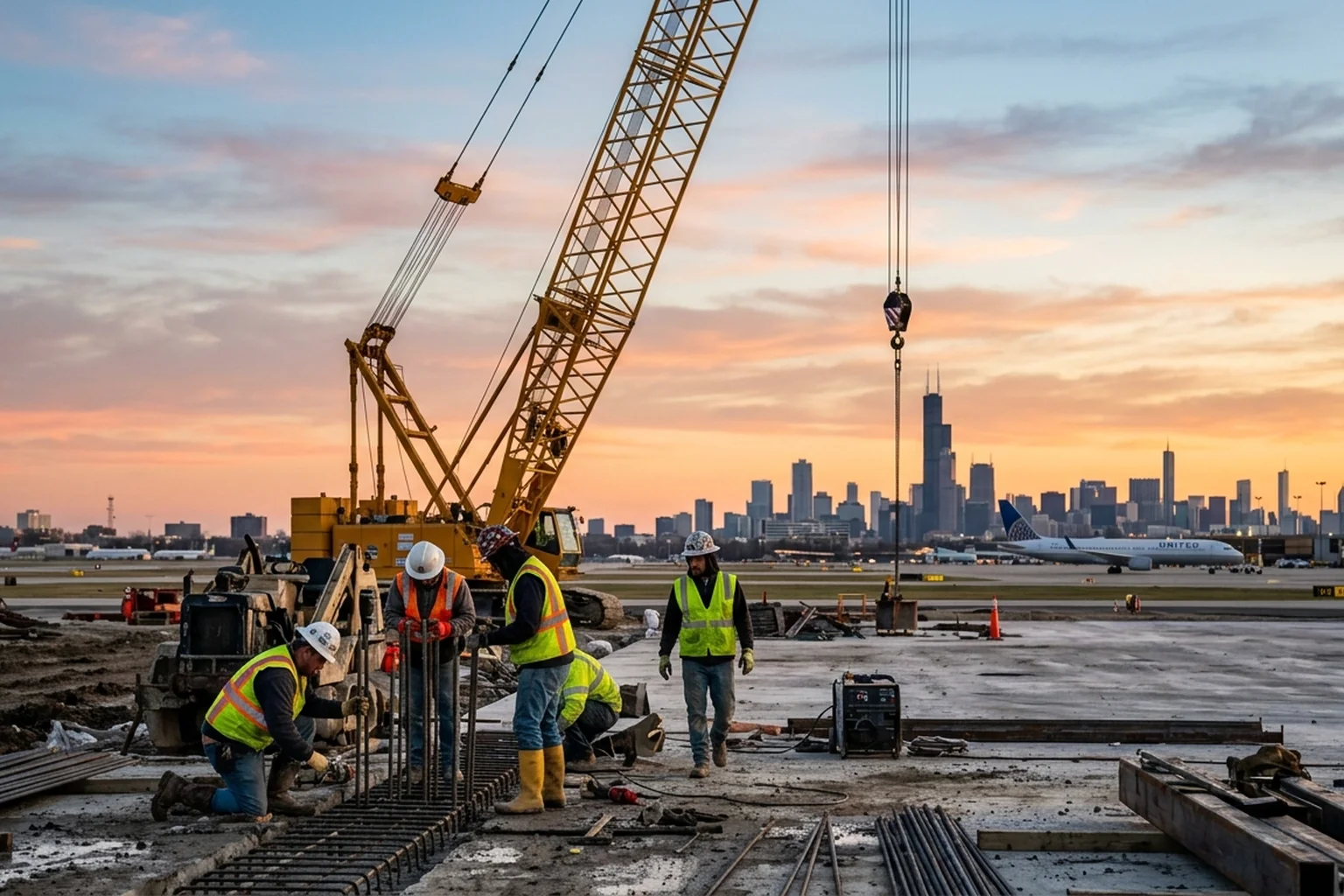
O’Hare 21 is the largest airport infrastructure program of the decade. The $8.2-$8.5 billion ORD Next program is now underway, with the city framing it as a generational jobs engine. Mayor Brandon Johnson said publicly that “by the end of the ORD Next development, we’re expecting to create 90,000 new jobs,” according to Hoodline. The first major piece — a new $1.3 billion Concourse D — is already under construction with vertical work scheduled for spring 2026 and completion targeted for 2028, per Construction Dive.
EV manufacturing is reshoring across the Illinois corridor. Stellantis announced in October 2025 that it would invest $600 million to reopen its long-idled Belvidere assembly plant by 2027, calling it “the single largest [investment] in the Company’s history” in the U.S., via FOX 32 Chicago. Rivian is scaling up its Normal facility for R2 production in 2026 with $1.5 billion in new tooling plus a $120 million supplier park, per Governor Pritzker’s office. And Gotion’s $2 billion battery gigafactory in Manteno just began production this past September, according to Manufacturing Dive.
The region’s aging water and electric infrastructure is finally being replaced. Chicago has roughly 412,000 lead service lines in the ground — by far the largest count of any US city — and a new federal EPA rule requires the city to begin systematic replacement starting in 2027, according to Circle of Blue. The total cost is projected at $14 billion. That is roughly two decades of continuous plumbing and pipefitting work.
Anirban Basu, chief economist at Associated Builders and Contractors, framed the bigger picture in early 2026: “a majority of new worker demand in 2026 will be attributable to retirement rather than increased demand for construction services,” via Construction Dive. Even without these megaprojects, demographic pressure would be intense. With them, the gap becomes structural.
What O’Hare 21 means for trades workers specifically
The O’Hare 21 / ORD Next program deserves a closer look because it is the single largest sustained construction commitment in the Chicago region and because its phasing means trades work is essentially guaranteed for the next decade.
The first major piece broke ground in summer 2025: a new Concourse D awarded to a joint venture led by AECOM Hunt. The $1.3 billion project — accompanied by roughly $300 million in supporting infrastructure work — is expected to support more than 3,800 construction positions before it opens in 2028, per Construction Dive. Concourse D alone will keep electricians, ironworkers, sheet metal crews, and pipefitters busy on a single site for nearly three years.
After Concourse D, the timeline ramps. Satellite Concourse 1 is targeted for 2028, the new Global Terminal for 2032, and Satellite Concourse 2 along with a new tunnel and people-mover for 2034 — adding roughly 25% more gate capacity overall, according to Chicago YIMBY. The city’s 90,000-jobs figure is best read as an aspirational target; the Illinois Economic Policy Institute’s economic impact study puts construction labor demand on more conservative ground. Even discounted, the numbers are large enough that the Cook County trades pipeline cannot fill them at current intake. A 25-year-old apprentice who tops out in 2030 will spend most of their early career in or adjacent to O’Hare work if they want to.
Top trades in highest demand in Chicago
Electricians
Every megaproject in the region — data center expansions, EV battery plants, airport terminals, downtown high-rises — runs on electrical work. The Illinois state median wage for electricians is $47.86/hour, or $99,540 annually, per BLS OEWS data via O*NET.
Chicago’s union ceiling is meaningfully higher. IBEW Local 134, which covers Cook County, posts a journeyman inside-wireman rate of $57.75/hour for 2025-2026, via the local. With benefits and overtime on industrial projects, total compensation regularly clears $150,000 a year. See electrician careers and electrical technology programs.
Plumbers, pipefitters, and steamfitters
Pipefitters and plumbers are linked to all three of Chicago’s growth stories — the airport, the EV plants, and the lead-pipe replacement. The Illinois state median wage for plumbers, pipefitters, and steamfitters is $47.54/hour, or $98,890 annually, per BLS OEWS via O*NET.
Union scale in Chicago runs higher. Plumbers Local 130 lists a journeyman wage of $60.50/hour effective June 2025 through May 2026 — roughly $125,840 a year at 40 hours before benefits, per the local. Pipefitters Local 597 runs a five-year UA apprenticeship covering pipefitters, welders, and HVAC service technicians, per the local — the most relevant union for industrial process work in the region. See plumbers, pipefitters, and steamfitters.
Sheet metal workers
Sheet metal is one of the most underrated trades for the work mix Chicago is generating. HVAC ductwork, architectural metal, and industrial ventilation systems are core to data centers, hospital expansions, and airport terminals. The Illinois state median wage for sheet metal workers is $47.10/hour, or $97,970 annually, per BLS OEWS via O*NET. On unionized commercial work in Chicago, journeymen routinely run above that. For more, see sheet metal workers.
Millwrights
Millwrights install, dismantle, and maintain heavy industrial machinery — exactly the skill set EV and battery plants need. Belvidere’s reopening, Rivian’s R2 production lines, and Gotion’s battery cell stacking and formation equipment will all need millwrights at the install phase and again every time tooling changes. The Illinois state median wage for millwrights is $39.99/hour, or $83,180 annually, per BLS OEWS via O*NET. For young trades workers willing to travel to Belvidere, Normal, or Manteno, this is one of the highest-leverage trades to learn right now. See millwrights for more.
Welders
Welders are where Chicago’s wage data tells a sharper story. The Illinois state median for welders, cutters, solderers, and brazers is $24.37/hour, or $50,700 annually, per BLS OEWS via O*NET — well below the construction trades above. The BLS occupation code captures a lot of fabrication-shop and small-shop manufacturing work, where wages are compressed.
That figure understates the ceiling. A welder who comes up through Pipefitters Local 597’s UA five-year program — which folds welder training into its apprenticeship — will earn far more than the BLS welding median. For prospective welders, the credential decision is the most important one. See welders, cutters, solderers, and brazers and welding technology programs.
EV reshoring — what’s being built and what trades are needed
The Illinois EV story is not one project, it is three, and they cluster differently across the trade mix.
Stellantis Belvidere. Stellantis announced a $600 million reopening of the Belvidere assembly plant in October 2025, framed by CEO Antonio Filosa as the single largest U.S. investment in the company’s history, per FOX 32 Chicago. The package targets 3,300 jobs across Illinois plants and a 2027 production restart. Two caveats: Stellantis scrapped the planned battery plant and parts hub that had been part of the October 2023 UAW deal, and the UAW has flagged a possible delay of the assembly restart to 2028, per WTVO MyStateline. Either way, the trades demand for the retooling phase — millwrights, electricians, pipefitters, controls technicians — is real and near-term.
Rivian Normal. Rivian is investing more than $1.5 billion in its Normal plant ahead of R2 production in 2026, plus a $120 million supplier park co-announced with the state, via the Governor’s office. CEO RJ Scaringe described the supplier park as “a key enabler to increasing production at the plant in 2026 when we start to build R2 in addition to R1 and our commercial vans.” The state attached a 30-year incentive package valued at $827 million to lock in the expansion, per the Illinois Economic Development Corporation.
Gotion Manteno. Gotion High-tech’s $2 billion battery gigafactory in Manteno — described by Governor JB Pritzker as “the largest EV battery production investment in the state to date,” via Manufacturing Dive — began production in September 2025. Gotion told the Daily Journal in November 2025 that it had roughly 300 employees on site and a target of 1,400 by the end of 2026, per Shaw Local, with eventual headcount targeted at 2,600.
The EV wave’s most distinctive feature is its skill mix. Battery plants are heavy on millwrights, electricians with industrial controls and PLC experience, pipefitters running deionized water and chemical lines, and HVAC technicians managing precision environmental controls. For a Chicago trade student thinking about a 25-year career, the EV corridor is where the highest-paying industrial maintenance work will sit.
Pay and career trajectory — Chicago vs. national averages
Chicago is one of the highest-paying construction markets in the United States for structural reasons. Illinois has the highest unionized construction density in the Midwest, which means the floor on Chicago wages — the journeyman scale set by IBEW Local 134, Plumbers Local 130, Pipefitters Local 597, and the Mid-America Carpenters Regional Council — sits well above the BLS state-median figures used for non-union work.
The state-median figures cited above ($99,540 for electricians, $98,890 for plumbers and pipefitters, $97,970 for sheet metal workers) are themselves above the national medians. Layer Chicago’s union scale on top, and journeyman tradespeople in the city’s signatory locals routinely clear $125,000 to $150,000 in cash wages alone, with another 30-40% in benefits.
The notable outlier is welders. The BLS welder median of $50,700 reflects shop-floor manufacturing wages, not unionized industrial pipe welding. A welder coming up through Pipefitters Local 597 will end up on a fundamentally different earnings trajectory than one employed by a small fabrication shop. The credential decision matters more here than in most other trades.
One risk worth naming: the Chicago Sun-Times reported in April 2026 that 32.5% of construction workers in the Chicago metro are foreign-born — about 83,522 workers — and that ICE enforcement is putting acute pressure on the available labor pool, per the Sun-Times. That dynamic is part of why Illinois is now short more than 200,000 trade workers. For US-citizen trades workers entering the market, the practical consequence is more leverage and faster wage growth than is typical.
Chicago’s apprenticeship pipeline — how to access it
Chicago’s apprenticeship system is one of the most developed in the country, with deep union locals running multi-year programs that combine paid on-the-job hours with classroom training.
- IBEW Local 134 runs a 5-year inside-wireman apprenticeship through the Electrical Joint Apprenticeship & Training Trust (EJATT) and the NECA-IBEW Technical Institute, per the local. Journeyman rate sits at $57.75/hour.
- Plumbers Local 130 runs a 5-year apprenticeship with 1,200+ classroom hours, leading to a journeyman wage of $60.50/hour, per Local 130’s wage page.
- Pipefitters Local 597 runs a 5-year UA apprenticeship that covers pipefitters, welders, and HVAC service technicians, with more than 6,000 trained piping professionals in its records, per the local. For anyone interested in EV plant maintenance, refinery work, or unionized welding, this is the single most directly relevant program.
- Mid-America Carpenters Regional Council runs a 4-year apprenticeship that starts at roughly 40% of journeyman scale (Year 1 around $40,000, Year 2 around $52,000, Year 3 around $61,000), graduating to journey-level pay listed at “$100,000+,” per the council.
- Chicago Regional Carpenters Apprentice Training Fund also operates a partnership with City Colleges of Chicago that offers a more accessible front door for prospective apprentices.
Aging infrastructure — Chicago’s lead service line replacement is the largest in the US
Chicago has approximately 412,000 lead service lines — more than any city in the country — and the federal EPA’s revised Lead and Copper Rule requires the city to begin a systematic replacement program in 2027, according to Circle of Blue. The total cost is projected at $14 billion, with the average per-line replacement around $35,000.
Current pace is well behind that target. WTTW reported in October 2025 that Chicago has replaced fewer than 4% of its lead service lines in the past five years, while the federal mandate calls for 15,000 replacements in 2027 and 19,000 in 2028, per WTTW News. The city has secured a $336 million WIFIA federal loan for an initial 30,000 lines, per Lead Safe Chicago, but the gap between current pace and required pace is the story.
For plumbers and pipefitters, this is essentially two decades of guaranteed residential work layered on top of the megaproject demand — mandated work that does not depend on macroeconomic cycles or private capital.
How to get started
If you are considering a trade career in the Chicago metro or surrounding Illinois, here is a practical roadmap.
-
Choose a trade. Weigh the five trades above against your interests, work environment preferences, and how much travel you can tolerate. Electricians, plumbers, and sheet metal workers do most of their work in the metro itself. Millwrights and industrial pipefitters often follow the EV corridor — Belvidere, Normal, Manteno — which means more road time but access to the highest-paying industrial work.
-
Get into a registered apprenticeship. The Chicago locals listed above are the gold standard. IBEW Local 134, Plumbers Local 130, Pipefitters Local 597, and the Mid-America Carpenters Regional Council all run formal application windows. Pre-apprenticeship programs run by the Chicago Building Trades Council and partner community organizations help applicants without prior trade experience pass the entrance assessments.
-
Consider a trade school first if you need foundational skills. A formal program can shorten the on-the-job learning curve and help you compete in apprenticeship selection. Browse trade colleges in Illinois to compare accredited programs on outcomes, cost, and placement rates.
-
Get licensed. Illinois licenses plumbers at the state level through the Illinois Department of Public Health, while electricians are licensed by the city or county. Track licensing requirements early so your apprenticeship hours count where you need them.
-
Target high-value projects. Once you reach journeyman, be deliberate. O’Hare 21 work, EV battery plant maintenance, and large data center builds pay well above standard residential wages and build the kind of reputation that compresses the timeline to foreman and superintendent. Use the best colleges rankings to identify programs with strong placement into Chicago’s signatory contractors.
The Chicago region’s trade market is rare in that it does not depend on a single industry or a single megaproject to sustain demand. O’Hare 21 will run for at least a decade. EV reshoring at Stellantis, Rivian, and Gotion will keep millwrights and industrial electricians busy for as long as those plants operate. And the lead service line mandate is a 20-year residential plumbing program with no off-ramp. For anyone willing to commit to a five-year apprenticeship, the timing for entering the trades in Illinois is about as favorable as it has ever been.
Sources
- Construction Dive — Zachary Phillips — “AECOM-led JV breaks ground on $1.3B O’Hare expansion” — 2025-08-19 — https://www.constructiondive.com/news/ohare-terminal-d-construction-start-aecom/758040/
- Hoodline — “Mayor Johnson Bets Big on O’Hare Overhaul, Dangles 90,000 New Jobs” — 2026-04-27 — https://hoodline.com/2026/04/johnson-bets-big-on-o-hare-overhaul-dangles-90-000-new-jobs/
- FOX 32 Chicago — “Stellantis to invest $600M to reopen Belvidere plant” — 2025-10-14 — https://www.fox32chicago.com/news/stellantis-600m-reopen-belvidere-plant
- CBT News — “Stellantis confirms 2027 reopening of Belvidere plant, scraps battery facility plans” — 2025-06-10 — https://www.cbtnews.com/stellantis-confirms-2027-reopening-of-belvidere-plant-scraps-battery-facility-plans/
- Office of Governor JB Pritzker — “Governor Pritzker and Rivian Announce New Supplier Park in Normal” — 2025-05-05 — https://gov-pritzker-newsroom.prezly.com/governor-pritzker-and-rivian-announce-new-supplier-park-in-normal
- Manufacturing Dive — “Gotion to invest $2B in Illinois battery gigafactory” — 2023-09-11 — https://www.manufacturingdive.com/news/gotion-2-billion-ev-lithium-battery-plant-manteno-illinois/693223/
- Shaw Local / Daily Journal — “Gotion gives updates on Manteno plant” — 2025-11-18 — https://www.shawlocal.com/daily-journal/2025/11/18/gotion-gives-updates-on-manteno-plant/
- Circle of Blue — “New EPA Federal Water Rules Put Chicago on Track to Replace All Lead Pipes Within 20 Years” — 2024 — https://www.circleofblue.org/2024/supply/water-management/infrastructure/new-epa-federal-water-rules-put-chicago-on-track-to-replace-all-lead-pipes-within-20-years/
- WTTW News — “Crews Have Replaced Less Than 4% of Lead Service Lines in Chicago Homes” — 2025-10-24 — https://news.wttw.com/2025/10/24/crews-have-replaced-less-4-lead-service-lines-shown-contaminate-tap-water-chicago-homes
- Chicago Sun-Times — “ICE raids deepen construction worker shortage” — 2026-04-25 — https://chicago.suntimes.com/work/2026/04/25/ice-raids-construction-industry-worker-shortage-border-patrol
- Construction Dive — “ABC: 2026 construction worker demand to ease slightly” — 2026-01-28 — https://www.constructiondive.com/news/labor-demand-gap-shrinks-abc-construction-staff/810681/
- BLS OEWS via O*NET — Illinois state wages for trades occupations — May 2024 — https://www.onetonline.org/link/localwages/47-2111.00?st=IL