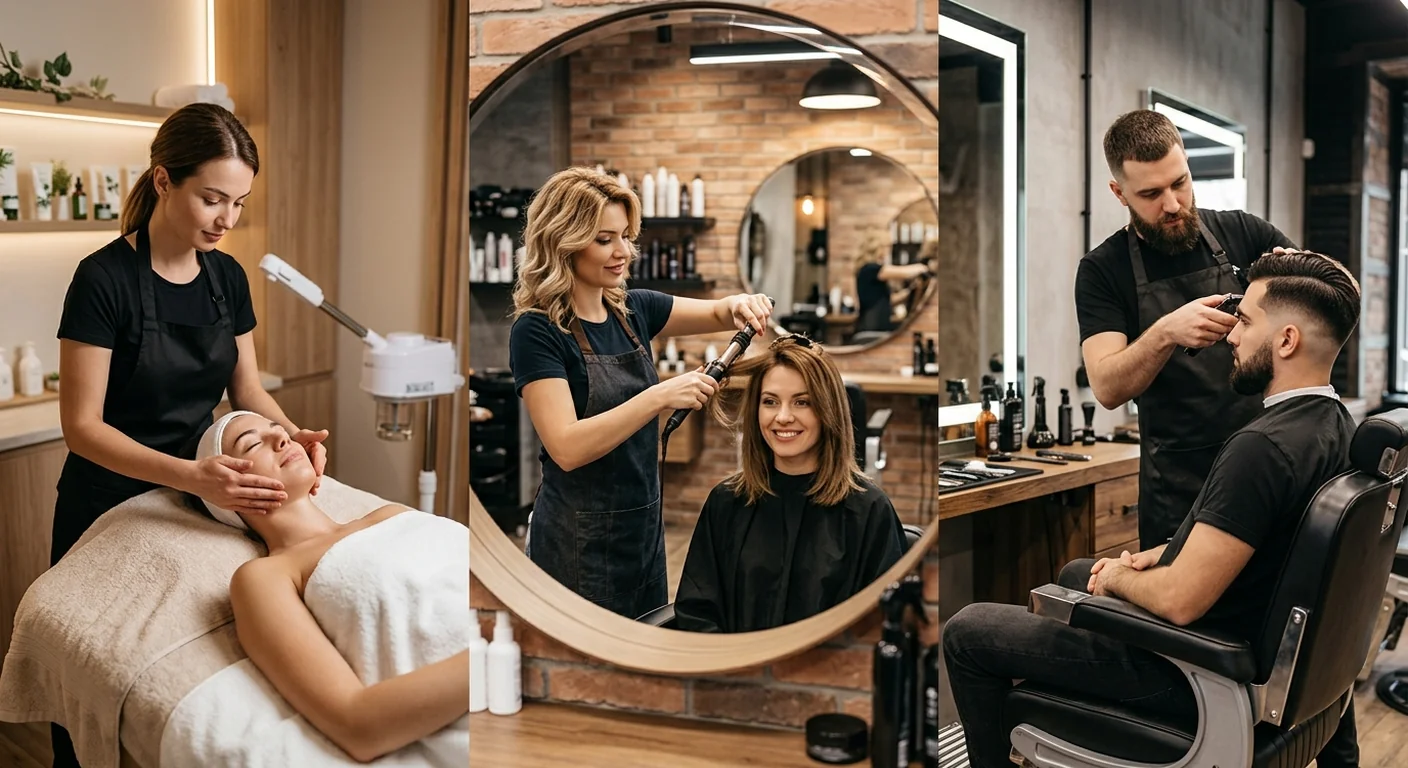

The three core beauty licenses — cosmetologist, esthetician, and barber — look similar on the surface and lead to wildly different careers. They share classrooms, share state regulators, and often share school buildings, but the licensure scope and the earnings ceiling diverge sharply once you’re working. Picking the wrong one locks you out of services you wanted to charge for. Picking the right one can shave a year and $10,000 off your training.
This guide compares the three on the dimensions that actually matter for the choice: legal scope of practice, training hours by state, 2024 BLS wage data, career ceiling, and the crossover paths if you decide to expand later.
TL;DR
- Cosmetologist — broadest scope (hair, skin, nails, makeup), longest training (typically 1,000–2,100 hours), May 2024 median hourly wage $16.95 (BLS OOH).
- Esthetician (skincare specialist) — skin only (facials, waxing, body treatments), shortest training (typically 600–1,500 hours), May 2024 median hourly wage $19.98 (BLS OOH Skincare Specialists). Highest projected job growth at 7% from 2024 to 2034.
- Barber — hair-focused with traditional men’s grooming and shaving, training typically 800–1,500 hours, May 2024 median hourly wage $18.73 (BLS OOH).
- Crossover paths exist. A cosmetology license usually covers most esthetics work without retraining, but not vice versa. Barber-to-cosmetologist or cosmetologist-to-barber typically requires a state-specific crossover course (e.g., 300 hours in Texas).
- Pick by what you actually want to do daily, not by what sounds prestigious. Doing what you don’t enjoy 40 hours a week burns careers faster than any pay difference.
The Three Licenses at a Glance
| Dimension | Cosmetologist | Esthetician | Barber |
|---|---|---|---|
| Primary work | Hair, skin, nails, makeup | Skin care, facials, waxing | Hair cutting, shaving, men’s grooming |
| Typical training hours | 1,000–2,100 | 600–1,500 | 800–1,500 |
| BLS median hourly wage (May 2024) | $16.95 | $19.98 | $18.73 |
| Projected growth 2024–2034 | 5% | 7% | 5% |
| Typical workplace | Full-service salon | Spa, medspa, skincare clinic | Barbershop, men’s salon |
| Tipping culture | Strong | Moderate | Strong |
| Typical entry investment | $14,000–$20,000+ | $4,000–$10,000 | $8,000–$15,000 |
The wage figures above are national medians for 2024 from the BLS Occupational Outlook Handbook — and like all wage data for service occupations, they understate take-home pay because tips, commission structure, and booth-rental revenue are significant. Working stylists at the top of any of these three tracks earn well above the median, particularly in metro markets.
Scope of Practice — What Each License Legally Allows
The biggest differentiator between the three licenses is what services you can legally charge for. Each state defines the lines slightly differently, but the broad pattern is consistent.
Cosmetologist
The cosmetology license is the broadest of the three. According to industry summaries from Glossgenius and Indeed, cosmetologists are licensed to:
- Cut, color, style, and chemically treat hair
- Perform facials, basic skincare treatments, and makeup
- Provide manicures, pedicures, and basic nail services
- Wax and remove hair
- Apply eyelash extensions (in most states)
The cosmetology curriculum spends most of its hours on hair work, with smaller modules on skin, nails, and makeup. Cosmetologists can legally perform basic esthetics services in most states, but they will not be as skilled as a dedicated esthetician — and many high-end spas hire only licensed estheticians for skin work regardless of what cosmetology law technically permits.
Esthetician
The esthetician license — sometimes called “skincare specialist” or “aesthetician” depending on the state — is narrower and deeper. Estheticians focus on skin:
- Facials and skin analysis
- Chemical peels (within state-defined limits)
- Body treatments, wraps, and exfoliation
- Hair removal: waxing, sugaring, threading
- Makeup application
- LED therapy, microdermabrasion, and other modalities permitted by state
What estheticians cannot do, per most state boards: cut, color, or chemically treat hair, and perform manicures, pedicures, or nail services. Estheticians who want to do nails or hair need a separate license — or a cosmetology license, which covers all three.
A separate “Master Esthetician” or “Advanced Practice Esthetician” license exists in some states (notably Washington, Virginia, and Utah) and unlocks more advanced procedures like microneedling and chemical peels at higher concentrations. These are typically a 1,200–1,500 hour second tier on top of the basic esthetician license.
Barber
The barber license overlaps with cosmetology in the hair domain but adds traditional men’s grooming services that cosmetologists are not always licensed for:
- Hair cutting (with stronger emphasis on shorter, clipper, and fade work)
- Hair coloring (in most states)
- Wet shaving and straight-razor work
- Beard and mustache shaping
- Scalp treatments
Barbers typically do not perform skin treatments, nails, or makeup — those services either require a separate license or fall outside the barber scope of practice entirely.
The wet-shaving privilege is the clearest legal difference. In many states, cosmetologists are not licensed to do straight-razor shaves on the face, while barbers are. If your business model includes traditional shaves or beard services, the barber license is the correct one.
Training Hours by State — The Biggest Variable
State-by-state training-hour requirements are where the real time-and-money divergence shows up. The numbers below come from state board summaries published by PJ’s College of Cosmetology, SalonExam, and the California Board of Barbering and Cosmetology.
Cosmetology hours (selected states):
- 1,000 hours: California, Florida (1,200), New York, Texas, Massachusetts, Maryland
- 1,500 hours: Colorado, Connecticut, Delaware, Illinois, Pennsylvania
- 1,600 hours: Arizona
- 2,100 hours: Iowa, Nebraska
Esthetician hours (selected states):
- 600 hours: New York, California, Texas (typical baseline)
- 750 hours: Illinois
- 1,000 hours: Connecticut, Florida (260 for facial specialist)
- 1,200–1,500 hours: Master Esthetician programs in Washington, Virginia, Utah
Barber hours (selected states):
- 1,000 hours: California, Texas, Florida (1,200 for full barber)
- 1,500 hours: Illinois, New York
- Crossover from cosmetology: 300 hours in Texas, similar short crossovers in other states
The broad pattern: estheticians complete training in roughly half the time of cosmetologists in most states. Barbers and cosmetologists usually have similar hour counts, with barbers slightly lower in some states.
For a deeper state-by-state look at cosmetology hours and the licensing process, see our companion guide on how to become a cosmetologist.
What Each License Actually Earns
The BLS Occupational Outlook Handbook is the authoritative source for U.S. wage data on these occupations.
Hairdressers, hairstylists, and cosmetologists (SOC 39-5012):
- May 2024 median hourly wage: $16.95
- Lowest 10%: under $11.82 / Top 10%: over $33.76
- 2024 employment: ~575,200 jobs
- Projected growth 2024–2034: 5%
- Annual openings: ~84,200 (combined with barbers)
Skincare specialists / estheticians (SOC 39-5094):
- May 2024 median hourly wage: $19.98 (annual median: $41,560)
- Lowest 10%: under $13.06 / Top 10%: over $37.18
- 2024 employment: ~97,400 jobs
- Projected growth 2024–2034: 7% (much faster than average)
- Annual openings: ~14,500
Barbers (SOC 39-5011):
- May 2024 median hourly wage: $18.73
- 2024 employment included in the combined ~575,200 with cosmetologists
- Projected growth 2024–2034: 5%
A few things to read into these numbers:
- Estheticians earn the highest median hourly wage of the three on the BLS data. The growth rate is also the strongest. The medspa industry — clinical-adjacent skincare — has driven both.
- Barbers’ median is higher than cosmetologists’ by roughly $1.78/hour. The reason is structural: barber visits are more frequent (every 2–4 weeks vs every 6–10 weeks for cosmetology clients), which translates to higher per-stylist revenue throughput.
- All three numbers significantly understate the top of the field. Top 10% of cosmetologists are above $33.76/hour, and that’s just the W-2 wage component. Booth-renter cosmetologists, salon owners, and high-volume colorists in metro markets earn well into six figures.
For the full earnings picture and where cosmetologists are hiring right now, see cosmetology career opportunities. The career page for hairstylists and cosmetologists and the skincare specialists and barbers career pages have full BLS and O*NET data per occupation.
Career Ceilings and Where Each Path Leads
A useful way to think about the three licenses: each one opens a different kind of business model.
The cosmetologist’s path
The natural cosmetology career arc:
- Apprentice or assistant stylist — first 1–2 years, often hourly + tips
- Junior stylist — building a personal book of clients
- Senior stylist or specialist — color specialist, balayage, cutting system specialist
- Booth renter or commission senior — keeping a larger share of revenue
- Salon owner or platform educator — top of the field
The ceiling is high but takes years to reach. Salon owners in metro markets routinely earn $150,000+; platform educators (the stylists who teach product brand seminars and conferences) can earn similar.
The esthetician’s path
The esthetician arc has a different shape:
- Spa esthetician — first 1–2 years at a day spa or resort spa
- Medspa esthetician — moving to a medical-spa setting (typically requires advanced practice license in some states)
- Lead esthetician or treatment manager — supervising other estheticians, more complex services
- Brand educator or product representative — Dermalogica, Eminence, SkinCeuticals, etc.
- Independent practice or medspa ownership — sometimes with a medical director partnership
The medspa track is where the highest earnings live. Medspas charge $200–$400+ for treatments that estheticians (with the right state-level scope) can perform, and the revenue split with the practice can support a six-figure career.
The barber’s path
Barbershops have a stronger small-business culture than salons:
- Apprentice barber — first year, often very low wage
- Chair barber — building book, often on commission or booth rental
- Senior barber — full book, premium pricing for established clients
- Shop owner — single-location independent barbershop
- Multi-location operator or brand owner — top of the field
Barbershop ownership is more accessible than salon ownership in most markets — lower buildout costs, simpler licensing, and a clientele that’s loyal once they find a barber they trust.
Crossover Paths and Dual Licensing
Many working stylists eventually pursue a second license. The good news: most states have crossover programs that recognize hours already completed.
Cosmetologist → Barber: typically a 300–500 hour crossover course (e.g., Texas requires 300 hours for a Class A Barber crossover) plus the barber state board exam.
Cosmetologist → Esthetician: in most states, the cosmetology license already covers most esthetics services, but if you want a dedicated esthetician license (e.g., for a medspa job that requires it), the crossover is typically 100–300 hours focused on the skin curriculum.
Esthetician → Cosmetologist: the longer crossover, since cosmetology adds hair, nails, and chemicals. Expect 600–1,500 additional hours depending on state.
Barber → Cosmetologist: typically a 300–600 hour crossover course covering chemicals, color, and women’s hair-cutting techniques.
Multiple-license stylists (“dual-licensed”) are common in mid-career. The most common combinations are cosmetologist + esthetician (broad service menu in a salon) and cosmetologist + barber (full-service shop catering to all genders). Each additional license expands what you can charge for and gives you optionality if the market in one segment softens.
How to Pick — Questions to Ask Yourself
A practical decision framework, in order:
-
What do you want to do for 30 hours a week? Cutting hair? Doing facials? Shaving beards? The license you pick is the work you’ll do daily for years. Don’t pick on prestige or pay differential — pick on which work you’d choose without the paycheck.
-
Do you want the longest or shortest training? Esthetician programs are typically half the hours of cosmetology and half the cost. If you’re not sure about the broader hair/nails work, the esthetician license is a faster, cheaper way into the industry — and you can always cross over later.
-
Where do you live and what do clients there spend on? A medspa-heavy metro (Miami, LA, NYC) supports estheticians at higher rates than a small market would. A traditional barbershop culture (most of the South and Midwest) supports barbers at premium rates. Demand is local.
-
Are you a hair person or a skin person? This is the cleanest split. People who are detail-obsessed about skincare protocols, ingredients, and treatment chemistry will find esthetics more rewarding. People who love haircutting, color, and the salon environment will find cosmetology or barbering more rewarding.
-
Do you want to own your own business someday? All three licenses lead to ownership, but barbershops have the lowest buildout cost, salons have the most flexibility, and medspas have the highest revenue ceiling but highest regulatory complexity.
For a broader framework on evaluating beauty schools and trade programs against your goals, see choosing the right trade program. For the school-evaluation playbook specifically — what to look for beyond tuition — see best cosmetology schools.
Action Plan
If you’re between two of the three licenses:
- Shadow a working professional in each license you’re considering for at least one full day. Most salons and barbershops welcome this if you ask.
- Pull the BLS occupation page for each — cosmetologists, skincare specialists — and look at state-level pay rather than national medians.
- Calculate the all-in cost of each program in your state: tuition + kit + lost wages during training. Esthetician programs typically come in at half the all-in cost of cosmetology.
- Confirm the scope of practice with your state board of cosmetology before enrolling. State scope-of-practice rules are the legal answer to “can I charge for this service?”
- Pick the license that fits the work you want to do, not the one with the highest median wage. Top-of-field earnings are more about your business and your clientele than about which license is on the wall.
If you’re already in beauty school and reconsidering, talk to the registrar about whether your hours can transfer to a different program at the same school — many beauty schools have shared first-semester curricula across cosmetology, esthetics, and barbering, which makes transferring less expensive than starting over.
When you’re ready to compare specific programs, the aggregated cosmetology program directory, esthetician program directory, and barbering program directory list accredited schools nationwide.
Sources
- U.S. Bureau of Labor Statistics — Occupational Outlook Handbook — Barbers, Hairstylists, and Cosmetologists — May 2024 wage and 2024–2034 projections — https://www.bls.gov/ooh/personal-care-and-service/barbers-hairstylists-and-cosmetologists.htm
- U.S. Bureau of Labor Statistics — Occupational Outlook Handbook — Skincare Specialists — May 2024 wage and 2024–2034 projections — https://www.bls.gov/ooh/personal-care-and-service/skincare-specialists.htm
- Texas Department of Licensing and Regulation — Cosmetologist to Barber Crossover Course Requirements — https://www.tdlr.texas.gov/barbering-and-cosmetology/individuals/cosmetologist-to-barber.htm
- California Board of Barbering and Cosmetology — License Requirements — https://www.barbercosmo.ca.gov/applicants/license_requirements.shtml
- PJ’s College of Cosmetology — Complete Guide to Cosmetology Licensing Requirements by State (2025) — State training-hour requirements — https://www.gotopjs.com/blog/complete-guide-to-cosmetology-licensing-requirements-by-state-2025/
- Glossgenius — Esthetician vs. Cosmetologist: How to Pick the Right Career — Scope of practice comparison — https://glossgenius.com/blog/esthetician-vs-cosmetologist