
Cosmetology is a trade with a surprisingly rigid structure underneath the creative work. Every state sets its own training-hour requirement, administers its own licensing exam, and licenses you to do a specific scope of practice — hair, skin, nails, or some combination. The path from “I want to do hair” to “licensed cosmetologist earning a paycheck” is well-defined, but it runs through paperwork and exam prep as much as through scissors and color.
The BLS Occupational Outlook Handbook lists the median hourly wage for hairdressers, hairstylists, and cosmetologists at $16.95 as of May 2024, with the top 10% earning over $33.76 per hour. The field is projected to grow 5% from 2024 to 2034, faster than the average for all occupations. What that hourly number hides is that most licensed cosmetologists earn significantly more than the base wage once tips, commission structure, and booth-rental margins enter the picture — but only after they’ve cleared the licensing gate.
This guide walks the full path: the baseline requirements, the training-hours maze, the NIC theory and practical exam, the real cost of getting licensed, and what you earn in the first one to three years out of school.
Step 1: Meet the Baseline Requirements
The fixed gates are low compared to most regulated professions, but they are state-enforced:
- Education: Most states require a high school diploma or GED. A handful accept homeschool completion or an ability-to-benefit test for applicants who haven’t finished high school.
- Age: Typically 16 or 17 to enroll in school; 17 or 18 to sit for the state board licensing exam. Some states allow enrollment at 16 only if you are concurrently completing high school.
- Background check: Not standard in every state, but becoming more common. Some disciplinary or assault-related convictions can block licensure in states with “moral character” clauses.
- Physical requirement: Cosmetology is a standing job with repetitive hand work. If you have chronic hand, wrist, or back issues, research ergonomics and booth setup before committing.
The one non-negotiable gate is state training hours — which varies more than almost any other regulated trade in the U.S.
Step 2: Understand Your State’s Training Hours Requirement
This is the single biggest decision point and it is entirely a function of geography. According to state-by-state summaries (PJ’s College of Cosmetology 2025 guide, Louisville Beauty Academy 2025 transfer guide), programs range from 1,000 clock hours on the low end to 2,100 clock hours on the high end. The national average is around 1,500 hours, and a full-time student typically completes that in 9 to 18 months.
Representative examples as of 2025:
| State | School hours | Apprenticeship hours |
|---|---|---|
| New York | 1,000 | — |
| Massachusetts | 1,000 | — |
| Florida | 1,200 | — |
| Texas | 1,000 | — |
| Alabama | 1,500 | 3,000 |
| Alaska | 1,650 | 2,000 |
| California | 1,000 (lowered from 1,600 in 2024) | — |
| Colorado | 1,800 | 3,600 |
| Indiana | 1,500 | — |
| Pennsylvania | 1,250 | 2,000 |
| Iowa | 2,100 | — |
(Always verify with your state board — a few states revised their hours in 2023–2025, and the national trend is toward fewer hours, not more.)
Two practical implications:
- Moving states during school is expensive. If you start in a 2,100-hour state and move to a 1,000-hour state, you don’t automatically finish on the lower number — you finish on the state your license will come from. Pick your state before you enroll.
- Apprenticeship hours are nearly always double. If you can enter an apprenticeship under a licensed cosmetologist, you avoid tuition, but you will double the calendar time.
Step 3: Pick Your Training Path — School or Apprenticeship
Roughly 95% of U.S. cosmetologists earn their hours in school. Apprenticeship exists in about 30 states but is uncommon because licensed professionals willing to formally train you are rare and the double-hours requirement adds 1–2 years.
School
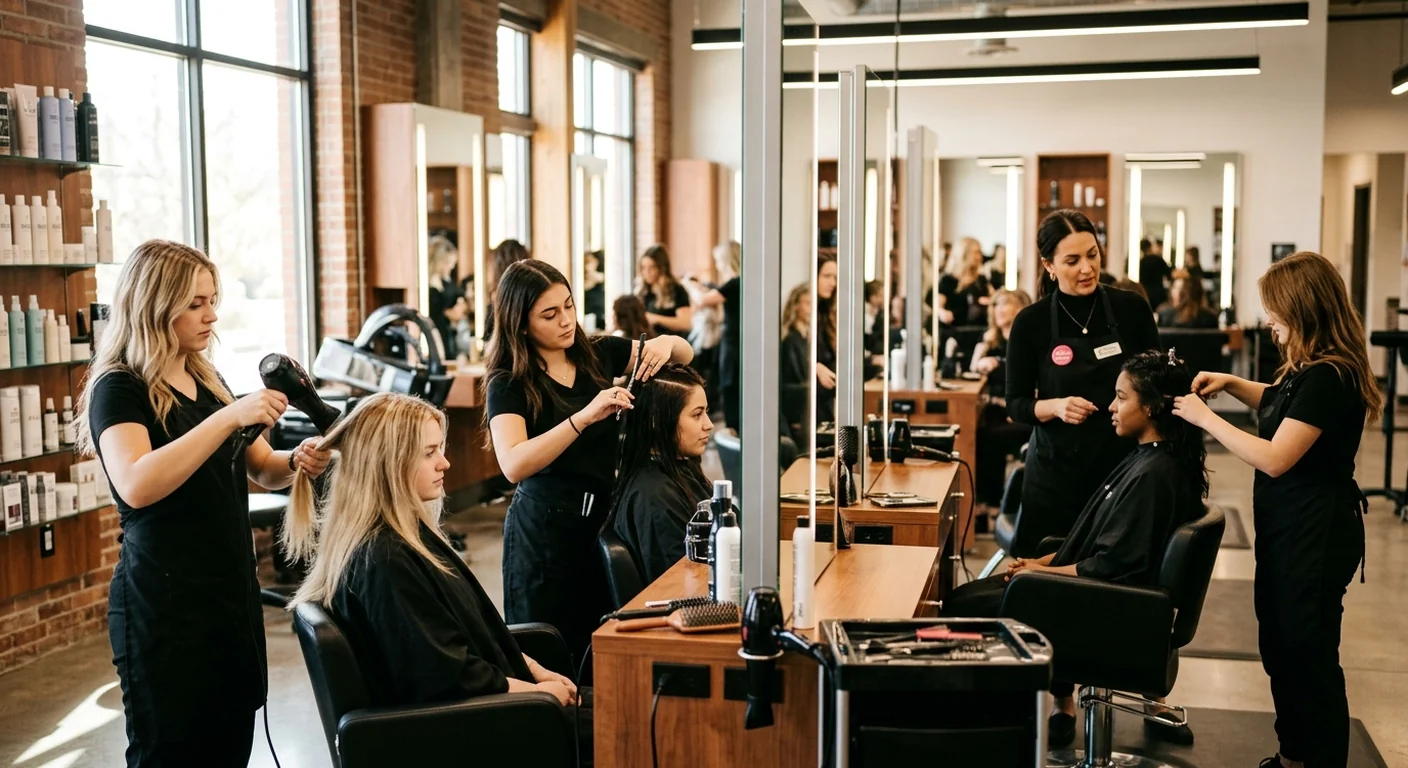
Private cosmetology schools dominate the market. Community college cosmetology programs also exist and are typically less than half the price. Expect tuition to run $6,500 to $20,000 total at private schools and $3,000 to $8,000 at community colleges. Add $1,200–$2,500 for a student kit (shears, dryer, mannequin heads, textbooks).
What to look for in a school:
- State board approval — non-negotiable; your hours only count if the school is state-approved
- Licensure pass rate — ask for the school’s first-attempt NIC/state board pass rate. Anything under 75% is a yellow flag.
- Placement rate — where do graduates actually work? A school that can’t name partner salons is a yellow flag.
- Clinic floor traffic — you need live clients to build speed. Schools in strip malls with walk-in traffic generally give better practical experience than campuses hidden on a side street.
For a broader framework on evaluating beauty schools and other trade schools, see our guide on choosing the right trade program.
Apprenticeship
If apprenticeship is available in your state, it’s a zero-tuition path at the cost of more calendar time and a dependency on one mentor. The trade-off is real: no debt, but the quality of your training is as good as the cosmetologist who takes you on. If you can find a high-volume salon willing to apprentice you under a seasoned stylist, it can be the best financial outcome. If not, school is more predictable.
Step 4: Complete the Required Hours
School hours are split between theory instruction (state laws, infection control, chemistry of color, anatomy of hair and skin, business basics) and practical/clinic work (cutting, coloring, perming, styling, skin and nail services). The ratio varies, but most 1,500-hour programs run roughly 300–500 hours of theory and 1,000+ hours of practical.
Two friction points worth knowing:
- Attendance is audited. Every hour is tracked by the school. Missed hours must be made up, and most schools cap how long you can take to complete (typically 150% of scheduled program length, per federal Title IV rules if the school accepts financial aid).
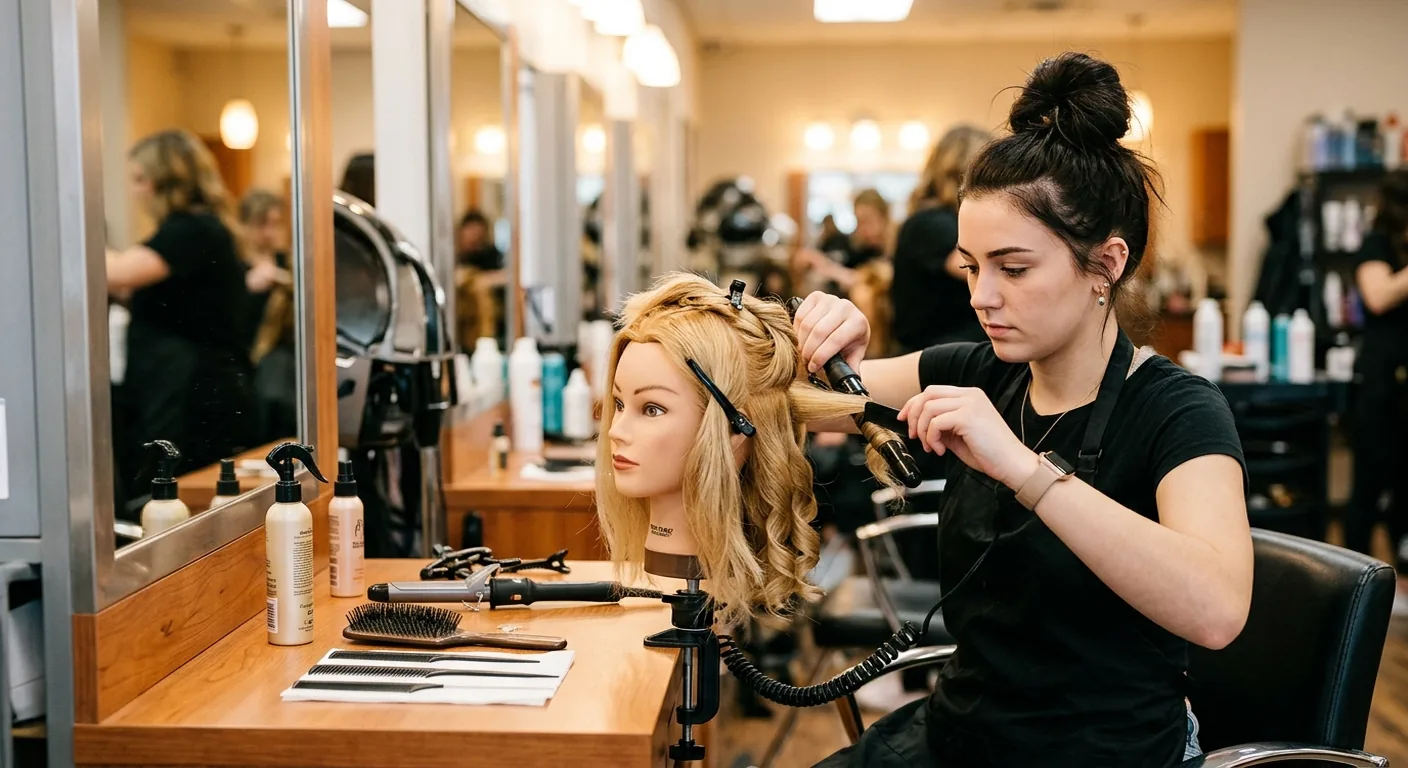
- Clinic work counts only once you pass the “freshman” phase. Most programs keep you on mannequins for the first 200–400 hours before letting you touch live clients. This is fine, but plan for the fact that “I’m halfway through school” doesn’t mean “halfway to being a stylist on real heads.”
Step 5: Pass the NIC Theory (Written) Exam
The National-Interstate Council of State Boards of Cosmetology (NIC) administers the written cosmetology exam in most states. Some states use their own exam instead; a handful use a PSI-delivered variant. Check your board’s website.
From NIC Testing and state exam details reported by Cosmetology Practice:
- Format: Multiple-choice, computer-based at Pearson VUE or state-approved test centers
- Duration: 90 minutes (typical)
- Content: Infection control and safety, anatomy and physiology, chemistry, hair services, skin services, nail services, state law
- Cost: Typically $80–$200 for the written portion, plus a registration fee up to $10 (varies by state — e.g., Virginia charges $99, South Dakota’s combined exam is $120)
The theory exam is pass-or-fail. Passing once moves you to the practical.
Step 6: Pass the NIC Practical Exam
The practical is a live demonstration of services performed on a mannequin (in most states) or a live model (in a few). You’ll be asked to perform a set of clinical services under timed conditions — a haircut, chemical color application, thermal styling, sanitation and infection control, and one or two skin or nail services depending on state scope.
- Cost: Typically $95–$150 for the practical portion
- Duration: 3–5 hours
- What gets people failed: Infection control violations (dirty tools, improper disinfectant use), safety violations (burns, chemicals near eyes), and time overruns
Fail either exam and you retake only the failed portion. Most states let you retake up to three times before requiring remedial hours.
Step 7: Apply for Your License
Once both exams are passed, you apply to the state board. The license fee runs $30–$150 and license validity is typically 1–2 years. Some states require fingerprinting and a separate FBI background check at this stage — budget another $50–$100.
You are now a licensed cosmetologist. The real training — building speed, building a book, figuring out the chemistry of working clients — starts here.
What You’ll Actually Earn in Your First Three Years
BLS reports the May 2024 median at $16.95/hour for hairdressers, stylists, and cosmetologists, but that number doesn’t cleanly reflect what a new licensee takes home. The pay structure varies dramatically by employment model:
Commission salon (most common first job):
- You earn a percentage of service revenue, typically 40–55% as a new stylist
- Clients are scheduled for you by the salon; walk-ins fill gaps
- First-year earnings typically $28,000–$40,000 including tips
- Benefits, training, and ongoing education included — this is the on-ramp most new licensees take
Salary + commission (chain salons like Supercuts, Great Clips, Sport Clips):
- Hourly base plus commission on services over a threshold
- First-year earnings $30,000–$42,000 including tips
- High client volume, less creative work, but a predictable paycheck and the fastest way to build cutting speed
Booth rental (not recommended in year one):
- You pay the salon a weekly rent ($150–$400+) for a chair and keep 100% of your service revenue minus expenses
- Requires an existing clientele — new licensees without a book typically lose money for months
- Experienced booth renters earn $50,000–$90,000+, but it’s an experienced-stylist move, not a first job
Independent contractor in a booth-rental-only salon:
- Same math as booth rental; some states classify this differently for tax purposes
- Confirm your state’s W-2 vs. 1099 rules before signing
The top 10% of cosmetologists ($33.76+/hour, per BLS) are almost exclusively booth renters with established books, specialty colorists at high-end salons in major metros, or salon owners. The ceiling is real — but you reach it in year 4–7, not year 1.
Timeline and Total Cost Estimate
For a 1,500-hour state (average), here’s a realistic budget and schedule:
| Phase | Timeline | Cost |
|---|---|---|
| Research and enroll | 1–2 months | Application fees ~$100 |
| School (full-time, 1,500 hours) | 12–15 months | Tuition $6,500–$20,000 + kit $1,500 |
| NIC theory + practical exam | 1–2 months after graduation | ~$200–$350 |
| License application + background check | 1 month | ~$100–$250 |
| Total | ~14–18 months | ~$8,500–$22,000 |
Community college programs substantially lower the tuition number. Apprenticeship eliminates tuition but extends the calendar to 2+ years.
For strategies on financing the tuition component without derailing your budget, see our guide on financing trade school.
Three Things That Will Slow You Down (And How to Avoid Them)
1. Missed hours. Every absence has to be made up, and most schools cap total enrollment length. Treat attendance like a job from day one.
2. Weak practical performance. You won’t pass the NIC practical if you can’t perform basic services cleanly under time pressure. The students who pass first-try are the ones who spent clinic hours on volume, not just technique. If your school lets you book more clients, book more clients.
3. Picking a state without thinking about reciprocity. Moving after you’re licensed is possible but not always clean. Some states have reciprocity agreements; others require you to sit for their state law exam, complete supplemental hours, or both. If you think you’ll move within 3 years, research the destination state’s reciprocity policy before enrolling.
Where This Path Leads
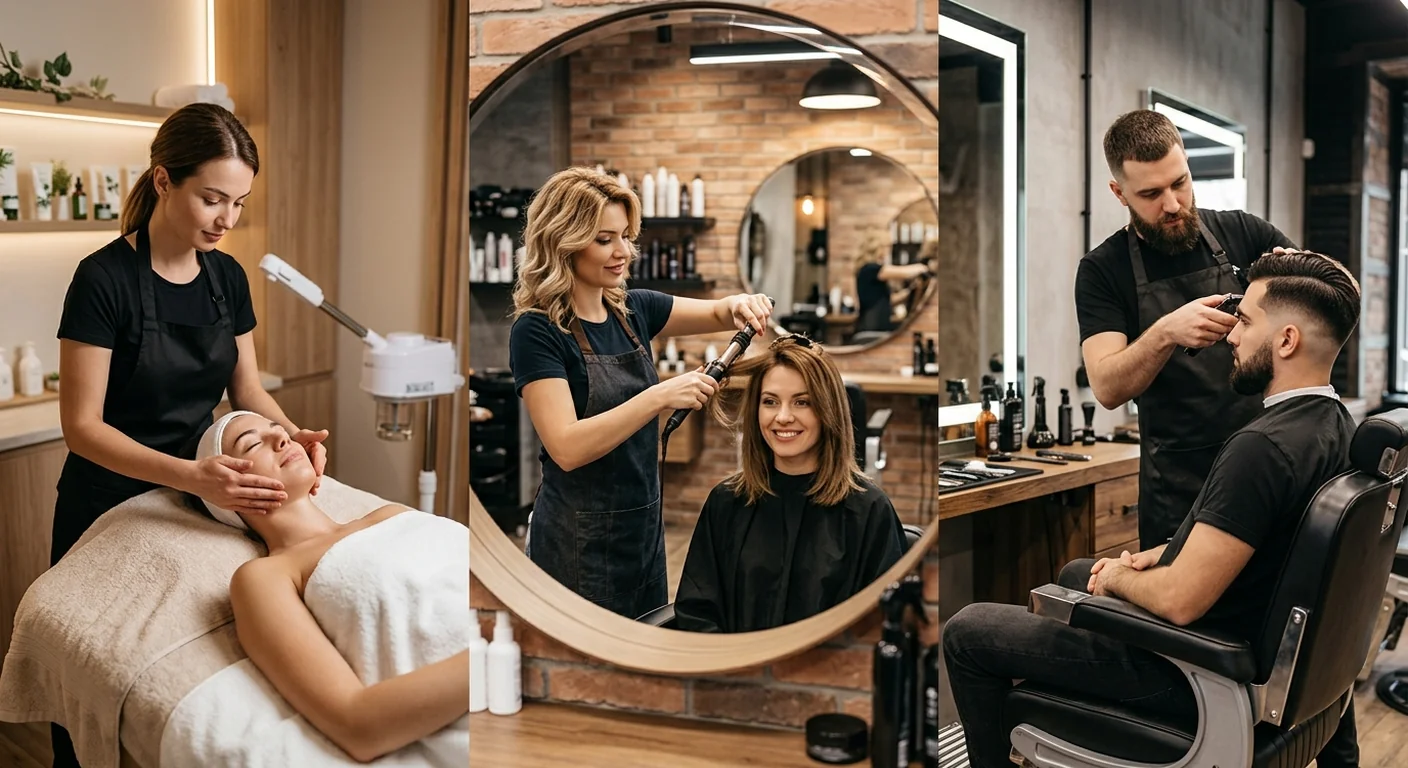
A cosmetology license is broader than “hairdresser” — it’s a legal credential to perform hair, skin, and nail services in every state that recognizes your license. From that baseline, licensed cosmetologists commonly move into:
- Specialty colorist — highest commission-based earnings in most markets
- Bridal and editorial stylist — freelance and event-based work
- Educator — at cosmetology schools, or brand educator for a product line (Redken, Pravana, etc.)
- Salon owner — requires business training; the path to 6-figure personal income for most top earners
- Platform artist / product educator — travel-based work with major beauty brands
For a full look at the career ceiling and where cosmetologists are hiring right now, read our companion guide on cosmetology career opportunities. If you’re looking at specific training programs, the aggregated cosmetology program directory lists accredited schools nationwide.
The license is the door. What you do after you walk through it — which salon you start at, how fast you build speed, when you move from commission to booth rental — determines whether “cosmetologist” is a $30k job or a $90k one.
Sources
- Barbers, Hairstylists, and Cosmetologists — U.S. Bureau of Labor Statistics, Occupational Outlook Handbook — May 2024 wage and employment data — https://www.bls.gov/ooh/personal-care-and-service/barbers-hairstylists-and-cosmetologists.htm
- PJ’s College of Cosmetology — “Complete Guide to Cosmetology Licensing Requirements by State (2025)” — State hours requirements — https://www.gotopjs.com/blog/complete-guide-to-cosmetology-licensing-requirements-by-state-2025/
- NIC Testing (National-Interstate Council of State Boards of Cosmetology) — Official exam provider — https://nictesting.org/
- Cosmetology Practice — “NIC Cosmetology: Everything You Need to Know (2025)” — Exam format and fees — https://www.cosmetologypractice.com/need-to-know
- Louisville Beauty Academy — “State-by-State Cosmetology License Transfer Guide (March 2025)” — Reciprocity and state-specific hour requirements — https://louisvillebeautyacademy.net/state-by-state-cosmetology-license-transfer-guide-comprehensive-research-as-of-march-2025/