Medical billing and coding is one of the few healthcare careers you can break into without any prior healthcare experience, without college debt, and without a licensing board slowing you down. The BLS Occupational Outlook Handbook lists the May 2024 median wage at $50,250, with projected growth of 7% through 2034 and about 14,200 openings per year. The credential that matters is a national certification from AAPC or AHIMA — not a degree, not a state license.
That sounds simple, and mechanically it is. What stalls most newcomers is sequencing: picking the wrong exam first, paying for a certificate program that doesn’t prepare them for a real credential, or passing the test but not having the externship hours to remove the apprentice designation that caps their pay. This guide walks the full path from zero to a fully-credentialed coder who can work remote.
What Medical Billers and Coders Actually Do
Before committing to the training, it helps to know what the work is.
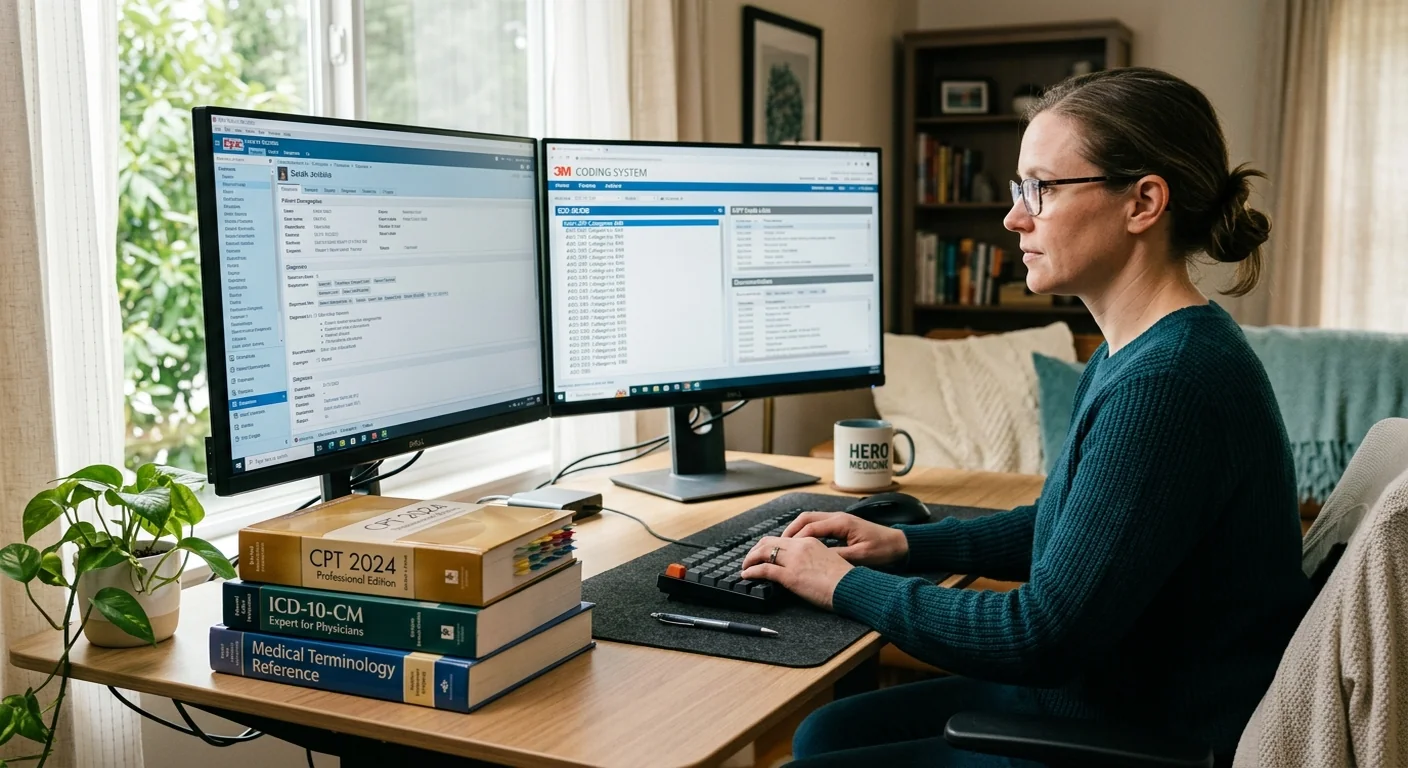
Coding is reading a patient chart — physician notes, labs, procedure reports, discharge summaries — and translating the clinical story into three code sets: ICD-10-CM (diagnoses), CPT (procedures), and HCPCS (supplies and services). Those codes become the claim.
Billing is taking the coded claim, submitting it to insurance, chasing down denials, posting payments, and following up on the patient balance. Many coders also bill, especially in small practices; in large hospitals and vendor shops, the two roles specialize.
Both are desk-and-computer jobs with minimal patient contact. For a broader picture of the career — salary, remote-work patterns, and what the market looks like — see our companion article on medical billing and coding career opportunities.
Step 1: Meet the Baseline Requirements
Before you spend money on training, confirm the fixed gates. They’re lower than most healthcare fields:
- Education: High school diploma or GED — required for every entry-level credential
- Age: 18+ at most programs; no age ceiling
- Background check: Employers run one before hire. Felony convictions and any fraud-related history are problematic in healthcare but don’t automatically disqualify — disclose honestly on applications.
- No licensing: There’s no state board for medical coding. Every state accepts the same AAPC and AHIMA certifications.
- Work environment: A reliable computer, broadband, and a quiet space to work. Remote employers verify this before hire.
- Soft skills that matter: comfort with written rules and reference lookups, tolerance for repetitive detail, willingness to ask providers clarifying questions when documentation is incomplete.
If you’re a career changer from administrative work, accounting, insurance, or any office-based role, you already have most of the transferable skills. If you’re coming from clinical work (CNA, medical assistant, pharmacy tech), you have a major advantage on the medical-knowledge side but less on the reimbursement side — plan more study time for insurance and claim workflow.
Step 2: Choose a Training Path
There are three realistic routes in. The right one depends on your budget, timeline, and how far you want the credential to carry you.
Path A: Certificate Program (4–9 Months)
Most new entrants take a medical coding certificate at a community college or vocational school. Tuition typically runs $1,500–$10,000 depending on whether the school is public or private and whether it includes exam vouchers. Programs cover medical terminology, anatomy, pharmacology basics, ICD-10-CM, CPT, HCPCS, HIPAA, and claim submission.
Browse local medical insurance coding specialist programs for colleges in your region. Two program attributes matter most:
- Does it explicitly prepare you for CPC or CCA? If a program says it teaches “billing and coding” but doesn’t name a target credential, pass — you’ll finish and still need exam-specific prep.
- Does it include a practicum or externship? 80–120 hours of real-office coding experience is the single most valuable part of the program, because it counts toward removing apprentice status from a CPC-A.
Path B: Associate Degree (2 Years)
A Health Information Technology (HIT) associate degree covers the same coding material plus electronic health records, health data analytics, privacy law, and healthcare finance. Look at health information technology programs for local options. Graduates of CAHIIM-accredited HIT programs are eligible for AHIMA’s RHIT credential, which opens doors to supervisory and health-information-management roles that a certificate alone won’t reach.
Pick the associate route if you might want to move into compliance, auditing, revenue-cycle management, or data analytics in 5–10 years. If you’re certain you want to be a front-line coder, a certificate is faster and cheaper.
Path C: Self-Study (Not Recommended for First-Timers)
AAPC sells self-paced online courses and the Practicode simulation platform. These work as supplements or for career changers with prior healthcare exposure — but if you’ve never seen a medical chart, self-study has a high dropout rate and gives you no externship hours. Use self-study to extend a certificate program, not replace it.
For help paying for any of these paths, our guide to financing trade school covers Pell Grants, the Workforce Innovation and Opportunity Act (WIOA), and employer-sponsored tuition assistance — all of which apply to medical coding training.
Step 3: Build the Foundation Knowledge
Regardless of path, you can’t skip these subjects. They’re tested on every credential exam and used every single workday:
- Anatomy and physiology — body systems, organ function, common diseases
- Medical terminology — prefixes, roots, suffixes, abbreviations used in charts
- Pharmacology basics — common drug classes, routes of administration, generic vs brand
- ICD-10-CM — diagnosis coding, including the conventions and guidelines volume
- CPT — procedure coding across surgery, radiology, laboratory, evaluation and management, anesthesia
- HCPCS Level II — supplies, equipment, drug administration codes
- Insurance and reimbursement — commercial payers, Medicare Parts A/B, Medicaid, workers’ comp, coordination of benefits
- HIPAA compliance — privacy, security, breach notification rules
A well-structured certificate program walks you through all of this in order. If you’re self-studying, AAPC and AHIMA both publish reading lists tied to their exam blueprints.
Step 4: Pick a Certification Track
This is the most consequential decision in the path. Three credentials dominate the field.
| Credential | Issuer | Cost | Exam | Who it’s for |
|---|---|---|---|---|
| CCA | AHIMA | $199 member / $299 non-member | 105 questions, 2 hours | First credential, entry-level |
| CPC | AAPC | $425 (+$222 membership) | 100 questions, 4 hours | Most widely recognized, outpatient-focused |
| CCS | AHIMA | $299 member / $399 non-member | 107 questions, 4 hours | Advanced, inpatient hospital coding |
CCA — Certified Coding Associate
The CCA from AHIMA is the friendliest first exam. Two-hour sitting, $199–$299 cost, and only a high school diploma required. Experience or an approved coding program is recommended but not required. A scaled score of 300 passes. CCA is explicitly branded as entry-level, which means it opens entry-level jobs but won’t, by itself, put you at the top of a stack of applicants competing for a hospital coding role.
CPC — Certified Professional Coder
The CPC from AAPC is the most widely recognized coding credential in the U.S., particularly for physician offices and outpatient clinics. 100 multiple-choice questions in 4 hours, 70% passing, cost is $425 for a single attempt (or $499 with a retake bundled), plus $222 annual AAPC membership. You’ll need to maintain the membership and earn CEUs every year to keep the credential active.
If you pass without two years of professional experience, you receive the CPC-A (Apprentice) designation. A CPC-A can work as a coder but tends to earn closer to the 25th percentile than the median. Removing the “A” is a core step — see Step 6 below.
CCS — Certified Coding Specialist
The CCS from AHIMA is the inpatient hospital credential. 107 questions in 4 hours, passing score 300, cost $299/$399. AHIMA reports 36,925 active CCS holders as of December 2025, with an 84% first-time pass rate in 2025 (up from 64% in 2023). Eligibility requires coursework plus one year of coding experience, two years of coding experience, or an existing credential (CCA, CCS-P, RHIT, RHIA). Don’t start here — take CCA or CPC first, work as a coder, then credential up to CCS.
The Right Order for Most People
- Shortest path to a first job: CCA → first coding job → CPC (now employer-sponsored) → specialty credentials
- Highest long-term pay ceiling: CPC → first coding job → CCS (after 2 years) → specialty and auditor credentials
- Inpatient hospital track specifically: associate degree in HIT → RHIT → CCS
Step 5: Pass Your Exam
Each credential has an exam format you need to train for specifically. General coding knowledge alone won’t carry you through test day.
Study Strategy
- Plan 2–3 months of dedicated prep after finishing coursework. Aim for 10–15 hours per week.
- Use official AAPC or AHIMA practice exams, not just third-party question banks. They match the real blueprint.
- Time yourself. The CPC averages ~2.4 minutes per question; CCA is faster at ~69 seconds each; CCS is the most time-generous at ~2.25 minutes per question.
- Build tabs and notes in your code books. The CPC is open-book — you’re allowed approved editions of ICD-10-CM, CPT, and HCPCS manuals. Tabbing them well saves minutes.
- Don’t rely on free YouTube prep alone. The videos are useful for warming up on concepts but rarely mirror exam difficulty. Pair them with paid practice exams.
Test-Day Specifics
- CPC: 100 questions, 4 hours, 70% passing. Results in 7–10 business days.
- CCA: 105 questions (90 scored + 15 pretest), 2 hours, scaled 300 passing.
- CCS: 107 questions (97 scored + 10 pretest), 4 hours, scaled 300 passing. 30-day wait between retakes.
Pass rates improve dramatically for candidates who complete a structured program and take at least 150–200 practice questions before test day. Candidates who self-study without simulation tend to fail the first sitting and retake — budget for that possibility with the $499 two-attempt CPC bundle if self-study is your only option.
Step 6: Land Your First Job (and Remove CPC-A Status)
Passing the exam is the ticket in. Getting paid at the median and removing apprentice status takes 12–24 months of actual work.
Where to Apply
- Physician practices and clinics — smallest shops, easiest entry, narrowest exposure
- Hospital coding departments — competitive for new grads, highest ceiling
- Billing service companies — handle claims for many practices; volume-based work that builds speed fast
- Insurance payers — reviewing claims from the other side of the transaction
- Healthcare staffing agencies — Aston Carter, Addison Group, and healthcare-specialized temp agencies have pipelines into entry-level coding contracts
Apply broadly. New coders often take the first offer they get, work 6–12 months to build resume credibility, and then job-hop to a better-paying role.
Removing the CPC-A Apprentice Status
This is the step newcomers most often leave on the table. According to AAPC’s applied experience guide, you can remove the “A” in three ways:
- Two years of on-the-job coding experience documented by employer verification letters (signed, on letterhead, specifying dates and duties)
- One year of experience plus AAPC’s Practicode program — 600 cases completed at 70% or higher accuracy
- One year of experience plus an approved medical coding preparation course
The Practicode path is the fastest for someone who wants to halve the experience requirement. It’s not free — expect $300–$500 depending on your AAPC membership tier — but if you’re motivated, it’s doable in 4–8 weeks on top of a regular workday.
Start collecting employer verification letters from your first day, not when you’re ready to submit. Processing time on apprentice removal is 2–4 weeks after documentation is complete.
Step 7: Go Remote (When You’re Ready)
The appeal of this field is the remote work ceiling, not the entry. According to AAPC’s 2026 Salary Report, 80.2% of medical records specialists work entirely or partly remotely, with 64.8% working fully remote. But most employers want 1–2 years of in-office production before letting you work from home.
Once you’ve got audited production history, remote-first shops — R1, Optum, Ciox, Maxim, and dozens of smaller vendors — will interview you. Remote job postings typically require:
- CPC or CCS in good standing (no apprentice designation)
- 18–24 months of documented coding experience
- A HIPAA-compliant home office (locking room, wired ethernet, employer-provided laptop)
- References from a current or recent coding supervisor
Plan the first phase of your career accordingly: take the on-site job, build speed and an audit trail, then transition to remote with a portable credential.
What You’ll Earn Along the Way
Coder pay has four phases with meaningfully different numbers. The BLS May 2024 median is $50,250; AAPC’s 2024 survey reports an average of $62,689 for AAPC-credentialed professionals. The difference is largely credentialing and experience.
| Stage | Typical range | Notes |
|---|---|---|
| Training / entry (CPC-A, CCA, no exp) | $35,000–$42,000 | 10th–25th percentile BLS |
| Credentialed, 1–2 years | $45,000–$55,000 | Around BLS median |
| Full credential (CPC or CCS) + 3–5 years | $55,000–$70,000 | AAPC average territory |
| Multi-credential + specialty (5+ years) | $70,000–$85,000+ | Top pctile reaches $80,950 (BLS); $76,035 avg for 3+ AAPC creds |
Auditing, compliance, and revenue-cycle leadership roles exceed these numbers by another $15,000–$30,000. If you know you want to climb, plan credential stacking and an associate degree (or RHIT) from the start. See our guide to trade certifications and licenses for more on how credential stacking affects pay across healthcare trades.
Common Mistakes That Stall Applications
- Testing too early — sitting the CPC with shaky medical terminology is a guaranteed retake. Use practice exams as a gate: if you’re not scoring 75%+ consistently, delay.
- Skipping the externship — certificate programs without practicum hours make CPC-A removal much slower and reduce your odds of a first interview.
- Picking a generic “medical office” certificate — it teaches too many things shallowly. If the program doesn’t explicitly prepare you for CPC or CCA, walk.
- Letting membership lapse — AAPC membership must be kept current to sit for exams and maintain the credential. Treat the annual $222 as non-negotiable.
- Relying solely on free YouTube — useful as a supplement, unreliable as a full prep. Budget for paid practice exams.
- Applying only to hospitals as a new grad — hospital coding is competitive. Start at a physician practice, billing company, or payer, then move.
- Not documenting experience for CPC-A removal — get letters from day one. Reconstructing job history years later is painful.
Timeline Cheat Sheet
Fast path (motivated, no constraints): ~8–10 months
- Month 0–6: Certificate program + practicum
- Month 6–8: CCA or CPC exam prep and sitting
- Month 8–10: Apply broadly; accept first offer
- Month 10+: Begin collecting employer verification letters; plan apprentice removal at month 22 (or month 18 with Practicode)
Community college associate path: ~24 months
- Semester 1: Medical terminology, anatomy
- Semester 2–3: Coding core, HIPAA, reimbursement
- Semester 4: Practicum + capstone + exam sitting
- Post-graduation: Hiring process; eligible for RHIT credential if CAHIIM-accredited program
Career changer with prior healthcare background: ~6 months
- Skip medical terminology / anatomy refresher
- Month 0–3: CPC-specific coding course + Practicode
- Month 3–4: Exam
- Month 4–6: Apply and land role
What Comes Next
Once you’re working, the next career-shaping decision is which specialty to credential in. AAPC offers specialty credentials across anesthesia, cardiology, emergency department, evaluation and management, family practice, OB/GYN, orthopedics, pediatrics, and surgical coding. Specialty CPCs typically earn $5,000–$15,000 above generalist CPCs. We’ll cover how to pick a specialty — and how CPC, CCS, and CCA compare head-to-head on pay — in upcoming articles.
Sources
- U.S. Bureau of Labor Statistics — Occupational Outlook Handbook: Medical Records Specialists — May 2024 — https://www.bls.gov/ooh/healthcare/medical-records-and-health-information-technicians.htm
- AAPC — Certified Professional Coder (CPC) Credential — https://www.aapc.com/certifications/cpc
- AAPC — Apprentice Removal: Applied Experience Requirements — https://www.aapc.com/apprentice/applied-experience.aspx
- AAPC Knowledge Center — “Survey Says: AAPC Credentials Insulate Members From Inflation” (2024 Salary Report) — https://www.aapc.com/blog/92000-survey-says-aapc-credentials-insulate-members-from-inflation/
- AAPC — 2026 Medical Coding and Billing Salary Report — https://www.aapc.com/resources/medical-coding-salary-survey
- AHIMA — Certified Coding Associate (CCA) Certification Overview — https://www.ahima.org/certification-careers/certifications-overview/cca/
- AHIMA — Certified Coding Specialist (CCS) Exam Information — https://www.ahima.org/certification-careers/certification-exams/ccs/