
Becoming a firefighter is one of the few career paths where the demand is measurable, the pay is livable from day one, and the credentials you need cost a fraction of a four-year degree. The BLS Occupational Outlook Handbook lists the median firefighter wage at $63,890 as of May 2024, with about 27,100 openings projected every year through 2034. The hiring pipeline is real — but the steps to get into it are specific, and doing them in the wrong order is the single most common reason applications stall.
This guide walks the full path from no experience to your first shift at a career department: what baseline requirements you actually need, why EMT comes before the academy, how to train for the CPAT, what certifications you’ll earn, how the hiring process works, and what you’ll be paid at each stage.
What Firefighters Actually Do
Before committing to the path, it helps to know what the job is — because the popular image is misleading. Modern career firefighters spend the majority of their shifts running medical calls, not structural fires. Vehicle accidents, cardiac events, overdoses, rescue calls, and hazmat responses dominate most dispatch logs. Structural fires are a relatively small fraction of runs at almost every department.
That’s why the dual-role firefighter/EMT has become the default. Most career departments now require candidates to hold at least an EMT-Basic certification before they can apply. If you’re starting from zero, plan on EMT school being the first thing you pay for — not the academy.
For a broader picture of day-to-day work, salary ranges, and why the first-responder workforce shortage is creating hiring pressure nationwide, see our companion article on firefighter and EMT career opportunities.
Step 1: Meet the Baseline Requirements
Before you spend a dollar on training, make sure you clear the fixed gates. These don’t vary much between departments:
- Age: Minimum 18 at application; some departments require 21
- Education: High school diploma or GED
- Driver’s license: Valid, clean record required (DUIs and reckless driving are near-automatic disqualifiers at most departments)
- Citizenship or permanent residency (varies by jurisdiction)
- Clean background check: No felony convictions; some misdemeanors will disqualify depending on recency and pattern
- Drug test: Nearly universal at offer stage; some departments test cannabis use even in legal states
- Vision and hearing: Correctable to department standard
FireRescue1 documents 11 common baseline requirements that fire departments apply with remarkable consistency. The single most common preventable disqualifier at the background stage isn’t a criminal record — it’s driving history. If yours has issues, start cleaning it up now, because every year of clean driving matters at the background investigation.
Step 2: Get Your EMT Certification First
This is the step most newcomers get wrong. They sign up for a fire academy, then discover that applications in their region require EMT certification at the time of application — meaning the academy wasn’t the bottleneck.
EMT-Basic certification runs 150–200 classroom hours and typically takes 3 to 6 months through a community college, hospital program, or dedicated EMT school. Cost is usually $800–$1,500 before books, fees, and the National Registry of Emergency Medical Technicians (NREMT) exam fee.
Why this order matters:
- Most career departments require EMT at application, not at hire. You can’t apply without the card.
- EMT experience itself is hireable work. Many candidates work 12–18 months on an ambulance while applying to fire departments, which puts paychecks and real patient contact on the résumé.
- Some states fold EMT into the academy, but even there, holding the cert independently lets you apply earlier and more broadly.
A handful of departments hire “firefighter-only” (no EMT) and train medics post-hire, but they’re the exception and usually reflect a department with paramedic-level ambulance service staffed separately. The dual-role standard covers most of the career market.
Step 3: Pass the Candidate Physical Ability Test (CPAT)
The CPAT is the standardized physical test developed by the IAFF and IAFC in 1999 and now used by more than 900 jurisdictions. It’s designed to simulate the physical demands of the job under realistic load.
The eight events, in order:
- Stair climb (3 min, with 25-lb hose pack on top of the vest)
- Hose drag
- Equipment carry
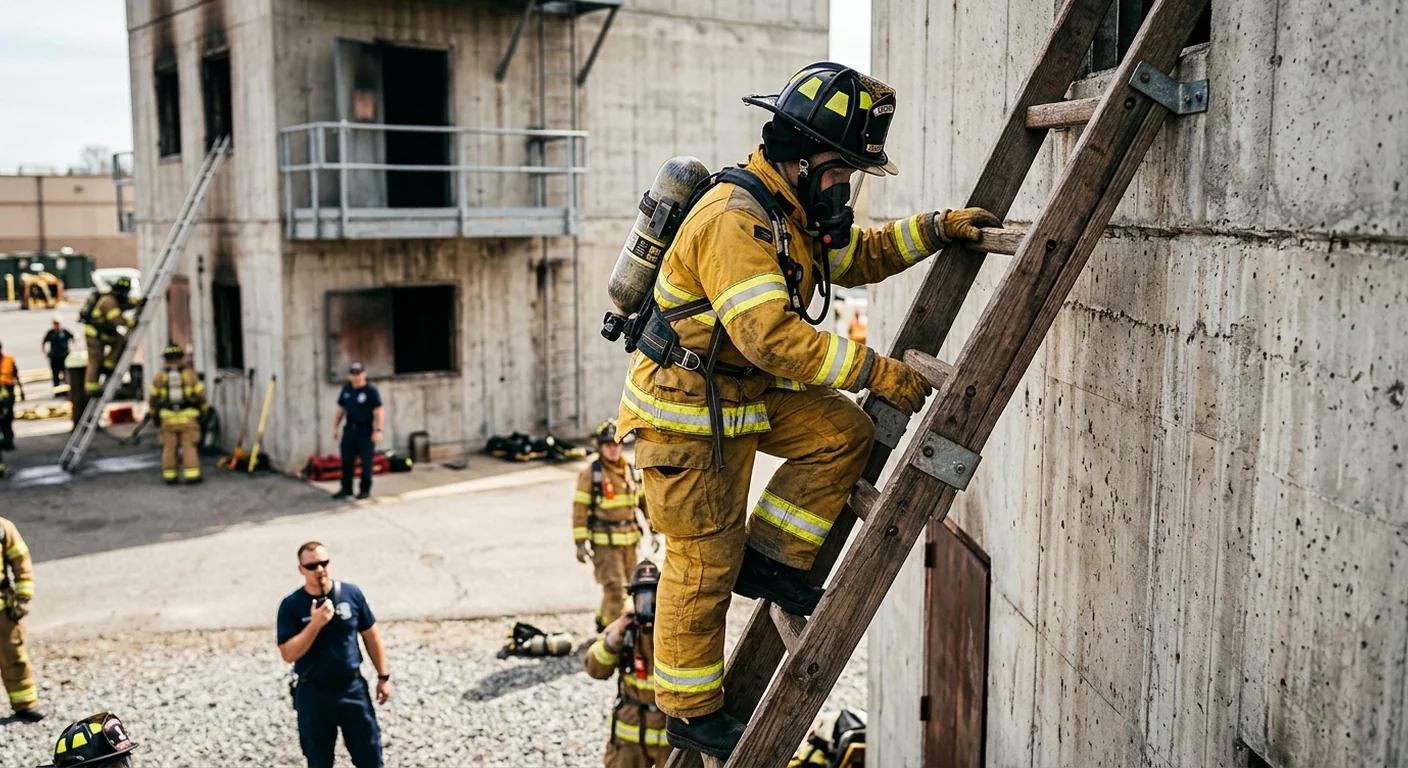
- Ladder raise and extension
- Forcible entry (sledge simulator)
- Search (crawl through darkened tunnel)
- Rescue (drag a 165-lb dummy)
- Ceiling breach and pull
The constraints:
- Total time: 10 minutes 20 seconds for all eight events
- Required gear: 50-lb weighted vest for the full test, +25 lb for the stair climb
- One failure = full failure. If any single event is incomplete or unsafe, the whole test fails.
The IAFC CPAT standards require each candidate to be offered at least two orientation sessions within eight weeks of the test, so you can physically try the equipment before the scored run.
How to train for the CPAT
The CPAT is not a general fitness test — it’s a work-capacity test under weighted-vest load. Generic gym training will get you strong but can leave you gassed after event three. A realistic prep timeline:
- 3 months out: Build an aerobic base (30–45 min sustained output), add compound lifts (squat, deadlift, farmer carry, loaded step-ups)
- 2 months out: Start weighted-vest work (start at 20–30 lb, add a stair-climber component)
- 1 month out: Simulate full-gear output — weighted-vest intervals, dummy drags, sledge swings, ladder climbs if you can access them
- Orientation sessions: Attend both offered windows. Touching the actual equipment matters.
A pass is a pass — there’s no bonus for speed. Plan for a comfortable 9:30, not a 10:15 gamble.
Step 4: Choose a Training Path
Once your EMT and CPAT are in hand, you have two main routes into the academy. Both end at a certified firefighter; they differ in cost, time, and what they bundle.
Path A: Direct-entry fire academy
Some departments hire off the street and run you through their own paid recruit academy (12–24 weeks typical). You earn cadet/recruit pay during training, and you leave with a job. These are competitive — hundreds of applicants per opening in mid-size cities — but they’re the fastest route from decision to paycheck.
Path B: Community-college fire academy or fire science program
If you can’t wait for a direct-hire opening, a community college fire science program gets you trained and certified on your own timeline, often with dedicated fire science / firefighting programs across the country. Costs are typically $3,000–$8,000 for the academy portion. You graduate credentialed and applicant-ready — but you pay your own way through training and aren’t guaranteed a job.
Many candidates do a hybrid: take a community-college academy to get hired faster, then complete an associate in fire science while on probation using department tuition benefits. Programs in fire services administration and fire prevention and safety technology can stack on top for promotion paths.
Step 5: Understand NFPA 1001 (and the 2026 NFPA 1010 Transition)
Whichever path you take, the certification you care about is built on NFPA 1001, Standard for Fire Fighter Professional Qualifications. Every U.S. state and territory uses NFPA 1001 as the basis for its firefighter certification. A state-approved academy delivers Firefighter I (entry-level) and typically Firefighter II (crew-capable) certifications.
What’s changing in 2026: NFPA has consolidated several personnel qualifications standards — including 1001 — into a single document called NFPA 1010. Accredited training agencies like the Alabama Fire College are required to implement the consolidated NFPA 1010 standard by June 1, 2026. No new NFPA 1001 certifications are being issued under IFSTA 7th Edition materials after that deadline.
The short version: the content of what you learn doesn’t materially change — it’s the same set of skills, reorganized. If you’re training in 2026, ask whether your academy has transitioned to the 1010 curriculum. Credentials issued under either standard are equivalent.
Credentials are typically stamped IFSAC or Pro Board accredited, which gives them reciprocity when you move between states or departments.
Step 6: Navigate the Hiring Process
Getting hired at a career department is a multi-stage gauntlet that can take 4 to 9 months from application to academy start. A typical process:
- Application (EMT card, driver’s license, résumé, CPAT on file)
- Written exam (cognitive ability, reading comprehension, situational judgment)
- Physical ability retest (some departments retest CPAT or use their own)
- Oral board interview (3–5 officers, scenario questions, “tell me about a time” behavioral)
- Chief’s interview (final leadership assessment)
- Psychological evaluation
- Medical exam (NFPA 1582 standard)
- Background investigation (multi-year driving, employment, neighbors, social media)
- Polygraph (some departments, usually large urban)
- Conditional offer → recruit academy → probationary year on the job
The LAFD qualifications and selection process is a useful reference even if you’re not applying to Los Angeles — it documents each stage publicly, including the 1% education bonus for associate’s degree holders and the full behavioral review.
Plan to apply to multiple departments simultaneously. The candidates who get hired fastest are the ones testing in 4–6 jurisdictions at once.
What You’ll Earn Along the Way
Firefighter pay has three distinct phases with very different numbers:
| Stage | Typical range | Notes |
|---|---|---|
| EMT (while applying) | $35,000–$50,000 | Private ambulance / hospital-based |
| Recruit/probationary | $45,000–$65,000 | Paid academy + first-year step |
| Journey (full step) | $65,000–$110,000+ | Base pay before overtime; varies sharply by region |
| Officer (lieutenant/captain) | $90,000–$150,000+ | Typically 5–10 years in, often with degree requirement |
The May 2024 BLS median of $63,890 reflects base pay — it understates take-home for most career firefighters. Schedule overtime (staffing holes, training, callback) and specialty pay (paramedic, rescue, hazmat, truck) routinely add 20–40% to W-2 earnings in busy departments.
High-cost metros run well above the national median. Bay Area, LA, Seattle, Boston, and New York journey firefighters commonly earn $100K+ base with total comp in the $140K–$180K range when overtime is included.
Common Mistakes That Kill Applications
These come up again and again at the background and oral board stages:
- Letting EMT certification lapse during the hiring process — renew aggressively
- Driving record — tickets in the year before application, never mind a DUI, sink more candidates than any other single factor
- Social media — assume the background investigator will read everything you’ve posted for the last ten years
- Inconsistent application stories — what you write in the background packet must match what you say in the oral and chief’s interviews
- Declining CPAT slots to “train more” — the card expires, and you may miss a hiring cycle
- Applying to only one department — candidates who test at 4+ jurisdictions get hired 2–3x faster
Timeline Cheat Sheet
Fast path (motivated, no constraints): ~12 months
- Month 0–5: EMT school, certification, start ambulance work
- Month 3–6: Train for CPAT, take first attempt
- Month 4–10: Apply to multiple departments; clear written, oral, chief
- Month 10–12: Medical, background, conditional offer
- Month 12+: Recruit academy begins
Community college path: ~24 months
- Semester 1: EMT
- Semester 2–3: Fire science core + academy portion
- Concurrent: CPAT prep and apply while in program
- Post-graduation: Hiring process, academy (if not bundled)
Either way, the people who move fastest are the ones who treat the whole process as a pipeline problem — keeping multiple applications, certifications, and physical training tracks running in parallel rather than sequentially.
What Comes Next
Once hired, the next decision is whether to pursue a fire science degree during probation. That’s a distinct question — the academy gets you the badge, but whether a degree is worth the tuition comes down to your department’s promotion structure. We cover that trade-off in our article on fire academy vs. fire science degree.
Sources
- U.S. Bureau of Labor Statistics — Occupational Outlook Handbook: Firefighters — May 2024 — https://www.bls.gov/ooh/protective-service/firefighters.htm
- International Association of Fire Fighters (IAFF) — Candidate Physical Ability Test (CPAT) — https://www.iaff.org/cpat/
- International Association of Fire Chiefs (IAFC) — Candidate Physical Ability Test — https://www.iafc.org/topics-and-tools/safety-health/wellness-fitness-task-force/candidate-physical-ability-test
- National Fire Protection Association (NFPA) — NFPA 1001 Standard Development — https://www.nfpa.org/codes-and-standards/nfpa-1001-standard-development/1001
- Alabama Fire College — NFPA 1010 Standards Consolidation — 2026 — https://www.alabamafirecollege.org/nfpa-1010-standards-consolidation-implications-for-recruit-firefighter-training-in-alabama/
- FireRescue1 Staff — “11 requirements to become a firefighter” — FireRescue1 — https://www.firerescue1.com/firefighter-training/articles/11-requirements-to-become-a-firefighter-FO0ZZpNdggP1GAmq/
- City of Los Angeles Fire Department — Qualifications and Selection Process — https://www.joinlafd.org/qualifications-and-selection-process
- Firehouse Magazine — “The Pros and Cons of the Dual-Role Firefighter/EMT” — https://www.firehouse.com/ems/article/53097847/the-pros-and-cons-of-the-dual-role-firefighter-emt