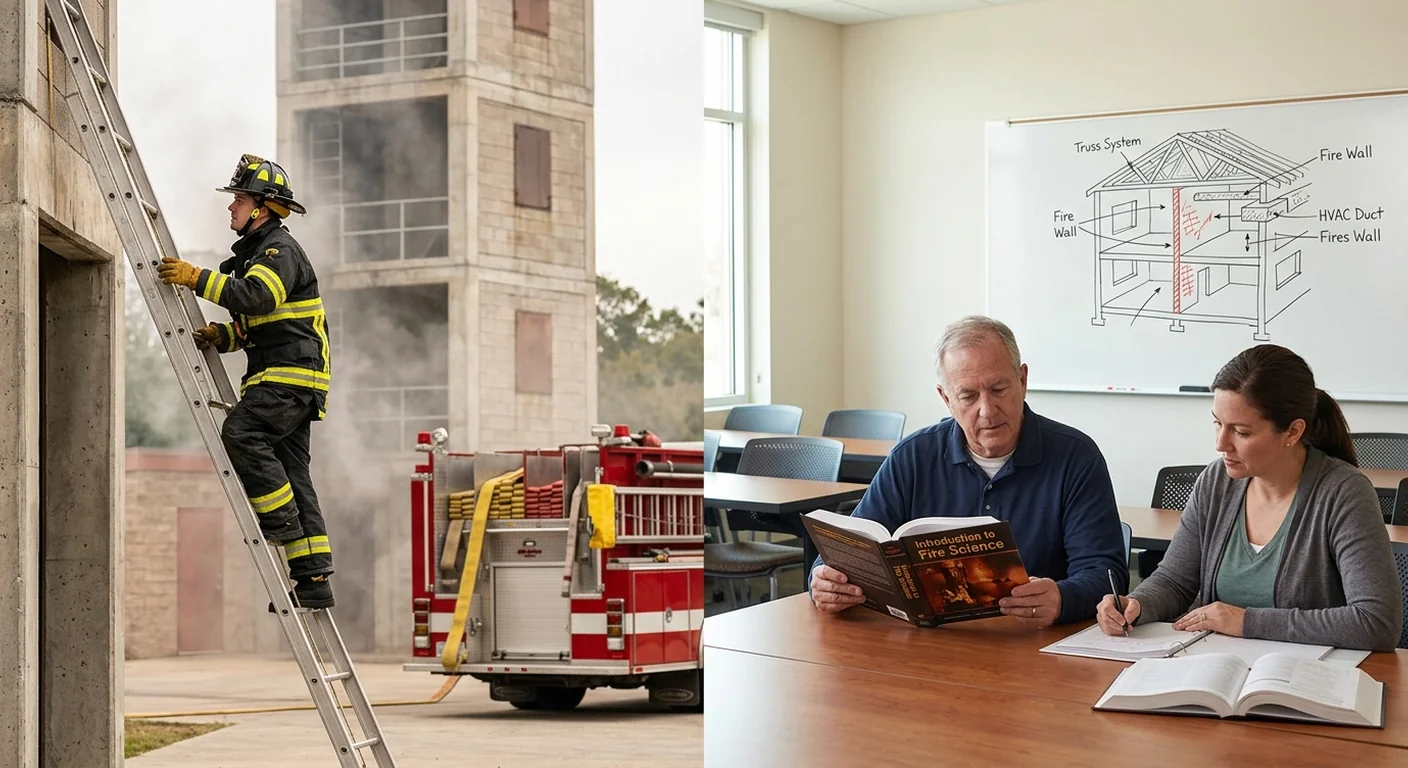

“Should I go to a fire academy or get a fire science degree?” is one of the most asked questions in the career-firefighter pipeline — and one of the most commonly answered wrong. The short version is that the two do different things at different career stages, and the right question is which order to do them in, not which one to pick.
This guide lays out what each credential actually delivers, what hiring departments require versus prefer, when a degree starts to matter for promotion, and how FESHE-recognized community college programs combine both.
What a Fire Academy Actually Is
A fire academy is a skills-certification program delivering hands-on firefighter training to the NFPA 1001 standard. On completion you hold Firefighter I (entry-level) and usually Firefighter II (crew-capable) credentials, stamped IFSAC or Pro Board accredited for reciprocity.
Typical academy parameters:
- Length: 12–24 weeks full-time (400–700+ contact hours)
- Cost: $3,000–$8,000 for a community-college academy; free if it’s a department-paid recruit academy
- Content: Fireground operations, ladders, hose, SCBA, search and rescue, ventilation, hazmat awareness/operations, vehicle extrication, live fire evolutions
- Outcome: Credential that makes you eligible to apply — or in direct-hire models, your first firefighter job
Academies are practical and operational. You leave able to do the job. What they don’t teach is why a department is organized the way it is, how fire service economics work, or how to manage people — the things that come up when you’re eligible to promote.
What a Fire Science Degree Actually Is
A fire science degree is an academic credential — an Associate of Science (AS), Associate of Applied Science (AAS), or Bachelor of Science (BS) — built around management, administration, investigation, and prevention topics rather than fireground skills. Many community colleges bundle the academy into the degree, but the degree itself is about what happens above the rank of firefighter.
The U.S. Fire Administration’s FESHE program — Fire and Emergency Services Higher Education — has standardized the curriculum nationally. The FESHE Associate Core defines six core courses every recognized program teaches:
- Principles of Emergency Services
- Fire Behavior and Combustion
- Fire Prevention
- Building Construction for Fire Protection
- Fire Protection Systems
- Principles of Fire and Emergency Services Safety and Survival
A bachelor’s-level FESHE curriculum adds courses in personnel management, community risk reduction, public administration, fire service law, and analytical approaches to community risk. IFSTA publishes 25+ textbooks aligned to the FESHE curriculum.
The Firehouse coverage of FESHE-style programs summarizes it accurately: the degree “is less about learning how to fight fires from scratch and more about preparing experienced responders for leadership.”
For Initial Hiring: Academy Wins (Usually)
Here’s the hiring reality most career departments operate under:
- A fire academy certificate is required or strongly preferred at application
- A degree is rarely required for firefighter I positions
- When a degree is referenced in a job posting, it’s almost always worded as “associate or bachelor’s degree in fire science or related field preferred, or equivalent experience”
FireRescue1’s coverage of the “degree or no degree” question makes this explicit: for initial hiring at most departments, you don’t need a degree, and the academy is what gets you past application screening.
Where a degree does help at hiring time:
- Competitive urban departments. Some top-10 metros see hundreds of qualified applicants per slot; any tiebreaker on the oral board matters.
- Departments with explicit education pay. The Los Angeles City Fire Department awards a 1% education bonus at academy graduation for candidates holding an associate’s degree. That’s a real but modest incentive — roughly $650–$900/year on a $65K base.
- Written-exam scoring. Some departments assign points on structured scoring rubrics that add a few points for associate’s or bachelor’s completion.
The math for a candidate in a hurry is: the academy is the gating credential, the degree is a marginal boost. A 12–16 week academy beats a 2-year associate on time-to-first-paycheck by roughly 18 months.
For Promotion: Degree Wins (Increasingly)
The picture inverts at the promotion stage. The USFA Fire and Emergency Services Professional Development Matrix maps education requirements to rank progression, and it’s now standard in most medium and large departments:
| Rank | Typical education expectation |
|---|---|
| Firefighter | None (academy only) |
| Driver/Engineer | None, or associate’s in larger departments |
| Lieutenant | Associate’s in fire science or related; Fire Officer I cert |
| Captain | Associate’s required; bachelor’s preferred |
| Battalion Chief | Bachelor’s required at most medium+ departments |
| Assistant/Deputy Chief | Bachelor’s required; master’s increasingly common |
| Fire Chief | Bachelor’s required; master’s (MPA, MEd, MPP) common |
FireRescue1’s guide to promotion requirements frames it clearly: “A fire science degree is no longer simply an academic supplement to firefighter academy training. Increasingly, it is the credential that separates firefighters from fire service leaders.”
This isn’t uniform. Small-town and rural departments often have no formal education requirement at any rank. But at any department where there’s real competition for promotion slots — which is most medium and large departments — the candidates without at least an associate’s get filtered out early.
Programs specifically in fire services administration align directly with this promotion track; broader fire science programs and specializations in fire prevention and safety technology or fire arson investigation open officer pathways in specific specialty tracks.
The Smart Combined Path
The question isn’t really “academy or degree.” The question is “which order, and when.” For most candidates, the best sequencing is:
- Earn EMT certification (3–6 months)
- Pass an academy — either direct-hire recruit academy or community-college academy (12–24 weeks)
- Get hired, finish probation (1 year on the job)
- Start an associate’s in fire science while working — most departments offer tuition assistance; many community colleges deliver coursework on schedules compatible with 24/48 shifts
This is the dominant path because:
- You start earning fast (academy credential hires you)
- The department often pays for the degree through tuition reimbursement
- Your practical experience makes the coursework more useful (and easier)
- By the time you’re eligible for lieutenant 5–7 years in, your degree is done
Our article on how to become a firefighter covers the academy-first path in detail, including how to sequence EMT and CPAT training before the academy itself.
FESHE Recognition: What to Look For in a Program
Not every fire science program is FESHE-aligned, and the designation matters for two reasons:
- Transferability. FESHE-recognized community college courses articulate cleanly into bachelor’s programs at partner universities. Non-aligned AS coursework often doesn’t transfer.
- National Fire Academy credit. Students in some FESHE-recognized programs can receive dual credit — college credit plus an NFA certificate — for core courses, which is useful both for résumés and for federal/military education accounting.
When evaluating a program, check:
- Is it listed on the USFA directory of FESHE-recognized degree programs?
- Does the curriculum cover all six FESHE core courses?
- Does it articulate to a FESHE-recognized bachelor’s program if you want to continue?
- Does it use IFSTA / Jones & Bartlett textbooks aligned to the model curriculum?
A FESHE-recognized associate program with articulation to a bachelor’s is the highest-return starting point for someone planning to make the fire service a long career.
Cost and Time: A Side-by-Side
| Path | Time | Typical out-of-pocket | Credential delivered |
|---|---|---|---|
| Fire academy (community college) | 12–24 weeks full-time | $3,000–$8,000 | NFPA 1001 FF I/II |
| Fire academy (department-paid recruit) | 12–24 weeks, paid | $0 (you’re paid) | NFPA 1001 FF I/II + job |
| AS Fire Science (includes academy) | 2 years | $6,000–$16,000 | AS + NFPA 1001 FF I/II |
| AS Fire Science (post-hire, tuition reimbursement) | 2–3 years part-time | Often $0 after reimbursement | AS degree |
| BS Fire Science (post-AS, online) | 2 years | $10,000–$30,000 | BS degree |
The total-cost picture flips dramatically once you’re employed: most medium and large fire departments reimburse tuition for fire-related coursework, which turns the question of whether to get a degree into a question of whether to do the paperwork.
Decision Framework
You’re 18, no experience, want to work ASAP: Academy-only community college program → EMT → apply. Do the degree later on the department’s dime.
You’re a career changer with savings, 25+: Same answer — but if you’re locked out of your current career anyway and the 2-year community college fire science AS fits your budget, the degree does accelerate your future promotion track. Either works.
You’re already a firefighter: Start the AS if you haven’t. Whether you push to a BS depends on whether you want to reach battalion chief and above. If yes, plan for it early — online BS programs in fire administration are plentiful and designed for shift workers.
You want to be a fire chief eventually: Bachelor’s minimum, often master’s. Treat the full education track as part of the career plan from year one, not something to figure out in your late 30s.
You’re aiming at federal fire (USFS, NPS, BLM): A fire science or fire administration degree helps at the fire management officer and prevention specialist ranks but is less relevant on the suppression track. See our article on wildland firefighter careers for that path.
The Bottom Line
The academy is what gets you hired. The degree is what gets you promoted. Almost no one should pick one at the expense of the other — the question is which one to pay for first, and whether you can get your employer to pay for the second.
For most people, the answer is: academy first, get hired, then let tuition assistance pay for the degree while you’re on shift. That sequence minimizes out-of-pocket cost, maximizes the value of the degree when you earn it (experience makes the coursework stick), and avoids the trap of spending $20,000 on a two-year degree only to realize the academy is what the hiring board actually cares about.
Sources
- U.S. Fire Administration — Fire and Emergency Services Higher Education (FESHE) Initiative — https://www.usfa.fema.gov/nfa/about/feshe/
- U.S. Fire Administration — Fire and Emergency Services Professional Development Matrix — https://www.usfa.fema.gov/nfa/about/feshe/professional-development-matrix.html
- U.S. Fire Administration — FESHE Associate’s Core Curriculum (PDF) — https://www.usfa.fema.gov/downloads/pdf/nfa/higher_ed/associate_curriculum_core.pdf
- Firehouse Magazine — “Earning a Fire Science Degree FESHE Style” — https://www.firehouse.com/careers-education/article/10496859/earning-a-fire-science-degree-feshe-style
- FireRescue1 Staff — “Do you need a college degree to be a firefighter or fire officer?” — FireRescue1 — https://www.firerescue1.com/firefighter-training/do-you-need-a-degree-to-be-a-firefighter-or-fire-officer
- City of Los Angeles Fire Department — Qualifications and Selection Process (1% education bonus) — https://www.joinlafd.org/qualifications-and-selection-process
- National Fire Protection Association — NFPA 1001 Standard Development — https://www.nfpa.org/codes-and-standards/nfpa-1001-standard-development/1001
- U.S. Bureau of Labor Statistics — Occupational Outlook Handbook: Firefighters — May 2024 — https://www.bls.gov/ooh/protective-service/firefighters.htm