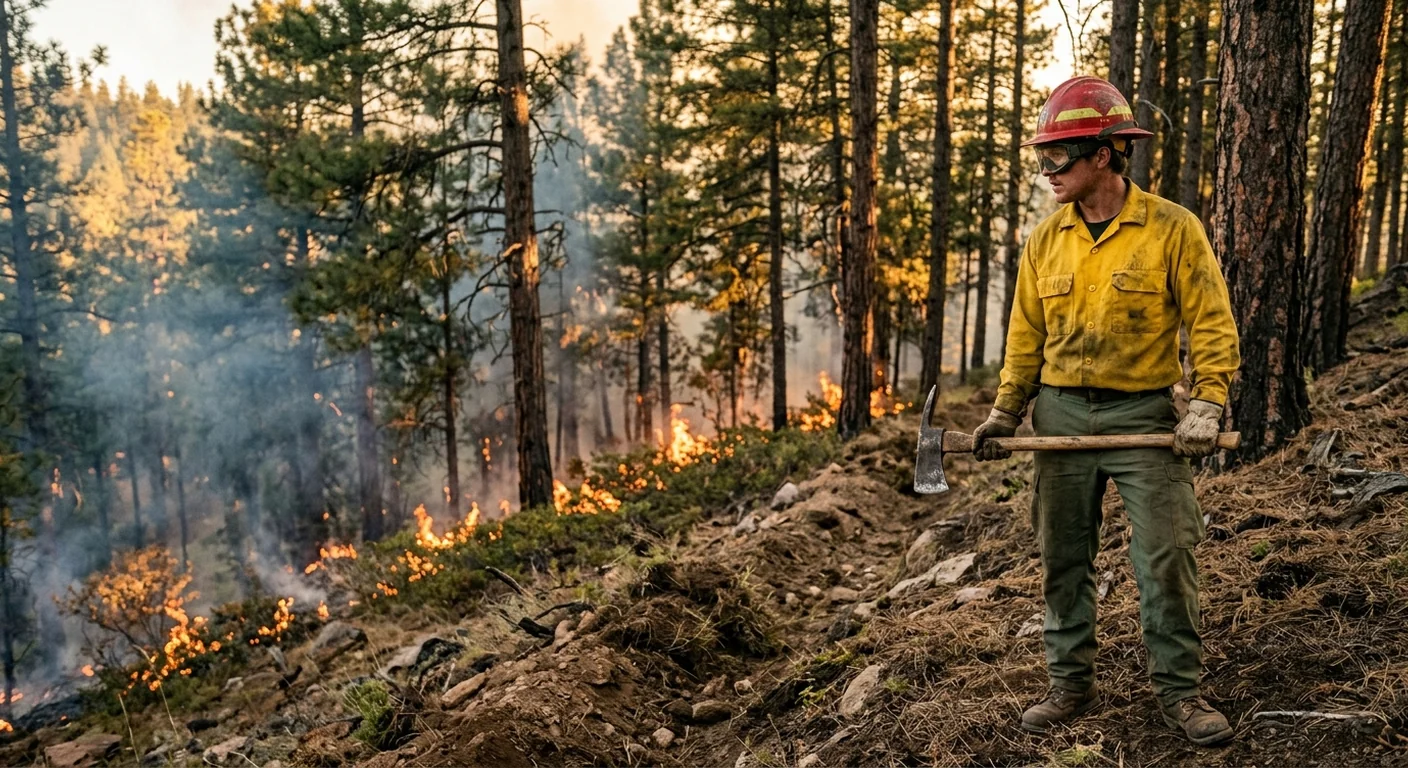

Wildland firefighting sits in its own labor market — and that market has changed more in the last 18 months than it had in the previous 20 years. A permanent federal pay raise, a new wildland-firefighter pay scale, and a sustained increase in fire-season intensity have reshaped what “applying to the Forest Service” actually means for someone entering the field in 2026.
The scale of the work is measurable. In 2025 the National Interagency Fire Center recorded 77,850 wildfires burning 5,131,474 acres, with 18,385 structures destroyed, including 12,773 residences. The fire count ran well above the 10-year average. Demand for qualified wildland firefighters is structural, not cyclical.
This guide covers who actually employs wildland crews, how the 2025 pay reform changed the earning math, what training you need before your first assignment, and exactly how the 2026 federal hiring windows work.
Structural vs. Wildland Firefighting: Two Different Jobs
City and county fire departments fight structural fires and run EMS calls — the path we cover in our article on how to become a firefighter. Wildland firefighters fight fires in forests, rangelands, and the wildland-urban interface, typically on federal or state land. The two careers share very little day-to-day.
Key differences:
- Employer: Wildland crews are predominantly federal (USFS, BLM, NPS, BIA, FWS) or state (Cal Fire, state DNR agencies). Structural crews are municipal.
- Schedule: Wildland work runs in 14-day assignments (“rolls”) with 2-day breaks, often 1,000+ miles from home. Structural is shift-based (24/48, 24/72).
- Certifications: Wildland requires NWCG-issued credentials (the “red card”). Structural requires NFPA 1001.
- Medical component: Wildland is almost entirely fire suppression. EMT is a plus but not the gateway it is for structural.
You can cross over, and many firefighters do, but the entry pipelines are separate.
Who Actually Employs Wildland Firefighters
The answer matters because the application processes, pay scales, and career trajectories differ.
Federal (roughly 18,000+ positions across agencies):
- U.S. Forest Service (USDA) — largest single employer
- Bureau of Land Management (DOI)
- National Park Service (DOI)
- Bureau of Indian Affairs (DOI)
- U.S. Fish and Wildlife Service (DOI)
The Department of the Interior wildland fire workforce page covers DOI agencies; the NIFC jobs portal aggregates federal wildland postings on USAJOBS.
State:
- Cal Fire (California Department of Forestry and Fire Protection) — the largest state agency, with its own pay scale
- State DNR or forestry agencies in OR, WA, ID, MT, CO, AZ, NM, UT, NV, TX, FL, NC, GA, SC, AK, and others
Private/contract crews:
- Type 2 and Type 2 IA hand crews operated by private contractors on federal contracts. Lower pay, higher variability, easier entry point for first-season work.
Municipal wildland-urban interface:
- Some city/county departments in fire-prone states (Cal Fire contract counties, for example) run seasonal wildland deployments out of structural stations.
For most new entrants, the federal pipeline is the primary target because the pay, benefits, and career ladder are best defined.
The 2025 Pay Raise That Changed Everything
For years, federal wildland firefighters were paid on the same GS scale as office clerks — often earning $15/hour base before hazard pay, with turnover rates that crippled the agencies. That changed with Public Law 119-4, signed in March 2025, which enacted a permanent pay raise and established a new wildland-firefighter-specific pay table: the GW scale.
What the 2026 hire needs to know:
- Positions are now classified on the GW pay scale, with locality pay tables, running grades GW-3 through GW-9 for most field positions
- The pay raise is permanent, not a supplement — this replaces the temporary bumps that had been renewed year-to-year since 2021
- Temporary and seasonal employees are included — previous pay supplements left gaps; GW does not
- Apprenticeship positions through the Wildland Firefighter Apprenticeship Program (WFAP) now carry permanent-seasonal status with retirement and health benefits
Translation: the federal entry-level wildland firefighter in 2026 is earning meaningfully more than the same position did in 2023, and the raise is baked into the pay tables rather than vulnerable to annual appropriations.
Career Tracks
Wildland firefighting has a relatively well-defined progression, even for new entrants:
- Type 2 hand crew — General-purpose fireline construction and mop-up. Common entry point.
- Engine crew — 3–5 person modules running wildland engines; mix of road access and mobile structure protection.
- Type 2 Initial Attack (IA) hand crew — More training, more aggressive initial-attack assignments.
- Hotshot crew (Type 1 IHC) — Elite 20-person crews, arduous standards, highest tempo. Competitive to enter.
- Helitack — Crews that insert via helicopter, often on remote ignitions.
- Smokejumpers — Crews that parachute into remote fires. Extremely small, extremely competitive (roughly 400 nationally).
- Squad boss → crew boss → engine captain → division supervisor — Fireline leadership track.
- Prevention / fire management officer / fuels specialist — Year-round permanent positions.
Many wildland firefighters enter through contract Type 2 crews or seasonal federal Type 2 positions, build a red-card qualification list over 2–3 seasons, and move up. The BLS tracks forest fire inspectors and prevention specialists separately at a May 2024 median of $52,380, with 2,900 jobs nationally — a narrower category than the full wildland workforce, but a useful reference for the year-round prevention track.
Academic programs in wildland-forest firefighting and investigation and fire science can accelerate promotion, particularly into prevention and fuels management roles.
Training and Certification: The Red Card Pipeline
Wildland fire qualifications are tracked by the National Wildfire Coordinating Group (NWCG) and documented on the Incident Qualification Card — the “red card” — which lists every position you’re currently qualified to fill.
The starting qualification is Firefighter Type 2 (FFT2), sometimes called “basic wildland firefighter.” FFT2 requires:
- S-130, Firefighter Training — Core fireline skills, tools, tactics, the 10 Standard Firefighting Orders and 18 Watchout Situations. Now offered in a blended online + instructor-led format.
- S-190, Introduction to Wildland Fire Behavior — The fire triangle, fuels, weather, topography, extreme fire behavior basics. Prerequisite to S-130.
- L-180, Human Factors in the Wildland Fire Service — Decision-making and communication under stress.
- Arduous Pack Test (WCT) — 3-mile walk carrying 45 pounds in 45 minutes. Required annually for arduous-rated positions.
- I-100 and IS-700 — Incident Command System basics (FEMA online, free).
Packaged as “Basic 32” or “S-130/S-190,” these courses are a 4-day program offered by state agencies, community colleges, and some contract crews. Costs range from free (offered by an employer) to $500–$900 as a standalone enrollment. The courses themselves are standardized — you take the same S-130 whether it’s delivered by a state forestry department, a community college, or an online blended provider.
You can’t actually hold a red card until you’re sponsored by an agency. The training qualifies you; the card gets issued once you’re hired and placed on a crew.
How to Apply for the 2026 Season
Federal wildland hiring runs on predictable calendar windows. The USFS 2026 wildland fire careers page documents the primary application window as August 22 – September 23, 2025 for positions starting in the 2026 season. Applicants who missed that window still have options:
- January permanent windows — Some regions (notably Pacific Southwest) open permanent firefighter announcements in January 5–26, 2026 for year-round positions
- Rolling announcements — Individual forests and districts post off-cycle announcements, especially for permanent or hard-to-fill positions
- DOI agencies — BLM, NPS, BIA, and FWS run their own windows, often slightly offset from USFS
All federal wildland jobs post at USAJOBS. Search for “forestry technician” (which covers most wildland firefighter positions) and “wildland firefighter” (the newer series being rolled out under the pay reform). Filter by series 0462 (forestry technician) and 0456 (range technician) for the widest net.
Application tips:
- Federal resumes are longer and more detailed than private-sector resumes. Month/year employment dates, hours per week, detailed duties.
- Upload your S-130/S-190 certificates and any prior Incident Qualification Card history as attachments.
- Answer the occupational questionnaire carefully — this drives your referral ranking. “Expert” answers must be defensible from your resume.
- Apply to multiple locations and agencies. Selection is competitive and location-specific; candidates who apply to 10+ announcements place faster than single-application applicants.
What You’ll Actually Earn
2026 pay on the GW scale, for the main entry-grade positions (base pay before locality adjustment):
| Position | GW grade | Base range (2025 tables) |
|---|---|---|
| Entry firefighter (seasonal) | GW-3 to GW-4 | ~$38,000–$48,000 annualized |
| Senior firefighter / squad boss | GW-5 | ~$45,000–$58,000 |
| Engine / crew captain | GW-7 to GW-8 | ~$55,000–$75,000 |
| Division supervisor / fire management | GW-9+ | $70,000+ |
But base pay understates actual take-home. Wildland firefighters earn hazard pay (25% on active fireline), substantial overtime (often 700–1,000+ overtime hours in a busy season), and per-diem/travel allowances on roll assignments. Working a busy fire season on a hotshot crew can push a GW-4 firefighter’s total W-2 into the $55,000–$75,000 range.
State agencies like Cal Fire run their own pay scales — Cal Fire seasonal firefighters in 2025 earned comparable hourly rates to federal but with generous overtime and state benefits in the permanent positions.
The Honest Trade-offs
The pay is real. So are the costs.
- Seasonal lifestyle: Even “permanent-seasonal” positions typically work 6–9 months and are furloughed in the off-season. Plan your year around that.
- 14-day rolls far from home: A busy season can mean 60–120 days on assignments with minimal contact. Relationships strain.
- Fatigue culture: Long shifts, irregular sleep, and back-to-back rolls are structurally unavoidable during fire season. This is part of the job, not a bug to be reformed.
- Health risks: Smoke inhalation, cardiovascular stress, and injury rates are meaningfully higher than in most trades. Long-term respiratory and cancer risk data is being taken seriously by the agencies but should inform your decision.
- Mental health: Deployment rhythm and exposure to trauma take a toll. Crews are increasingly open about this, but it’s a real factor.
Most people who stay in the field long-term either (a) move up to permanent leadership positions within 3–5 seasons, or (b) accept the seasonal lifestyle as a feature, not a bug, and structure their life around it.
Path to Year-Round Work
The clearest route from seasonal to permanent is to build your red card aggressively in your first 2–3 seasons: earn every qualification offered, take the classroom courses in the off-season, and volunteer for prescribed burns. When a permanent apprenticeship (WFAP) or permanent fuels/prevention position opens at your duty station or nearby, you’ll compete against candidates who didn’t do that work.
Education helps at the officer level. An associate degree in fire science or fire services administration is not required for entry but becomes increasingly relevant for fire management officer, fuels specialist, and staff positions.
What Comes Next
If structural fire is also on your radar, many departments in the Western U.S. value prior wildland experience when hiring for municipal positions — particularly in Cal Fire contract counties and WUI-focused departments. The reverse is less common: structural experience doesn’t map directly to wildland skill sets, which is why most crossovers flow from wildland to structural.
For the structural path, see how to become a firefighter. For the broader career context and salary data on both, see firefighter and EMT career opportunities.
Sources
- National Interagency Fire Center — Wildfires and Acres — 2025 — https://www.nifc.gov/fire-information/statistics/wildfires
- National Interagency Coordination Center — 2025 Wildland Fire Summary and Statistics Annual Report — NIFC — https://www.nifc.gov/sites/default/files/NICC/2-Predictive%20Services/Intelligence/Annual%20Reports/2025/annual_report_2025_0.pdf
- U.S. Forest Service — 2026 Wildland Fire Careers Opportunities — 2026 — https://www.fs.usda.gov/working-with-us/careers/recruitment-events/2026-wildland-fire-careers-opportunities
- National Interagency Fire Center — Wildland Fire Jobs — https://www.nifc.gov/about-us/working-with-us/jobs
- U.S. Department of the Interior — Wildland Fire Workforce (Public Law 119-4 pay raise) — March 2025 — https://www.doi.gov/wildlandfire/workforce
- U.S. Fire Administration — NWCG S-130 Firefighter Training — https://apps.usfa.fema.gov/nfacourses/catalog/details/10622
- U.S. Fire Administration — NWCG S-190 Introduction to Wildland Fire Behavior — https://apps.usfa.fema.gov/nfacourses/catalog/details/10623
- National Wildfire Coordinating Group — S-130 Firefighter Training (Blended) Now Available — https://www.nwcg.gov/announcement/training/new-s-130-firefighter-training-blended-now-available
- U.S. Bureau of Labor Statistics — OEWS: Forest Fire Inspectors and Prevention Specialists (May 2024) — https://www.bls.gov/oes/current/oes332022.htm