
The United States is in the middle of its largest infrastructure investment in decades, and there are not enough people to run the machines. The 2021 Infrastructure Investment and Jobs Act (IIJA) authorized $1.2 trillion in spending — $550 billion of it new investment — funding roughly 68,000 projects across roads, bridges, transit systems, water infrastructure, and the power grid. Meanwhile, 92% of construction contractors report difficulty filling positions, and the workforce gap is only expected to widen as experienced operators retire.
For anyone weighing a career in the trades, heavy equipment operation is one of the most strategically positioned fields in 2025. The money is flowing, the demand is documented, and the barriers to entry are lower than many people assume.
Why Heavy Equipment Operators Are in Demand
Infrastructure spending is creating massive demand
The IIJA alone has funded more than 68,000 projects nationwide, spanning highway reconstruction, bridge repair, public transit expansion, water system upgrades, and power grid modernization. Each of these projects requires operators to move earth, grade surfaces, dig foundations, and lay pipe. Federal spending at this scale has not occurred since the Interstate Highway System buildout of the 1950s and 1960s, and the private construction sector is adding further pressure on top of it.
The workforce shortage is real and worsening
According to Associated Builders and Contractors (ABC), the construction industry needs to attract 349,000 new workers in 2026 on top of normal hiring — the majority driven by retirements. ABC Chief Economist Anirban Basu noted that macroeconomic headwinds make the recruiting challenge even steeper.
The Associated General Contractors of America (AGC) 2025 Workforce Survey put hard numbers on the problem:
- 92% of contractors report difficulty filling craft positions
- 45% say labor shortages are directly causing project delays
- 88% have open positions for craft workers they cannot fill
- 7 out of 8 firms have raised base pay to attract and retain workers
“Construction workforce shortages are the leading cause of project delays,” said AGC Chief Economist Ken Simonson. That pressure is pushing wages up and creating real leverage for workers entering the field.
What Does a Heavy Equipment Operator Do?
Heavy equipment operators control the machines that shape construction sites, mine resources, and build infrastructure. The work is physical, outdoor, and varied — no two jobsites are identical.
Daily responsibilities
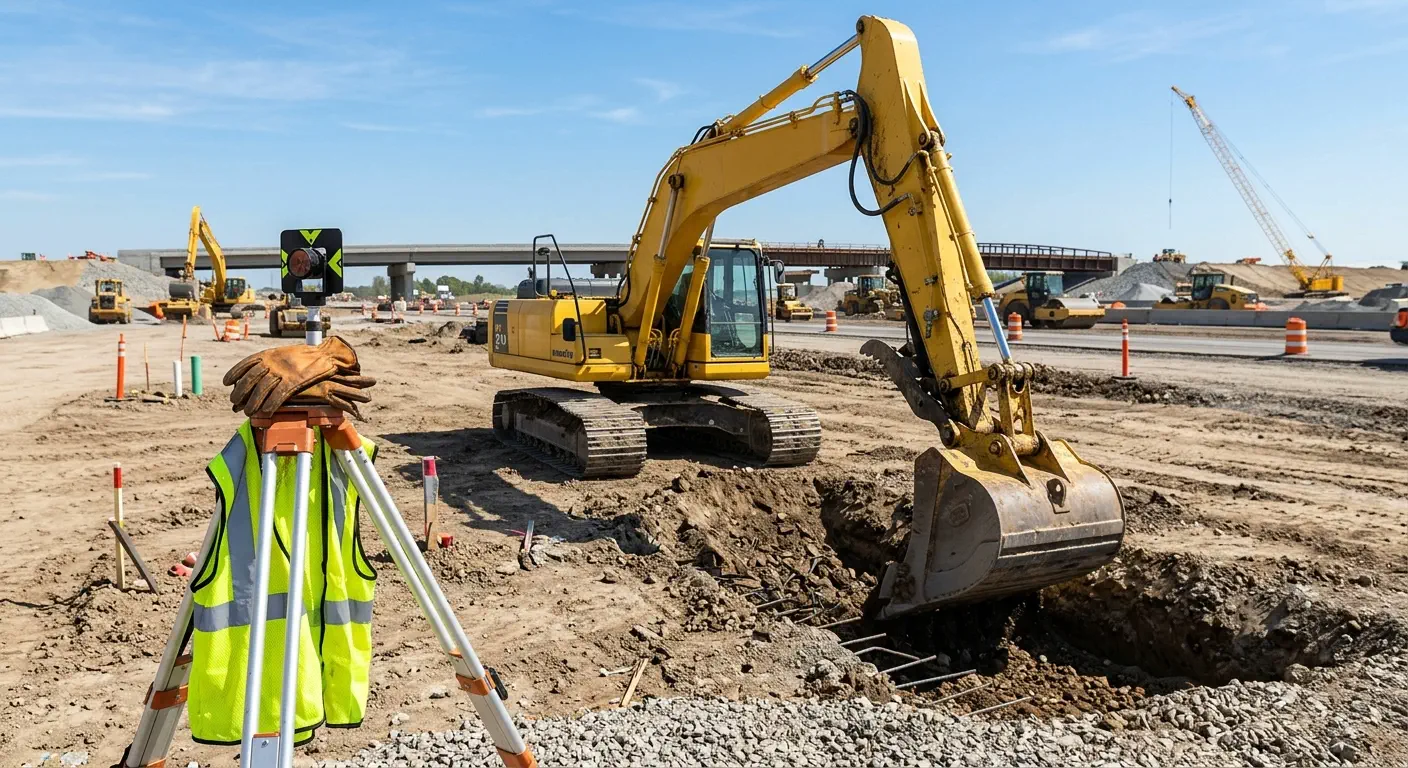
- Operating excavators, bulldozers, backhoes, wheel loaders, motor graders, scrapers, and compactors
- Reading site plans and grade stakes to execute precise earthwork
- Performing pre-operation inspections and routine maintenance checks
- Coordinating with ground crews, surveyors, and site supervisors
- Managing fuel, fluids, and equipment condition logs
Where operators work
Heavy equipment operators are employed across multiple industries:
- Highway and road construction: Grading, paving prep, drainage installation
- Site development: Clearing, excavating, and grading for commercial and residential projects
- Utility installation: Digging trenches for water, sewer, gas, and electrical lines
- Mining and quarrying: Material extraction and site management
- Pipeline construction: Right-of-way clearing and trench excavation
- Demolition: Controlled teardown of structures using excavators and specialized attachments
The National Center for Construction Education and Research (NCCER) recognizes 12 equipment specializations within heavy equipment operations, ranging from backhoes and excavators to off-road dump trucks and motor graders. Most operators begin with one or two machine types and expand their capabilities over time.
Work conditions
This is outdoor work. Operators sit in enclosed cabs for most of the day but are exposed to dust, noise, vibration, and weather extremes. Jobsites can be remote. Schedules often follow daylight hours, though some projects run second shifts or weekends to meet deadlines. The physical demands are moderate compared to other construction trades — the machines do the heavy lifting — but operators need alertness, spatial awareness, and the endurance to maintain focus over long shifts.
Salary and Job Outlook
What heavy equipment operators earn
According to the Bureau of Labor Statistics (BLS), the median annual wage for construction equipment operators was $58,320 as of May 2024. The pay range is wide:
- Lowest 10%: Less than $39,850
- Highest 10%: More than $99,930
That top-end figure reflects operators working in high-cost metro areas, union shops, or specialized roles like crane operation and motor grader work. Geography, union status, equipment specialization, and overtime availability all affect where an individual falls on the scale.
The AGC workforce survey underscores that wages are climbing: 7 out of 8 construction firms raised base pay in the past year to compete for workers. In a market where 92% of contractors cannot fill positions, compensation is not stagnating.
Job growth and openings
The BLS projects 4% job growth for construction equipment operators from 2024 to 2034 — described as about as fast as the average for all occupations. But the raw numbers tell a more compelling story:
- 539,500 total jobs existed in 2024
- ~46,200 openings are projected annually over the next decade
Those 46,200 annual openings include both new positions created by growth and existing positions vacated by retirements and career changes. For a field that requires no four-year degree, those are substantial numbers.
How to Become a Heavy Equipment Operator
The entry requirement is straightforward: a high school diploma or equivalent. From there, you have several paths into the cab.
On-the-job training
Many operators start as laborers on construction sites and gradually move into equipment operation under the supervision of experienced operators. This path costs nothing in tuition but takes longer and depends on finding an employer willing to invest in your development. It works best for people already connected to the construction industry.
Vocational and technical school programs
Trade schools and community colleges offer heavy equipment operation programs ranging from a few weeks to a full academic year. These programs provide structured seat time on multiple machine types, safety training, and often include job placement assistance. If you are exploring programs near you, the heavy equipment maintenance technology page lists schools offering related credentials.
NCCER curriculum
The NCCER Heavy Equipment Operations curriculum is a widely recognized industry training standard. It consists of:
- 3 levels of instruction covering approximately 530 hours of training
- 12 equipment specializations including excavator, dozer, loader, backhoe, scraper, grader, and off-road dump truck
- A GPS/GNSS technology module added in the 4th Edition (2024), reflecting how precision grading and machine control have become standard on modern jobsites
NCCER credentials are portable — recognized by contractors and agencies across the country — and provide a documented, verifiable record of your training.
IUOE apprenticeship programs
For a structured earn-while-you-learn path, the International Union of Operating Engineers (IUOE) offers one of the most comprehensive options. IUOE apprenticeships include:
- 3 to 4 years of combined classroom and on-the-job training
- 95 programs across the United States and Canada
- 6,000+ hours of on-the-job training and 240+ hours of classroom instruction
- Progressive pay: apprentices typically earn 60% of the journeyman rate in their first year, scaling to 90% by the fourth year
The earn-while-you-learn structure makes apprenticeships particularly attractive for career changers and anyone who cannot afford to stop working during training. For a deeper look at how apprenticeships work across the trades, see our guide to apprenticeships.
Military transition: Helmets to Hardhats
Veterans with equipment experience from military service have a direct path into the field. The IUOE participates in the Helmets to Hardhats program, which connects transitioning service members with construction apprenticeship opportunities. Military operating experience often counts toward apprenticeship hour requirements, accelerating the timeline to journey-level status.
Certifications and Licensing
There is no single federal certification
This is a point that often confuses newcomers. OSHA does not issue a federal “heavy equipment operator certification.” Instead, under 29 CFR 1926, employers are required to ensure that anyone operating construction equipment is trained and competent to do so. The responsibility falls on the employer to verify and document operator qualification.
That said, holding recognized credentials makes you more employable and gives employers confidence in your abilities.
NCCER credentials
NCCER offers performance-verified credentials for each of its 12 equipment specializations. These certifications require demonstrated competency on each machine type and are tracked in a national registry. Certifications are valid for 1 to 5 years depending on the credential, after which renewal or retesting is required.
GPS and machine control technology
Modern construction increasingly relies on GPS/GNSS-guided machine control systems. Operators who can work with Trimble, Topcon, Leica, and similar systems command a premium. The NCCER’s 4th Edition curriculum now includes a dedicated GPS/GNSS module, and several private training providers offer stand-alone machine control courses. This is one of the clearest ways to differentiate yourself as a newer operator.
State and local requirements
Some states and municipalities require additional licensing for specific equipment types — particularly cranes and certain types of earthmoving equipment on public projects. Requirements vary significantly by jurisdiction, so checking with your state’s contractor licensing board or department of labor is essential before you begin training.
Career Advancement Paths
Heavy equipment operation is not a dead-end job. The field offers clear progression routes for operators who want to grow.
Equipment specialization
Operators who master high-demand machines earn more. Crane operators, motor grader operators, and those certified in GPS machine control consistently command wages at the higher end of the pay scale. Specialization in pipeline work, bridge construction, or demolition similarly opens premium niches.
Foreman and crew leader
Experienced operators often move into supervisory roles, managing crews of operators and laborers on a project. This involves scheduling, coordinating with project managers, reading plans, and ensuring work is completed to specification. Foreman roles typically come with a pay bump and reduced physical wear.
Site superintendent and project management
Further up the ladder, superintendents manage entire jobsites. Some operators pursue additional education in construction management or estimating to move into office-based project management roles. The operational knowledge gained from years in the cab is highly valued by employers filling these positions.
Estimator
Experienced operators who understand production rates, soil conditions, and equipment capabilities make natural estimators. Estimating involves calculating how long a project will take, how much material needs to be moved, and what equipment and crew are required. This is a role that combines field knowledge with analytical skills, and it often leads to higher compensation.
Business ownership
Some operators eventually start their own contracting businesses. With a few pieces of equipment, industry contacts, and a contractor’s license, owner-operators can bid on site work, utility installation, or demolition projects. The path from operator to business owner is well-trodden in construction.
Related fields
Heavy equipment operating skills transfer to adjacent roles including surveying, heavy equipment maintenance and repair, safety management, and construction technology (laser scanning, drone surveying, BIM coordination). Operators interested in the mechanical side should explore heavy equipment maintenance technology programs that teach the repair and service side of the machines.
Where the Jobs Are
Infrastructure projects nationwide
The IIJA has funded projects in every state. The Department of Transportation tracks over 68,000 active projects covering highway expansion, bridge replacement, transit construction, water system upgrades, and broadband infrastructure. States with the largest allocations — California, Texas, New York, Florida, and Pennsylvania — have correspondingly heavy demand for operators.
Construction hotspots
Beyond federal infrastructure, private construction activity drives operator demand in fast-growing metro areas. Data centers, semiconductor fabrication plants, renewable energy installations, and residential development in the Sun Belt are all generating equipment-intensive work. Markets experiencing housing booms, industrial buildouts, or energy development tend to offer the strongest combination of high wages and steady work.
Union opportunities
The IUOE represents operating engineers across 95 local unions in the U.S. and Canada. Union operators typically receive higher base pay, defined benefit pensions, health insurance, and training fund contributions. Union shops are most prevalent in the Northeast, Midwest, and West Coast, though locals exist in every region. For a comparison of union and non-union paths, see our guide to union vs. non-union trades.
Getting Started
The workforce numbers are clear: the construction industry needs operators, and it needs them now. Whether you pursue a vocational program, an NCCER curriculum, an IUOE apprenticeship, or start as a laborer and work your way into the cab, the paths into this field are well-established and accessible.
If cost is a concern, apprenticeships let you earn while you train, and many vocational programs qualify for financial aid. For guidance on paying for training, see our guide to financing trade school.
Start by exploring heavy equipment programs at schools near you, contacting your local IUOE training center, or reaching out to contractors in your area who run their own training. The machines are not going to sit idle — the question is whether you will be the one running them.
Sources
- U.S. Bureau of Labor Statistics — “Construction Equipment Operators: Occupational Outlook Handbook” — May 2024 — bls.gov
- Associated General Contractors of America — “Construction Workforce Shortages Are Leading Cause of Project Delays” — August 2025 — agc.org
- Associated Builders and Contractors — “ABC: Construction Industry Must Attract 349,000 Workers in 2026” — 2026 — abc.org
- National Center for Construction Education and Research — “Heavy Equipment Operations Craft Catalog” — nccer.org
- NCCER — “How to Become a Heavy Equipment Operator” — nccer.org
- International Union of Operating Engineers — “Heavy Equipment Operator Training” — iuoe.org
- OSHA — “Standard Interpretations: Equipment Operator Certification” — July 2016 — osha.gov
- U.S. Department of Transportation — “Infrastructure Investment and Jobs Act (IIJA) Funding Status” — transportation.gov