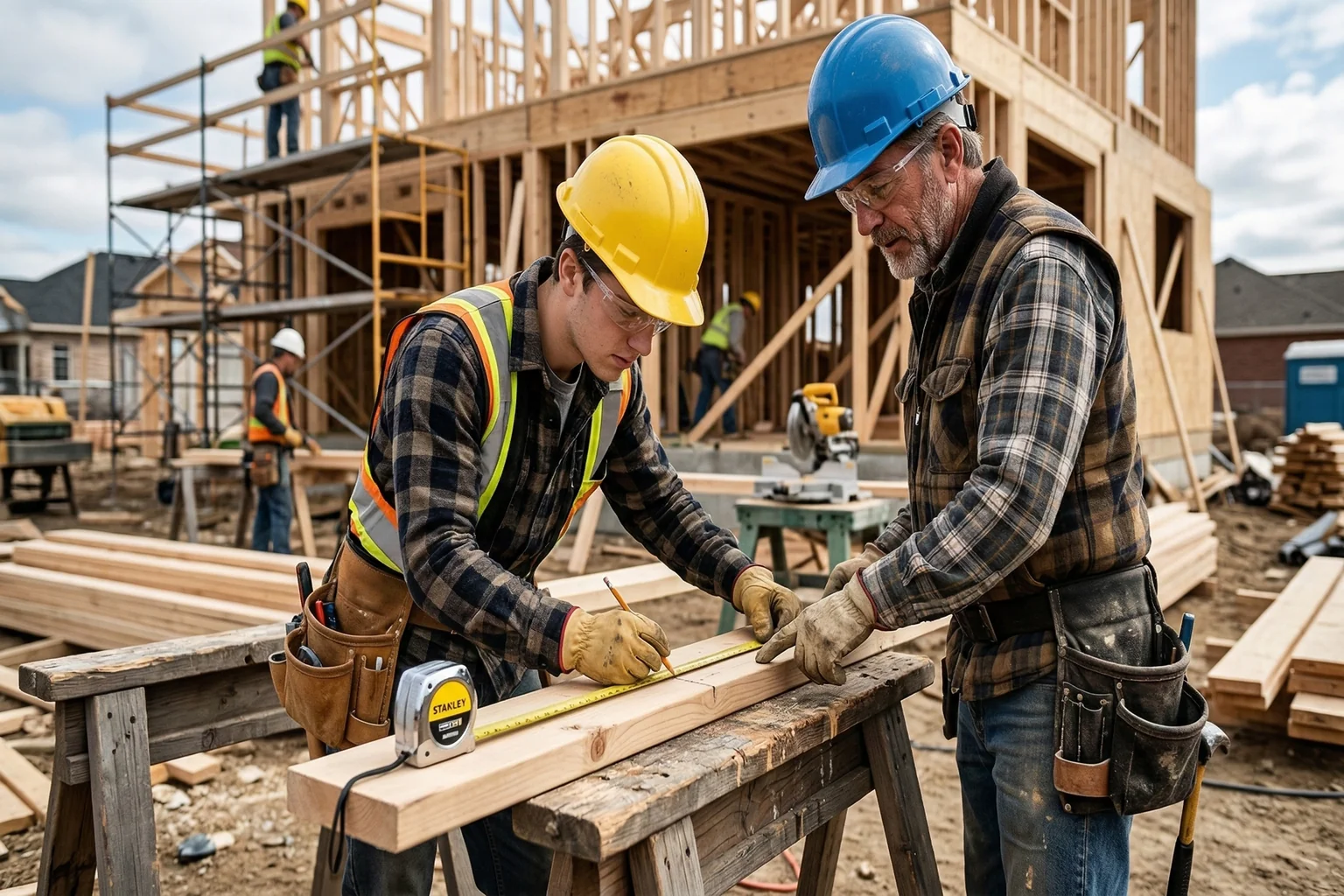

Carpentry is one of the few skilled trades where you can start earning a real paycheck within weeks of deciding you want in — before you’ve spent a dollar on school. The catch is knowing which door to walk through first.
This guide walks through the full path: what requirements you actually need, how to choose between apprenticeship and trade school, what to expect on the job and in the classroom year by year, and what you’ll be earning at each stage. The BLS Occupational Outlook Handbook puts median carpenter pay at $59,310 as of May 2024, with about 74,100 job openings expected every year through 2034. The pipeline is real. Here’s how to get into it.
What Carpenters Actually Do
Before committing to a training path, it helps to know what the job is. Carpenters construct, install, and repair structures made from wood and other materials — framing walls and roofs, hanging doors and windows, building concrete forms, finishing interiors with trim and cabinetry. The trade splits broadly into rough carpentry (framing, structural work, outdoor exposure) and finish carpentry (interior trim, built-ins, precision detail work). Some carpenters specialize further into cabinetmaking, restoration, or commercial tenant improvements.
The BLS counted roughly 959,000 carpenters employed in 2024 — the largest single occupation in the construction trades. That scale means there’s demand across essentially every region and every stage of the training pipeline.
For a detailed look at where the specializations lead and what experienced carpenters earn, see our Carpentry Career Opportunities overview. This guide focuses on the front end: how to get in and what the training years look like.
Step 1 — Check the Basic Requirements
The bar to enter carpentry is deliberately low. You don’t need prior experience, a portfolio, or any specific college coursework. What you do need:
- Age: At least 18 for most registered apprenticeship programs. Some states allow 17-year-olds with parental consent.
- Education: A high school diploma or GED. No exceptions for union or government-registered apprenticeships.
- ID: A valid driver’s license or REAL ID-compliant photo ID, per Eastern Atlantic States Carpenters Technical Center FAQ.
- Physical fitness: Carpentry involves lifting, kneeling, working at heights, and standing for full shifts. You don’t need to be an athlete, but you need to be able to do physical work safely and consistently.
- No prior experience required: Every registered apprenticeship is designed for people starting from zero.
If you’re still in high school, the most productive thing you can do now is look for shop or construction classes, build basic tool familiarity on home projects, and line up your diploma or GED before you turn 18.
Step 2 — Choose Your Training Path
There are three realistic routes into carpentry. None is universally better; the right one depends on your financial situation, your timeline, and how much structure you want.
| Union Apprenticeship | Non-Union Apprenticeship | Trade School First | |
|---|---|---|---|
| Cost | Free (you earn while you learn) | Free (same model) | $750–$6,500 for a certificate |
| Time to journeyman | 3–4 years | 3–4 years | 6 months to 2 years (then often enter apprenticeship) |
| Starting pay | ~40–60% of journeyman rate | Similar | Varies; may enter at higher apprentice level |
| Credential | Journeyman card (UBC or equivalent) | Journeyman card (ABC or equivalent) | Certificate or associate degree |
| Benefits | Health, pension (union) | Varies by employer | None from school itself |
Union Apprenticeship (UBC)
The United Brotherhood of Carpenters (UBC) runs the largest union apprenticeship network in North America. Apprentices attend 160 hours of related classroom instruction per year at no cost, and earn wages from day one — typically starting around 40–60% of the journeyman rate and stepping up with each year completed. There is no tuition.
To apply, you find your regional council through carpenters.org, attend a required information session, and submit a high school diploma or transcript, government ID, and any other documents your local council requires. The process varies by region but the core requirements are consistent.
Non-Union Apprenticeship (ABC)
The Associated Builders and Contractors (ABC) runs registered carpentry apprenticeships through local chapters operating on a “merit shop” model — meaning advancement is based on skill rather than union membership. The structure is similar: paid on-the-job training combined with classroom hours, no tuition, federally registered programs. Use the ABC chapter locator to find programs in your state.
For a detailed breakdown of how union and non-union paths differ on wages, job security, and benefits, see our Union vs. Non-Union Trades guide.
Trade School First
A carpentry certificate program typically runs 6 months to 2 years and costs between $750 and $6,500, according to VocationalTrainingHQ’s 2025 cost data. Associate degree programs run 2 years and $4,000–$20,000. Trade school gives you a foundation in blueprints, tool safety, and basic framing before you step onto a job site — which can accelerate your progress once you do enter an apprenticeship, since some programs credit prior training toward apprenticeship hours.
The tradeoff: you’re paying tuition and not earning while you’re in school. If cost is a concern, explore federal financial aid eligibility first. Our financing trade school guide covers Pell Grants, workforce development grants, and employer sponsorship programs that apply to carpentry training.
Browse carpentry programs to compare certificate and associate degree options at accredited schools.
Step 3 — Apply and Get Accepted
For Apprenticeships
The application process has a few predictable steps regardless of which path you choose:
- Find your local program. Use carpenters.org/training-center for UBC or abc.org/Workforce/Chapter-Registered-Apprenticeship-Locator for ABC.
- Attend an information session. Many programs require this before you can formally apply.
- Submit your documents. High school diploma or GED, valid ID, and sometimes a completed application form or aptitude test.
- Wait for placement. Acceptance timelines vary; some councils have waiting lists, others process applications quickly based on employer demand.
Programs run by the Eastern Atlantic States Carpenters note that women, minorities, and veterans are actively encouraged to apply — several regional councils prioritize outreach to these groups.
For Trade School
When evaluating carpentry certificate programs, look for:
- Regional accreditation or accreditation by the Accrediting Commission of Career Schools and Colleges (ACCSC)
- Published job placement rates
- Hands-on lab time with actual tools and construction setups
- Instructors with field experience, not just academic backgrounds
Step 4 — What Happens During the Apprenticeship (Year by Year)
The Carpenters Training Institute structures its program around 7,000 hours of on-the-job training plus 640 hours of classroom instruction — roughly four years of full-time work. Here’s what that progression actually looks like.
Year 1: Learning the Rhythm
On the job, first-year apprentices handle site support tasks — staging materials, cleaning up debris, running tools to experienced carpenters — alongside basic hands-on work: measuring, cutting lumber, driving fasteners, and assisting with framing. This year is as much about learning how a job site functions as it is about carpentry technique.
In the classroom (approximately 160 hours over the year), you cover construction math, blueprint reading fundamentals, OSHA safety requirements, and basic tool use. Expect to be tested on these subjects, not just lectured at.
Pay at this stage typically runs 40–50% of the journeyman rate. It’s the lowest-earning point of your apprenticeship, but you’re earning — not taking on debt.
Year 2: Building Competency
By year two, you’re doing more independent work on the job: framing walls and partitions, reading and interpreting prints directly, operating power tools without constant supervision. You’re still an apprentice, but experienced carpenters are delegating tasks rather than just having you assist.
Classroom work deepens into construction methods, material properties, and building codes. Pay steps up to roughly 55–65% of journeyman rate.
Year 3: Specialization Begins
Third-year apprentices start applying skills to specific project types — residential framing, commercial interior buildout, or whatever work their employer specializes in. Blueprint reading moves from theory to daily practice. You may begin taking on limited lead responsibility on smaller tasks.
Some programs introduce specialty modules at this stage: concrete formwork, scaffold building, or finish carpentry techniques. Pay climbs to approximately 65–75% of journeyman rate.
Year 4: Near-Journeyman Work
In the final year, you’re executing most tasks at close to full competency and taking meaningful responsibility on site — potentially helping direct newer apprentices, managing your own material lists, and working more independently on complex installs. The goal of this year is closing any remaining skill gaps before your journeyman evaluation.
Pay reaches approximately 80% of journeyman rate. You graduate with a recognized journeyman card and a foundation in both rough and finish carpentry.
Step 5 — Earning Journeyman Status
Completing your hours and classroom requirements earns you journeyman carpenter status. In most states, carpentry is not licensed at the individual level (licensing typically applies to contractors, not journeymen), so the journeyman card is a credential issued by your training program sponsor — the UBC, ABC, or another registered apprenticeship entity — rather than a government license.
What the credential means practically:
- You’re no longer classified as an apprentice and earn the full journeyman rate
- You can work on any job site requiring journeyman-level certification
- You’re a credible candidate for lead and foreman roles
- You have a documented, portable credential recognized by contractors nationwide
At this point, many journeymen add optional certifications: OSHA 30 (a step up from the OSHA 10 most apprentices earn), specialty certifications in areas like scaffold inspection or concrete formwork, or green building credentials for work on LEED projects.
What Comes After Journeyman
The journeyman card is not a ceiling — it’s a starting point for the rest of a career. From there, carpenters typically move toward:
- Foreman or superintendent roles, leading crews and managing project timelines
- General contracting, once you’ve built the field experience and business knowledge to take on projects independently (most states require a contractor’s license for this)
- Estimating and project management, moving off the tools into planning and bidding work
- Specialty work, like historic restoration or high-end finish carpentry, where a journeyman reputation commands premium rates
For a full breakdown of the career ladder, earnings by specialization, and the self-employment path, see our Carpentry Career Opportunities overview.
Sources
- Bureau of Labor Statistics — Carpenters: Occupational Outlook Handbook — May 2024
- Eastern Atlantic States Carpenters Technical Center — Frequently Asked Questions About Apprenticeship
- United Brotherhood of Carpenters — Join Us
- Carpenters Training Institute — Carpenter Apprenticeship Program
- Associated Builders and Contractors — Craft Training & Apprenticeship
- Eastern Atlantic States Regional Council of Carpenters — How to Become a Carpenter
- VocationalTrainingHQ — How Much Does Carpentry Training Cost? — 2025