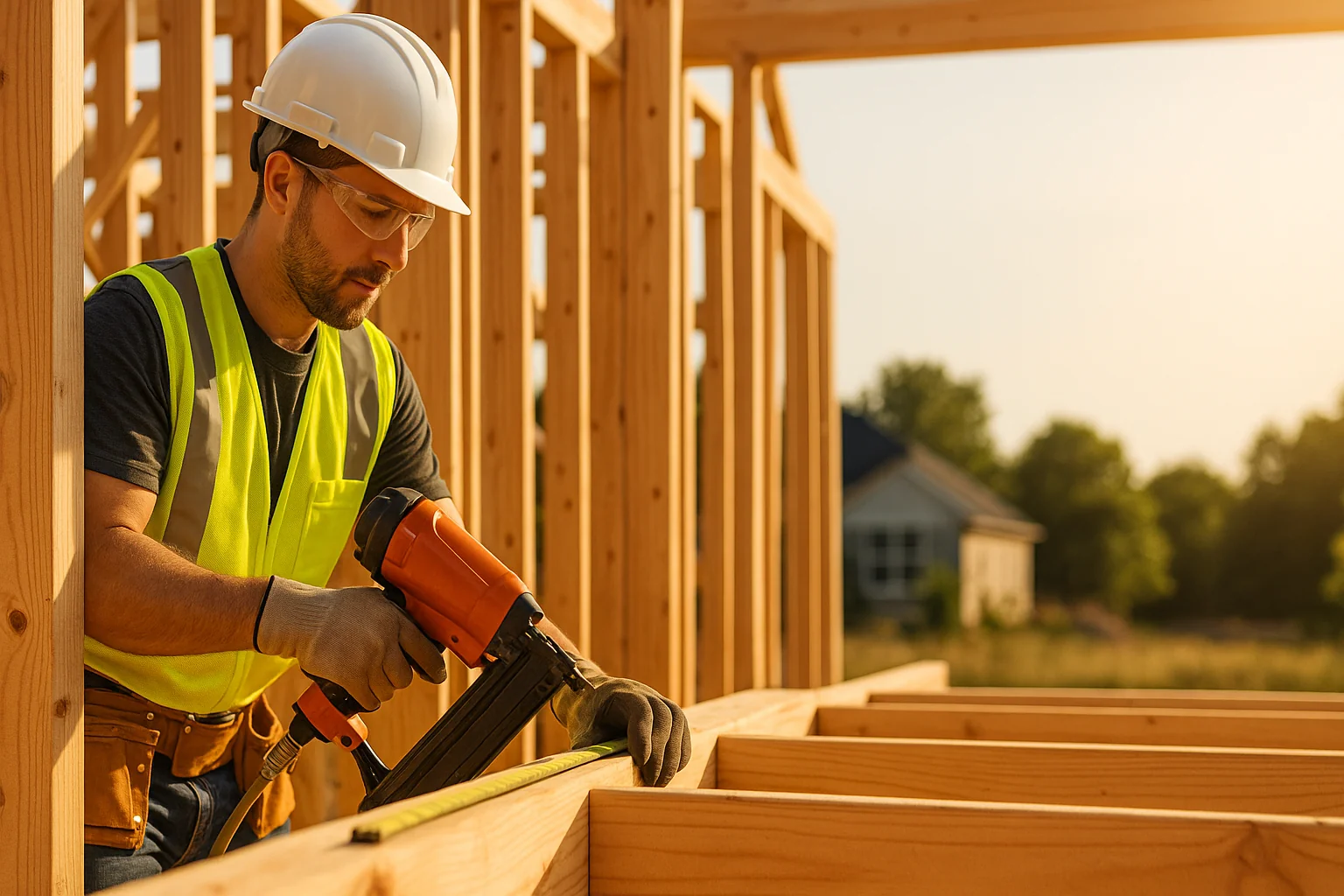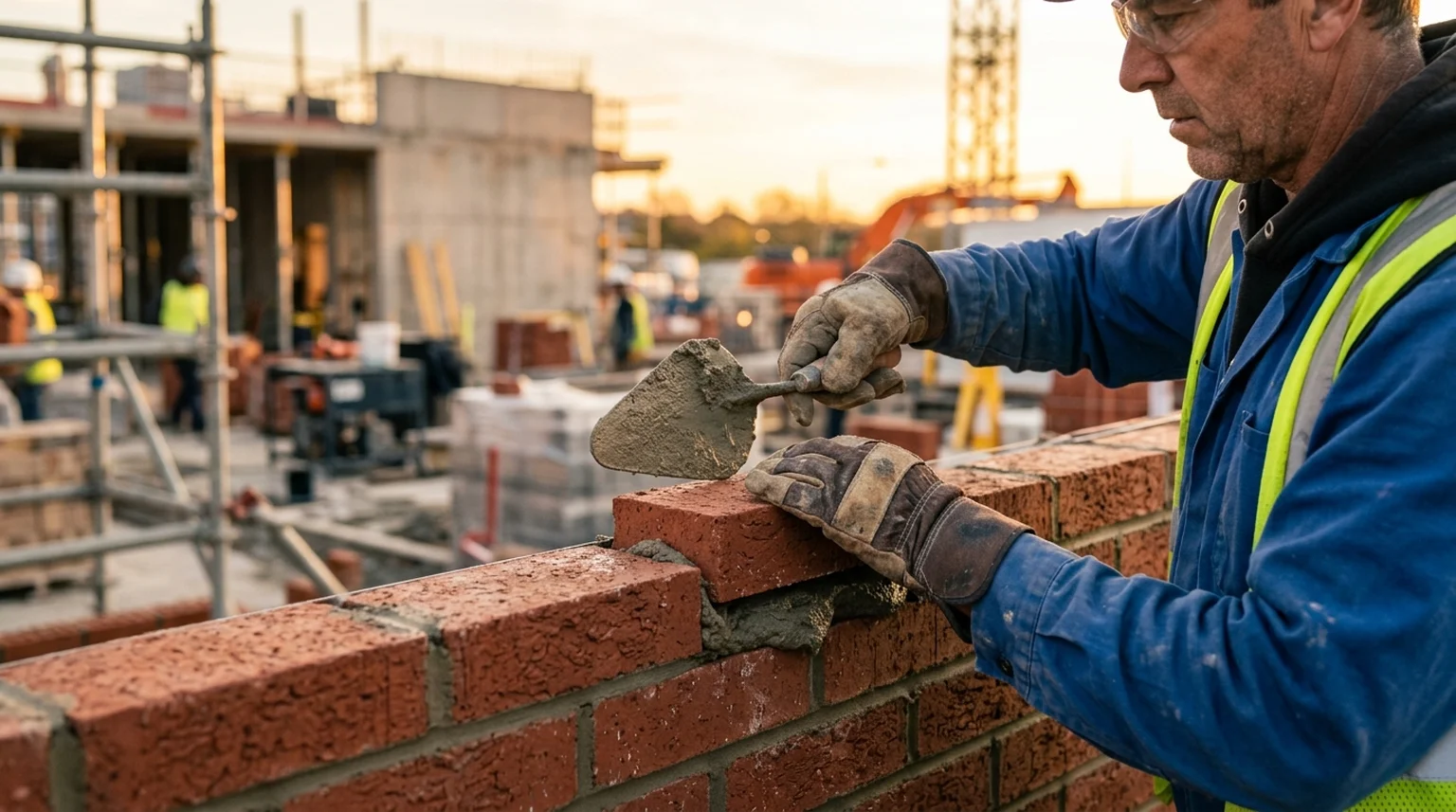

Picture the front wall of a 19th-century courthouse — each brick laid so tightly that mortar barely shows, the coursing perfectly level after more than a century. Now picture the masonry crew that’s been called in to restore it: reading the original lime mortar formula, sourcing matching handmade brick, cutting out failed joints by hand, and tuck-pointing a facade that tourists photograph every day. That’s not a job a robot can do in 2026, and it’s not a job that general laborers can step into without years of training.
Masonry is one of the oldest skilled trades on Earth. It is also, right now, one of the most persistently understaffed.
TL;DR
- Solid median pay: The BLS reports a median annual wage of $56,600 for masonry workers (brickmasons, blockmasons, and stonemasons combined) as of May 2024. Brickmasons and blockmasons specifically median at $60,800. Source: BLS Masonry Workers OOH.
- Persistent shortage: The shortage of bricklayers and masons ranks fourth in severity among 15 construction occupations tracked by the National Association of Home Builders, according to data cited by Mortar Net Solutions. The broader construction industry needs 439,000 net new workers in 2025. Source: ABC.
- Steady openings: BLS projects approximately 20,700 masonry job openings per year through 2034, most driven by retirements rather than new growth. Source: BLS OOH.
- Union apprenticeship path: The Bricklayers and Allied Craftworkers (BAC) union offers a 3–4 year earn-while-you-learn apprenticeship with 5,000–6,700 hours of paid field work and 160 hours of classroom training per year.
- Craft that lasts: Masonry is permanent, visible, and structurally essential — a career where your work outlasts you by centuries.
What Do Masons Do? The Spectrum from Brick to Stone
The Bureau of Labor Statistics groups masonry workers into three main categories under a single occupational profile, but the day-to-day work differs significantly by specialty.
Bricklayers lay courses of brick, concrete block, and other masonry units to build and repair walls, foundations, arches, fireplaces, chimneys, and decorative facades. Commercial bricklayers may spend weeks running the exterior skin of an apartment building or a hospital — thousands of bricks per day on scaffolding with a tight production schedule. Residential bricklayers work smaller jobs: a porch column here, a retaining wall there, a fireplace surround that the homeowner will look at for the next thirty years. The work demands precision: a wall that is one degree out of plumb at the base will be visibly wrong by the time you reach the roofline.
Blockmasons work primarily with concrete masonry units (CMUs) — the heavy grey blocks used in foundations, load-bearing walls, and industrial structures. Block work moves faster than brick but requires physical endurance: CMUs can weigh 30–50 pounds each, and a productive mason may set several hundred in a shift. Much block work is structural, meaning it carries load and must meet engineering specifications. This specialty tends to dominate in commercial and industrial construction.
Stonemasons occupy the craftwork end of the spectrum. They cut, shape, and set natural stone — granite, limestone, marble, sandstone, bluestone — using both hand tools and angle grinders. Stonemason work ranges from large-format granite cladding on a corporate headquarters to intricate fieldstone walls, decorative garden features, and historic building restoration. It demands an eye for color, texture, and form that few trades require. See the stonemason career profile for a detailed look at this specialty.
Running across all three categories is a common thread: these workers mix mortar, read blueprints and specifications, use levels and plumb lines, cut masonry units with saws and chisels, and clean and maintain their work areas. Increasingly, masons are also expected to understand waterproofing, flashing, and drainage behind the masonry — skills that matter for the long-term performance of a wall, not just its appearance on the day it’s built.
For a broader view of the career landscape, the brickmason and blockmason career profile covers employment distribution, major industries, and regional demand in detail.
Why Masonry Is Still in Demand
Construction Keeps Building
The fundamental driver of masonry employment is construction activity, and the U.S. has been running a construction deficit for years. The housing market is short millions of units. Infrastructure legislation has directed hundreds of billions into roads, bridges, public buildings, and transit systems. Commercial real estate, healthcare facilities, and educational institutions continue to commission new structures, many of which have brick or masonry exteriors specified for durability and fire resistance.
The Associated Builders and Contractors estimated that the construction industry needed 439,000 net new workers in 2025 — and that figure was expected to remain in the hundreds of thousands through 2026 and beyond. The core problem is structural: roughly one in five construction workers is over age 55, and the pipeline of new entrants has never been rebuilt after the 2008–2012 housing collapse drained much of the industry’s workforce.
Historic Restoration Is a Durable Niche
One demand driver that often goes unmentioned is historic preservation. The United States has tens of thousands of pre-1950 masonry buildings — courthouses, churches, schools, warehouses, civic centers — that require ongoing maintenance and periodic restoration. This work calls for skills that are genuinely difficult to find: understanding of lime-based mortars that differ from modern portland cement mixes, ability to source or fabricate matching brick, proficiency at tuck-pointing (removing and replacing deteriorated mortar joints) without damaging original masonry, and an eye for matching historic coursing patterns.
Historic restoration work is labor-intensive, relationship-driven, and largely immune to automation. It also tends to pay above market rates for workers who develop the specialty. The International Masonry Institute offers advanced training in restoration techniques for masons who want to develop this niche.
The Workforce Shortage Is Real
The Mason Contractors Association of America (MCAA), the national trade association representing mason contractors since 1950, has stated directly that the supply of skilled masonry workers does not meet demand — and is not expected to meet growing demand in the foreseeable future. NAHB survey data cited by Mortar Net Solutions places the bricklayer and mason shortage fourth in severity among 15 construction occupations. Among builders, 67% reported a shortage of bricklayer and masonry subcontractors.
For prospective students, a shortage labor market means shorter wait times to find work after training, stronger negotiating leverage on starting wages, and contractors who are motivated to invest in retention. It also means the apprenticeship application pipeline is less competitive than it was a decade ago in many markets.
What the Work Actually Looks Like
Commercial vs. Residential
The vast majority of masonry employment is commercial. Apartment buildings, hospitals, schools, government buildings, and industrial facilities represent the bulk of brick and block work by volume. Commercial masonry tends to be production-oriented: a crew might lay 800–1,200 bricks per day on a large project. The pace is demanding, the crew sizes are larger, and the jobs run longer — sometimes months on a single site.
Residential masonry is more varied and often more craft-intensive. Custom fireplaces, decorative garden walls, brick driveways, stone veneer on a custom home — the residential mason switches tasks frequently and works more directly with homeowners and architects. Job sizes are smaller, which means more time on job setup, transit, and client communication.
Physical Demands and Working Conditions
Masonry is physically demanding work. Masons spend most of the day on their feet, often on scaffolding, kneeling, bending, and lifting materials that weigh 20–50 pounds or more. Back, knee, and shoulder health are legitimate concerns over a long career, and experienced masons often develop strong preferences for ergonomic tools and jobsite setups that reduce cumulative strain.
Weather is a significant factor. Masonry cannot be laid in freezing temperatures without special heating precautions, because mortar sets poorly and ice can disrupt the bond. Very hot, dry conditions require different mortar mixes and curing strategies. Masons work predominantly outdoors, which means significant exposure to heat, cold, rain, and dust. Indoor work — fireplaces, refractory work, commercial interior block — offers some relief, but it’s a smaller share of total activity.
Dust exposure, particularly from cutting masonry units, is an occupational health concern. Respirable silica dust from cutting concrete, brick, and stone can cause silicosis with prolonged exposure. OSHA’s silica rule (29 CFR 1926.1153) requires dust controls — water suppression, vacuum-equipped tools, and respiratory protection — on construction sites. Masons who understand and follow these protocols protect their long-term health and, in union shops, are backed by safety programs that enforce compliance.
The Craft Angle
What distinguishes masonry from most construction trades is permanence and visibility. A mason’s work can be seen, touched, and admired. A historic building restoration completed by a skilled crew will stand for another century. A well-laid brick facade on a new school will be the first thing students see every morning for decades. There is genuine craft satisfaction in this work that’s harder to find in trades where the finished product is hidden inside walls or underground.
Related building trades like cement masonry and concrete finishing share some of this permanence, but the material properties of concrete are fundamentally different — and the aesthetic range of masonry, particularly stone, is considerably wider.
Masonry Pay: What to Expect
The Median and the Range
According to the BLS Occupational Outlook Handbook, the median annual wage for masonry workers was $56,600 in May 2024. The lowest 10% earned under $38,520, while the highest 10% earned more than $90,120.
Breaking it down by category, brickmasons and blockmasons have a somewhat higher median than the group average. BLS OEWS data puts the brickmason and blockmason median at approximately $60,800, with the top quartile earning above $77,290 and the bottom quartile below $49,430. Source: BLS OEWS — Brickmasons and Blockmasons.
Entry-Level vs. Experienced
Entry-level masons — typically working as helpers or in the early stages of apprenticeship — start significantly below the median. Apprentices in union programs generally start at around 50% of journeyman wages, increasing in steps as they advance through the program. At full journeyman status (typically after 3–4 years), compensation reaches or exceeds the median, and experienced masons with specialty skills in restoration or commercial production often push well past it.
Union vs. Non-Union
Union masons, represented primarily by the Bricklayers and Allied Craftworkers (BAC), typically earn higher base wages than non-union counterparts, along with structured benefit packages: health insurance, defined-benefit pension plans, paid vacation, and training funds. The BAC represents approximately 100,000 members across North America across trades including bricklayer/mason, tile setter, plasterer, terrazzo worker, and refractory specialist.
Non-union masonry work is prevalent, particularly in residential and smaller commercial markets. Wages are market-determined and vary significantly by employer and region. Benefits packages tend to be less comprehensive than union contracts.
Geographic Variation
Masonry wages vary considerably by geography. Markets with strong union density — the Northeast, Midwest industrial cities, the Pacific Coast — tend to pay above the national median. One example from BLS data: brickmasons in Massachusetts average close to $86,630, well above the national figure. Right-to-work states in the South and Mountain West often have lower prevailing wages, though cost of living differences partially offset that gap. Source: BLS OEWS.
For masons willing to travel — and many union members do for large commercial projects — per diem pay, travel bonuses, and higher-wage markets can push total annual compensation considerably above the median.
How to Become a Mason
The Apprenticeship Path
The primary route into skilled masonry is a registered apprenticeship. The Bricklayers and Allied Craftworkers (BAC) union sponsors the largest masonry apprenticeship system in the United States through the International Masonry Training and Education Foundation (IMTEF). Key program details:
- Duration: 3–4 years depending on the specific trade
- Field hours: 5,000–6,700 hours of paid on-the-job training
- Classroom requirement: 160 hours of related technical instruction per year
- Starting qualifications: Must be at least 18 years old, hold a valid driver’s license, and be eligible for employment in the U.S.
- Pay: Apprentices earn wages from day one, starting at roughly half of journeyman scale and increasing with each advancement step
Apprenticeship applications are competitive by local market — some areas have waiting lists, others have immediate openings. Contacting your local BAC chapter is the starting point. The BAC website provides contact information and regional training center locations.
For a broader explanation of how construction apprenticeships work — including what to expect in the application process and what “registered” status means — see Apprenticeships Explained.
Non-union apprenticeships also exist through individual mason contractors and regional contractor associations. These programs are less standardized but can lead to journeyman-level skills, particularly in markets where union density is low.
Trade School Programs
Trade schools and community colleges offer certificate and associate degree programs in masonry that can accelerate entry into the workforce. These programs typically run 6–18 months and cover foundational skills: mortar mixing, brick and block layout, reading blueprints, safety protocols, and basic estimating. They don’t replace apprenticeship — employers and unions value field hours — but they can make a candidate more competitive for apprenticeship slots and may allow credit toward formal apprenticeship requirements.
Browse masonry programs on Trade Colleges to compare programs by location, length, and cost.
Certifications
The Mason Contractors Association of America (MCAA) and the International Masonry Institute (IMI) offer continuing education, certifications, and specialty training for working masons. Areas covered include restoration techniques, colored mortar systems, LEED-relevant masonry practices, and project management. These certifications are primarily pursued by journeymen looking to move into specialty work, supervisory roles, or estimating.
For those with longer career ambitions — moving from the tools into project management, estimating, or running a contracting business — the path runs through construction management, which builds on trade experience with business, scheduling, and contract skills.
Is This Trade Right for You?
What Masonry Rewards
Masonry is a trade that rewards patience and precision. A mason who can lay a straight, level course at sustained production rates is valuable. A mason who can do that on a tricky curved wall, or match a 100-year-old brick pattern, or read a set of structural drawings and adjust on the fly — that person has a career with real earning potential and job security.
Good spatial reasoning helps. Masons constantly think in three dimensions: how the next course lands, how the corner plays out, how the pattern wraps around an opening. A comfort with math — fractions, proportions, basic geometry — is practical on the job every day.
Physical fitness matters. Masonry will demand your back, knees, and shoulders. Masons who develop good body mechanics, use ergonomic tools, and pay attention to cumulative strain have significantly longer careers than those who don’t. This is worth thinking about seriously before entry, not after.
The Trade-Offs
Outdoor work in variable weather is not for everyone. Hot summers, cold falls, and the inevitable rain delay are realities. Masonry also slows or stops during hard freezes — which means seasonal earnings variability in Northern markets. Union masons in northern climates typically build financial reserves to cover the slower winter months.
The physical demands taper career longevity for some. Many masons transition into supervisory roles, estimating, or project management by their 40s or 50s — not because they have to, but because the accumulated knowledge of the trade is more valuable at that point directing crews than swinging a hammer. That transition is entirely normal and well-compensated.
Competition from alternative materials is a long-run consideration. Fiber cement, EIFS (exterior insulation and finish systems), and prefabricated cladding systems compete with traditional brick and stone in some market segments. That said, masonry has maintained a strong position in commercial construction, historic preservation, and higher-end residential work where durability and aesthetics justify the cost. Brick and stone are not going away.
Who Thrives in Masonry
The masons who build the most satisfying careers tend to share a few traits: they take quality personally, they find genuine satisfaction in the permanence and visibility of their work, they are willing to commit to the multi-year learning curve of apprenticeship, and they have the physical endurance to meet production demands when the schedule is tight. If that sounds like you, this is a trade worth investigating seriously.
Sources
- U.S. Bureau of Labor Statistics — “Masonry Workers: Occupational Outlook Handbook” — May 2024 — https://www.bls.gov/ooh/construction-and-extraction/brickmasons-blockmasons-and-stonemasons.htm
- U.S. Bureau of Labor Statistics — “Occupational Employment and Wage Statistics: Brickmasons and Blockmasons (OES 47-2021)” — May 2024 — https://www.bls.gov/oes/current/oes472021.htm
- Associated Builders and Contractors (ABC) — “ABC: Construction Industry Must Attract 439,000 Workers in 2025” — 2025 — https://www.abc.org/News-Media/News-Releases/abc-construction-industry-must-attract-439000-workers-in-2025
- International Union of Bricklayers and Allied Craftworkers (BAC) — “Education & Training” — https://bacweb.org/education-training
- Mason Contractors Association of America (MCAA) — “About MCAA” — https://masoncontractors.org/about/
- Mortar Net Solutions (citing NAHB/Wells Fargo Housing Market Index data) — “Labor Shortage on the Rise” — https://mortarnet.com/labor-shortage-rise/