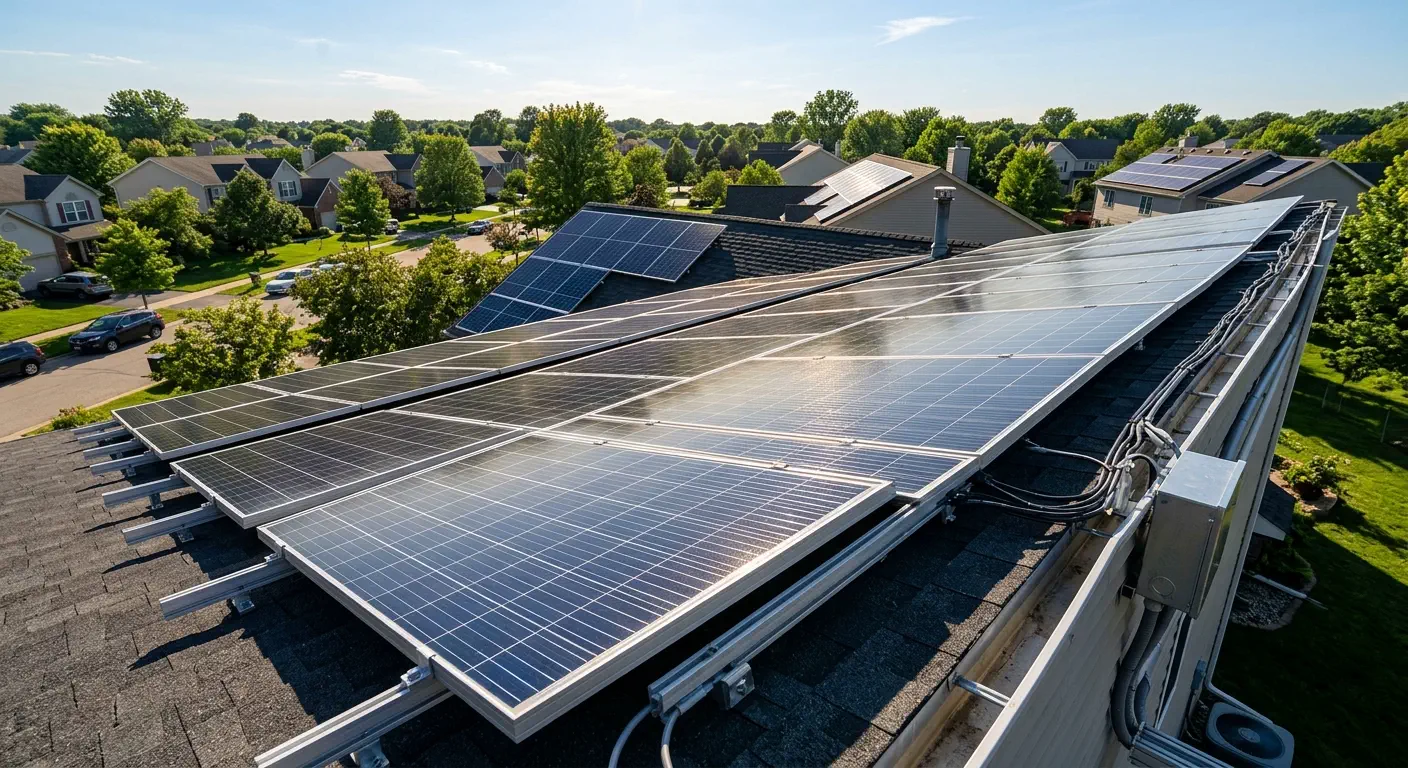

The Bureau of Labor Statistics projects 42% job growth for solar photovoltaic installers between 2024 and 2034 — roughly eight times faster than the average for all occupations. That makes solar PV installer one of the two fastest-growing occupations in the entire U.S. economy, alongside wind turbine technician.
Behind that projection is a straightforward dynamic: the cost of solar panels has dropped dramatically over the past decade, electricity demand keeps rising, and every panel that goes on a roof or into a ground-mounted array needs someone with the technical skill to install it safely and correctly. For prospective trade students looking at a career with strong demand and a realistic entry path, solar installation is one of the most compelling options available right now.
Why Solar Installation Is Booming
A workforce that has scaled fast — and is still short-handed
The 15th annual National Solar Jobs Census, published by IREC and SEIA, counted 280,119 solar workers in the United States in 2024. When battery storage roles are included, the combined solar and storage workforce reaches 464,053. Installation and project development alone account for 178,713 of those positions — nearly two-thirds of all solar jobs.
Despite that scale, the industry cannot hire fast enough. The Solar Jobs Census found that 86% of solar employers reported difficulty filling open positions in 2024, with 26% describing hiring as “very difficult” and another 60% calling it “somewhat difficult.” Only 14% of employers said hiring was not difficult.
Declining costs driving adoption
The BLS identifies the decreasing cost of PV panels as one of the primary drivers behind the occupation’s growth. As panels become more affordable, both residential and commercial installations expand. Solar leasing plans have further lowered the upfront barrier for homeowners, putting installation demand on a sustained upward trajectory.
For a broader look at how clean energy is reshaping the skilled trades, see our overview of clean energy trades careers.
Solar Installer Career Paths
What the work involves
Solar photovoltaic installers assemble, install, and maintain solar panel systems on rooftops and other structures. The work is physical and outdoor — climbing ladders, carrying equipment, working on rooftops in varying weather conditions. It requires a combination of electrical knowledge, mechanical skill, and strict attention to safety protocols.
Core responsibilities include measuring, cutting, and assembling structural framing for panel support; connecting panels to the electrical grid through inverters and wiring; and ensuring all installations comply with local building codes and electrical standards.
Entry-level positions: $39,000 to $52,000
The Bureau of Labor Statistics reports a median annual wage of $51,860 for solar PV installers as of May 2024, with the lowest 10% earning less than $39,070. For context, the median wage across all occupations is $49,500, which means even entry-level solar installers earn close to the national midpoint.
New installers typically start as helpers or junior technicians, working under the supervision of experienced crews. At this stage, the focus is on learning proper panel mounting techniques, basic electrical connections, and safety procedures. Most entry-level positions require only a high school diploma or equivalent, though candidates with community college coursework or prior electrical experience often advance faster.
Experienced installers: $52,000 to $65,000
After two to four years of field experience, installers typically move into lead installer or senior technician roles. At this level, workers take on more responsibility for system design interpretation, crew coordination, and quality assurance. The BLS data shows median earners in this range, with compensation varying by geography, employer size, and whether the work is residential or commercial-scale.
Experienced installers who earn their NABCEP PV Installation Professional certification often see a meaningful pay bump, as many employers treat this credential as a differentiator for higher-responsibility positions.
Advanced roles: $65,000 to $80,000+
The highest 10% of solar PV installers earn more than $80,150 annually. These top earners typically work in supervisory or specialized roles:
- Installation manager or project supervisor: Overseeing multiple crews and managing project timelines, quality control, and client communication
- Solar system designer: Combining field experience with technical design skills to plan installations, size systems, and specify equipment
- Operations and maintenance specialist: Managing the long-term performance of installed systems, including monitoring, diagnostics, and repair
- Sales engineer: Leveraging technical knowledge to support the sales process, conduct site assessments, and design proposals for commercial clients
Workers who transition into solar engineering or project management with additional education can push well beyond $80,000, though these roles typically require a bachelor’s degree or equivalent technical credentials.
Training and Certification
Entry requirements are accessible
One of the most attractive features of solar installation as a career is the low barrier to entry. The BLS confirms that the typical entry-level education is a high school diploma or equivalent. Most new hires receive on-the-job training lasting between one month and one year, depending on the employer and the complexity of the work.
That said, candidates who arrive with some formal training — whether from a community college program, a certificate in solar energy technology, or prior experience in electrical or construction trades — tend to be hired more readily and promoted faster. Given that 86% of employers report hiring difficulty, anything that demonstrates competence and commitment gives applicants a meaningful edge.
NABCEP: the industry’s gold standard certification
The North American Board of Certified Energy Practitioners (NABCEP) administers the certification that matters most in this field. NABCEP offers two levels:
- PV Associate: An entry-level credential that demonstrates foundational knowledge of solar PV systems. This is a strong addition to a resume for anyone starting out, and it serves as a stepping stone to the professional certification.
- PV Installation Professional (PVIP): The advanced certification that validates competence in PV system design, installation, commissioning, and maintenance. Earning PVIP requires a minimum of 58 hours of advanced PV training (40 hours from an accredited institution plus 18 hours from other qualifying sources, or an active PV Associate credential) along with 10 hours of OSHA Outreach Training for Construction Industry.
NABCEP also introduced a “Board Eligible” status program that allows candidates to pass the certification exam first and then gain the required field experience within three years — a practical option for recent graduates who want to demonstrate their knowledge before accumulating on-the-job hours.
DOL-approved apprenticeships: a new pathway
In a significant development for the industry, the U.S. Department of Labor certified National Guidelines for Apprenticeship Standards for the solar industry on January 13, 2025. These guidelines, developed jointly by IREC and SEIA, use the DOL-recognized “Construction Craft Laborer” occupation as the framework, since DOL does not yet recognize “solar installer” as a standalone apprenticeable occupation.
This matters for two reasons. First, Registered Apprenticeship programs provide structured, paid training — earn while you learn — which removes a significant financial barrier. Second, solar construction projects over 1 MW that use Registered Apprenticeship qualify for enhanced IRA tax credits, giving employers a direct financial incentive to create these programs.
The DOL’s Apprenticeships in Clean Energy (ACE) Network provides free technical assistance for organizations looking to develop Registered Apprenticeship programs, making it easier for employers and training providers to build these pathways from scratch.
The DOE Solar Training Network
The U.S. Department of Energy operates the Solar Training Network, which connects aspiring solar workers with training programs across the country. The program has been instrumental in building the industry’s training infrastructure, increasing the number of qualified solar instructors at the community college level from just over 50 in 2006 to more than 1,000 today. Training pathways range from high school career and technical education programs to community college certificates, associate degrees, apprenticeships, and continuing education for working professionals.
Industry Outlook and Policy Context
BLS projections remain strong
The Bureau of Labor Statistics projects approximately 4,100 openings per year for solar PV installers over the coming decade, driven by both new positions and replacement needs. The 42% growth rate through 2034 is classified as “much faster than average” and reflects fundamental demand drivers — declining hardware costs, rising electricity consumption, and growing adoption of solar across residential, commercial, and utility-scale markets.
According to SolarReviews’ workforce analysis, roughly 12,000 new solar positions (across all solar occupations, not just installers) are expected to open annually. Between March and August 2025, approximately 82,000 solar job postings were tracked on labor market platforms, slightly above the same period in 2024.
The IRA effect — and what came after
The Inflation Reduction Act, signed in August 2022, was described by SEIA as the “most transformational clean energy policy in history.” The legislation was projected to nearly double solar industry employment from 263,000 to 478,000 by 2033, and solar and storage companies added over $100 billion to the U.S. economy in the years following its passage.
The federal policy landscape shifted in 2025 with the passage of the “One Big Beautiful Bill Act” (OBBBA), signed into law on July 4, 2025. The legislation ended the Section 48E and 45Y tax credits after 2027, and the Section 25D residential solar tax credit after 2025. SEIA warned that the bill puts 330,000 clean energy jobs at risk and threatens 331 manufacturing facilities with closure or cancellation.
Why demand persists despite policy headwinds
Despite the federal policy shift, several factors continue to support strong demand for solar installers:
- State-level incentives: Many states maintain their own solar tax credits, rebates, net metering policies, and renewable portfolio standards that drive installation activity independently of federal policy.
- Declining hardware costs: The fundamental economics of solar continue to improve. Panel prices have dropped so far that solar is cost-competitive with conventional electricity in most markets, even without subsidies.
- Rising electricity demand: Data centers, electric vehicles, and building electrification are all increasing the amount of electricity the U.S. needs, creating more opportunities for solar generation.
- Installed base maintenance: The 21,833 workers in solar operations and maintenance roles reflect the growing need to service systems that are already in the field. As the installed base expands, so does the maintenance workforce.
The 2024 Solar Jobs Census showed that solar employment held roughly level year-over-year even as companies adjusted to shifting policy signals, suggesting the industry has found ways to absorb uncertainty while maintaining its workforce. The BLS 42% growth projection, which accounts for a range of economic and policy scenarios, remains in place.
How to Get Started
The most direct path into a solar installer career depends on where you are starting from:
If you have no prior trade experience
-
Explore community college and trade school programs. A certificate or associate degree in solar energy technology provides the foundational knowledge — electrical systems, panel mounting, inverter wiring, building codes, and safety protocols — that employers look for. These programs typically run six months to two years.
-
Earn the NABCEP PV Associate credential. This entry-level certification signals to employers that you understand the fundamentals and are serious about the career. It also sets you up for the more advanced PVIP certification later.
-
Look into Registered Apprenticeship programs. With the DOL’s newly certified solar apprenticeship guidelines, more programs are becoming available. The ACE Network is a good starting point for finding programs in your area.
-
Use the DOE Solar Training Network. The Solar Training Network maintains a directory of training programs and can help you identify options near you.
If you have electrical, construction, or related trade experience
Existing trade skills transfer well to solar installation. If you already have experience with electrical wiring, roofing, or general construction, the transition may require less formal training and more targeted on-the-job or manufacturer-specific instruction. Many employers will hire experienced trade workers and train them on solar-specific systems and codes.
What to realistically expect
Solar installation is physical, outdoor work. You will spend long days on rooftops, in variable weather, carrying equipment and working at heights. The work is seasonal in some regions, with slower periods during winter months in northern states. The pay is competitive for a trade that requires only a high school diploma to enter, but the early years require real physical effort and a willingness to learn on the job.
The upside is clear: an industry with 42% projected growth, 86% of employers struggling to hire, and multiple pathways for advancement from entry-level installer to project manager, system designer, or business owner. The skills are transferable, the demand is documented, and the training infrastructure is more developed than it has ever been.
Sources
- U.S. Bureau of Labor Statistics — “Occupational Outlook Handbook: Solar Photovoltaic Installers” — bls.gov
- Interstate Renewable Energy Council (IREC) — “2024 Solar Jobs Roughly Level with 2023, Provide Critical Baseline for Measuring Impacts of Federal Policy Changes” — 2025 — irecusa.org
- Solar Energy Industries Association (SEIA) — “SEIA National Solar Jobs Census Shows Solar Employment Strong, Expected to Grow” — 2025 — seia.org
- SEIA — “Impact of the Inflation Reduction Act” — seia.org
- SEIA — “Solar and Storage Companies Add Over $100 Billion to U.S. Economy as a Result of Inflation Reduction Act” — seia.org
- PV Tech — “SEIA: One Big Beautiful Bill Risks 330,000 Clean Energy Jobs in Republican States” — 2025 — pv-tech.org
- North American Board of Certified Energy Practitioners (NABCEP) — “2025 Certification Handbook” — January 2025 — nabcep.org
- IREC / SEIA — “U.S. Department of Labor Approves Guidelines for Registered Apprenticeship Programs for the Solar Industry” — January 2025 — irecusa.org
- U.S. Department of Energy — “Solar Design and Installation Training” — energy.gov
- U.S. Department of Energy — “Solar Training Network” — energy.gov
- SolarReviews — “2025 Solar Workforce Statistics” — 2025 — solarreviews.com
- Solar Power World — “Solar Jobs Stayed Level in 2024, but Impacts of OBBBA Still TBD” — November 2025 — solarpowerworldonline.com