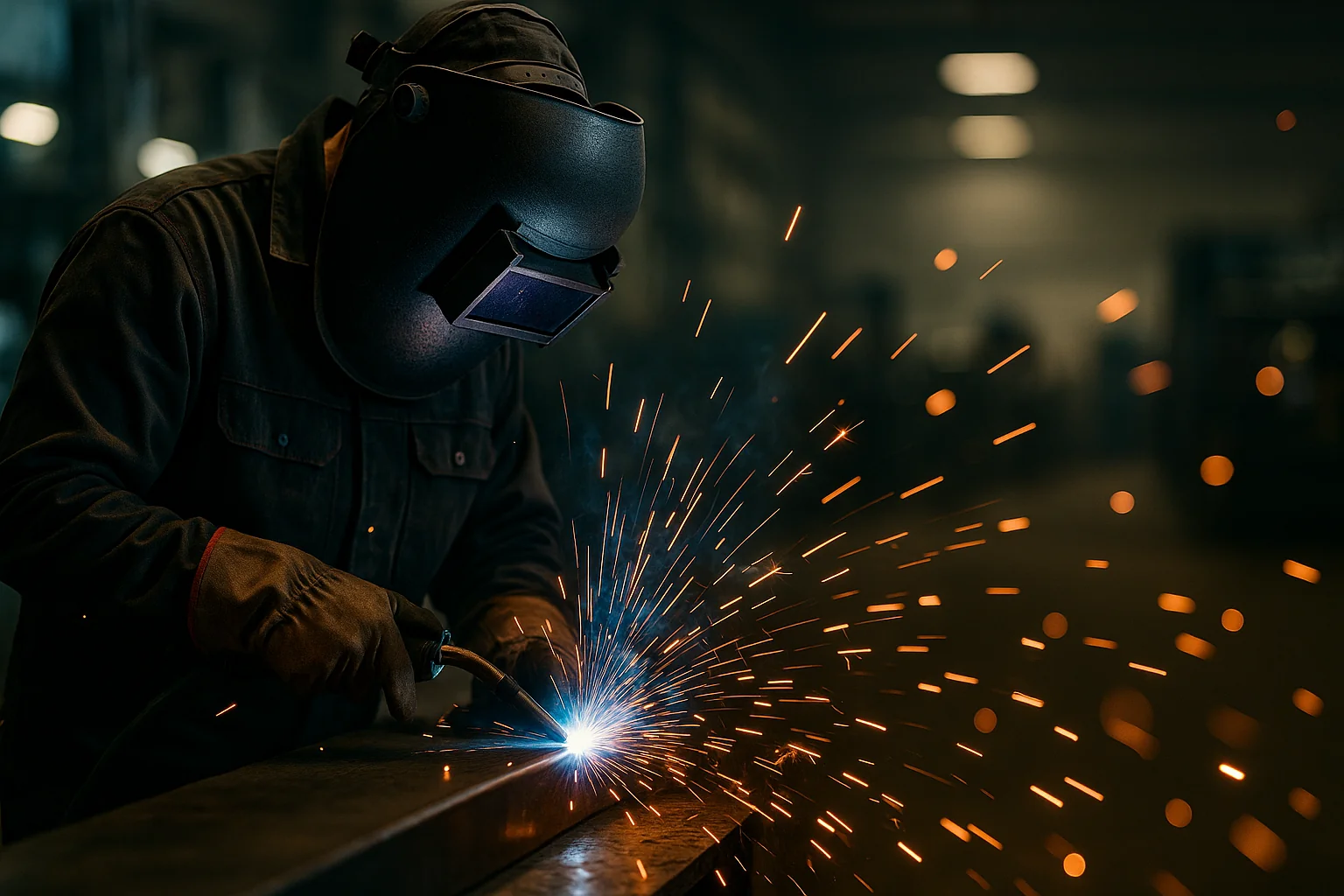
A welder leans into the joint, flips the hood down, and strikes an arc. In seconds, two pieces of steel become one — strong enough to hold up a bridge, seal a pipeline, or keep a pressure vessel from blowing apart. It’s physical, precise work that hasn’t been automated away, and it pays better than most people assume. But the real story in 2026 isn’t the sparks — it’s the demographics. The welding workforce is aging fast, and the industry needs hundreds of thousands of new professionals to fill the gap.
TL;DR
- Solid median pay: Welders, cutters, solderers, and brazers earned a median of $51,000/year in May 2024. Specialized welders (pipeline, underwater, nuclear) can reach $80,000–$150,000+. Source: BLS OOH.
- Massive replacement demand: The industry needs 336,000 new welding professionals by 2026, with roughly 80,000 positions to fill annually through 2029. Source: AWS Welding Workforce Data.
- Tens of thousands of openings: BLS projects about 45,600 welding openings per year through 2034. Source: BLS OOH.
- Multiple paths in: Trade school (7 months to 1 year), community college programs, apprenticeships, and AWS certifications from entry-level Certified Welder (CW) to Certified Welding Inspector (CWI).
- The honest truth: BLS projects just 2% job growth — slower than average. But 45,600 annual openings tells the real story, because retirements are gutting the existing workforce faster than new welders are entering.
Why Welding Still Matters
The Bureau of Labor Statistics projects 2 percent job growth for welders, cutters, solderers, and brazers from 2024 to 2034. That’s below the national average. On its face, it doesn’t sound exciting.
But here’s what the growth rate doesn’t tell you: the BLS also projects roughly 45,600 job openings every year during that period. Most of those openings come from workers retiring or moving to other occupations — not from employers creating brand-new positions. When you’re the one filling those openings, the distinction between “new growth” and “replacement demand” doesn’t matter much. The paycheck clears either way.
Several forces keep welding demand strong even with modest growth:
- Infrastructure spending — Bridges, pipelines, water systems, and power plants all need welded joints. Federal infrastructure bills have put billions into projects that require skilled welders on site.
- Manufacturing — Domestic production of machinery, vehicles, and industrial equipment depends on welding at every stage. About 457,300 welders are currently employed in the U.S., per the BLS.
- Energy — Oil and gas pipelines, wind turbine towers, solar panel mounting structures, and nuclear plant maintenance all require certified welders.
- Shipbuilding and defense — Navy contracts and commercial vessel construction keep welding shops busy in coastal areas.
The bottom line: 2 percent growth sounds quiet, but 45,600 annual openings sounds like opportunity — because it is.
The Demographic Crisis
This is the real hook. The American Welding Society (AWS) has been tracking the welding workforce, and the numbers paint a stark picture.
According to the AWS Welding Workforce Data and reporting by The Fabricator, the U.S. welding workforce totals approximately 771,000 workers (a broader count than BLS’s 457,300, since AWS includes related roles like welding operators, inspectors, and supervisors). Among the key findings:
- 336,000 new welding professionals are needed by 2026 — a number driven largely by retirements
- The industry needs to fill approximately 80,000 welding positions per year through 2029
- Over 20 percent of the current welding workforce is nearing retirement age
- The average welder is about 55 years old, compared to roughly 42 for the general U.S. workforce
- Fewer than 10 percent of welders are under 25
Read those last two bullets again. When the average worker in your field is 55 and less than one in ten is under 25, you’re looking at a wave of retirements with a thin pipeline behind it. For anyone in their late teens or twenties considering a trade, this is a wide-open door.
The AWS data shows the welding industry faces a structural problem: it has more people leaving than entering. That imbalance won’t fix itself overnight, and it means employers are competing for qualified welders — which puts pressure on wages, benefits, and working conditions to attract and keep talent.
Salary and Career Paths
What the BLS Reports
| Role | Median Annual Pay (May 2024) | Projected Growth (2024–2034) |
|---|---|---|
| Welders, Cutters, Solderers, and Brazers | $51,000 | 2% |
That $51,000 median means half of welders earn more. Experience, certifications, specialization, and geography all push compensation higher — sometimes significantly.
Career Progression
Entry-Level — Welding helpers, tack welders, and production MIG welders typically earn $30,000–$42,000. The focus at this stage is building speed and consistency, learning shop safety protocols, and passing basic position certifications (3G, 4G). A welding technology program gets you here faster than starting from scratch.
Certified / Mid-Career — With AWS certifications and 3–5 years of experience, structural welders, TIG welders, and combo welders move into the $45,000–$65,000 range. Pipe welding certifications (5G, 6G) open the door to higher-paying work. Welders who pass multiple process and position tests become more valuable to employers and gain access to better contracts.
Specialized and Advanced Roles — This is where pay jumps. Pipeline welders working shutdowns and turnarounds can earn $70,000–$100,000+. Underwater welders (hyperbaric welders/divers) reach $80,000–$150,000+ depending on depth pay, hazard pay, and project duration. Certified Welding Inspectors (CWI) earn $60,000–$95,000. Welding supervisors, engineers, and fabrication shop owners can exceed $100,000.
What Affects Your Pay
- Certifications — AWS Certified Welder (CW) is the baseline; CWI status commands a premium
- Specialization — Pipeline, underwater, aerospace, and nuclear welders earn significantly more than general fabrication welders
- Travel willingness — Traveling welders working shutdowns, pipeline projects, and construction sites often earn 30–50% more through per diem, overtime, and hazard pay
- Geographic location — Texas, Louisiana, Alaska, California, and the industrial Midwest tend to pay more
- Overtime — Common in most shops and on construction projects, typically at time-and-a-half
- Union membership — Union pipefitters and boilermakers often earn higher base wages with stronger benefits packages
Specialization Opportunities
Welding isn’t one job — it’s dozens of jobs that share a core skill set. The processes you master and the industry you work in determine your day-to-day experience and your earning potential.
By Welding Process
MIG (GMAW) — The most common starting point. Fast, versatile, and used heavily in manufacturing and general fabrication. Good for production work where speed matters.
TIG (GTAW) — Slower but produces cleaner, more precise welds. Required for aerospace, food-grade stainless, thin-wall tubing, and any application where weld appearance and integrity are paramount. TIG welders typically earn more than MIG-only welders.
Stick (SMAW) — The workhorse of field welding. Handles wind, rust, and imperfect conditions better than MIG or TIG. Structural steel, pipeline, and maintenance welding all rely on stick. If you want to work outdoors on construction projects, you need solid stick skills.
Flux-Core (FCAW) — A hybrid between MIG and stick, popular for heavy structural work, shipbuilding, and outdoor fabrication. High deposition rates make it efficient for thick materials.
By Industry
Pipe Welding — Cross-country pipelines, refineries, power plants, and process piping. Pipe welders work in all positions on round joints and are among the highest-paid welders in the field. Certifications in 5G and 6G positions are the ticket in.
Underwater Welding — Offshore platform repair, ship hull maintenance, dam and bridge work, and salvage operations. Requires both welding certifications and commercial diving credentials. The pay is high because the work is dangerous and physically demanding.
Structural Welding — Buildings, bridges, towers, and heavy steel frames. Governed by AWS D1.1 Structural Welding Code. Ironworkers and structural welders often work at height, which isn’t for everyone but pays well.
Aerospace Welding — Aircraft and spacecraft components using exotic alloys (titanium, Inconel, aluminum-lithium). Clean-room environments, extreme quality standards, and tight tolerances. The work is precision-focused, and the certifications are demanding.
Robotic Welding / Welding Automation — Programming and maintaining robotic welding cells in high-volume manufacturing. This isn’t hands-on welding — it’s a hybrid of welding knowledge and programming skill. Growing fast as manufacturers invest in automation.
Welding Inspection (CWI) — Certified Welding Inspectors examine welds for code compliance using visual, ultrasonic, radiographic, and other non-destructive testing methods. It’s a path for experienced welders who want to move off the tools without leaving the trade.
Education and Training
Training Pathways
You don’t need a four-year degree to become a welder. Multiple paths work:
- Trade school programs (7 months to 1 year) — focused, hands-on training that gets you into the workforce fast. Browse welding technology programs to compare options near you.
- Community college programs (1–2 years) — broader education, often with an associate degree. Some include blueprint reading, metallurgy, and welding inspection coursework.
- Apprenticeships (3–4 years) — earn while you learn under journeyman welders. Union programs (pipefitters, boilermakers, ironworkers) combine classroom hours with on-the-job training.
- Military training — Several branches offer welding MOS/rating programs with transferable skills and certifications.
When choosing a training program, look for multiple process training (MIG, TIG, Stick at minimum), adequate booth time on real equipment, certification test preparation, and job placement support.
AWS Certifications
The American Welding Society is the main credentialing body for welders in the U.S. Key certifications include:
- Certified Welder (CW) — Performance-based test demonstrating ability to make sound welds per a specific WPS (Welding Procedure Specification). This is the entry-level professional credential.
- Certified Welding Inspector (CWI) — Requires a combination of education and experience (typically 5+ years welding or a degree plus fewer years). CWIs verify that welds meet code requirements. Passing the exam is a career-changing move that often lifts pay into the $60,000–$95,000 range.
- Senior Certified Welding Inspector (SCWI) — Advanced credential for experienced inspectors.
- Certified Welding Educator (CWE) — For those who want to teach welding at trade schools or community colleges.
Other Certifications Worth Pursuing
- ASME certifications for pressure vessel and boiler welding
- API 1104 qualification for pipeline welding
- Position certifications — 3G, 4G (plate), 5G, 6G (pipe) — the higher the G number on pipe, the more doors open
- Material-specific qualifications — stainless steel, aluminum, chromoly, exotic alloys
- OSHA safety certifications — 10-hour and 30-hour cards are commonly required on construction sites
Technology and Future Trends
Welding is changing, and the welders who adapt will earn the most. Here’s what’s shifting:
- Robotic and automated welding is expanding in manufacturing. This doesn’t eliminate welders — it changes the job description. Someone has to program the robots, maintain them, and handle the joints that automation can’t reach. Welders who learn robotic programming add a high-value skill.
- Laser welding is growing in precision manufacturing and automotive applications. It’s faster and produces smaller heat-affected zones than traditional arc welding.
- Friction stir welding joins materials (especially aluminum) without melting them. Used in aerospace, shipbuilding, and rail. It’s a niche but growing process.
- Additive manufacturing (wire-arc) uses welding processes to 3D-print metal parts layer by layer. Still emerging, but it’s expected to grow in repair, prototyping, and specialty manufacturing.
- Augmented reality training is entering welding education. AR welding simulators let students practice without consuming materials, and some shops use AR overlays for weld placement guidance.
The common thread: technology is changing the trades, but it’s adding to the welder’s toolkit rather than replacing the welder. Robots handle repetitive production welds; humans handle everything else — field work, repair, custom fabrication, inspection, and any joint that’s in an awkward position or made of an unusual material. The welders who’ll earn the most going forward are the ones who can do both: lay a bead by hand and program a cell to do it automatically.
What Makes a Successful Welder
Technical Skills
Good welders understand more than just how to run a bead. They read blueprints, interpret welding symbols, understand metallurgy (why preheating matters, how different alloys behave under heat), and know which process, filler metal, and shielding gas to use for a given joint. Code compliance — knowing AWS D1.1, ASME Section IX, or API 1104 inside and out — separates a welder who passes tests from one who doesn’t.
Physical Requirements
Welding is physical work. You’ll need:
- Steady hands and good hand-eye coordination — especially for TIG and pipe welding
- Good vision (correctable is fine) and depth perception
- Heat tolerance — you’re working near molten metal, often in non-air-conditioned shops or outdoors
- Physical stamina — holding awkward positions for extended periods, working overhead, crouching in tight spaces
- Comfort at height — structural and ironwork welders routinely work on beams, scaffolds, and lifts
Safety Mindset
Welding involves real hazards: UV radiation that can burn eyes and skin in seconds, hot metal and slag, toxic fumes, electrical shock risk, and fire potential. Successful welders take PPE seriously — auto-darkening helmets, flame-resistant clothing, proper ventilation or respirators, leather gloves, and steel-toed boots aren’t optional. A 30-year career depends on protecting yourself every day.
Getting Started
- Research training programs — Browse welding technology programs and compare trade schools, community colleges, and apprenticeships near you.
- Try an introductory course — Many community colleges and makerspaces offer weekend or evening intro welding classes. Get your hands on a MIG gun before committing to a full program.
- Talk to working welders — Visit a fabrication shop or construction site. Ask what they like, what they don’t, and what they’d do differently starting out.
- Pick a training path — See our guide on choosing the right trade program for what to look for in a program.
- Plan for certifications early — Know which AWS certifications your target industry requires and make sure your training program prepares you to test.
- Look at the big picture — Welding is part of a broader skilled trades boom. Understanding where welding fits alongside other trades helps you make an informed decision.
The workforce numbers tell a clear story: more welders are leaving than entering, employers are competing for qualified hands, and the pay reflects that. If you’ve got the physical ability, the patience to learn precision skills, and the willingness to work hard, welding offers a career that can’t be offshored, won’t be fully automated, and pays a living wage from day one.
Sources
- Bureau of Labor Statistics — Welders, Cutters, Solderers, and Brazers: Occupational Outlook Handbook — Accessed March 2026
- American Welding Society — Welding Workforce Data — Accessed March 2026
- The Fabricator — Outlook, Trends, and Pay for the Welding Workforce According to AWS Data — Accessed March 2026