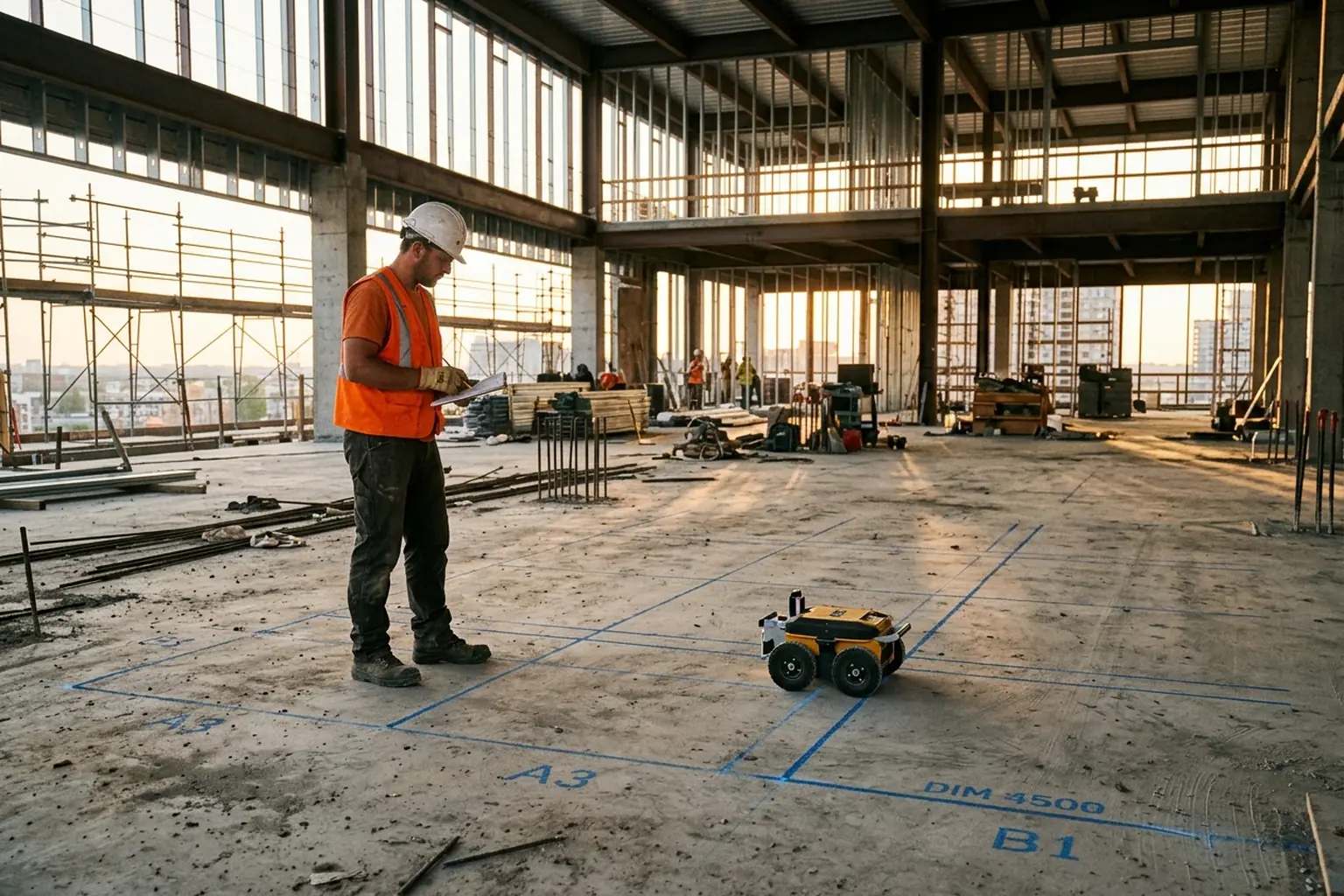

A data-driven look at the tools and tech reshaping skilled trades careers in the U.S.
TL;DR: AI isn’t replacing tradespeople. It’s making them faster, safer, and better paid. Meanwhile, 3D printers are building homes, robots are laying bricks, and exoskeletons are protecting workers’ backs. Here’s what’s actually happening on jobsites right now and what it means for anyone considering a career in the trades.
The conversation about technology and work usually focuses on office jobs: who’s getting automated, which white-collar roles are shrinking, who needs to “upskill.” But some of the most dramatic tech adoption in 2026 is happening on construction sites, in HVAC service vans, and inside welding shops.
Demand for skilled trades workers is growing 3x faster than demand for white-collar roles, according to a March 2026 Randstad analysis of over 50 million job postings. Robotics technician postings alone are up 107%. HVAC engineer demand has jumped 67%. Industrial automation technician roles have grown 51%.
These aren’t jobs being destroyed by technology. They’re jobs being created by it. And the workers filling them need a new mix of physical skill and digital fluency.
Let’s look at what’s actually changing, trade by trade.
AI on the Jobsite: Not Replacing, Augmenting
If you’ve been told AI will take your job, the data tells a different story for trades. A ServiceTitan survey of over 1,000 contractors found that 46% are already using or experimenting with AI, and 72% see it as relevant to their business. But here’s the key: they’re using it for admin work (59%), marketing (51%), and customer service (39%). The actual field work? Still firmly in human hands.
What AI does well in trades is handle the stuff tradespeople don’t want to do anyway. Scheduling. Invoicing. Generating quotes. Writing follow-up emails to customers. Two-thirds of the contractors surveyed believe AI will transform their industry within one to three years, but the transformation they’re describing is about running a better business, not about a robot crawling under a house to fix a pipe.
The barriers are real but manageable. The top challenges contractors cite are lack of training (44%) and integration with existing systems (44%). Employee resistance? Only 18%. Most tradespeople aren’t afraid of AI. They just need to learn how to use it.
This tracks with what we’ve been seeing in the broader AI and trades conversation. AI is driving massive demand for physical infrastructure, which means massive demand for the people who build it. Randstad’s data backs this up: construction job postings are up 30%, welding up 25%, and electrician roles up 18%. And HVAC wages have climbed 10-15% in just four years.
Meanwhile, for every 100 young workers entering manufacturing, 102 leave. The math is stark: the industry needs people, and the people who show up with both trade skills and tech literacy will have serious leverage.
3D-Printed Buildings Are Here
This isn’t a prototype in a lab. 3D-printed construction is going commercial in 2026.
ICON, the Austin-based construction tech company, announced its next-generation Titan system for commercial rollout. The specs are striking:
- Wall systems cost roughly $20 per square foot, about 40% less than conventional methods
- The printer stands 27 feet tall and covers a 2,500-square-foot print area
- It can print a home’s structure in under 7 days
- It takes just 2 operators to run
The Titan unit starts at $899K, with training programs launching in Q3 2026 and first deliveries expected early 2027. This isn’t going to replace construction workers overnight, but it will change what construction workers do. The two operators running a Titan need to understand robotics, materials science, and digital modeling. That’s a different skill set than traditional framing, and training programs will need to catch up.
Then there’s Alquist, which is partnering with Walmart on what’s being called the largest-scale 3D-printed commercial deployment in U.S. history. The numbers tell the story:
- 12+ projects across the United States
- An 8,000-square-foot 3D-printed building for a Walmart in Athens, Tennessee (the largest of its kind)
- A 5,000-square-foot Walmart addition built in 7 days with 4 workers and 2 robots
Four workers. Two robots. Seven days. That’s the kind of efficiency gain that reshapes an industry. But notice: it still takes people. People who can operate the equipment, troubleshoot problems, handle finishing work, and manage the site. The job description changes, but the jobs don’t disappear.
Robots Are Coming to the Jobsite
The construction robotics market tells you everything you need to know about where this industry is heading. According to SNS Insider, it’s projected to grow from $253 billion in 2025 to $1.2 trillion by 2035, a compound annual growth rate of nearly 17%. Their analysis suggests robots could cut repetitive labor by 90% and dangerous tasks by 72%.
Two companies give a good picture of what’s coming to U.S. jobsites.
Buildroid AI is bringing model-based automated bricklaying from the UAE to the United States. Their system runs on Nvidia’s Omniverse platform and uses BIM-driven digital twins to lay blocks weighing up to 40 kg, building walls up to 4 meters wide and 3 meters tall. Backed by a $2 million pre-seed round and already piloted in the UAE, Buildroid has U.S. projects planned for 2026.
RIC Robotics is going even bigger with Zyrex, a 20-foot-tall AI-powered construction robot with 26 degrees of freedom. Zyrex is battery-powered with self-changing battery packs and can handle welding, assembling, carpentry, and even 3D printing. It uses LiDAR and VLA (vision-language-action) AI models, and operators control it through VR. The price point matters here: under $1 million to buy, or under $20,000 per month to lease.
For tradespeople, these robots create a new category of work. Someone has to program them, maintain them, supervise them, and fix them when they break. Robotics technician demand is already up 107% according to Randstad’s data, and that number will keep climbing. If you’re entering the trades today, getting comfortable with robotics is a career multiplier.
Exoskeletons and Wearables: Protecting the Workers Who Stay
Construction is hard on bodies. The numbers are blunt: 51.1% of construction workers experience lower back pain, 37.2% have knee problems, and 30.4% deal with shoulder issues. These aren’t minor inconveniences. They’re career-enders.
That’s why the wearable exoskeleton market hit $4.6 billion in 2025 and is growing fast. There are two main types showing up on jobsites:
Passive exoskeletons use springs and mechanical structures to redistribute weight. The Esko EVO and Hilti EXO-O1 are already in use on commercial construction sites, helping workers who spend hours doing overhead work or heavy lifting. No batteries, no software, just physics helping your body do what it was already going to do.
Powered exoskeletons are the next step. The IX BACK VOLTON bills itself as the first “intelligent exoskeleton,” using AI to adapt its support to the wearer’s movements. It runs on an 8-hour battery, which means it lasts a full shift. The AI component learns how each wearer moves and adjusts accordingly, providing more support during heavy lifts and less during regular walking.
For HVAC technicians who spend their careers crawling through attics and hoisting equipment, or welders holding heavy torches in awkward positions for hours, exoskeletons aren’t a luxury. They’re the difference between a 30-year career and one that ends at 45 because your back gives out.
AR/VR Training Is Replacing Textbooks
Learning a trade has always been hands-on. That hasn’t changed. But the way hands-on training happens is shifting dramatically.
Interplay Learning has built hundreds of hours of 3D and VR simulations covering HVAC, electrical, and plumbing. Students can troubleshoot a furnace, wire a panel, or diagnose a plumbing issue in a virtual environment before they ever touch a real system. Their Interplay Achieve platform, launched in March 2025, expanded into industrial maintenance and crane/rigging training. A partnership with Modigent now offers structured VR-based apprenticeship programs for plumbing and HVAC.
Why does this matter? Two reasons.
First, practice without consequences. A student can make mistakes in VR that would be dangerous or expensive on a real jobsite. Wire something wrong in VR and you get a pop-up. Wire something wrong in real life and you get an arc flash. The learning outcomes are the same; the risk is gone.
Second, access. Not every community college or trade school has the budget for a fully equipped training lab with every possible scenario. VR can simulate equipment, conditions, and problems that a school might not be able to replicate physically. A student in rural Montana can train on the same systems as a student in Houston.
In the field, technology is changing diagnostics too. ServiceTitan and Conduit Tech are using LiDAR scanning to help HVAC technicians measure spaces and design systems more accurately. Point your phone at a room, and the software builds a 3D model with precise measurements. That data feeds directly into load calculations and equipment recommendations. What used to take hours of manual measurement and calculation now takes minutes.
BIM and Digital Twins: The New Blueprint
Building Information Modeling (BIM) has been around for years, but 2026 is the year it becomes truly unavoidable. The BIM market is projected to grow from $9 billion in 2025 to $15.4 billion by 2030, a CAGR of 11.3%. Multiple countries now mandate BIM for public infrastructure projects, and cloud-based BIM has become the de facto industry standard.
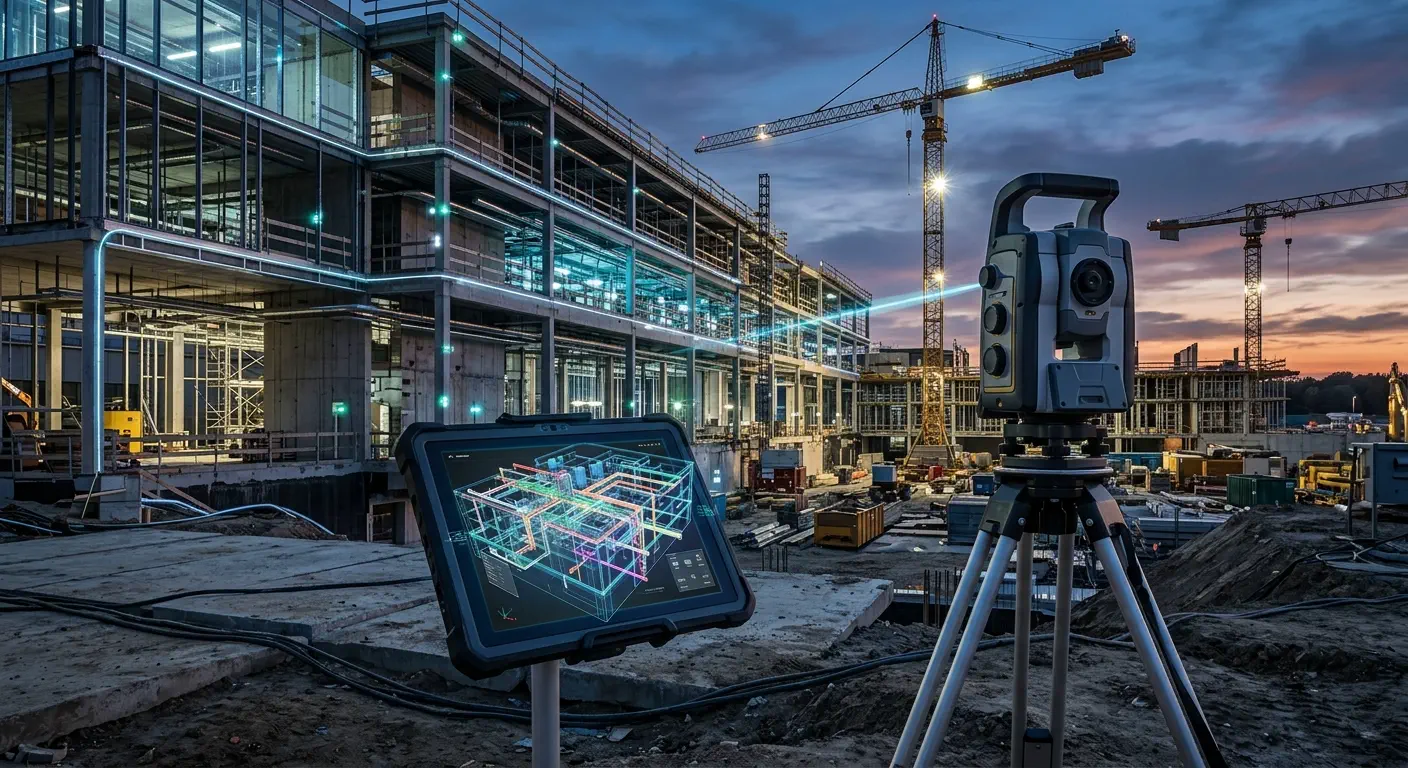
What does this mean on the ground? Every major commercial construction project now starts with a detailed 3D digital model. Electricians, plumbers, HVAC techs, and other trades work from this model instead of (or alongside) traditional 2D drawings. You can see where every pipe, wire, and duct goes before a single piece of material is installed. Conflicts between systems get caught in the model, not during framing.
Deloitte’s 2026 Engineering & Construction Outlook goes further, predicting that cloud-native digital twins and AI agents will become standard practice in 2026. A digital twin is a living model of a building that updates as construction progresses and continues to collect data after the building is occupied. AI agents can analyze this data to predict maintenance needs, optimize energy use, and flag potential problems before they become emergencies.
Deloitte also notes that the industry is expecting investment growth of 1.8% in 2026 and needs 499,000 new workers (up from 439,000 in 2025). The workers who understand BIM, digital twins, and the software tools that tie them together will be the ones filling those positions.
For someone entering a trade today, BIM literacy isn’t optional anymore. It’s as fundamental as knowing how to read a tape measure.
What This Means for Your Career
All of this technology points in the same direction: the trades are becoming higher-skilled, higher-paid, and harder to automate. The person who can run a 3D printer, read a BIM model, operate in VR, and still bend conduit by hand is worth more than someone who can only do one of those things.
The pay is already reflecting this shift. Nvidia CEO Jensen Huang has talked publicly about data center electricians earning $250,000 to $300,000 per year. That’s not a typo, and it’s not a projection. Mike Rowe recently described meeting three electricians under 30 at a data center in Plano, Texas who were earning $240,000 to $280,000 a year with no college debt.
Vicki Salemi, a career expert at Monster, told CNBC that trades are “so AI-proof” precisely because they require physical presence, problem-solving in unpredictable environments, and human judgment that current AI simply can’t replicate.
The broader numbers support this. The National Association of Manufacturers projects a 1.9 million manufacturing worker shortfall by 2033. Associated Builders and Contractors says the construction industry needs 499,000 new workers by 2027. These aren’t small gaps. They’re structural shortages that will take years to fill.
Here’s the practical takeaway: tech literacy is your competitive advantage. You don’t need a computer science degree. You need to be the electrician who can work with BIM software. The HVAC tech who understands LiDAR-based diagnostics. The welder who can program and maintain a robotic welding cell. The construction worker who can operate a 3D printer or supervise an autonomous bricklayer.
The technology isn’t taking jobs away from tradespeople. It’s splitting the trades into two tiers: those who work with the technology and command premium pay, and those who work without it and compete on price alone.
The choice is yours. But the data makes it pretty clear which tier you want to be in.
Sources
- Randstad, “AI Can’t Build Data Centers: Global Demand for Skilled Trades Soars in the AI Era” (March 2026) — https://www.randstad.com/press/2026/ai-cant-build-data-centers-global-demand-for-skilled-trades-soars-in-the-ai-era/
- CNBC, “Jobs Apocalypse: AI-Proof Skilled Trades” (March 8, 2026) — https://www.cnbc.com/2026/03/08/jobs-apocalypse-ai-proof-skilled-trades.html
- ServiceTitan, “AI in the Skilled Trades Report 2025” (December 2025) — https://www.servicetitan.com/press/ai-in-the-skilled-trades-report-2025
- Deloitte, “2026 Engineering & Construction Industry Outlook” (2026) — https://www.deloitte.com/us/en/insights/industry/engineering-and-construction/engineering-and-construction-industry-outlook.html
- ICON, “ICON Announces First Commercial Rollout of Its 3D Printing Construction Technology for Builders” (March 2026) — https://www.iconbuild.com/newsroom/icon-announces-first-commercial-rollout-of-its-3d-printing-construction-technology-for-builders
- PRNewswire/Alquist, “Alquist to Scale 3D Print Construction Technology via Walmart and Other Commercial Retail Projects in 2026” (2026) — https://www.prnewswire.com/news-releases/alquist-to-scale-3d-print-construction-technology-via-walmart-and-other-commercial-retail-projects-in-2026-302623710.html
- ENR, “Robotics Start-Up Buildroid AI to Bring Model-Based Automated Bricklaying to U.S. Jobsites” (2026) — https://www.enr.com/articles/62176-robotics-start-up-buildroid-ai-to-bring-model-based-automated-bricklaying-to-us-jobsites
- Electrek, “RIC Robotics Shows Off Giant Construction Robot Coming to Job Sites in 2026” (May 2025) — https://electrek.co/2025/05/13/ric-robotics-shows-off-giant-construction-robot-coming-to-job-sites-in-2026/
- CONEXPO-CON/AGG, “From Sci-Fi to Jobsite: Wearable Exoskeletons Are Proving Their Worth” (2025) — https://www.conexpoconagg.com/news/from-scifi-to-jobsite-wearable-exoskeletons-are-pr
- SkillCat/Interplay Learning, “Interplay Learning HVAC Skilled Trades Training” (2025) — https://www.skillcatapp.com/post/interplay-learning-hvac-skilled-trades-training
- MarketsandMarkets, “Building Information Modeling Market” (2025) — https://www.marketsandmarkets.com/Market-Reports/building-information-modeling-market-95037387.html
- Fortune, “Mike Rowe on Skilled Trade Careers and Data Center Electricians” (March 19, 2026) — https://fortune.com/2026/03/19/mike-rowe-dirty-jobs-host-skilled-trade-warning-education-alarm-gen-z-six-figure-careers-data-center-electricans/
- GlobeNewswire/SNS Insider, “Construction Robotics Market Size to Hit $1,218.02 Billion by 2035” (February 2026) — https://www.globenewswire.com/news-release/2026/02/12/3237072/0/en/Construction-Robotics-Market-Size-to-Hit-1218-02-Billion-by-2035-SNS-Insider.html
Note: U.S. focus; links current as of March 21, 2026.