
Americans now owe more than $1.77 trillion in student loan debt, spread across roughly 43 million borrowers. That figure has tripled over the past 15 years, and the average bachelor’s degree holder leaves school owing around $39,000 — before interest. Source: Education Data Initiative — Student Loan Debt Statistics.
Meanwhile, a licensed electrician, a certified HVAC technician, and a commercial truck driver can enter the same workforce — often in the same metro area, earning comparable or better wages — with a fraction of that debt. Some finish training in weeks, not years.
This article puts numbers behind that comparison. We will look at what trade school actually costs, how long each program takes, what the default rates reveal about affordability, and which trades offer the best return on your educational investment.
The Numbers: Trade School Debt vs. Four-Year Degree
The gap between trade school borrowing and four-year degree borrowing is not a marginal difference — it is a multiple.
- Average trade school debt: approximately $10,000. Public community college certificate students average roughly $8,075 in total borrowing. Source: Education Data Initiative — Student Loan Debt Statistics.
- Average bachelor’s degree debt: approximately $39,000. Public university students borrow an average of $31,960 — nearly four times the trade school average. Source: Education Data Initiative — Student Loan Debt Statistics.
- Total program cost: Trade school tuition typically ranges from $5,000 to $33,000 for the entire program. By comparison, four years of in-state public university tuition and fees totals roughly $119,640. Source: College Transitions — Is Trade School Worth It?.
Federal data confirms that 38% of all undergraduate students received some form of federal loan aid during the 2022-23 academic year. Source: NCES — Undergraduate Financial Aid. That borrowing falls disproportionately on four-year students, who take on larger loans over longer enrollment periods.
For a deeper look at how to reduce what you owe before you even start classes, see our guide on financing your trade school education.
Time to Employment by Trade
One of the most consequential differences between trade school and a four-year degree is not the sticker price — it is the time before you start earning. Every semester spent in school is a semester of lost wages on top of tuition paid. The BLS classifies occupations by the typical education and training required for entry. Source: BLS — Education and Training Classification System.
Here is how the most popular trades compare:
| Trade | Typical Program Length | Earning While Training? |
|---|---|---|
| CDL / Truck Driving | 3–8 weeks | No (but working within days of certification) |
| Welding Certificate | 7–9 months | Sometimes (some programs offer co-ops) |
| Medical / Dental Assistant | 9–12 months | Clinical rotations are unpaid |
| HVAC Certificate | 6–24 months | Some employers sponsor on-the-job training |
| Cosmetology | 12–18 months | Clinic floor hours may generate tips |
| Electrical Apprenticeship | 4–5 years | Yes — earning wages from day one |
| Plumbing Apprenticeship | 4–5 years | Yes — earning wages from day one |
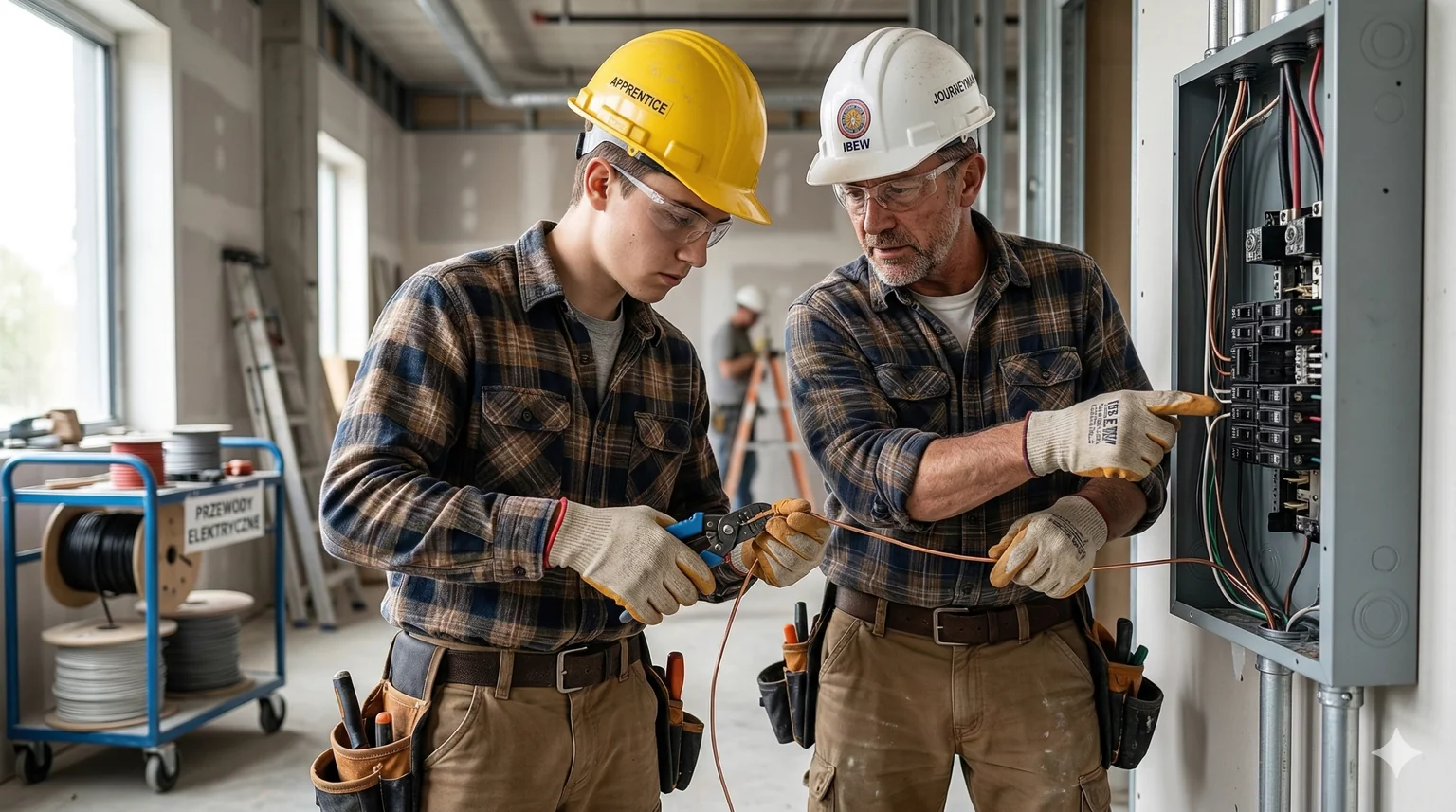
Even the longest programs on this list — electrical and plumbing apprenticeships — come with a crucial advantage: apprentices earn while they learn. Starting pay is typically around 50% of a journeyworker’s wage and rises with each completed phase. That means these workers accumulate little or no debt while building years of paid experience. For more on how apprenticeships work, see our apprenticeships explained guide.
The shortest programs, like CDL training, can put you behind the wheel of a commercial vehicle in under two months. That speed-to-employment dramatically changes the financial math compared to four years of full-time study.
Default Rates Tell the Real Story
Debt is only part of the equation. What matters more is whether graduates can actually repay what they owe. Default rates — the percentage of borrowers who stop making payments — reveal how manageable the debt burden truly is.
- For-profit school cohort default rate: 14.7%
- Nonprofit school cohort default rate: 6.4%
Source: Federal Student Aid — Default Rates.
The Federal Reserve’s 2024 Survey of Household Economics and Decisionmaking paints an even more detailed picture: 30% of borrowers whose highest education is some college, a technical certificate, or an associate degree are behind on their student loan payments, compared to 11% of borrowers with a bachelor’s degree. Source: Federal Reserve — Economic Well-Being of U.S. Households, Higher Education and Student Loans.
That 30% figure deserves careful reading. It includes students who enrolled in low-quality programs, dropped out before completing, or attended unaccredited schools that left them with debt but no credential. The lesson is not that trade school is risky — it is that program quality and accreditation matter enormously. A $10,000 loan for an accredited welding certificate that leads to a $55,000/year job is a fundamentally different proposition than a $15,000 loan for a program with a 30% completion rate.
When evaluating programs, verify accreditation through the Department of Education’s database, check completion and job placement rates, and ask graduates directly about their experience. Browse accredited programs by field in our programs directory.
ROI: How Fast Do You Break Even?
Return on investment in education is straightforward to calculate: divide your total cost (tuition plus lost wages) by the salary increase the credential provides. The lower the cost and the higher the salary, the faster you break even.
Consider two scenarios:
Trade school path: A $10,000 welding certificate completed in 9 months leads to a job paying $48,000/year. Total investment including lost wages (9 months at a hypothetical $15/hour part-time job): roughly $10,000 in tuition. Break-even point: well under one year of full-time work.
Four-year degree path: A bachelor’s degree costing $39,000 in debt alone (not counting four years of limited earning) leads to a median starting salary of approximately $62,000 for all bachelor’s holders. But the borrower also foregoes four years of potential full-time earnings. At the median, it takes significantly longer to recoup that combined investment.
Source: College Transitions — Is Trade School Worth It?.
The BLS Occupational Outlook Handbook provides median annual wages for skilled trades that compete directly with many bachelor’s-level starting salaries:
- Electricians: $62,350/year median. Source: BLS — Electricians.
- Plumbers, pipefitters, and steamfitters: $62,970/year median. Source: BLS — Plumbers.
- HVAC mechanics and installers: $59,810/year median. Source: BLS — HVAC Technicians.
- Elevator installers and repairers: $102,420/year median — a figure that exceeds many white-collar professional salaries, and the apprenticeship is paid, so there is no tuition debt to break even on at all (see our elevator installer career guide). Source: BLS — Elevator Installers.
The trades with the fastest break-even times share two characteristics: low program costs and strong labor demand that keeps starting wages high.
Trades with the Best Debt-to-Earnings Ratio
To compare trades on a level playing field, we can look at the ratio of estimated total program cost to median annual salary. A lower ratio means you spend less relative to what you earn — the hallmark of a high-ROI credential.
| Trade | Est. Program Cost | Median Annual Wage (BLS) | Cost-to-Wage Ratio |
|---|---|---|---|
| CDL / Truck Driving | $3,000–$7,000 | $54,320 | 0.06–0.13 |
| Welding Certificate | $5,000–$15,000 | $51,000 | 0.10–0.29 |
| HVAC Certificate | $5,000–$20,000 | $59,810 | 0.08–0.33 |
| Medical Assistant | $6,000–$18,000 | $42,000 | 0.14–0.43 |
| Dental Assistant | $6,000–$18,000 | $44,820 | 0.13–0.40 |
| Cosmetology | $10,000–$25,000 | $35,080 | 0.29–0.71 |
| Electrical (apprenticeship) | $0–$2,000 (earn while learning) | $62,350 | 0.00–0.03 |
| Plumbing (apprenticeship) | $0–$2,000 (earn while learning) | $62,970 | 0.00–0.03 |
Wage sources: BLS Occupational Outlook Handbook.
The standout pattern: apprenticeship-based trades dominate the rankings because the out-of-pocket cost approaches zero. You are paid to learn, and you graduate with a journeyworker credential and no debt. Even among certificate-based trades, CDL and HVAC programs offer exceptional ratios because they combine low tuition with strong median wages.
Cosmetology sits at the other end of the spectrum — not because it is a poor career choice, but because licensing requirements mandate more training hours (often 1,000–1,500+), which drives up program cost, while median wages start lower. Cosmetologists who build a client base or open their own shop often earn well above the median, but the entry-level numbers are worth understanding before you enroll.
For a broader comparison of trade school versus a traditional four-year college path, including non-financial factors like career flexibility and job satisfaction, we cover that in a separate guide.
How to Minimize Your Debt Further
Even with trade school’s lower price tag, unnecessary borrowing is still unnecessary borrowing. A few strategies that can reduce or eliminate what you owe:
- File the FAFSA. Trade school students at accredited institutions qualify for Pell Grants (up to $7,395/year), which do not have to be repaid. Many students skip this step and miss free money. Details in our financing guide.
- Choose an apprenticeship when available. Apprenticeships in electrical, plumbing, HVAC, pipefitting, and other trades let you earn from day one. Search open programs at apprenticeship.gov.
- Apply for trade-specific scholarships. Industry groups like mikeroweWORKS, TechForce Foundation, and local trade unions offer scholarships with smaller applicant pools than academic awards.
- Compare accredited programs on cost and outcomes. Tuition for the same credential can vary by $10,000 or more between schools. Check completion rates, job placement rates, and employer partnerships before committing.
- Consider employer-sponsored training. Many contractors and companies pay for training in exchange for a work commitment. This is common in trucking, HVAC, and electrical work.
Browse programs by trade and location in our programs directory to start comparing options.
Sources
- Education Data Initiative — Student Loan Debt Statistics
- NCES — Undergraduate Financial Aid Indicators (COE)
- College Transitions — Is Trade School Worth It?
- BLS — Education and Training Classification System
- Federal Student Aid — Default Rates
- Federal Reserve — Economic Well-Being of U.S. Households in 2024: Higher Education and Student Loans
- BLS — Electricians
- BLS — Plumbers, Pipefitters, and Steamfitters
- BLS — HVAC Mechanics and Installers
- BLS — Elevator Installers and Repairers
- BLS — Occupational Outlook Handbook