
Two electricians with the same license, the same years on the job, doing the same work can earn vastly different paychecks depending on where they live. An electrician in Washington state earns a mean wage of $88,620, while one in Arkansas earns $49,800. That is a 78% gap for the same occupation.
This article breaks down what electricians, plumbers, HVAC technicians, and welders actually earn across the country using federal wage data. It also explains why those gaps exist and what they mean if you are deciding where to train and build a career.
The National Picture
The skilled trades already pay well above the national median for all occupations. According to the Bureau of Labor Statistics, the median annual wage for construction and extraction occupations is $58,360, compared to roughly $49,500 across all occupations — an 18% premium.
Individual trades push even higher. Here are the median annual wages from the most recent BLS Occupational Employment and Wage Statistics (OEWS) data:
| Trade | Median Annual Wage |
|---|---|
| Plumbers, pipefitters, steamfitters | $62,970 |
| Electricians | $62,350 |
| HVAC mechanics and installers | $59,810 |
| Welders, cutters, solderers, brazers | $51,000 |
These are medians, meaning half the workers in each trade earn more. In states with higher demand, stronger unions, or higher costs of living, wages climb well above these benchmarks. The gap between the top-paying and lowest-paying states is substantial — and understanding it can shape where you choose to start your career.
Top-Paying States for Each Major Trade
State-level wage data reveals just how wide the geographic spread is. The following figures are mean annual wages from the BLS OEWS May 2024 release, which captures what workers are actually paid on average — not just the midpoint.
Electricians
| State | Mean Annual Wage |
|---|---|
| District of Columbia | $88,860 |
| Washington | $88,620 |
| Hawaii | $88,280 |
| Illinois | $88,040 |
| Oregon | $85,330 |
| California | $84,330 |
| New York | $83,550 |
Washington, Illinois, and Oregon all have strong union representation in the building trades, which directly pushes wages higher. California and New York combine high cost of living with heavy construction activity across residential, commercial, and infrastructure projects. Hawaii’s isolation drives up costs for everything, including labor.
If you are exploring what an electrical career looks like in practice, these top states represent where licensed electricians earn the most — though cost of living should factor into any comparison.
Plumbers, Pipefitters, and Steamfitters
According to PTT.edu’s plumber salary analysis, the highest-paying states for plumbing professionals are:
| State | Top Annual Wage |
|---|---|
| Illinois | $123,350 |
| New Jersey | $122,250 |
| Massachusetts | $119,990 |
| Washington | $116,940 |
| California | $115,500 |
These figures represent the upper end of the pay range for experienced plumbers and master plumbers in each state. The BLS median for the trade nationally is $62,970, but the ceiling is far higher in states with licensing requirements that limit supply and union contracts that set premium rates.
Our full guide to plumbing career opportunities covers what training and licensing actually require.
HVAC Technicians
HVAC wages follow a similar geographic pattern. States with extreme weather — where heating and cooling are not optional — tend to pay more because demand stays high year-round. The BLS median is $59,810 nationally, but top-paying states like Massachusetts, Washington, and Illinois push mean wages well into the $70,000-$80,000 range.
What drives HVAC wages is not just climate — it is also the increasing complexity of the work. Modern systems involve sophisticated controls, refrigerant management regulations, and energy-efficiency requirements that demand higher skill levels. States that enforce stricter licensing and certification requirements tend to pay more because fewer workers clear those bars. For a deeper look at what the career involves, see our HVAC career guide.
Welders
Welding has the widest variance of any major trade because specialty certifications create entirely separate pay tiers. The BLS OEWS data for welders, cutters, solderers, and brazers shows:
| State | Mean Annual Wage |
|---|---|
| District of Columbia | $71,230 |
| Alaska | $70,490 |
| Hawaii | $66,020 |
The $51,000 national median masks the fact that certified pipeline welders, underwater welders, and those with specialized TIG or MIG certifications in aerospace or energy sectors earn dramatically more. Alaska’s wages reflect the combination of pipeline work, hazardous conditions pay, and remote-site premiums. DC’s high wages come from industrial and infrastructure welding in the metro area.
Our overview of welding career opportunities breaks down the different specializations and what training each requires.
The States Where Trades Pay Least
The bottom of the pay scale tells an equally important story. According to NAHB/Eye on Housing research, the ten lowest-paying states for construction wages are all in the South:
| State | Avg Hourly Wage |
|---|---|
| Mississippi | $28.00 |
| Arkansas | $28.90 |
| West Virginia | $30.80 |
| South Carolina | $31.30 |
| Florida | $31.40 |
Compare that to the top of the scale: Massachusetts at $48.90/hr, Washington at $47.30/hr, and New Jersey at $45.60/hr. The gap between Massachusetts and Mississippi — $48.90 versus $28.00 — is a 75% difference in hourly pay.
For electricians specifically, the BLS data shows Arkansas at $49,800, Florida at $52,380, and North Carolina at $53,610. Compare those to Washington’s $88,620 for electricians and the gap is unmistakable.
This does not mean Southern states are bad places to work in the trades. Cost of living is lower, competition for jobs can be less intense, and homeownership is more attainable on a tradesperson’s salary. But the raw earning potential is substantially less, and that matters when you are comparing career options.
Why the Gap? Factors That Drive Regional Pay
The state-by-state wage differences are not random. Four factors account for most of the variation.
Union Density
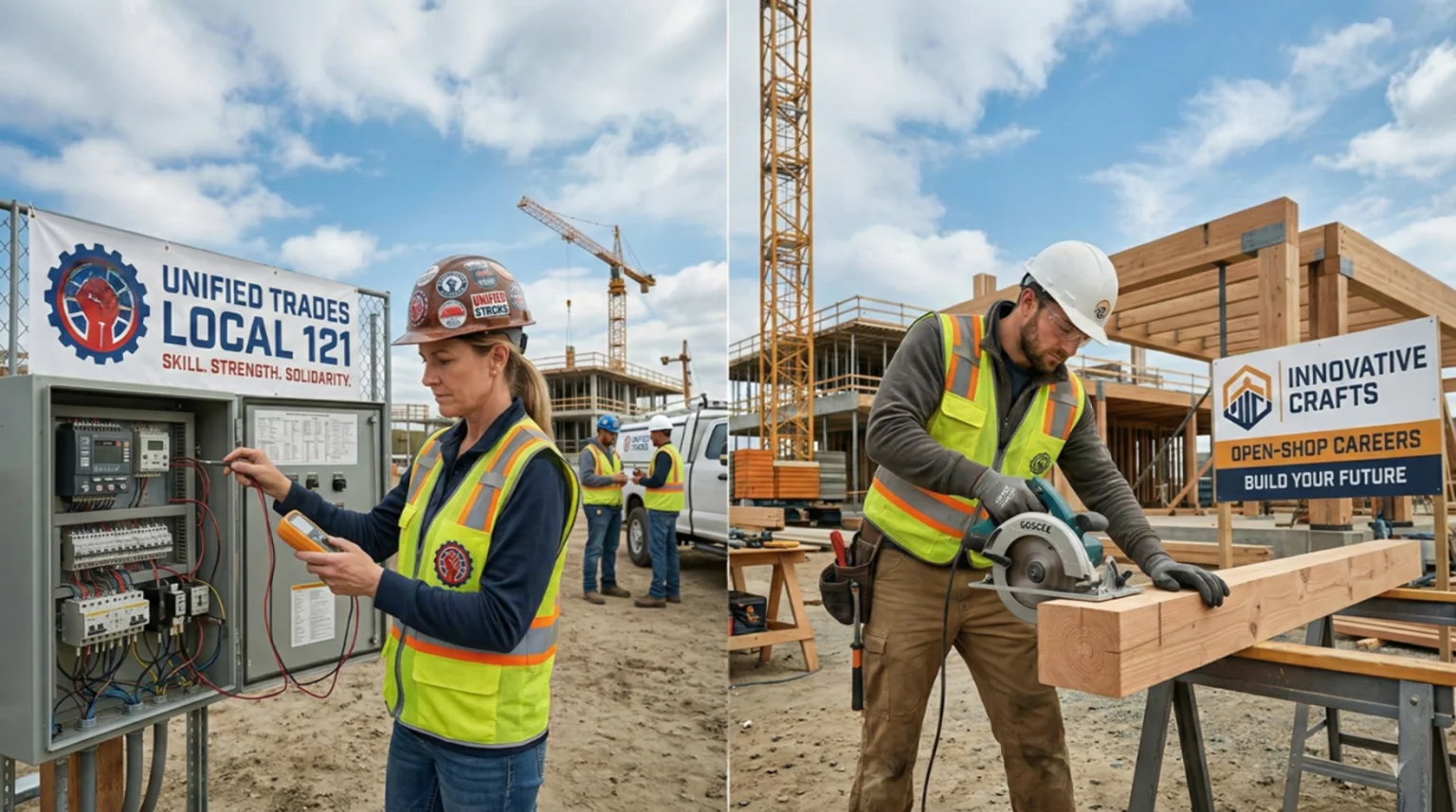
This is the single biggest driver. BLS data shows that union construction workers earned a median of $1,530 per week, compared to $1,051 for nonunion workers — a 46% premium. States with high union membership in the building trades (Illinois, New York, Washington, Massachusetts) cluster at the top of the pay scale. States with low union density (Mississippi, Arkansas, South Carolina) are consistently at the bottom.
This is not a political statement — it is a math problem. Collective bargaining agreements set wage floors that individual negotiation in non-union markets cannot reliably match. For a full breakdown of how this affects your career choice, see our comparison of union vs. non-union trades.
Cost of Living
High-cost states pay more partly because they have to. An electrician in San Francisco needs to earn more than one in rural Alabama to afford housing. But cost of living does not explain the entire gap. When researchers adjust for purchasing power, high-wage states still come out ahead — the premium is real, not just a cost-of-living offset.
Local Demand
States with major construction booms, infrastructure investment, or energy projects push wages up through competition for workers. Data center construction is currently the most visible example: Northern Virginia, central Ohio, and parts of Texas are seeing electrician demand spike as hyperscale facilities require massive electrical infrastructure.
Licensing Requirements
States with stricter licensing requirements — more training hours, harder exams, continuing education mandates — tend to pay more because the barrier to entry limits supply. This creates a trade-off: it takes longer and costs more to get licensed, but once you are, you face less competition and command higher rates.
Fastest-Rising Wages
Where wages are growing fastest may matter more than where they are highest today, especially if you are early in your career and planning ahead.
According to NAHB research, the national average hourly wage for construction workers is $37.70 with 5% year-over-year growth. But several states are outpacing that by a wide margin:
| State | YoY Wage Growth |
|---|---|
| Idaho | ~9% |
| Wisconsin | ~8-9% |
| Iowa | ~8-9% |
| Utah | ~8-9% |
These states share a common pattern: fast population growth, significant residential and commercial construction, and relatively tight labor pools. They started from lower wage bases but are catching up as demand outstrips supply.
The data center boom is accelerating electrician wage growth specifically. NCCER reports that the construction industry needs 349,000 new workers in 2026, with 456,000 needed in 2027. A significant share of that demand is concentrated in electrical work for data centers, renewable energy, and EV infrastructure — all of which require licensed electricians.
Amtec Staffing’s 2026 construction workforce report puts the national average hourly wage for all construction at $40.55/hr as of January 2026, with 92% of firms reporting hiring difficulty. That hiring pressure is the engine driving wage growth.
Six-Figure Trade Jobs Without a College Degree
Can you actually clear $100,000 in the trades without a bachelor’s degree? Yes — but the path matters more than the trade.
Only one trade pays six figures at the national median: elevator installers and repairers, at $106,580 per BLS data. It’s also one of the hardest trades to enter — a competitive union apprenticeship with a waiting list — which is exactly why the pay holds up. Our elevator installer career guide covers the salary data and the IUEC/NEIEP application process in detail.
For every other trade, six figures comes from stacking two of the three multipliers this article has already covered:
- Geography. Electricians and plumbers at journeyman scale in the top-paying states (Washington, Illinois, New York, Massachusetts) reach or clear $100K with overtime, while the same license in a bottom-ten state pays half that.
- Union scale. The union wage premium plus benefits puts big-market union electricians, pipefitters, and operating engineers into six-figure total compensation territory — see how to get into an IBEW apprenticeship for the most common route.
- Specialization. Pipeline and pressure-vessel welders, industrial-controls electricians, and master plumbers running their own shops out-earn their generalist peers by $40K–$100K+, as the next section shows.
No four-year degree appears anywhere in that list — but four to five years of apprenticeship or credential-building does. Six-figure trades pay for training time, just not tuition.
What Experienced Workers Actually Earn
Entry-level and median wages only tell part of the story. The earning ceiling in the trades is higher than most people expect, especially for workers who pursue advanced credentials, move into specializations, or take on supervisory roles.
According to The Blue Collar Recruiter, here is what experienced tradespeople can realistically earn in 2026:
Elevator installers and repairers sit at the top of the trades pay scale with a median around $99,000 and top earners reaching $130,000 to $150,000 or more. This trade requires highly specialized training, work at heights, and the ability to troubleshoot complex mechanical and electrical systems.
Commercial and industrial electricians with journeyman or master status earn $85,000 to $95,000 at the median, with top earners — especially those in industrial controls, high-voltage work, or project management — reaching $120,000 to $180,000 or more.
Master plumbers command $85,000 to $95,000 at the median, with experienced professionals in commercial plumbing, fire suppression systems, or those who run their own shops earning $120,000 to $200,000+. The master license is the key differentiator — it takes years to earn and it unlocks the ability to pull permits and run projects independently.
Specialized welders have the widest earning range of any trade. A general MIG welder in a fabrication shop might earn $45,000 to $55,000. A certified pipeline welder working on cross-country oil and gas infrastructure can earn $100,000 to $150,000. Underwater welders — who combine commercial diving with welding certifications — can reach $200,000 or more, though the work involves significant physical risk.
The common thread across all of these is that earning power scales with specialization and credentials, not just years on the job. A welder with 20 years of experience doing the same basic work will earn significantly less than a welder with 10 years who holds pipeline and pressure vessel certifications.
How to Use This Data
If you are researching trade careers, state-by-state wage data should inform your decisions — but it should not be the only factor.
Consider net pay, not just gross pay. A $90,000 salary in San Francisco and a $60,000 salary in Boise do not provide the same standard of living. Look at local housing costs, tax rates, and cost-of-living indexes alongside wage data. In many cases, a mid-range state with fast wage growth and affordable living (like Idaho, Iowa, or Utah) offers a better quality of life than a top-paying state with crushing housing costs.
Factor in licensing portability. If you get licensed in one state, can you transfer that license elsewhere? Some states have reciprocity agreements; others require you to re-test. Training in a state with broadly recognized licensing standards gives you more geographic flexibility down the road.
Look at where demand is growing, not just where it is today. The states with 8-9% annual wage growth are telling you something about where opportunity is expanding. Getting established in a fast-growing market early means your wages and seniority rise with the tide.
Think about union access. If the 46% wage premium for union construction workers matters to you — and the data suggests it should — prioritize states and metro areas where union locals are active and accepting apprentices in your trade. Illinois, New York, Washington, Massachusetts, and New Jersey consistently rank high on both wages and union density for a reason.
Pursue specialization. Regardless of geography, the data is clear: specialized credentials drive earning power more than location alone. A pipeline welder in Oklahoma can out-earn a general MIG welder in New York. Invest in certifications, advanced training, and specialty skills that command premium rates.
The construction industry needs 349,000 new workers this year and 456,000 in 2027. 41% of the current workforce will retire by 2031. The supply-demand imbalance is structural and lasting. Where you choose to enter this market — both geographically and in terms of specialization — will shape your earning trajectory for decades.
Sources
- U.S. Bureau of Labor Statistics — Occupational Employment and Wage Statistics (OEWS), May 2024 — Electricians — bls.gov
- U.S. Bureau of Labor Statistics — Occupational Outlook Handbook — Electricians — bls.gov
- U.S. Bureau of Labor Statistics — Occupational Outlook Handbook — Plumbers, Pipefitters, and Steamfitters — bls.gov
- U.S. Bureau of Labor Statistics — Occupational Outlook Handbook — HVAC Mechanics and Installers — bls.gov
- U.S. Bureau of Labor Statistics — OEWS — Welders, Cutters, Solderers, and Brazers — bls.gov
- Natalia Siniavskaia — NAHB/Eye on Housing — “States with Highest and Fastest Rising Construction Wages, 2024” — May 2024 — eyeonhousing.org
- Amtec Staffing — “Construction Workforce Report” — February 2026 — amtec.us.com
- Troy Latuff — The Blue Collar Recruiter — “Best and Worst Skilled Trades 2026: Salaries & Job Outlook” — December 2025 — thebluecollarrecruiter.com
- Jonathan Arnholz — NCCER — “Report: Construction Needs 349K New Workers in 2026” — February 2026 — nccer.org
- PTT.edu — “How Much Do Plumbers Make in 2025? Salary by State and Experience” — ptt.edu
- PTT.edu — “Welding Technicians Salary: State-by-State Complete Guide” — ptt.edu