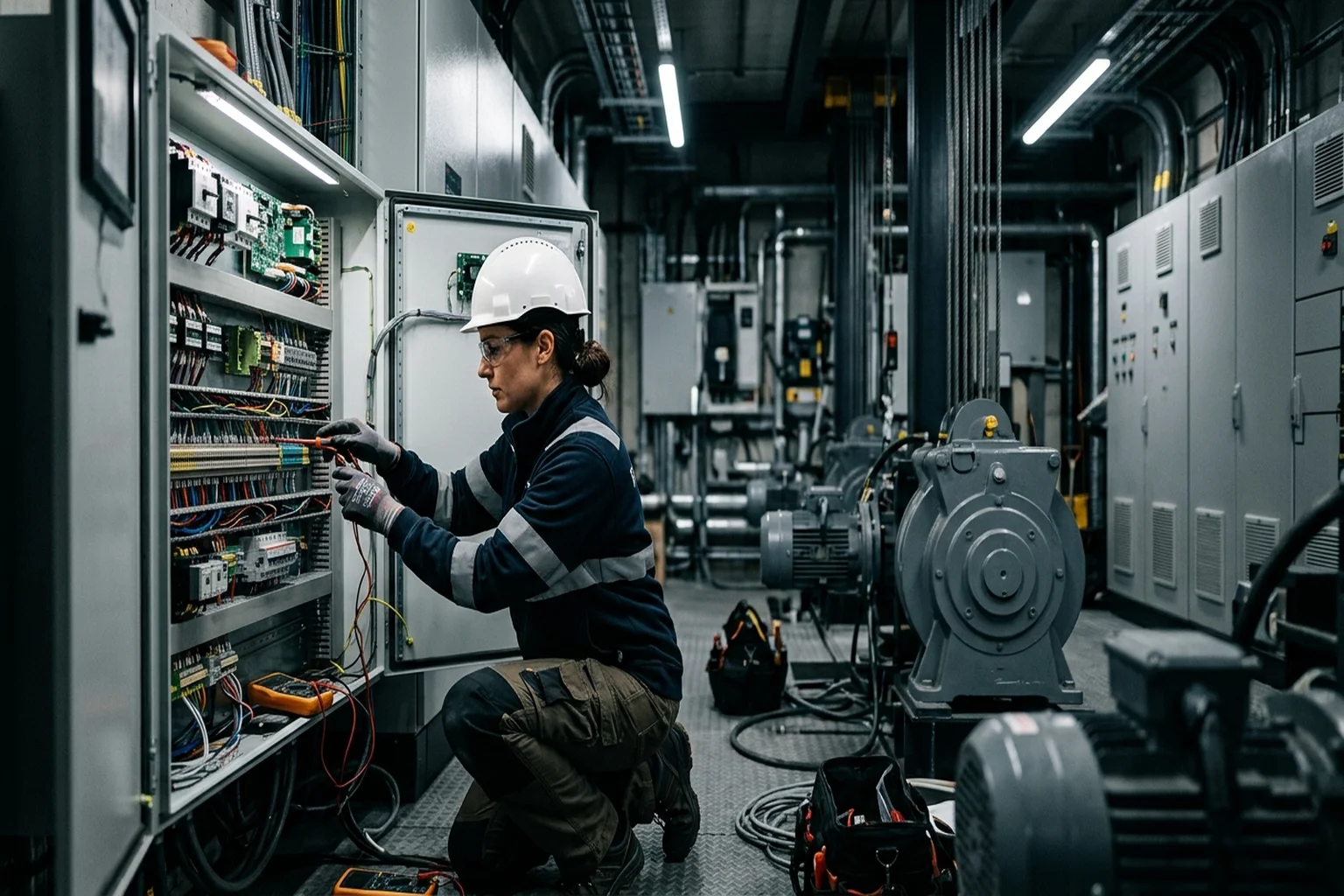

An elevator mechanic tightens a connection inside a cramped machine room thirty floors up, traces a fault through a computerized control panel, and gets a stalled car moving again. It’s work that blends electrical theory, mechanical aptitude, and problem-solving under pressure — and it pays a median of $106,580 a year. No four-year degree required. No six-figure student loan debt. Just a high school diploma, a competitive apprenticeship, and the willingness to learn a trade that most people never think about until they’re stuck between floors.
That last part is exactly why this career is worth your attention. Elevator installation and repair is one of the most invisible — and most essential — trades in the built environment. There are roughly 1.3 million elevators in the United States, and every single one of them needs regular maintenance, periodic modernization, and emergency repair when something goes wrong. The workforce that keeps them running is small, aging, and hard to replace.
TL;DR
- Highest-paid trade: Elevator and escalator installers and repairers earned a median of $106,580/year ($51.24/hour) in May 2024 — more than double the national median across all occupations. Source: BLS OOH.
- Strong demand: 24,200 workers in the field, with ~2,000 openings per year projected through 2034. 5% growth — faster than average. Source: BLS OOH.
- Apprenticeship path: 600 hours of classroom instruction plus 8,000 hours of on-the-job training over 4–5 years, administered through the NEIEP and IUEC. Source: NEIEP.
- Top-paying states: Nevada ($151,500), Hawaii ($132,150), Massachusetts ($126,830), California ($126,110), New Jersey ($124,970). Source: BLS OEWS.
- The catch: Getting into an apprenticeship is competitive. The EIAT aptitude test and JAC interview filter out a lot of applicants. But if you make it in, you’re looking at a career that pays six figures with no college debt.
What Do Elevator Installers and Repairers Actually Do?
The official BLS title is “Elevator and Escalator Installers and Repairers,” and the job covers everything that moves people vertically in a building: passenger elevators, freight elevators, escalators, moving walkways, chairlifts, and dumbwaiters.
What the Job Is Called
The trade answers to about six names, and which one you hear depends on who is doing the talking:
- Elevator installer or elevator repairer — the BLS and Department of Labor title, so this is what you will see in wage tables and job-outlook reports.
- Elevator mechanic — the everyday term on job sites and in a large share of job postings.
- Elevator constructor — the union term. IUEC members are elevator constructors, and that is the classification that shows up on prevailing-wage schedules and big-city construction contracts.
- Elevator technician — common on the service and maintenance side, particularly at companies that hold repair contracts rather than doing new installation.
- Elevator electrician — used occasionally for the controller and wiring end of the work. It is not a separate license or a separate apprenticeship.
All of them describe the same occupation and the same pay scale. This matters when you go looking for work: a role posted as “elevator constructor apprentice” and one posted as “elevator mechanic helper” can be the identical IUEC opening at the identical wage, so search every variant rather than just the one you happen to know.
Day-to-Day Responsibilities
The work breaks into three broad categories:
Installation — Reading blueprints, assembling elevator cars and components, connecting electrical wiring to control panels and motors, and testing newly installed equipment against specifications. This is the new-construction side of the trade.
Maintenance — Conducting scheduled inspections, oiling and greasing moving parts, replacing worn components, adjusting equipment for optimal performance, and keeping detailed service records. Most states have strict codes governing how often elevators must be inspected.
Repair — Troubleshooting malfunctions in brakes, motors, switches, and computerized control systems. Dismantling units to remove and replace defective parts using hoists, ladders, and hand or power tools. This is the emergency-call side of the job, and it’s where the troubleshooting skills really matter.
Most elevator mechanics specialize in one of these areas. Maintenance and repair workers generally need deeper knowledge of electronics, hydraulics, and digital control systems than installers do, because modern elevators run on computerized systems that require complex diagnostic work.
Where They Work
About 84% of elevator and escalator installers and repairers work for building equipment contractors — companies that specialize in installing and maintaining building systems. The remainder work for government agencies, educational institutions, and equipment wholesalers.
The Physical Reality
This is not a desk job. Elevator mechanics work in cramped machine rooms, inside elevator shafts, and at significant heights. They lift equipment weighing up to 200 pounds, work in hot or cold environments, and deal with oily, greasy machinery. The injury rate is higher than average — falls, electrical shocks, and muscle strains are the most common hazards. Proper use of hardhats, harnesses, and safety glasses isn’t optional; it’s the difference between going home and going to the ER.
If you’re claustrophobic or uncomfortable with heights, this trade is probably not for you. If you like working with your hands, solving mechanical puzzles, and don’t mind getting dirty, keep reading.
Why Elevator Mechanics Are the Highest-Paid Trade
Let’s put the numbers in context.
| Occupation | Median Annual Pay (May 2024) |
|---|---|
| Elevator & Escalator Installers/Repairers | $106,580 |
| Boilermakers | $73,340 |
| Industrial Machinery Mechanics | $63,510 |
| Electricians | $62,350 |
| Plumbers, Pipefitters, Steamfitters | $62,090 |
| Wind Turbine Technicians | $62,580 |
| All Occupations (national median) | $49,500 |
Sources: BLS OOH — Elevator Installers, BLS OOH — Similar Occupations table
Elevator mechanics earn more than double the national median wage. Even compared to other well-paid trades like electricians and plumbers, the gap is substantial — roughly $44,000 more per year at the median.
Why the Premium?
Several factors combine to push elevator mechanic wages to the top of the trade ladder:
Specialized technical knowledge. Modern elevators use microprocessor-based control systems, variable-frequency drives, and regenerative power systems. The troubleshooting skills required go well beyond basic electrical work. Mechanics need to understand electronics, hydraulics, and digital systems simultaneously.
Licensing requirements. Most states require elevator mechanics to be licensed, which means passing exams that verify competence. Licensing creates a barrier to entry that limits the supply of qualified workers — and basic economics tells us what happens when supply is constrained and demand is steady.
Union strength. The International Union of Elevator Constructors (IUEC) has represented elevator mechanics since 1890. Union-negotiated collective bargaining agreements set wage floors, benefits, and working conditions that are among the strongest in the construction trades.
Risk and responsibility. An elevator failure can be fatal. The stakes of the work are high, and the liability is real. Employers and building owners pay a premium for mechanics who can do the job safely and correctly.
Replacement demand. With an aging workforce and a relatively small pipeline of new entrants, experienced mechanics are in a strong negotiating position. When there are more open positions than qualified candidates, wages go up.
Pay by State
Where you work matters enormously. The BLS Occupational Employment Statistics show dramatic geographic variation:
| State | Mean Annual Wage |
|---|---|
| Nevada | $151,500 |
| Hawaii | $132,150 |
| Massachusetts | $126,830 |
| California | $126,110 |
| New Jersey | $124,970 |
| Washington | $118,280 |
| New York | $110,590 |
| Illinois | $106,650 |
The national mean across all states is $100,060. In Nevada, the mean is 50% higher. If you’re willing to relocate to a high-demand market, the earning potential is significantly greater than the national median suggests.
The lowest 10% of earners in this occupation make less than $54,720 — typically apprentices or early-career mechanics in lower-wage regions. The top 10% earn more than $149,250. For those who advance to mechanic-in-charge or supervisor roles, compensation can exceed that threshold.
How to Become an Elevator Installer
There is no shortcut here. Nearly every elevator mechanic in the United States came up through a formal apprenticeship. Trade school programs in electrical or industrial maintenance can give you a head start on the technical knowledge, but they don’t replace the apprenticeship itself.
Here’s the step-by-step path, based on the NEIEP’s current requirements.
Step 1: Meet the Basic Requirements
Before you can apply, you need to check three boxes (NEIEP):
- High school diploma or GED — No exceptions. Have a copy ready when you apply.
- At least 17 years old at the time of application (18 to be registered by the Local Joint Apprenticeship Committee).
- Authorized to work in the United States.
High school coursework in math, mechanical drawing, and physics will serve you well, even though they’re not formal requirements. If you’re still in school, take those classes.
Step 2: Pass the Elevator Industry Aptitude Test (EIAT)
The EIAT is the first real filter. It evaluates four areas:
- Reading comprehension
- Mechanical comprehension
- Basic arithmetic
- General tool knowledge
The test is scored on a pass/fail basis, and you need at least 70% to advance. Study materials are available on the NEIEP website, and taking them seriously matters. This isn’t a test you can wing.
If you have background in construction trades or hands-on mechanical work, the mechanical comprehension and tool knowledge sections will feel familiar. If not, spend time studying before test day.
Step 3: Ace the Joint Apprenticeship Committee Interview
Candidates who pass the EIAT move to the interview stage. You’ll be interviewed by two members of the Joint Apprenticeship Committee (JAC) — one from the IUEC union side, one from the employer side. They use a standardized set of questions designed to assess your work experience, problem-solving ability, and fit for the trade.
A few things that help you stand out (NEIEP):
- Highlight any relevant training — trade school coursework, vocational programs, or hands-on mechanical experience
- OSHA 10 or OSHA 30 safety certifications are a genuine advantage
- Demonstrate teamwork, willingness to learn, and reliability
- Show up prepared and on time
Like the EIAT, the interview requires a score of at least 70% to make the hiring list. Your rank on that list determines the order in which you’re offered positions, and the ranking is valid for two years.
Step 4: Complete the Apprenticeship
Once you’re hired, the real training begins. The NEIEP apprenticeship requires (NEIEP):
- 600 hours of classroom instruction at NEIEP training facilities
- 8,000 hours of on-the-job training working alongside experienced mechanics
- 4 to 5 years to complete the full program
The curriculum covers safety, blueprint reading, mathematics, applied physics, elevator and escalator components, electrical and digital theory, and electronics. You’re paid throughout the apprenticeship — starting at roughly 50% of the full mechanic rate, with scheduled increases as you progress through each year.
For context on how this compares to other apprenticeship models, our guide to how apprenticeships work covers the earn-while-you-learn structure in detail.
When you finish, you become eligible to sit for the Mechanic Exam. Passing that exam makes you a journeyman elevator mechanic — and that’s when your earnings jump to the full rate.
Licensing
Most states require elevator mechanics to hold a license. The specific requirements vary by state, so check with your state’s licensing board or department of labor. Some states accept the NEIEP Mechanic Exam as part of the licensing process; others have their own exams.
The Elevator Union: IUEC Wages and the Waiting List
Elevator installation is one of the most heavily unionized trades in the country. Most working elevator mechanics belong to the International Union of Elevator Constructors (IUEC), and the apprenticeship path described above runs through NEIEP — the union’s education program, jointly funded with employers. That union density is a big part of why the pay-by-state numbers earlier in this article sit so far above other trades: elevator mechanics are generally paid negotiated union scale, with health coverage and a pension on top of the hourly rate.
The trade-off is access. IUEC locals only take on apprentices when there’s work to support them, so NEIEP recruitment opens region by region rather than year-round. Applicants are scored on the aptitude test and interview and ranked; when a local’s list is long and its work picture is slow, qualified candidates can wait a year or more for an apprenticeship offer — the “waiting list” you’ll hear mechanics mention. You can’t control the work picture, but you can control your rank: test and interview preparation is what moves you up the list (how union apprenticeships actually work).
While you wait, keep the application competitive: mechanical or electrical coursework, construction experience, and a clean driving record all strengthen the next cycle. For current wage and outlook data on the trade itself, see our elevator installer career profile.
Job Outlook: Is There Demand?
The BLS projects 5% employment growth for elevator and escalator installers and repairers from 2024 to 2034 — faster than the 3% average across all occupations (BLS OOH). That translates to about 1,200 net new jobs over the decade.
But the more important number is the ~2,000 openings per year projected on average over that period. Most of those openings won’t come from new construction. They’ll come from retirees leaving the workforce and from the constant need to maintain, modernize, and repair existing equipment.
The Labor Shortage Is Real
The construction industry broadly is facing a workforce crunch, and elevator installation is no exception. As DC Elevator reported in March 2026, labor shortages are extending project timelines, creating scheduling bottlenecks, and making qualified elevator crews a critical path item on construction schedules.
The underlying dynamics:
- Aging workforce. A significant portion of current elevator mechanics are approaching retirement age. When they leave, they take decades of experience with them.
- Few new entrants. The competitive apprenticeship process and the obscurity of the trade mean most young people never consider it as an option.
- Growing complexity. Modern elevators with computerized controls, destination dispatch systems, and energy-efficient drives require more sophisticated technical skills than older models, which narrows the pool of qualified candidates even further.
- Modernization demand. Older buildings need elevator upgrades to meet accessibility requirements (ADA compliance) and energy codes. This creates a steady stream of work that’s independent of new construction cycles.
For anyone entering the field now, these conditions are favorable. Employers are competing for qualified workers, which means better wages, better benefits, and more job security than in most other trades.
If you’re comparing this to other high-demand fields, the union vs. non-union trades guide covers how union representation affects pay and job stability across the construction sector.
The Real Pros and Cons
No career is perfect. Here’s the honest assessment.
Pros
- Highest median pay of any trade. $106,580 at the median, with top earners clearing $149,000. That’s not a typo.
- No college debt. The apprenticeship pays you while you train. You graduate with experience and a credential, not a loan balance.
- Strong union benefits. IUEC-represented mechanics typically receive health insurance, pension contributions, and annuity funds on top of their wages.
- Recession-resistant. Elevators break whether the economy is booming or not. Maintenance contracts provide steady income even when new construction slows.
- Clear advancement path. Mechanic-in-charge, adjuster, supervisor — there are defined steps up, and each one comes with a pay bump.
Cons
- Physically demanding. Cramped spaces, heavy lifting, heights, and exposure to electrical hazards are part of the job. This takes a toll over time.
- On-call emergencies. When an elevator stops working in a hospital or high-rise, someone has to fix it — at 2 AM if necessary. Expect irregular hours.
- Competitive entry. The EIAT and JAC interview filter out a lot of applicants. Not everyone who wants in gets in.
- Geographic limitations. The best-paying markets are concentrated in specific states and metro areas. If you live in a rural area with few high-rise buildings, opportunities are limited.
- Licensing complexity. Moving between states may require obtaining a new license, which can involve additional exams or documentation.
Is This the Right Trade for You?
Elevator installation and repair is a great fit if you:
- Are mechanically inclined and enjoy troubleshooting complex systems
- Are comfortable working at heights and in confined spaces
- Can handle the physical demands of the job
- Are willing to relocate to a high-demand market for better pay
- Want a career that pays six figures without a four-year degree
- Value job security and strong union benefits
You should think twice if you:
- Are claustrophobic or have a fear of heights
- Need a predictable 9-to-5 schedule
- Aren’t willing to compete for an apprenticeship slot
- Plan to stay in a rural area with limited elevator infrastructure
- Aren’t interested in ongoing technical training (the technology keeps evolving)
Related Trades to Consider
If the elevator path doesn’t work out or doesn’t appeal to you, several related trades offer strong pay and similar skill requirements:
- Electricians — Median $62,350, with strong demand and transferable electrical knowledge that could help you re-apply to an elevator apprenticeship later. See our electrical career opportunities guide.
- Industrial machinery mechanics — Median $63,510, working on factory equipment and industrial systems. Similar troubleshooting skills, different environment. Industrial maintenance programs can prepare you for this path.
- HVAC technicians — Median $59,810, with growing demand from energy-efficiency retrofits. Our HVAC career opportunities guide covers the full picture.
Next Steps
If you’re serious about pursuing this career:
- Check for open recruitments on the NEIEP Apprenticeship Opportunities page. Recruitment drives typically happen every two years in each IUEC local.
- Search Apprenticeship.gov for additional openings in your area using the Apprenticeship Job Finder.
- Prepare for the EIAT by reviewing study materials on the NEIEP website. Focus on mechanical comprehension, reading comprehension, and basic math.
- Consider getting OSHA 10 or OSHA 30 certified before applying — it’s a genuine differentiator in the interview process.
- Explore related programs if you want to build skills while waiting for the next recruitment cycle. Electrical programs and construction trades programs give you relevant background that strengthens your application.
There are roughly 24,000 people in the country who know how to keep 1.3 million elevators running. That ratio isn’t getting better anytime soon. If you can get through the apprenticeship, you’ll join a workforce that’s small enough to stay in demand and skilled enough to command pay that most college graduates never reach.
Sources
- U.S. Bureau of Labor Statistics — Occupational Outlook Handbook — “Elevator and Escalator Installers and Repairers” — Updated August 28, 2025 — https://www.bls.gov/ooh/construction-and-extraction/elevator-installers-and-repairers.htm
- U.S. Bureau of Labor Statistics — Occupational Employment and Wage Statistics — “47-4021 Elevator and Escalator Installers and Repairers” — May 2023 — https://www.bls.gov/oes/2023/may/oes474021.htm
- Diana Vasile — NEIEP (National Elevator Industry Educational Program) — “How to Become an Elevator Apprentice in the IUEC” — July 26, 2024 — https://www.neiep.org/blog/how-to-become-an-elevator-apprentice-iuec/
- NEIEP Help Center — “How much does being an IUEC apprentice/mechanic pay?” — August 28, 2023 — https://www.neiep.org/iuec-apprenticeship-faq/how-much-does-being-an-iuec-apprentice-mechanic-pay/
- DC Elevator — “Labor Shortages and Elevator Installation Delays” — March 12, 2026 — https://www.dcelevator.com/labor-shortages-and-elevator-installation-delays/