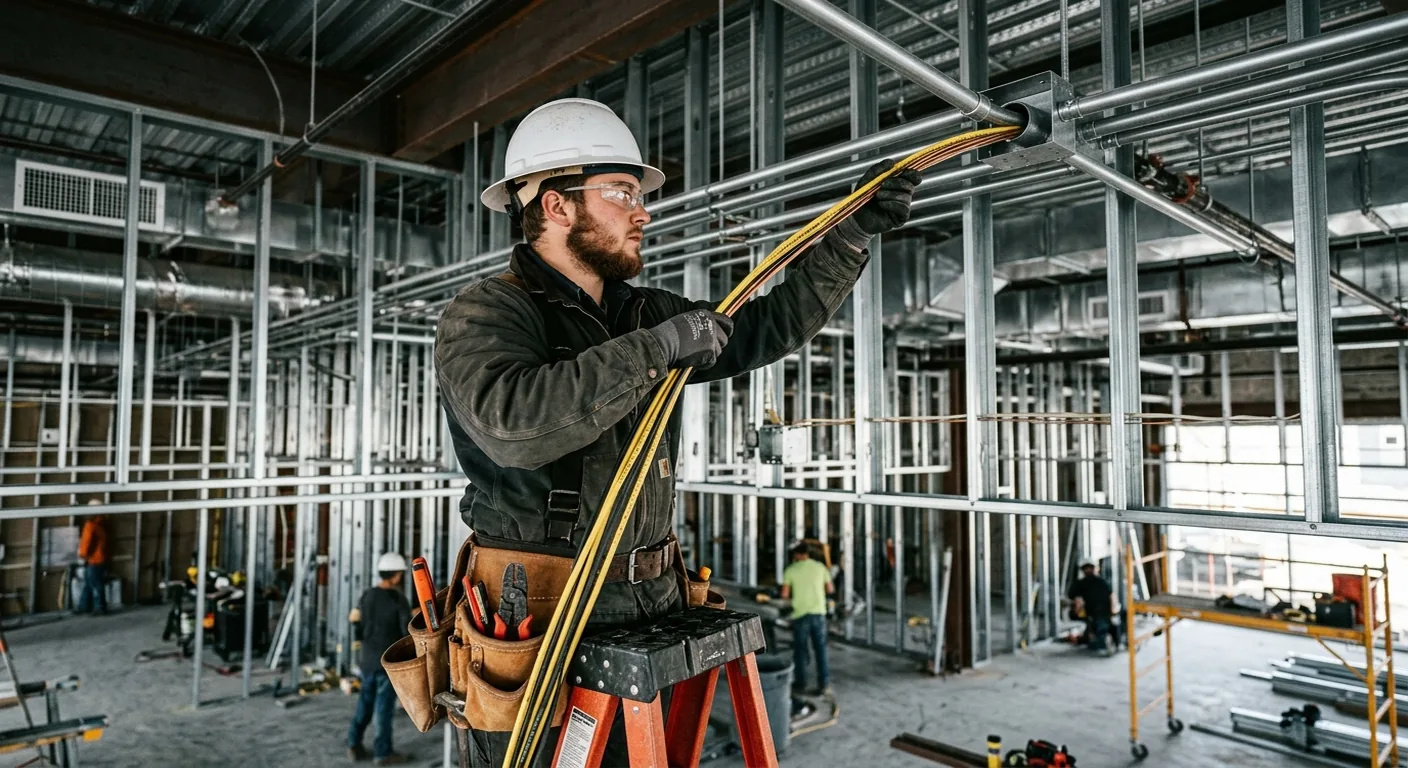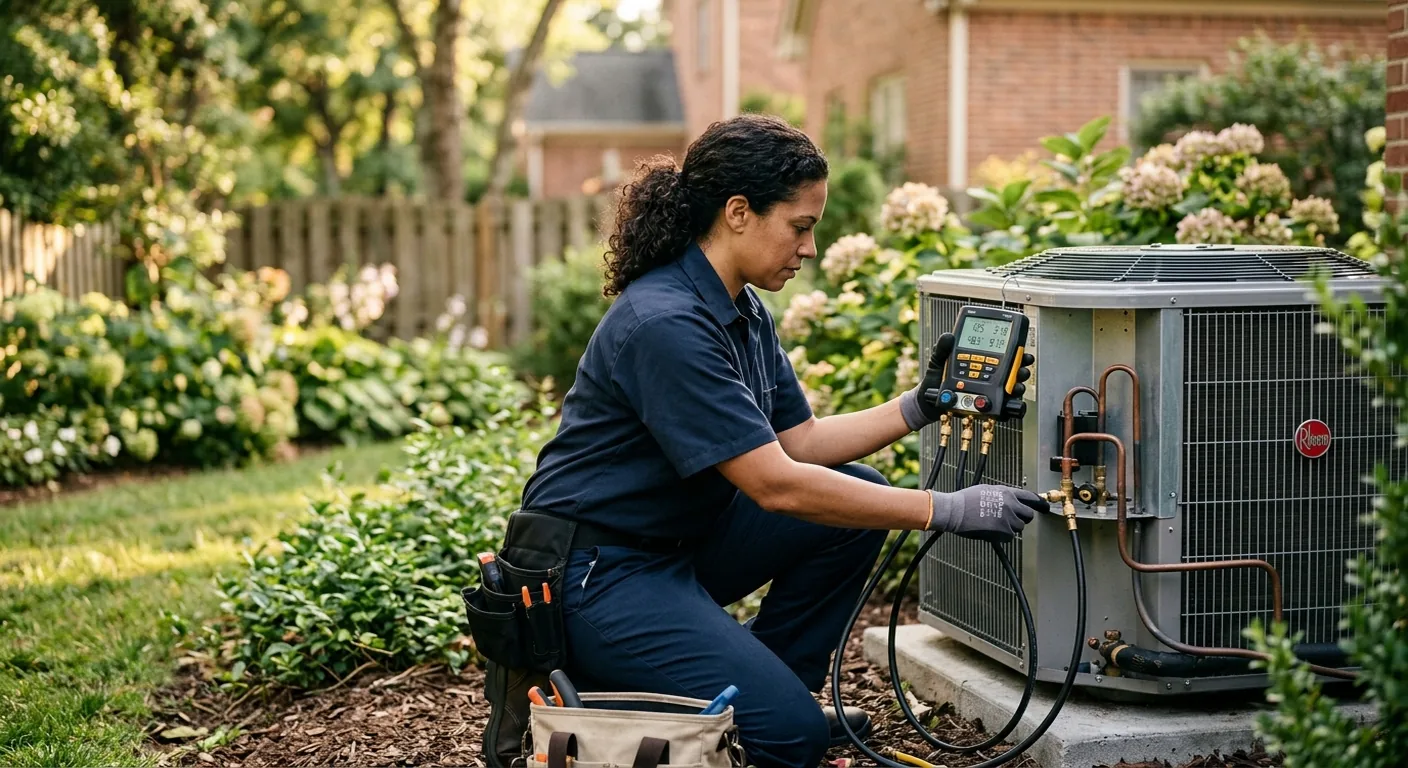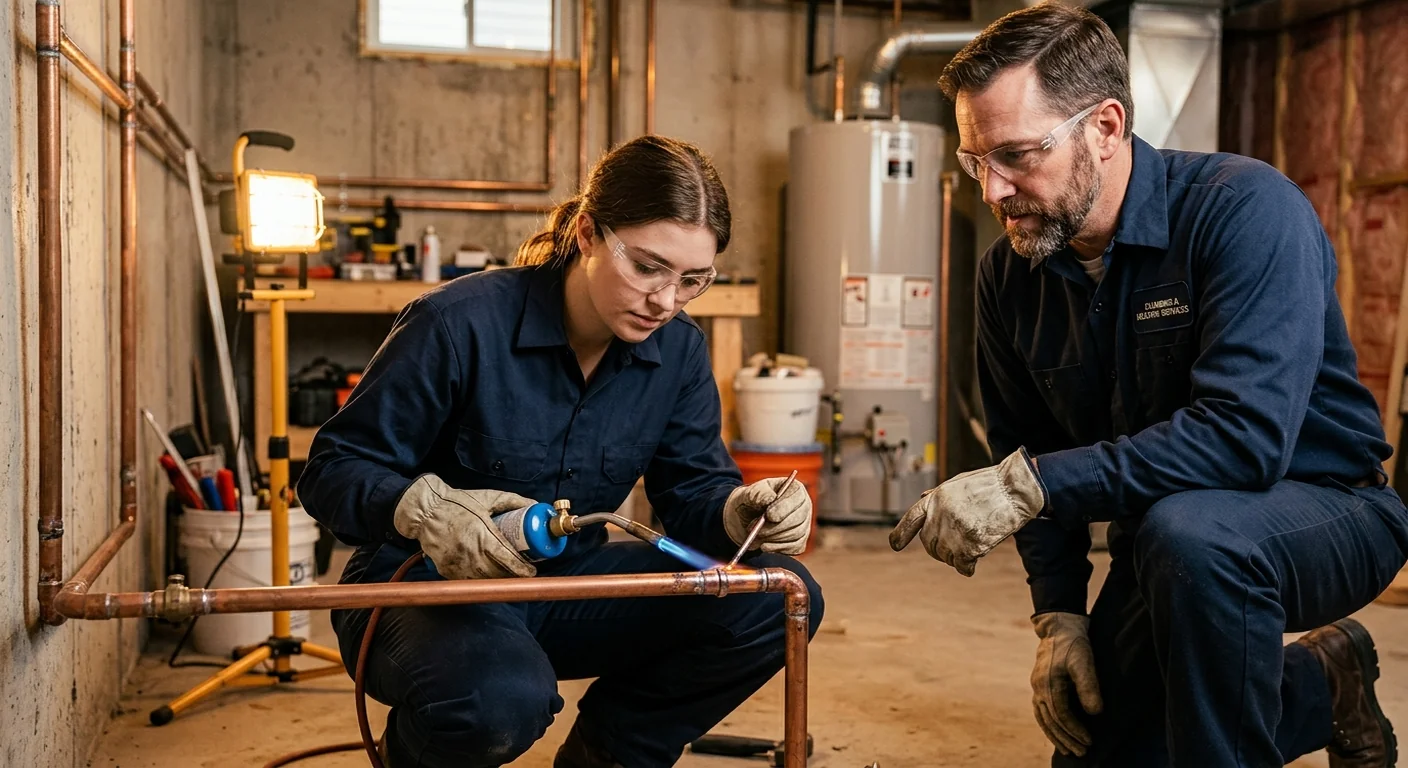

Plumbing is one of the most license-protected, recession-resistant trades in the country. Every fixture, every drain, every gas line in the U.S. is governed by code, and that code is enforced by a state-issued license. The BLS Occupational Outlook Handbook lists the May 2024 median wage for plumbers, pipefitters, and steamfitters at $62,970, with about 504,500 jobs in the field, 4% projected employment growth through 2034, and roughly 44,000 openings every year as the existing workforce ages out.
The trade is well-paid and the pipeline is open. What trips most people up is the early-pathway choice — union vs non-union, apprenticeship vs school-first — without understanding how each one shapes the next twenty years of earning. This guide walks the full path from zero to licensed master plumber: baseline requirements, how apprenticeships actually work, how UA and PHCC/ABC differ, how to sit for journeyman and master exams, and what you earn at each stage.
Step 1: Meet the Baseline Requirements
The fixed gates are modest and uniform across most states:
- Education: High school diploma or GED. Many apprenticeship programs require at least one year of high school algebra; some require algebra II for pipe sizing and load calculations.
- Age: 18 or older for every registered apprenticeship. A few pre-apprenticeship programs accept 17 with parental consent.
- Driver’s license: Required. You’ll drive a company van or truck to job sites every day.
- Physical: Ability to lift 50+ pounds, work in tight crawlspaces, on ladders, and in trenches, kneel for extended periods, and operate hand and power tools all day.
- Drug screening: Near-universal at hire and common as random testing throughout the career, especially on federal and union projects.
- Math fundamentals: Algebra, geometry, and basic trigonometry for offset calculations and pipe routing. Most apprenticeship applications include an aptitude test on math, mechanical reasoning, and reading comprehension.
If you have a felony record, you’re not automatically disqualified, but some state licensing boards review certain offenses (especially for the master license, since it’s effectively a contracting license). Disclose honestly on applications.
Step 2: Pick Your Pathway — UA Union, PHCC/ABC Non-Union, or Trade School First
This is the pivotal decision. The wrong choice doesn’t end a career, but it changes the slope of your earnings for the rest of your working life.
UA (United Association) Union Apprenticeship
The United Association of Journeymen and Apprentices of the Plumbing and Pipe Fitting Industry runs the largest registered apprenticeship program in the trade. The program is:
- Length: 5 years
- On-the-job training (OJT): Approximately 10,000 hours under journeyman supervision (1,700–2,000 hours per year, divided into ten six-month periods)
- Related classroom instruction: Roughly 1,230 hours total — 216+ hours per period — covering code, theory, drawing/blueprint reading, math, and welding
- Cost to apprentice: Zero tuition. You pay for your own books and tools.
- Pay: Apprentices typically start at 35–55% of journeyman scale depending on local, with raises every six months (or after accumulating a set number of hours), reaching 80–90% of journeyman scale by year 5
- Benefits: Union health insurance, pension, and annuity from day one — a major part of total compensation that non-union paths often don’t match
Journeyman hourly scales vary dramatically by local. Major-metro UA locals (NYC, Chicago, Boston, San Francisco) report journeyman wages over $55/hour plus benefits; smaller markets run $28–$42/hour plus benefits.
Competition to enter UA programs is real. You apply to a specific local’s Joint Apprenticeship and Training Committee (JATC), take an aptitude test, complete an interview, and are ranked. Some locals accept 1 in 4 applicants per cycle; others are tighter.
PHCC / ABC Non-Union (Merit Shop) Apprenticeship
The Plumbing-Heating-Cooling Contractors Association (PHCC) and Associated Builders and Contractors (ABC) run the two largest non-union apprenticeship networks. The structure is similar but typically shorter — most are 4-year programs with 7,200–8,000 hours OJT and 576–800 hours of classroom instruction — and programs are registered with state and federal labor departments, so graduates qualify for journeyman licensure.
PHCC Academy specifically offers an online Related Technical Instruction option of about 156 classroom-equivalent hours per year for apprentices working in shops without in-person training nearby.
Differences from union:
- Lower starting wage in most markets (often a similar percentage of a journeyman wage, but the journeyman wage itself is lower in non-union shops)
- Lower benefits — health insurance is typically employer-provided rather than union-trust-based; often no pension, though some employers offer 401(k) matching
- Faster placement — non-union contractors are often easier to get hired by, especially in markets where union density is lower (most of the Southeast and Mountain West)
- Flexibility — moving between employers is simpler; you’re not tied to a hiring hall
In right-to-work states where union density is below ~10%, the non-union path often produces similar career earnings, because the non-union market rate is competitive with union scale and employers offer retention-driven benefits.
Trade School First, Then Apprenticeship
A third path: enroll in a 9- to 24-month plumbing program at a community college or trade school, then apply to an apprenticeship. The school can credit a portion of your apprenticeship OJT and give you a head start on the aptitude test, in many states shortening your timeline by roughly 6 months.
Tuition runs $3,000 to $15,000. If you accept some tuition debt for the shorter path and the aptitude-test preparation advantage, this can be worth it. If you’re going to apply to a UA local anyway and are confident on the aptitude test, skip the school.
For the framework on registered apprenticeship — what to expect, how to apply, and red flags to avoid — see our guide on apprenticeships explained.
Step 3: Complete the On-the-Job Training Hours
This is the longest phase and where you actually learn the trade. Apprentice work evolves substantially over the 4–5 years:
Year 1: Mostly material handling, trenching, demolition, and helping a journeyman — running pipe, holding fittings, learning the names of tools and materials. You’re learning the language: how to read a print, how to identify pipe types and sizes, how to use a torch and a press tool safely.
Year 2: Soldering and brazing copper, threading black iron, gluing PVC, basic rough-in work on residential jobs. Some fixture installation under direct supervision.
Year 3: Full residential rough-in start-to-finish, water heater installations, drain/waste/vent layout, basic gas piping. Less direct supervision on routine tasks.
Year 4: Commercial rough-in, larger DWV systems, hydronic heating fundamentals, backflow prevention, medical gas exposure depending on shop type. Supervising year-1 helpers on simple tasks.
Year 5 (UA): Functionally a journeyman with one hat remaining. Running small jobs, pulling permits under a master’s license, handling change orders. The classroom is heavy on code, motor controls for pumps, and welding certification prep for those going pipefitter route.
Classroom runs concurrently — typically one or two evenings a week, or alternating-week intensives. Courses progress from basic plumbing math, code fundamentals (UPC or IPC depending on state), and tool/safety use in year 1 to advanced code interpretation, isometric drawing, and gas/medical-gas certifications by year 4–5.
Step 4: Pass the Journeyman Exam
At the end of the apprenticeship (and in some states, after documenting the hours without a formal apprenticeship), you sit for the journeyman plumber exam. Journeyman licensing is administered at the state level in most cases — there is no national license, and a few states delegate to municipalities.
Typical exam structure:
- Open-book code-based exam: 80–100 questions, 4–6 hours, passing score typically 70–75%
- Cost: $50–$300 depending on state
- Content: Code compliance (UPC or IPC depending on the state), fixture units and pipe sizing, drainage and venting, water supply, gas piping, backflow prevention, safety
- Some states add a hands-on practical: Massachusetts, Maryland, and Louisiana, among others, require demonstration tasks like roughing in a fixture or brazing to spec
License requirements vary substantially. The Texas State Board of Plumbing Examiners requires 4 years and 8,000 hours of apprentice experience before sitting for the journeyman exam. Alabama requires 4 years of documented experience. Alaska journeyman applicants need 8,000 hours under a licensed master. Massachusetts and Connecticut have among the most demanding hour requirements in the country. A handful of states — Kansas, Wyoming, Missouri among them — have no statewide plumbing license at all and delegate entirely to municipalities. Check your state licensing board before you enroll in any program.
Once you pass, you’re a journeyman plumber. You can work independently on most installations, supervise apprentices, and, in most states, pull permits under a master plumber’s license.
What You Earn at Each Stage
BLS data gives the full-occupation picture: median $62,970, top 10% over $104,000. But the profession is stratified heavily by stage, market, and union status. Here’s a realistic earnings curve for a residential/commercial service plumber career in a mid-sized metro:
| Stage | Timeline from start | Typical base pay (hourly) | Annual base + OT |
|---|---|---|---|
| Pre-apprentice / helper | 0–6 months | $14–$18 | $29,000–$40,000 |
| Year 1 apprentice | Year 1 | $17–$24 | $35,000–$55,000 |
| Year 2 apprentice | Year 2 | $20–$28 | $42,000–$65,000 |
| Year 3 apprentice | Year 3 | $24–$32 | $50,000–$74,000 |
| Year 4 apprentice | Year 4 | $28–$38 | $58,000–$88,000 |
| Year 5 apprentice (UA) | Year 5 | $32–$44 | $66,000–$102,000 |
| Journeyman | Year 5+ | $35–$58+ | $73,000–$135,000 |
| Master plumber | Year 7–10+ | $42–$72+ | $88,000–$165,000 |
| Owner / contractor | Year 10+ | Profit-based | $100,000–$300,000+ |
(Apprentice rates are typically percentages of journeyman scale. Major metros with strong union markets — NYC, Chicago, Boston, the Bay Area — run meaningfully higher at every stage. Smaller markets run lower.)
First-year UA apprentices typically earn 35–55% of journeyman scale — meaning an hourly rate somewhere between $17 and $24 nationally, with the median around $19–$20. Step increases compound fast: by year 4, you’re often earning 70–80% of a journeyman paycheck while still classified as an apprentice.
For a broader picture across the wider plumbing field — including service, new construction, and pipefitting — see our guide on plumbing career opportunities.
Step 5: Consider the Master Plumber License
The master plumber license is the credential that lets you:
- Pull your own plumbing permits (in most states)
- Supervise multiple journeymen
- Start your own plumbing contracting business
Most states require 1–5 years of documented journeyman experience before you can sit for the master exam, with some states requiring as much as 10,000 verifiable hours. The exam is typically longer (100–120 questions), more rigorous on load calculations and system design, and covers commercial code topics including backflow prevention, fire suppression interconnection, complex DWV layouts, and medical gas piping. Many states also require a separate business and law exam.
The master license is the jump from tradesman to contractor economically. Journeymen who never pursue it typically cap at the higher end of journeyman scale (with overtime and on-call premiums). Masters who stay as employees earn 10–20% more than journeymen at the same company; masters who open their own shops often double or triple their income within 3–5 years, with the expected trade-off of carrying business risk, payroll, insurance, and customer acquisition.
Specialization: Where Plumbers Earn Premium Pay
Year 3+ is when specialization starts paying. A few worth evaluating during your apprenticeship:
- Medical gas installation — separately certified (typically ASSE 6010), required for hospitals and dental clinics. Premium hourly rates and a steady commercial pipeline.
- Backflow prevention testing/certification — a separately licensed credential in most states. Once certified, you can do annual testing rounds at scale, often as a lucrative side business.
- Hydronic heating and radiant systems — high-end residential and light commercial work; pays well in cold-climate markets.
- Pipefitting / steamfitting — the industrial side of the trade, often a separate UA classification with higher hourly rates. See our guide on pipefitter and steamfitter careers.
- Service plumbing (residential repair) — the front-line, customer-facing side. Top performers in service plumbing often out-earn commercial peers via commission/spiff structures, though the work pace is faster.
- Gas service work — separately certified (or held as a separate gas fitter license in some states), with steady utility and commercial demand.
Timeline and Cost Summary
For the UA apprenticeship path in a typical market:
| Phase | Timeline | Cost to you |
|---|---|---|
| Apply, aptitude test, interview | 3–12 months | $25–$75 application fees |
| Years 1–5 apprenticeship | 5 years (paid) | ~$200/year for books + $500–$2,000 for tools |
| Journeyman exam | End of year 5 | $50–$300 |
| Years 1–5 earnings (cumulative) | — | $240,000–$380,000 (approximate, mid-market metro) |
| Master exam (optional, 1–5 years post-journeyman) | Year 6–10 | $75–$400 |
Net lifetime cost of training: effectively negative — you’re paid throughout the apprenticeship at wages that exceed what most 4-year college students pay in tuition. If you’re weighing this against a degree path, our guide on trade school vs college covers the comparison in detail. For the financing options around any school-first track, see financing trade school.
Three Mistakes That Slow People Down
1. Picking a non-registered apprenticeship. Some employers will call an informal training arrangement an “apprenticeship” but not register it with the state or U.S. Department of Labor. Without formal registration, your OJT hours may not count toward your state’s journeyman licensing requirement. Always confirm the program is state-registered and check that your hours will be recognized.
2. Not tracking your hours formally from day one. Most states require detailed OJT logs signed by your supervising journeyman and submitted as part of the journeyman license application. Lose the log, and you may have to redo or re-document hours. Treat your hour log like a tax document — keep originals, scan them quarterly.
3. Skipping classroom. Related Technical Instruction is compressed — typically one evening or two a week — and it’s tempting to skip after a hard shift. But the journeyman exam is heavily based on classroom material, attendance is usually a graduation requirement, and the code knowledge is what separates a journeyman from an experienced helper.
Where This Path Leads
The plumbing career has well-defined long-term branches:
- W-2 journeyman — steady top-of-scale earner, often with overtime and on-call premiums
- Master plumber employee — same field work, higher pay, supervisory responsibility
- Independent contractor / plumbing business — the path most masters eventually take; requires master license, business licensing, bonding, and insurance
- Service plumber (commission) — front-line residential repair; top performers earn into six figures via incentive comp
- Industrial pipefitter / steamfitter — separate UA classification, often higher pay; common in refineries, power plants, manufacturing
- Maintenance plumber at a single facility — less variety, but benefits, pension, and predictable hours at hospitals, universities, and large commercial campuses
For the full career picture across the wider field — including regional hiring data and growth segments — see our companion guide on plumbing career opportunities. For training programs specifically, see the aggregated plumbing program directory.
The apprenticeship pipeline is the real product of this trade. It takes 4–5 years, pays you the entire time, ends with a state-issued license that’s portable across most of the country, and sets you up for a career where the path from employee to owner is achievable, well-worn, and clearly valued by the market.
Sources
- Plumbers, Pipefitters, and Steamfitters — U.S. Bureau of Labor Statistics, Occupational Outlook Handbook — May 2024 wage and employment data — https://www.bls.gov/ooh/construction-and-extraction/plumbers-pipefitters-and-steamfitters.htm
- United Association — UA Apprenticeship Program (5 years, ~10,000 OJT hours, ~1,230 classroom hours) — https://ua.org/career-paths/apprentice/
- PHCC Academy — Plumbing Apprenticeship Related Technical Instruction (online, ~156 hours/year) — https://phccacademy.org/plumbing-apprenticeship/
- PlumbingJobs.com — Plumbing License Requirements By State — Hours, Exams & Fees — https://plumbingjobs.com/blog/plumbing-license-requirements-by-state
- PlumbingJobs.com — Master Plumber License Requirements: State-By-State Guide — https://plumbingjobs.com/blog/master-plumber-license-requirements
- Texas State Board of Plumbing Examiners — Journeyman Plumber Licensing — https://tsbpe.texas.gov/license-types/journeyman/