
Every welder eventually learns more than one process. Pipeline welders combine Stick and TIG. Aerospace welders live in TIG. Auto-body shops run almost entirely on MIG. But everyone starts with one — and which one you start with is the first real decision in your welding training. Pick the right process for the work you actually want, and you’re earning a paycheck three months sooner. Pick the wrong one, and you spend a year practicing something that nobody on a job site is paying you to do.
This guide compares the three core arc-welding processes — MIG (GMAW), TIG (GTAW), and Stick (SMAW) — on the four things that matter when you’re choosing: how hard each is to learn, what each is actually used for in industry, what each pays, and what welding programs in the U.S. teach first.
The Three Processes in 60 Seconds
The technical names matter because that’s what shows up on certification cards, job postings, and program syllabi.
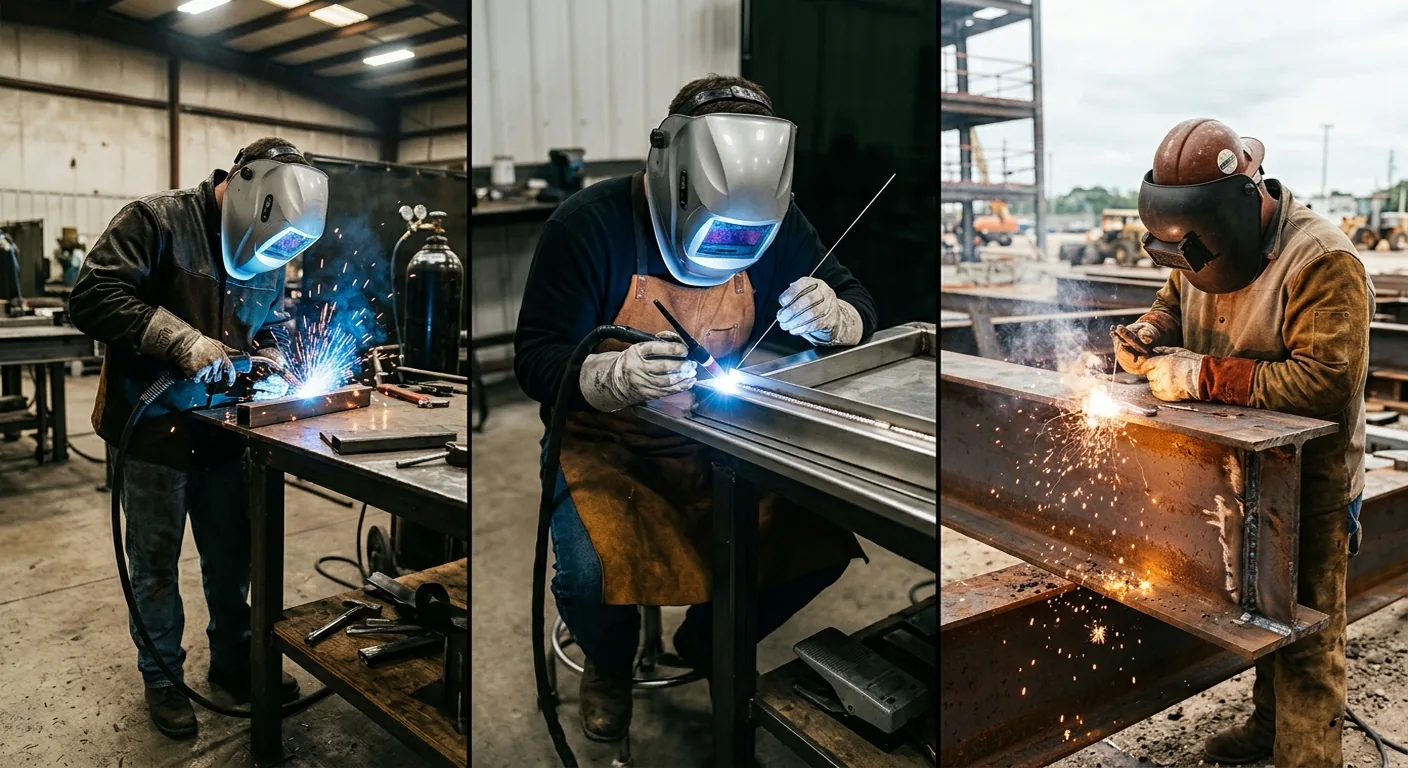
- MIG — Gas Metal Arc Welding (GMAW). A wire electrode feeds continuously from a gun, melted by an arc, and shielded from the atmosphere by an inert gas. Pull the trigger and you’re welding. Best on clean steel and aluminum, indoors.
- Stick — Shielded Metal Arc Welding (SMAW). A consumable flux-coated electrode (the “stick”) strikes an arc with the work; the flux burns off to shield the weld puddle. No gas bottle. Works outdoors in wind and rain, on dirty or rusty steel.
- TIG — Gas Tungsten Arc Welding (GTAW). A non-consumable tungsten electrode produces the arc; the welder feeds filler rod by hand and shields with inert gas. Slow, precise, and the highest-quality finish of the three.
Those one-line definitions cover 90% of what differentiates them on a job site. The rest of this article is about what those differences mean for your training and your paycheck.
Difficulty Curve: How Long to a Passable Bead
If you’ve never welded before, the difficulty ranking is consistent across every welding instructor and every shop owner who’s ever trained an apprentice:
MIG is the easiest. You can lay a passable bead on flat plate within a few hours of practice. The trigger feeds wire automatically; you concentrate on travel speed and angle. The Fabricator’s welding columnist Jim Mosman makes the case for new welders to learn GMAW first on exactly this basis: low frustration, fastest path to a clean weld, and the most-used process in U.S. industry.
Stick is moderate. The mechanics are simple — strike an arc, drag the rod, maintain arc length. The basics can be learned in an afternoon. What slows beginners down is the constant management of arc length (too short and you stick the rod, too long and the arc breaks), the slag chipping after every pass, and the fact that the rod consumes itself as you work, so the arc length is always changing. Plenty of welders make Stick their second process and reach a working level in a few months.
TIG is the hardest. TIG asks you to do four coordinated things at once: dominant hand controls the torch position, off-hand feeds filler rod into the puddle, foot pedal modulates amperage, and your brain reads the puddle to keep the bead consistent. There’s no equivalent process for “feeding the wire automatically.” It’s a year-or-more learning curve to clean, code-quality TIG work — and that long curve is exactly what makes credentialed TIG welders well paid.
If your only goal is “pay me to weld,” MIG gets you there fastest.
What Each Process Is Actually Used For
Pay attention to this section more than the difficulty section. The process you learn first should match the kind of work that’s available near you and the kind of work you actually want to do.
MIG (GMAW) — manufacturing, auto, general fabrication
MIG is the workhorse of indoor production welding. UTI’s overview of welding processes summarizes the typical industries plainly: construction, vehicle production, manufacturing, and aerospace use MIG for high-throughput indoor work. If you live near an auto-body shop, an OEM plant, a metal furniture maker, or a structural fab shop, MIG is what they hire for first.
MIG’s limitations are also what define its scope: it doesn’t tolerate wind well (the shielding gas blows away), it’s awkward on rusted or painted steel, and the equipment is heavier and less portable than Stick.
Stick (SMAW) — outdoors, structural, repair, pipeline root
Stick is what you take outside. UTI’s SMAW deep-dive lists its primary industries as maintenance and repair, construction, and industrial fabrication — all environments where the welder is in the field, not in a clean shop. Stick works in wind, on dirty material, and through paint and light rust. It’s the dominant process for ironworkers on outdoor structural steel and for the root pass on pipeline welds.
Stick equipment is cheap, portable, and forgiving of bad power. That’s why every farmer with a welding rig has a Stick machine, and why repair welders carry one in the truck.
TIG (GTAW) — aerospace, stainless, aluminum, code piping
TIG produces the cleanest, most precise welds of the three processes. It’s the default for aerospace, stainless food-grade piping, aluminum, exotic metals (titanium, magnesium, copper), and any code work where weld appearance and X-ray quality both matter. ESAB’s writeup on orbital welding notes that orbital GTAW is the standard for high-spec pipe work where weld quality has to be inspectable.
TIG is slow, which is part of why it pays. A good TIG welder might lay a foot of weld in the time a MIG welder lays five — but the foot of TIG weld is the one that goes on a pressure vessel, an aircraft skin, or a craft beer brite tank.
Pay Implications: Which Process Unlocks Which Paychecks
The BLS Occupational Outlook Handbook for Welders, Cutters, Solderers, and Brazers lists the May 2024 wage band:
- Median: $51,000/yr
- Bottom 10%: under $38,130
- Top 10%: over $75,850
- Annual openings: ~45,600
- Projected growth (2024–34): 2% (slower than average overall, but with steady opening volume from retirements and infrastructure)
That distribution understates the spread inside the field, because the big premiums are tied to specific process + industry combinations:
- General-fab MIG welder in a job shop or auto facility: usually clusters around the median.
- Stick / structural welder with current AWS D1.1 certification on outdoor construction or ironwork: typically above-median, especially with overtime on commercial jobs.
- TIG welder in aerospace, food-grade stainless, or code-piping shops: routinely in the upper third of the wage band.
- Pipeline welder (Stick root + Hot pass + Fill, often with TIG on alloy lines): the most consistent path to the top decile and beyond, frequently working contract / per-diem rates.
- Underwater welder, nuclear welder, certified inspector: smaller niches, materially higher pay, and longer training/credentialing curves.
The shorthand: MIG keeps you employed and gets you to the median. TIG and pipeline-Stick are how you push past it.
Equipment Cost: For Hobby Learners and Shop Owners
If you’re buying gear to practice at home or set up a small shop, the cost ladder runs roughly:
- Stick: the cheapest entry point. A capable 120V/240V Stick inverter and a few pounds of 7018 rod runs a few hundred dollars. No gas bottle, no wire feeder.
- MIG: a true mid-range. A reliable 240V MIG machine, regulator, gas bottle, and spool of wire is usually a low-four-figure setup once you include consumables.
- TIG: the most expensive. A good AC/DC TIG inverter (you need AC for aluminum) plus argon, foot pedal, water-cooled torch (for sustained work), and quality consumables can run several thousand dollars before you even add a welding cart.
Cost should not drive your first process choice if you’re going through an accredited program — the school’s machines do the heavy lifting. Cost matters when you’re deciding what to buy after graduation to keep practicing or to take side work.
What U.S. Welding Programs Actually Teach First
Walk into nearly any community-college welding program, and the curriculum sequence is the same: Stick or MIG first (with most modern programs starting on MIG), then the other, then TIG, then advanced topics (pipe welding, code-quality testing, specialty materials).
There are two reasons for this sequence:
- Skill transfer. Learning MIG teaches you puddle reading without simultaneously asking you to manage filler-rod feed and amperage. Once you can read a puddle, picking up Stick or TIG is faster.
- Employability halfway through. A student who’s competent at MIG by month four can take a part-time fab shop job while finishing the program. A student who started on TIG might not be employable until graduation.
A meaningful number of welders also enter the field through 4–8 week accelerated MIG programs aimed at production hiring — useful for getting into a shop quickly, but tighter on the breadth of skills needed for higher-paying specialty work later. (For broader context on training paths and credentials, see how to become a welder and welding career opportunities.)
The Right Answer, By Goal
A short decision matrix.
Want a paycheck as fast as possible? Start with MIG. Highest job availability, shortest learning curve, easiest to hit a hireable level in a few months. Find local welding technology / welder programs and look for ones that emphasize MIG production hours.
Want outdoor structural / construction work? Start with Stick. AWS D1.1 structural certification, ironworker pathways, and construction sites all live on Stick. MIG is the second process you add.
Want aerospace, food-grade, or code-piping work? Start with MIG to learn puddle reading, then go straight to TIG. Plan on a longer training horizon — typically a 1-year certificate or 2-year associate degree — and look for welding engineering technology programs that include TIG on stainless and aluminum.
Want pipeline? Start with Stick (because the root pass on most pipeline is Stick), get experienced on 6010 and 7018 in all positions, then add TIG for alloy lines. This is the highest-paying mainstream welding career and the path takes years to mature into.
Want maximum versatility? Start with MIG, add Stick by month six, and pick up TIG in year two. This is the curriculum most accredited programs are already designed around.
Bottom Line
There isn’t a “best” first welding process — there’s a best first process for the job you actually want. MIG is the right answer for most beginners because it’s the easiest to learn, the most widely used in U.S. manufacturing, and the fastest path to a paycheck. Stick is the right starting point if you know you want outdoor structural or pipeline work. TIG is rarely the right first process — but it’s the one that, added later, opens the highest-paying specialty work in the field.
Whichever you start with, the credential that turns “I can weld” into “I’m hireable” is an AWS-administered welder qualification on the process and position your target employer cares about. Pick a program that lets you sit for the right test before you graduate.
Sources
- U.S. Bureau of Labor Statistics — Welders, Cutters, Solderers, and Brazers, Occupational Outlook Handbook (May 2024 wage data) — https://www.bls.gov/ooh/production/welders-cutters-solderers-and-brazers.htm
- Jim Mosman / The Fabricator — Jim’s Cover Pass: Why new welders should learn GMAW first — https://www.thefabricator.com/thewelder/article/arcwelding/jims-cover-pass-why-new-welders-should-learn-gmaw-first
- Universal Technical Institute — Types of Welding (program overview) — https://www.uti.edu/programs/welding/types-welding
- Universal Technical Institute — What Is Shielded Metal Arc Welding (SMAW)? — https://www.uti.edu/blog/welding/smaw-shielded-metal-arc-welding
- ESAB University — GMAW vs GTAW in Orbital Processes (pipeline applications) — https://esab.com/us/nam_en/esab-university/blogs/gmaw-vs-gtaw-in-orbital-processes-ami/