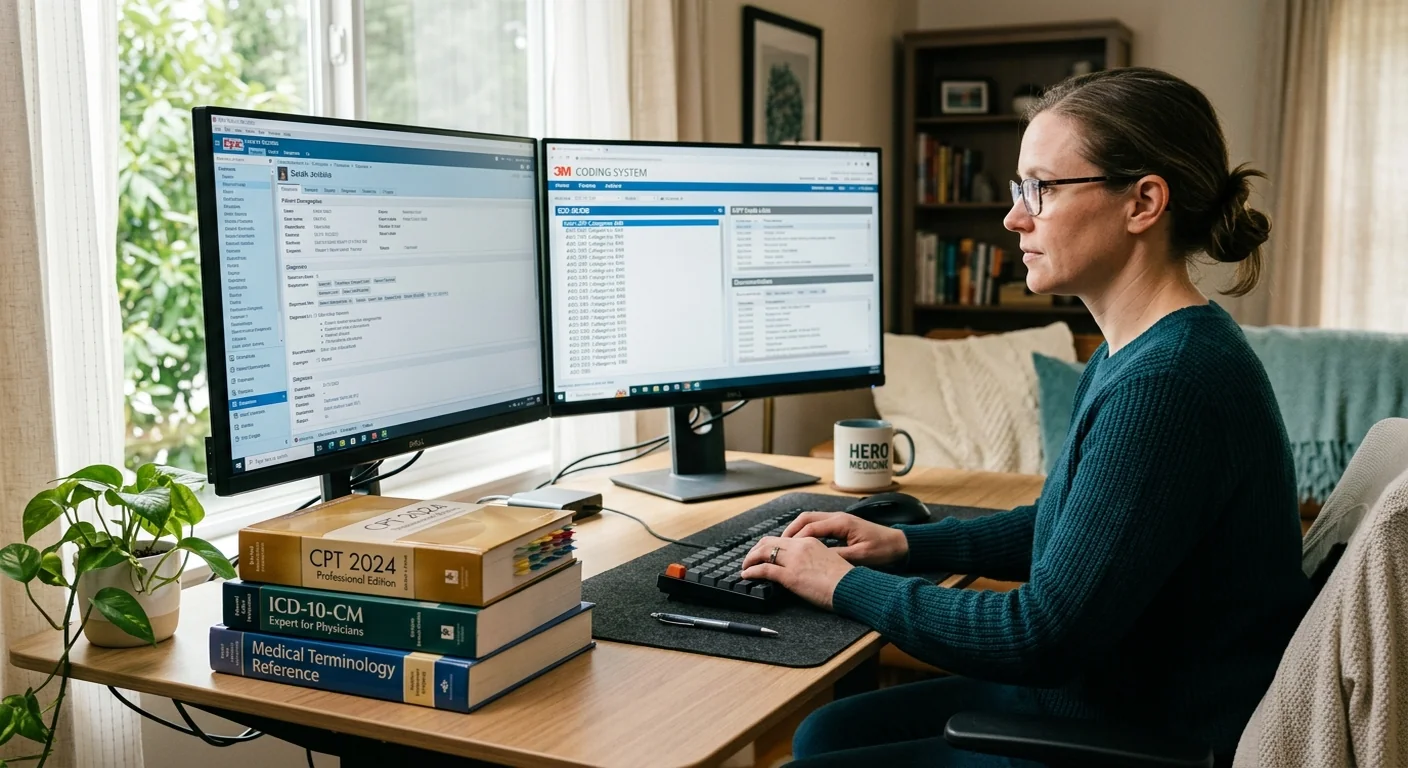

Medical billing and coding is one of the very few healthcare careers you can build entirely from a home office. Most clinical roles — nursing, dental assisting, surgical tech — require you to be physically present with a patient. Coders work from claims, encounter notes, and operative reports, all of which travel just fine over a secure connection. The result, according to the AAPC’s 2026 Medical Coding and Billing Salary Report, is that 80.2% of medical records specialists now work entirely or partly remotely, and 64.8% work fully remotely.
That headline number hides a more interesting question: who is actually doing the hiring? “Remote coder” is not a single job. It splits across at least four different kinds of employer, each with different work, different pay, and different tolerance for new graduates. This guide names the companies that actually hire from home, what they ask for at the door, what the pay really looks like, and three realistic paths to a remote first job — including ones that don’t require the standard two years of in-office time.
What “Remote Medical Billing” Actually Means
Before naming employers, it’s worth being precise about what kind of remote coding work you’re aiming at. The four buckets:
- Provider in-house coders — coders who work directly for a hospital system, physician group, or specialty clinic. The employer is the same one whose claims you’re coding. These were the last to go remote and are the most likely to require some onsite time.
- Revenue cycle management (RCM) vendors — third-party companies hospitals and clinics outsource billing to. Conifer, R1 RCM, nThrive, and Aviacode are the big names. RCM jobs are remote by default and are the largest single source of work-from-home coder hiring.
- Payer-side coders — coders working for insurance companies and managed-care organizations, reviewing claims, doing audits, and processing appeals. Aetna and other CVS Health subsidiaries hire here.
- Risk-adjustment / HCC coders — a fast-growing niche that codes diagnoses for Medicare Advantage plans. Pay is higher than general outpatient and almost entirely remote. Optum and Humana dominate this space.
Knowing which bucket you’re targeting changes which credentials you need, which postings to apply to, and how much you’ll earn.
The Companies That Actually Hire Remote Coders
The list below is drawn from publicly reported hiring patterns and from FlexJobs’ tracking of remote medical coding employers. These are the names that show up most consistently on remote-coder job boards in 2025-2026.
Optum (UnitedHealth Group)
The largest single hirer of remote coders in the U.S. Optum runs the whole stack: outpatient, inpatient, HCC risk adjustment, coding quality analyst roles, and audit positions. The HCC risk-adjustment line is the busiest — Medicare Advantage growth has driven sustained hiring there for several years. Optum typically wants a CPC plus 1–2 years of coding experience, with HCC work paying a premium over general outpatient.
Humana
Humana hires heavily for remote HCC and risk-adjustment coders, plus outpatient and inpatient roles tied to its provider network. CPC is the default ask; CRC (Certified Risk Adjustment Coder) is a strong differentiator for the HCC track.
Aetna (CVS Health)
Aetna’s coding hires are primarily payer-side — claims review, audits, prior authorization coding. The work is more compliance-flavored than production coding and tends to attract coders who want a slower-paced, more analytical day.
Conifer Health Solutions
A large RCM vendor (a Tenet Healthcare subsidiary) that handles billing for hospitals and physician groups. Conifer hires for outpatient, inpatient, denials, and edit-resolution work. Strong track for coders who want straight production volume.
R1 RCM
R1 is one of the bigger pure-play RCM companies and a particularly good fit for coders with 2–4 years of experience looking to move into auditing or quality work. Their remote roles span the full revenue cycle.
Aviacode and nThrive
Both are coding-services vendors who place coders into provider contracts. Aviacode runs a large 1099 / contract-coder network in addition to W-2 roles, which is one of the few places experienced coders can build a remote book of business without going through a traditional employer.
Maxim Health Information Services
A healthcare staffing arm of Maxim Healthcare. Remote coding placements range from short-term contract gaps to permanent remote roles, with positions across outpatient, inpatient, and specialty coding (radiology, oncology).
There are dozens of smaller RCM vendors, billing services, and physician-network in-house teams hiring remote coders too. The pattern is consistent: the biggest volume comes from RCM vendors and large payers, not from individual hospitals.
What Employers Actually Require to Let You Work Remote
Three requirements show up in nearly every remote coder posting.
1. A national coding credential. This is non-negotiable. AAPC’s data on remote workers is striking: among medical records specialists working remotely, 81% hold the CPC, with COC (8.6%) and CPMA (8.5%) making up most of the rest, according to AAPC’s “Survey Reveals Remote Coding Realities” report. If you’re targeting a remote first job, the CPC is the credential to plan around. (For how it compares to AHIMA’s CCA and CCS, see our breakdown of CPC vs CCS vs CCA.)
2. One to two years of coding experience. This is the rule that catches new coders by surprise. Almost every remote posting at the major employers — Optum, Humana, Aetna, Conifer — lists “2 years coding experience” as a minimum. The reasoning is supervisory: managers can’t watch a remote coder’s work in real time, so they want someone who has already proven they can hit accuracy and production targets onsite. The AAPC’s resource on working remote makes this point explicitly, and it’s repeated in AAPC member discussions on entry-level remote roles.
3. A workspace that meets the employer’s HIPAA and IT requirements. That typically means: a locked, private room (no working from a coffee shop or shared living space); a hardwired or otherwise secured internet connection; dual monitors (one for the encounter, one for the code reference / claim system); and an employer-provided or approved workstation. Some employers ship you a laptop and security tokens; others require you to provide hardware to a spec.
The CPC is the door key. The two years and the workspace are what gets you past it.
The Remote Pay Reality — and the Trade-off
Remote coders are well paid, but slightly less well paid than their onsite peers. AAPC’s salary report puts the average remote coder at $54,784/yr, against a broader medical-records-specialist average of about $65,007/yr. The BLS Occupational Outlook Handbook reports a May 2024 median wage of $50,250, with the top 10% earning more than $80,950.
The remote/onsite gap usually runs 5–10% on the same role, and there are a few reasons for it:
- Geography. Onsite coders are paid against the local healthcare market — often a high-cost metro. Remote coders are paid against a national market that includes lower-cost regions.
- Specialty mix. The very highest-paying specialties — interventional cardiology, surgery, anesthesia, oncology — still have a meaningful onsite hiring footprint at academic medical centers.
- Auditor and manager promotions sometimes still require onsite presence at certain employers.
The flip side: the specialty and HCC premium is real and is most accessible from home. HCC risk-adjustment coders at Optum, Humana, and similar payers regularly clear the $65–80k range with experience, and the work is essentially 100% remote. The “give up 5% to work from home” trade is one most coders take willingly, and the satisfaction data backs that up: AAPC reports 92% of remote coders are “very” or “somewhat” satisfied with their jobs.
How to Get Hired Remote Without Two Years Onsite
The two-year experience rule is the rule, not a law. Three paths around it work consistently for new coders:
Path 1 — Small physician practices and specialty clinics
Single-physician offices and small group practices rarely have a coding department of their own. Many are willing to hire a freshly credentialed CPC or CCA on a remote-from-day-one basis because they need someone coding their claims and don’t have the infrastructure to bring you onsite. Pay is usually below large-employer scale, and you’ll wear more hats (charge entry, eligibility checks, sometimes patient calls), but it’s a legitimate way to log year one of remote experience that the bigger employers will count.
Path 2 — RCM vendors with formal training pipelines
Some RCM vendors run their own training and apprenticeship programs designed for new CPCs. They’re explicit about it: you sit in a structured training queue, then graduate into production coding. The trade-off is starting pay and a multi-year non-compete in some cases, but you skip the two-year onsite gate. Aviacode, nThrive, and a handful of regional RCM companies fit this pattern; check the careers pages for “coder trainee” or “CPC-A pathway” roles.
Path 3 — 1099 contract work via coding-services networks
Aviacode and several smaller coding marketplaces (including some posted on Upwork’s medical-coding category) place certified coders on per-claim or per-chart contracts. These don’t always require the two-year minimum because the company isn’t hiring you as an employee — it’s contracting you for a defined deliverable. You’ll need to manage your own taxes, your own benefits, and your own production discipline, but it’s the fastest path from credential to remote paycheck.
A common combined strategy: take a small-practice or RCM-trainee role for 12–18 months, then jump to Optum or Humana once you have measurable production stats and audit scores to put on your résumé. (For the broader path from zero to credentialed coder, see how to become a medical biller and coder, and for the local program landscape, medical insurance coding specialist programs.)
What the Day Actually Looks Like — and What Burns Coders Out
Remote coding is desk work, on a screen, alone, against a production target. That sentence summarizes both the appeal and the strain.
A typical day at an RCM vendor or large payer looks like this: log in, pick up your queue of charts, code each chart against the source documentation, route any chart with a documentation gap to physician query, hit a daily chart count or RVU target. There’s a quality cycle on top — your work is sampled by an auditor, and your accuracy score affects everything from raises to whether you keep specialty assignments.
What burns people out:
- Production quotas that push speed at the cost of clean coding, especially at vendors paid per-chart.
- Isolation. No coffee chats, no walk-and-talk with the physician — you talk through messaging tools and get most feedback through audit reports.
- Repetitive specialty queues — radiology coders may code the same kinds of imaging studies for hours; a less variety-tolerant person finds this draining.
The countervailing benefits — no commute, full schedule control, a workspace you actually like — are the reasons coders rate this work as well as they do. But the “work from home, life is great” framing oversells a job that, at its core, is highly focused desk work for several hours at a time.
Bottom Line
Remote medical billing and coding is real, large, and growing — 80% of the field is now at least partly remote, and the headline employers (Optum, Humana, Aetna, Conifer, R1 RCM, Aviacode, Maxim) hire from home as a default. The credential you should plan around is the CPC, because that’s what 81% of remote coders carry. Plan on a soft floor of one to two years of coding experience before the big remote employers will look at you, and use small physician practices, RCM trainee programs, or 1099 coding-services work to get past it. Expect to give up 5–10% of nominal pay versus an equivalent onsite role; expect to gain back the commute, the schedule, and — for most coders — meaningfully higher job satisfaction.
If you’re still earlier in the decision, our overview of medical billing and coding career opportunities covers training paths, certification choices, and the broader job-market picture, and the fastest-growing trade careers guide puts coding in context next to other allied-health and skilled-trade tracks.
Sources
- AAPC — 2026 Medical Coding and Billing Salary Report — https://www.aapc.com/resources/medical-coding-salary-survey
- AAPC Knowledge Center — Survey Reveals Remote Coding Realities — https://www.aapc.com/blog/42258-survey-reveals-remote-coding-realities/
- AAPC — Working Remote as a Medical Records Specialist — https://www.aapc.com/resources/remote-work
- AAPC member forum — Entry level remote jobs discussion — https://www.aapc.com/discuss/threads/entry-level-remote-jobs.193489/
- FlexJobs — 10 Companies Hiring for Remote Medical Coding Jobs — https://www.flexjobs.com/blog/post/companies-remote-medical-coding-jobs
- U.S. Bureau of Labor Statistics — Medical Records Specialists, Occupational Outlook Handbook (May 2024 wage data) — https://www.bls.gov/ooh/healthcare/medical-records-and-health-information-technicians.htm