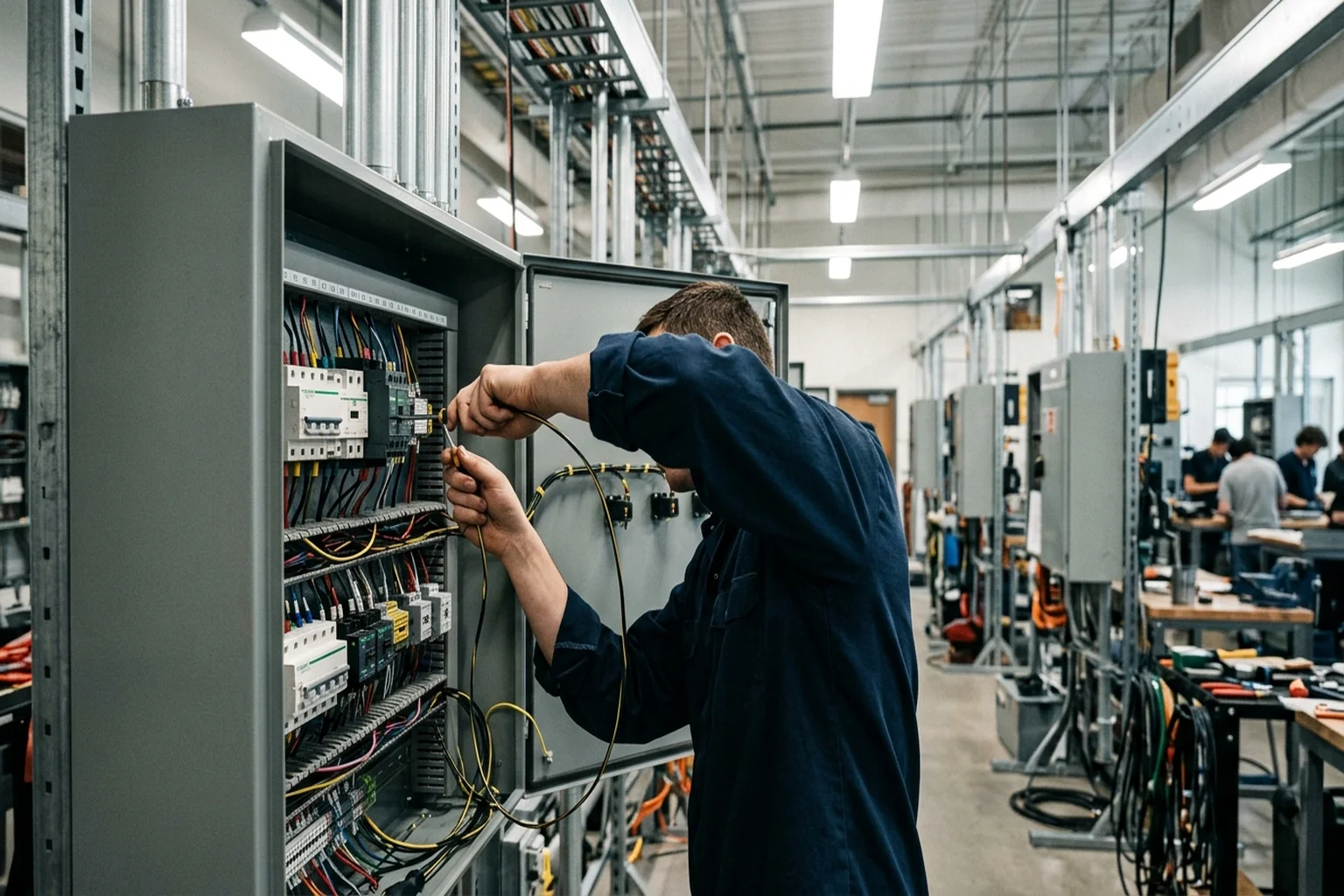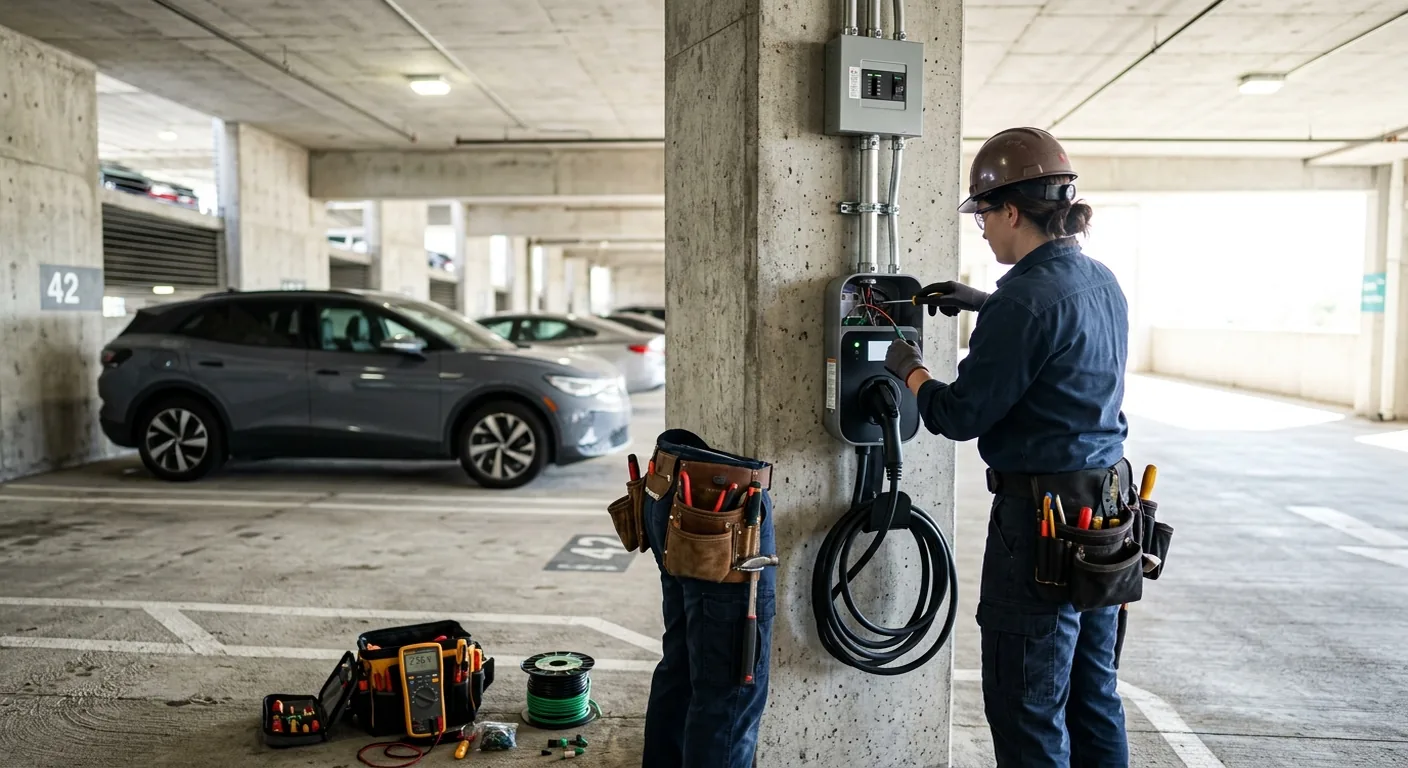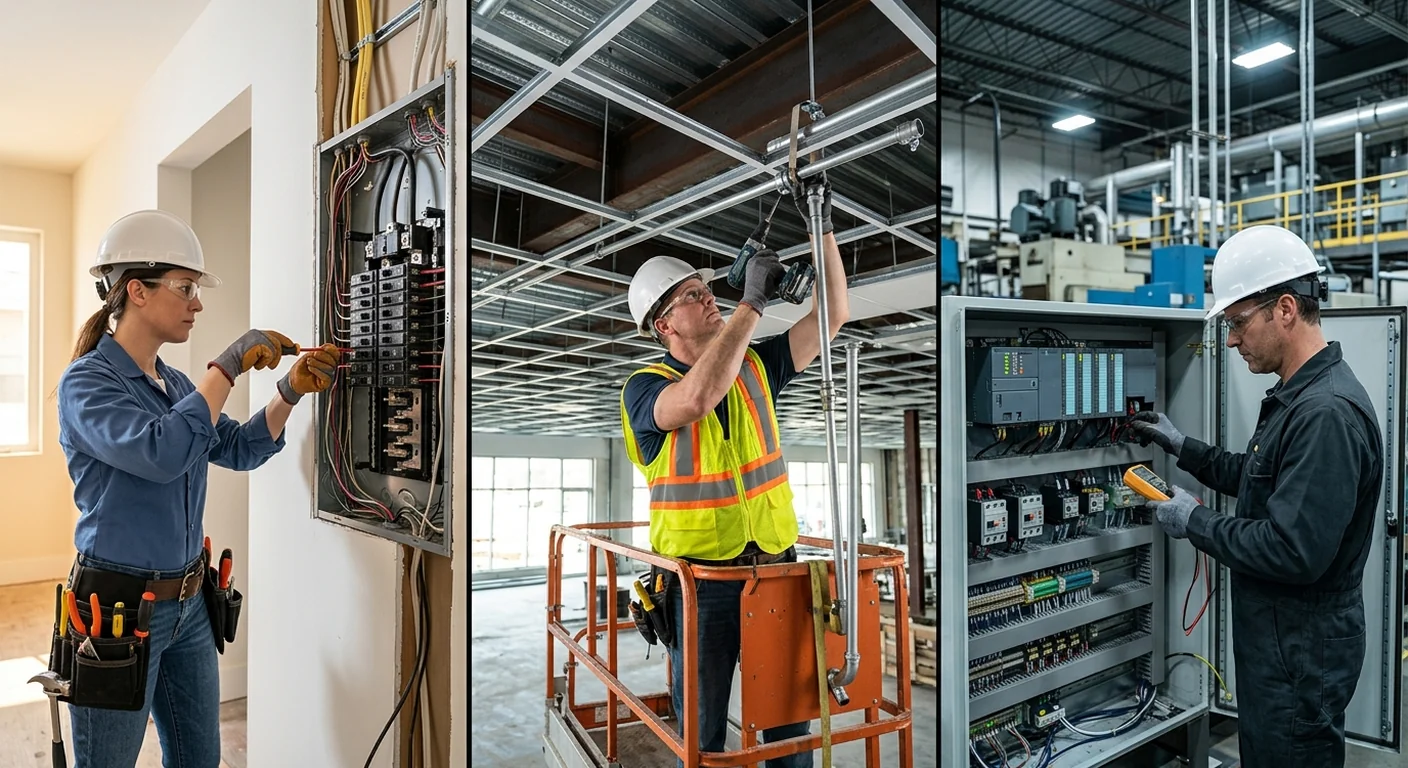

The same journeyman license puts you in three completely different jobs. A residential electrician spends the day in finished and unfinished homes pulling Romex through stud bays and answering questions from the homeowner. A commercial electrician spends it on a job site running 277/480-volt three-phase feeders through EMT conduit on a forty-person crew. An industrial electrician spends it in a steel mill or food-processing plant troubleshooting a PLC cabinet next to a $400,000 robot that’s been down for six minutes and is costing the plant $4,000 a minute.
Same trade. Same license. Three different incomes, three different lifestyles, and three different career ceilings. Picking the wrong one early in your apprenticeship doesn’t kill your career — but it can cost you $15,000 to $35,000 a year for a decade before you fix it. This guide is the comparison you should run before you sign onto a particular track.
For the broader picture of why electrical work is one of the strongest trade choices in 2026 — including the AI data-center demand spike — see our electrical career opportunities overview. This article focuses on the choice between the three sector tracks.
TL;DR — The Pay Comparison
The Bureau of Labor Statistics reports a single median wage for all electricians ($62,350/year, May 2024), but the underlying distribution is not uniform across sectors. Industry-specific surveys consistently rank industrial highest, commercial second, and residential third — though geography and union status can flip the order in specific markets.
| Track | Typical annual pay (mid-career) | Top 10% reaches | Hours pattern | Career ceiling |
|---|---|---|---|---|
| Residential | $48,000–$65,000 | ~$85,000 | Mostly day shifts; small-shop overtime | Master license + own contracting business |
| Commercial | $58,000–$80,000 | ~$105,000 | Day shifts plus night/weekend tie-ins; OT common | Foreman → superintendent → PM, often unionized |
| Industrial | $65,000–$95,000 | $130,000+ | Shift work (24/7 plants); heavy overtime; on-call | Plant electrician → controls technician → maintenance manager |
Sources: BLS OOH — Electricians; ZipRecruiter and Salary.com sector breakdowns (commercial, industrial); Lincoln Tech Electrician Salary Guide.
The full BLS picture for context: median $62,350/year in May 2024, top 10% earning more than $106,030, and bottom 10% under $39,430. About 818,700 electricians are employed nationally, with 9% projected growth through 2034 — much faster than average — and roughly 81,000 openings per year. Source: BLS OOH.
Residential Electrician
What the Work Actually Looks Like
Residential electricians install, maintain, and repair electrical systems in homes — single-family houses, duplexes, townhouses, and small apartment buildings. The work alternates between two distinct modes:
- Rough-in — running the wiring infrastructure before walls close. Drilling studs, pulling Romex (NM-B cable), setting boxes, stubbing up for panels. New construction work, full sub-floor and attic crawls, often in unfinished structures.
- Trim/finish — after drywall and paint, mounting devices (outlets, switches, fixtures), terminating circuits, energizing the panel, and walking the homeowner through the system.
- Service work — diagnosing why a circuit keeps tripping, replacing failed breakers, upgrading 100A panels to 200A, running a new line for a hot tub or EV charger, troubleshooting ceiling-fan wiring.
A team of two residential electricians typically handles one to five service calls per 8-hour day, ranging from a 30-minute outlet swap to a full-day panel upgrade. Source: EC&M — A Day in the Life of a Residential Electrician.
Voltage and Systems
Residential is single-phase 120/240V. You’ll see split-phase 120/240 from the utility transformer, standard NM-B and UF cable, plastic boxes, and circuit breakers in 100A, 150A, and 200A residential panels. Modern work increasingly includes Level 2 EV chargers (40–50A circuits), heat-pump-ready service upgrades, and solar interconnects — but the underlying system is uniform across the country. Source: Buildforce — Residential vs Commercial Electricians.
Hours and Lifestyle
Residential is the most predictable schedule of the three tracks. Most shops run a standard day, and overtime is moderate — service calls and weekend emergencies happen, but you’re usually not on a strict on-call rotation. New-construction crews work seasonally and can have winter slowdowns in northern states.
You’ll work at customer-facing distance every day. Customer service skills matter — homeowners ask questions, want to understand the bill, and review you online. If you find that draining, residential is harder than the higher-voltage tracks where customer interaction is rare.
Pay
Residential pay sits at the lower end of the electrician range nationally. Typical mid-career residential pay runs $48,000–$65,000, with top earners (master electricians who own service vans, or specialists in EV/solar/smart-home) reaching $80,000–$100,000.
Why lower than commercial or industrial? Simpler systems, less specialized training, smaller projects, and shops that compete on price for homeowner work. The trade-off is gentler entry — residential apprenticeships are often easier to find, especially for non-union candidates, and the learning curve is less steep.
Career Ceiling
The residential ceiling is getting your master license and starting your own contracting company. A residential contractor running 4–8 trucks in a healthy market can clear $200,000+ in profit, but you’re now running a business — bidding, scheduling, hiring, payroll — not climbing ladders. For technicians who don’t want to own a business, the hard ceiling is around $90,000–$100,000 as a senior service technician or small-shop foreman.
Pure-play residential is also more cyclical than commercial or industrial — it tracks the housing market. Veterans of the trade who came up in 2007–2010 will tell you to keep at least one foot in commercial work as a hedge.
Commercial Electrician
What the Work Actually Looks Like
Commercial electricians wire stores, offices, schools, hospitals, restaurants, parking decks, and mid-rise apartment buildings. The job is systems-scale: you’re not pulling a single 14/2 to a bedroom outlet, you’re running a 4-inch conduit feeder up a ten-story riser to a 1,200A switchgear lineup.
Daily work tends to be:
- Conduit and cable tray — running EMT, IMC, or rigid conduit through ceilings and across roofs, supporting cable trays, pulling large multi-conductor cable
- Three-phase distribution — installing transformers, panel boards, switchgear, motor control centers (MCCs)
- Lighting systems — 0–10V dimming, DALI, networked lighting controls, emergency egress and exit signs, fire-alarm interfaces
- Tie-ins and shutdowns — tying new work into live systems, often during nights or weekends to minimize building-occupant disruption
- Code compliance — commercial work has stricter inspection regimes and tighter spec compliance than most residential work
Commercial electricians typically work in teams, alongside HVAC technicians, plumbers, and the general contractor’s crew. Source: Indeed — Residential vs. Commercial Electrician Differences.
Voltage and Systems
Commercial is three-phase, typically 208V/120V wye for smaller buildings or 480V/277V wye for larger ones. You’ll work with conduit-encased copper conductors (THHN/THWN), switchgear, transformers, and motor controllers — systems that supply heavier loads and more occupants than any residence. Source: Summit College — Residential vs Commercial Electricians.
The complexity also means more specialized knowledge: load calculations, demand factors, conduit fill, voltage drop, fault current — material that makes up a much larger share of the journeyman exam in commercial-heavy locals.
Hours and Lifestyle
Commercial is day-shift dominant with significant overtime. New-construction projects run on aggressive schedules — punch-list weeks before turnover are routinely 50–60 hours. Tie-ins, energizations, and changeovers often happen overnight or on weekends to avoid disrupting tenants. If you join a unionized commercial contractor, overtime past eight hours typically pays time-and-a-half, and Sundays and holidays often pay double-time — the income upside on long projects can be substantial.
Travel varies. Local commercial work means home every night. Industrial-commercial overlap (data centers, large hospitals, sports arenas) often involves regional or interstate travel — sometimes per-diem-paid stints of weeks to months at a single megaproject.
Pay
Commercial pay is meaningfully higher than residential and approaches industrial. Typical mid-career pay is $58,000–$80,000, top 10% reaching $100,000+ in high-cost-of-living markets and union-heavy regions. ZipRecruiter pegs the national average for commercial electricians at roughly $54,000/year ($25.98/hr) but that average understates senior journeyman and foreman pay. Source: ZipRecruiter — Commercial Electrician Salary.
In the IBEW (International Brotherhood of Electrical Workers) system, commercial journeyman wage rates plus benefit package (the “wage and fringe”) in major markets — Boston, Chicago, NYC, San Francisco, Seattle, Washington DC — frequently exceed $80–$110/hour total package. Foreman scale adds 5–15% on top.
Career Ceiling
The commercial track has the highest formal career ladder of the three.
- Journeyman → foreman → general foreman → superintendent → project manager
A commercial PM running multiple data-center electrical builds in the right market can earn $150,000–$250,000+ — the highest pure-W2 ceiling in the trade. Outside the construction-management track, master-electrician contractors who specialize in commercial bids and tenant improvements can build $1M+ shops, but the customer-acquisition and bonding requirements are higher than residential.
Commercial work is also where the data-center boom lives. Hyperscale construction is overwhelmingly commercial-classification work, and young commercial electricians at major data-center sites are reportedly earning into the $240,000–$280,000 range with overtime. Source: Fortune — AI Data Centers and Electrician Shortage (2026).
Industrial Electrician
What the Work Actually Looks Like
Industrial electricians keep manufacturing plants, refineries, water-treatment facilities, mines, food-processing lines, paper mills, power plants, and chemical operations running. The job is maintenance-heavy rather than installation-heavy. You’re not pulling new wire most days — you’re troubleshooting why a system that worked yesterday isn’t working today.
Daily work is dominated by:
- Motor and motor-control work — across-the-line starters, soft starters, variable-frequency drives (VFDs), motor protection relays
- PLC troubleshooting — Allen-Bradley, Siemens, Modicon controllers; reading ladder logic, finding the input that’s not coming on, replacing I/O modules
- Instrumentation — 4–20 mA loops, transmitters, control valves, level sensors, flow meters
- Power distribution — 480V three-phase, 4160V medium-voltage in larger plants, switchgear maintenance, transformer testing
- Safety systems — lockout/tagout, arc-flash hazard analysis, energy-isolation procedures, working hot when unavoidable
The pace is different from construction. A bad day in residential is the homeowner being late. A bad day in industrial is a fermentation tank overflowing because a level-control loop failed. The work is more diagnostic, more pressured, and more rewarded.
Voltage, Systems, and Specialized Skills
Industrial work routinely involves 480V three-phase as a baseline, with 2.4kV, 4.16kV, and 13.8kV medium-voltage in larger plants. Beyond high voltage, the control side dominates the skill ladder: PLC programming, HMI systems, networked I/O (EtherNet/IP, Profinet), motion control, and industrial safety systems (SIL-rated stops, light curtains).
Industrial electricians at the controls level are sometimes formally classified as “industrial controls technicians” rather than electricians, with associated pay premiums. PLC training is ubiquitous in the field — programs at community colleges and trade schools cover ladder logic, the prototyping process, and circuit simulation, and graduates routinely move into oil-and-gas, automotive, manufacturing, and food-production roles. Source: Cincinnati State PLC Certificate.
Hours and Lifestyle
Industrial is shift work. Continuous-process plants (refineries, paper mills, semiconductor fabs) run 24/7/365 and need electricians on every shift. Typical schedules:
- Day shifts — straight 8s or 4×10s for plants with daytime maintenance windows
- Rotating shifts — 12-hour shifts on patterns like 2-on/2-off/3-on/3-off, common in refineries and chemical plants
- On-call rotation — for plants with maintenance staffing only on day shift, the on-call electrician handles nights and weekends; pay typically includes call-out minimums (4 hours) plus drive time
Overtime is heavy and consistent. Many industrial electricians average 50–55 paid hours per week year-round; turnaround/shutdown periods at refineries can spike to 70–84 hours weekly for several weeks at premium pay rates.
The lifestyle trade-off is real. Shift work over years takes a measurable toll on sleep, family routines, and health. The pay reflects this.
Pay
Industrial pay is the highest sector for mid-career electricians without a management title. Typical industrial electrician pay is $65,000–$95,000 base, frequently reaching $100,000–$130,000+ with overtime. ZipRecruiter reports a national average around $61,635/year, while Salary.com ($72,362/year) and Payscale ($33.54/hour, ≈$70,000/year) report higher — the variance reflects how thin “industrial electrician” is as a job-title category and how much of total comp is overtime and on-call. Sources: ZipRecruiter — Industrial Electrician Salary; Salary.com — Industrial Electrician; Payscale — Industrial Electrician.
Specialty roles compound the upside. PLC programmers and controls technicians in oil-and-gas and pharma routinely clear $110,000–$140,000. Electricians in nuclear power, chemical plants, and remote oil-field operations earn the highest end of the band — $150,000+ is not unusual when you account for shift differential, hazard pay, and per-diem on travel rotations.
Career Ceiling
The industrial career ladder is technical and specialized, not management-driven.
- Industrial electrician → senior tech / lead tech → controls technician → automation engineer / maintenance supervisor → maintenance/reliability manager
The natural ceiling for technical work without crossing into salaried management is roughly $140,000–$160,000 in major metros, plus benefits. Crossing into maintenance management or reliability engineering can push past $200,000 in heavy industry, but those roles often require an associate or bachelor’s degree on top of journeyman experience.
The industrial track is also the hardest to enter cold. Most industrial plants prefer hires who already have a journeyman license plus PLC/instrumentation training — they don’t typically run apprenticeship programs the way IBEW commercial locals do. The most reliable path in is: complete a commercial or general apprenticeship, get the journeyman license, then add PLC and motor-control coursework at a community college and apply to plants directly.
Hours and Lifestyle Side-by-Side
| Factor | Residential | Commercial | Industrial |
|---|---|---|---|
| Schedule predictability | High | Moderate | Variable (shift work) |
| Overtime frequency | Low–moderate | Moderate–high | High and consistent |
| Travel | Local (city/region) | Local to regional; megaprojects can require travel | Site-fixed (one plant) or rotational (oilfield, refinery turnarounds) |
| On-call rotation | Service shops yes, install crews no | Tie-in driven, occasional | Common, with call-out premiums |
| Customer interaction | High (homeowners daily) | Moderate (GC, owner reps) | Low (operations and engineering staff) |
| Physical demand | Moderate (attics, crawls, ladders) | High (stair climbs, conduit work, elevation) | Moderate–high (climbing, confined space, shutdowns) |
| Stress source | Customer expectations, scheduling | Project deadlines, punch lists, code inspectors | Production downtime ($$/minute), safety, troubleshooting under pressure |
Career Ceiling Side-by-Side
| Path | Pure-technician ceiling | With management/business | Specialty premium |
|---|---|---|---|
| Residential | ~$90K–$100K (senior service tech) | $200K+ as small-shop owner | EV/solar/smart-home: +$10K–$20K |
| Commercial | ~$105K–$120K (senior journeyman/foreman) | $150K–$250K+ (PM/super), $300K+ as contractor in major markets; data-center specialists report $240K+ in current cycle | Data center, controls integration: +$30K–$80K |
| Industrial | ~$140K–$160K (senior controls tech) | $200K+ as maintenance manager or reliability lead | PLC programming, instrumentation, nuclear/chemical: +$30K–$60K |
How to Choose Your Track Early in an Apprenticeship
Most apprenticeships expose you to multiple sectors in the first one to two years before you commit. Your decision points:
Pick Residential If
- You want the most stable, customer-facing version of the trade
- You see yourself owning a service company in 10–15 years
- You prefer smaller, varied jobs to long projects
- You’re in a market with strong housing growth and limited industrial base
Pick Commercial If
- You want the highest construction-management ceiling
- You’re in a market with active commercial construction (data centers, hospitals, urban density)
- You want union compensation and benefits in a major metro
- You’re physically up for stair climbs, scaffold work, and stick-built large-project pace
Pick Industrial If
- You’re drawn to troubleshooting and electrical-controls work
- You can tolerate (or actively prefer) shift work for the pay premium
- You’re in a region with manufacturing, energy, or process-industry employers
- You’re willing to invest in PLC and instrumentation training on top of journeyman credentialing
- You value site stability — once you’re inside a plant, you tend to stay there for years
Specialty Sub-Tracks That Fit Multiple Sectors
- EV charger installation — bridges residential, commercial, and light-industrial work and is one of the fastest-growing electrician specialties. Federal and state incentives plus IRA-era infrastructure spending have driven rapid expansion. See our EV charger installer certification guide for the credentials and entry path.
- Data-center electrician — formally classified as commercial but with a distinct pay scale and skill premium. Currently the highest-paying journeyman electrician work in the country.
- Solar/storage installer — straddles residential and commercial; NABCEP certification adds a meaningful pay premium.
- Linework (utility electrician) — a separate trade in most jurisdictions, with its own apprenticeship and pay structure (typically $90,000–$140,000 mid-career), but worth considering alongside the three traditional sectors.
For the apprenticeship structure that underlies all three tracks, see our walkthrough of how to become an electrician, which covers IBEW vs non-union paths, journeyman exam prep, and the master-license track.
Switching Tracks Mid-Career
The journeyman license is portable across all three sectors, but the experience you have is not. A residential electrician with 10 years on the tools who walks onto a commercial high-rise crew is going to be a fast learner — but they’re starting near the bottom of the pay scale until they prove competence with conduit, three-phase, and commercial code.
Practical timelines for sector switches:
- Residential → Commercial: 3–6 months to be productive; 1–2 years to be at full-journeyman wage and competence
- Residential → Industrial: 1–3 years if you also pursue PLC and motor-control coursework; difficult without that supplementary training
- Commercial → Industrial: 1–2 years; commercial-trained electricians have most of the high-voltage and three-phase exposure already
- Commercial → Residential: 1–3 months; usually a downward pay move
- Industrial → Commercial: 3–9 months; controls-heavy backgrounds adapt well to data-center and hospital work
- Industrial → Residential: Easy mechanically, but most industrial electricians won’t accept the pay cut
The most common career arc is commercial-trained journeyman → industrial mid-career switch for higher pay → eventually back to commercial as a foreman or PM. Industrial pay is highest, but not everyone wants to keep working rotating shifts at age 50.
Geographic Factors
The three sectors are not evenly distributed.
- Residential demand follows population growth: Sun Belt cities, Texas, Florida, the Carolinas, and Mountain West.
- Commercial demand follows urban density and capital investment: Northeast Corridor, San Francisco–Seattle, Chicago, Houston/Dallas, and increasingly Atlanta, Phoenix, and Northern Virginia (data-center alley).
- Industrial demand is concentrated in the Gulf Coast (refineries, petrochemicals), the upper Midwest and Great Lakes (manufacturing), the Southeast (auto plants, semiconductor fabs), and the Pacific Northwest (wood products, semiconductor, hydroelectric).
If you’re geographically flexible, follow the work. If you’re geographically committed, pick the sector that’s strongest in your region — fighting an undersupplied sector is a waste of career years.
Common Mistakes
- Picking a track based on starting pay rather than ceiling. Residential apprentice wages can be the highest of the three (because non-union shops pay first-year apprentices closer to scale). Industrial and commercial journeyman wages are higher. Look at the 5-year and 10-year numbers, not the first paycheck.
- Picking commercial if you actually want to do controls work. Commercial electricians touch some controls (lighting, fire-alarm interfaces) but the heavy controls work — PLCs, automation, instrumentation — is industrial. The two paths look similar from the outside; they’re not.
- Picking residential because the apprenticeship is easier to get, then never specializing. Generalist residential electricians cap out around $80K. Specializing in EV charging, solar, or whole-home automation pushes that to $100K+ and futures-proofs against housing cycles.
- Ignoring shift work as a serious lifestyle factor. Industrial pay reflects the shift premium for a reason. Some people thrive on rotating shifts; many don’t. Talk to electricians who’ve worked the schedule you’re considering before committing.
- Treating the licenses as different. They’re not. The master and journeyman licenses are sector-agnostic. What changes is what you’ve practiced and what you can prove on a resume — sectors gate based on demonstrated experience, not license type.
- Not factoring in benefits and pension. Union commercial work in major markets often comes with a defined-benefit pension worth $20K–$40K/year in retirement and a health package no other sector matches. The headline wage understates total compensation.
Quick Decision Heuristic
If you’re 20–25, mechanically inclined, undecided, and choosing today:
- You like figuring out why things break: Industrial.
- You want the biggest projects, biggest crews, and the highest construction-management ceiling: Commercial.
- You want to run your own business someday and like being the customer-facing expert: Residential.
Pick a track aligned to that, and pick a market that has volume of that work. The apprenticeship will teach you the rest.
Sources
- U.S. Bureau of Labor Statistics — Occupational Outlook Handbook: Electricians — May 2024 — https://www.bls.gov/ooh/construction-and-extraction/electricians.htm
- U.S. Bureau of Labor Statistics — Occupational Employment and Wage Statistics: Electricians (47-2111) — May 2024 — https://www.bls.gov/oes/current/oes472111.htm
- ZipRecruiter — Commercial Electrician Salary: Hourly Rate (April 2026) — https://www.ziprecruiter.com/Salaries/Commercial-Electrician-Salary
- ZipRecruiter — Industrial Electrician Salary: Hourly Rate (April 2026) — https://www.ziprecruiter.com/Salaries/Industrial-Electrician-Salary
- Salary.com — Industrial Electrician Salary, Hourly Rate (2026) — https://www.salary.com/research/salary/listing/industrial-electrician-salary
- Payscale — Industrial Electrician Hourly Pay (2026) — https://www.payscale.com/research/US/Job=Industrial_Electrician/Hourly_Rate
- Indeed Career Advice — Residential vs. Commercial Electrician: Key Differences — https://www.indeed.com/career-advice/finding-a-job/residential-vs-commercial-electrician
- Buildforce — Residential vs Commercial Electricians: Key Differences — https://www.buildforce.com/resource/residential-vs-commercial-electricians
- EC&M (Electrical Construction & Maintenance) — A Day in the Life of a Residential Electrician — https://www.ecmweb.com/construction/article/55306671/a-day-in-the-life-of-a-residential-electrician
- Lincoln Tech — Electrician Salary Guide: How Much Do Electricians Earn? — https://www.lincolntech.edu/news/skilled-trades/electrical/electrician-salary-guide-how-much-do-electricians-earn
- Cincinnati State Workforce Development Center — PLC Training Specialty — https://www.cincinnatistate.edu/wdc/training-specialties/plc/
- Fortune — AI Data Centers, Electrician Shortage, and Gen Z Training Careers — March 2026 — https://fortune.com/2026/03/02/ai-data-centers-electrician-shortage-gen-z-training-careers/