
Let’s start with the honest part: you cannot install a furnace from your couch. You cannot rewire a panel over Zoom. The phrase “remote-friendly trade career” sits in tension with itself, and any guide that promises otherwise is selling something.
The Bureau of Labor Statistics is blunt about it. In the first quarter of 2024, natural resources, construction, and maintenance occupations had a telework rate of just 3.2 percent — compared with 37.9 percent for management and professional roles and 68.5 percent for computer and math occupations. Trades are, structurally, physical and on-site work.
But “on-site” is not the same as “tied to one office every day.” There is a real and growing set of trade careers built around location flexibility: mobile-first field work where the truck is the office, hybrid estimating and project-management roles where half the week is in front of a laptop, and a small handful of trade-adjacent roles — CAD drafting, virtual energy auditing, online trade instruction — that genuinely run from home.
This guide separates the three categories honestly so you can pick a path based on the kind of flexibility you actually want.
TL;DR: Key Takeaways
- Pure work-from-home in the trades is rare. BLS data shows construction and maintenance occupations teleworked at 3.2 percent in Q1 2024 — the lowest of any major occupational group.
- “Remote-friendly” in trades almost always means one of three things: mobile (no fixed office), hybrid (office plus field), or truly remote (a small set of trade-adjacent roles).
- Mobile trades — mobile mechanic, mobile HVAC service, RV technician, home service plumbing — give you location independence without WFH. The van is the workplace.
- Hybrid trades — cost estimator ($77,070 median), construction project manager ($106,980), building inspector ($72,120) — split time between office, home, and field.
- Truly remote trade roles — CAD drafter ($65,380 median), technical writer, online trade instructor, virtual energy auditor — exist but are usually two or three years past the toolbox.
- The pattern across all three: location flexibility in trades comes from owning the schedule, the route, or the deliverable — not from a “remote” job listing.
The Reality: BLS Telework Data on the Trades
Before talking about flexibility, look at what the data says about pure remote work in trades.
Per the BLS Telework Trends report, the Q1 2024 telework rate by major occupation group was:
- Management and professional: 37.9 percent
- Sales and office: 24.9 percent
- Service occupations: 5.4 percent
- Production, transportation, material moving: 3.2 percent
- Natural resources, construction, maintenance: 3.2 percent
That 3.2 percent for construction and maintenance is the floor of the U.S. labor market. It exists because some workers in those occupational groups — estimators, project managers, dispatchers, inspectors doing paperwork days — are technically classified inside the same broad occupation codes. The technician with a wrench is not teleworking. The estimator pricing the job from a home office often is.
That distinction is the whole point of this guide. The question is not “can I do trade work from home.” The question is which trades give you the most control over where and when you do the work — and which trade-adjacent roles let you keep your hands-on training while living a more office-flexible life.
Category 1: Mobile Trades (Field Work, No Fixed Office)
This is the largest category and the most honest interpretation of “location-flexible trade work.” You are not at a desk. You are also not stuck reporting to the same shop, the same building, the same parking lot at 7:00 a.m. for the next thirty years.
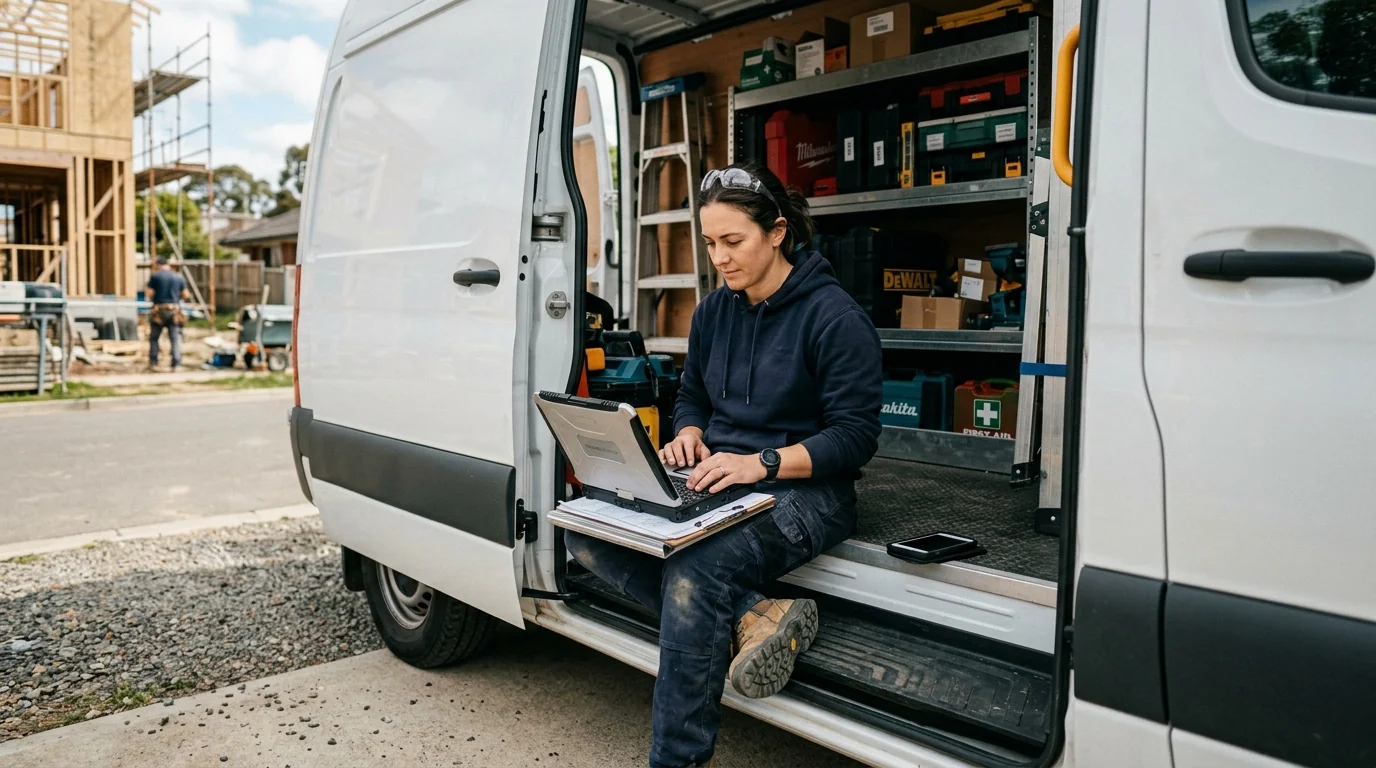
Your office is a service van, a route, and a phone. You set your own schedule (especially as an owner-operator), pick your service area, and can usually relocate cities or states without changing careers. For people who became tradespeople specifically to escape office life, this is the form of flexibility that actually fits.
Mobile Mechanic
Diagnoses and repairs vehicles at the customer’s location — driveway, parking lot, fleet yard. No shop overhead, no waiting room. Many run their own businesses after a few years working for a dealership or independent shop.
- Setup: Field-mobile. Customers come to you only in the sense that you go to them.
- Median pay: Automotive service technicians and mechanics earn a median of $49,670 (BLS, May 2024).
- Why it’s location-flexible: You choose your service radius. Switching cities means new customers, not a new career.
Mobile HVAC Service Technician
Residential service routes — diagnosing failed condensers, replacing capacitors, doing seasonal tune-ups. Different from new-construction HVAC install crews, which work fixed building sites. Service techs are dispatched and rarely see the same building twice.
- Setup: Field-mobile, dispatched daily from home or van.
- Median pay: $59,810 (BLS, May 2024).
- Why it’s location-flexible: Service work follows where people live. Move to Phoenix or Charlotte and your skill set transfers immediately.
RV and Marine Technician
Repairs recreational vehicles and boats — often at campgrounds, marinas, or storage lots. Some run fully mobile businesses driving to customer storage sites.
- Setup: Field-mobile, often seasonal flexibility.
- Why it’s location-flexible: Demand follows tourism and retirement geography. Many techs work the snowbird circuit — Florida winters, northern summers.
Residential Service Plumber (Owner-Operator)
Once you have your license, residential service plumbing is one of the most genuinely portable trades. You pick the territory, you set the hours, and you can run a one-truck operation indefinitely.
- Setup: Field-mobile.
- Median pay: Plumbers, pipefitters, and steamfitters earn a median of $63,420 (BLS).
- Why it’s location-flexible: License is state-by-state, but demand is universal and you control your route.
If you want to push mobile flexibility further into self-employment, our guide on starting your own trade business covers the licensing, insurance, and customer-acquisition basics.
Category 2: Hybrid Trade Roles (Office + Site)
These are jobs that combine a desk component — quoting, scheduling, planning, reviewing — with a field component. Often 30–50 percent of the workweek is at a laptop, frequently from home. The other half is on job sites, with customers, or in a vehicle.
This is the closest most people in the trades get to a partially-remote job. It is also the natural promotion path for experienced field tradespeople: when your knees and shoulders start filing complaints, hybrid roles let you stay in the trade while doing more of the work from a chair.
Construction Cost Estimator
Estimators analyze blueprints, calculate material and labor costs, and prepare bids. The deliverable is a spreadsheet, not a wall. Many estimators work a hybrid schedule — site walks early in the week, bid preparation from home or office mid-to-late week.
- Setup: Hybrid. Frequently 60–70 percent desk, 30–40 percent field.
- Median pay: $77,070 (BLS, May 2024).
- Path in: Most estimators come from the field — five to ten years as a journeyman, then estimating school or on-the-job promotion.
Construction Project Manager
Coordinates schedules, subcontractors, budgets, and inspections. Site visits during active phases, office or home days during planning and closeout. Industry guides describe a typical rhythm of roughly 30–40 percent office planning and 60–70 percent site execution.
- Setup: Hybrid, weighted to field during builds and office during pre-construction.
- Median pay: Construction managers earned a median of $106,980 (BLS, May 2024).
- Why it suits people transitioning out of full field work: Decades of trade knowledge become more valuable, not less, when you stop swinging the hammer.
Construction and Building Inspector
Inspectors examine buildings for code compliance. Field-heavy, but report writing, plan review, and code research are routinely done from home or office. Inspectors who work for municipalities sometimes have flexible “field days plus a home-office paperwork day” arrangements.
- Setup: Hybrid. Mostly field, with meaningful office/home time.
- Median pay: $72,120 (BLS, May 2024).
- Why it’s a good late-career fit: Low physical demand, schedule flexibility, and the same trade knowledge you already have.
Service Dispatcher and Trade Office Manager
Less glamorous but worth naming. Every HVAC, plumbing, electrical, and roofing company needs people who answer phones, route trucks, schedule installs, and chase invoices. Many of these jobs are fully remote or hybrid post-COVID. Salaries are lower (typically $40,000–$60,000), but the path in is short and the location flexibility is real.
For more on lower-physical-demand trade roles generally, see our guide on trade careers without heavy physical labor.
Category 3: Truly Remote Trade-Adjacent Roles
These are the rare birds: jobs where someone with trade training and experience genuinely works from home most or all of the time. None of them are common entry points — most are second acts five to ten years past the toolbox — but they exist.
CAD Drafter and BIM Modeler
Drafters produce technical drawings for buildings, mechanical systems, and electrical layouts. The job is software-driven (AutoCAD, Revit, SolidWorks) and a growing share of drafting roles are advertised as remote or hybrid. Tradespeople with strong spatial reasoning who picked up CAD often transition into this work.
- Setup: Truly remote in many roles, hybrid in others.
- Median pay: $65,380 for drafters (BLS, May 2024).
- Caveats: BLS projects little or no overall employment growth, with about 16,200 openings per year. CAD and BIM tools are also reducing the role to fewer, more skilled workers. Competitive, but not closed.
Virtual / Remote Energy Auditor
Energy auditors inspect buildings to identify efficiency losses and recommend improvements. The traditional version is field-based — walking attics with thermal cameras. A growing virtual variant runs remote: utility company desk auditors review homeowner-submitted photos, smart-meter data, and utility bills, then generate reports and recommendations from home.
- Setup: Field-only, hybrid, or truly remote depending on employer.
- Pay: BPI-certified remote energy auditors earned about $24 per hour on average in 2026 per ZipRecruiter aggregated postings, with senior consultants and self-employed auditors with strong credentials reaching well over $80,000.
- Path in: Building Performance Institute (BPI) certification, Residential Energy Services Network (RESNET) HERS Rater certification, or related state-level credentialing.
Online Trade Instructor
Community colleges, online career schools, and training platforms hire experienced tradespeople to develop and teach virtual coursework — code review, exam prep, business operations for self-employed tradespeople, soft-skill modules. Usually requires 10+ years of field experience plus a teaching credential or strong portfolio.
- Setup: Truly remote, with occasional in-person workshops.
- Pay: Highly variable — $50–$150 per hour for adjunct instruction; full-time online instructor salaries in the $55,000–$85,000 range.
- Path in: Master journeyman license or equivalent credential, plus teaching experience or curriculum development experience.
Technical Writer for Trade Publications and Manufacturers
Manufacturers of HVAC equipment, electrical components, plumbing fixtures, and construction machinery need writers who understand the trades to produce installation manuals, service bulletins, training content, and marketing copy. Trade publications and how-to platforms hire similar writers. Strong fit for tradespeople who can write clearly.
- Setup: Truly remote, with occasional manufacturer site visits.
- Pay: Technical writers earned a median of $80,050 (BLS, May 2024).
- Path in: Trade background plus writing samples; many enter through manufacturer service-training departments first.
Comparison Table: Trades by Remote-Friendliness
The table below summarizes the practical picture. Telework percentages reflect the broader BLS occupational group the role falls under, since the BLS does not publish telework rates for every individual trade.
| Trade / Role | % Telework-Eligible | Typical Setup | Median Salary (BLS, May 2024) | Key Remote-Enabling Skill |
|---|---|---|---|---|
| Mobile Mechanic | ~3% | Mobile field, no fixed office | $49,670 | Route management and customer scheduling apps |
| Mobile HVAC Service Tech | ~3% | Mobile field, dispatched daily | $59,810 | Diagnostic software, dispatch apps |
| Residential Service Plumber (Owner-Op) | ~3% | Mobile field, self-routed | $63,420 | Business operations, mobile invoicing |
| RV / Marine Technician | ~3% | Mobile field, seasonal flex | $49,670 (auto baseline) | Geographic mobility, specialty diagnostics |
| Building Inspector | ~10–15% | Hybrid (field + home reports) | $72,120 | Code knowledge, digital report writing |
| Cost Estimator | ~25–40% | Hybrid (office + site walks) | $77,070 | Estimating software (PlanSwift, Bluebeam, ProEst) |
| Construction Project Manager | ~20–30% | Hybrid (planning + execution) | $106,980 | Project management software, communication |
| Service Dispatcher / Office Manager | 40–70% | Hybrid or fully remote | ~$45,000–$60,000 | CRM/dispatch software, scheduling |
| CAD Drafter / BIM Modeler | 50–80% | Mostly remote | $65,380 | AutoCAD, Revit, SolidWorks |
| Virtual Energy Auditor | 60–90% | Mostly remote | ~$50,000 typical | BPI/RESNET credentials, data interpretation |
| Technical Writer (Trade) | 70–90% | Mostly remote | $80,050 | Technical writing, trade subject expertise |
| Online Trade Instructor | 80–100% | Fully remote (with workshops) | $55,000–$85,000 | Teaching, curriculum development |
The pattern is clear: the more your value depends on physical presence in a specific place, the lower your telework eligibility. The more your value depends on knowledge, software, or written deliverables, the higher.
What “Remote-Friendly” Actually Means in Skilled Trades
For most people who land on this guide, the practical translation is something like:
- You can live where you want — because your trade is mobile and licensed in multiple states.
- You control your own schedule — because you own the truck and the customer relationships.
- You can work from home some days — because your role includes quoting, planning, dispatching, or report writing alongside the field component.
- You can rotate out of the field eventually — because hybrid and remote trade-adjacent roles exist for experienced tradespeople.
What it almost never means in the trades is “I never leave my house.” Even drafters and online instructors usually have occasional site visits or in-person workshops. The roles closest to pure WFH — virtual energy auditing for a utility, technical writing for a manufacturer — typically require years of field credibility before they hire you.
If your real goal is pure work-from-home, the trades are not the cleanest path. Software, customer support, accounting, and digital marketing are. But if you want a hands-on career with portable income, geographic mobility, and the option to age into a hybrid or remote role later, the trades are one of the most flexible mid-skill paths available.
For tradespeople who want to add the digital and software skills that unlock hybrid and remote work, our guide on digital tools and apps for trade professionals is a good starting point.
How to Plan a Remote-Friendly Trade Path
The honest advice depends on where you are.
If you’re choosing a first trade: Pick mobile-friendly fieldwork — HVAC service, residential electrical, residential plumbing, mobile mechanic. Build five years of solid technical and customer skills. The flexibility comes later, but the technical foundation has to come first. Field experience is the credential that opens every hybrid and remote door downstream.
If you’re three to ten years into a trade and want more flexibility: Start building the second skill set. Estimating software, project management tools, CAD or BIM, BPI/RESNET certifications, technical writing samples. The transition into hybrid roles usually happens through internal promotion at a contractor — they need a field-credible estimator or PM, and you become it.
If you’re a mid-career professional changing industries into the trades: Be realistic about the timeline. The remote-friendly version of a trade career is rarely available on day one. Plan for three to five years of full field work first, then leverage prior office-job skills (project management, finance, technical writing, training development) to move into a hybrid role faster than someone coming straight from the field. Our guide on switching trades mid-career walks through the practical mechanics.
If you’re already in a trade and your body is asking for a change: The hybrid roles in the table above — estimator, PM, inspector — exist precisely for you. Add the software and credential layer, and you can stay in the trade for another 15–20 years without doing the heaviest physical work.
A Word on OSHA and Remote Work
One question that comes up: can a trade contractor legally have a remote office, or does OSHA require a physical location?
The short answer: OSHA’s home-based worksites policy (CPL 2-0.125) clarified that the agency does not conduct inspections of home offices. Where employees do clerical, professional, or administrative work from home, OSHA’s home-office policy applies and the agency will not hold employers liable for those settings. Field worksites — actual job sites, customer homes, commercial buildings — remain fully subject to OSHA standards. So a mobile contractor can absolutely run the business portion from home; the field work follows the normal OSHA rules wherever it happens.
This matters mostly for self-employed tradespeople and small contractors wondering whether they need a leased office. Generally, they do not — at least not for OSHA compliance.
Tools on This Site That Can Help
Find Your Trade — Two-minute career-matching quiz. If location flexibility matters to you, weight your answers toward mobility, customer service, and independent work.
Programs Directory — Browse accredited trade programs by specialty. The mobile-friendly trades (HVAC service, residential electrical, plumbing, automotive) are well-represented in community college certificate programs.
Careers Explorer — Each career page includes BLS wage and employment data, plus O*NET work-context details that hint at field-versus-office balance.
Sources
- U.S. Bureau of Labor Statistics — Telework rates increased over the year at all levels of educational attainment, first quarter 2024 — 2025
- U.S. Bureau of Labor Statistics — Telework Trends, Beyond the Numbers Volume 14 — telework rates by occupation group
- U.S. Bureau of Labor Statistics — CPS Telework data and highlights
- U.S. Bureau of Labor Statistics — Drafters, Occupational Outlook Handbook — May 2024 wage data
- U.S. Bureau of Labor Statistics — Cost Estimators, Occupational Outlook Handbook — May 2024 wage data
- U.S. Bureau of Labor Statistics — Construction Managers, Occupational Outlook Handbook — May 2024 wage data
- U.S. Bureau of Labor Statistics — Construction and Building Inspectors — May 2024 wage data
- U.S. Bureau of Labor Statistics — HVAC Mechanics and Installers — May 2024 wage data
- U.S. Bureau of Labor Statistics — Plumbers, Pipefitters, and Steamfitters — May 2024 wage data
- U.S. Bureau of Labor Statistics — Technical Writers — May 2024 wage data
- OSHA — Home-Based Worksites Policy, CPL 2-0.125
- NAHB Eye on Housing — Who’s Still Working from Home in 2025: A Look at America’s Telework Trends — December 2025