
A data-driven guide for anyone considering a skilled-trade career around the world’s largest concentration of data centers.
TL;DR: Virginia is the global capital of data center infrastructure. A March 2026 Northern Virginia Technology Council report finds data centers drive $40 billion in total statewide economic impact, support 112,000 Virginia jobs, and generate $1.5 billion in annual state tax revenue (NVTC). The Joint Legislative Audit and Review Commission (JLARC) put the labor footprint at 74,000 jobs — 59,000 construction + 15,000 operations — heavily concentrated in Loudoun, Prince William, and Fairfax counties (JLARC, December 2024). Dominion Energy’s 2025 long-range plan now forecasts 9 GW of peak data-center demand within 10 years, with contracted capacity up 185% since July 2023 (Virginia Mercury). For trade workers, this is the biggest single-region construction and operations story in the country right now.
The scale — what Virginia actually hosts
When people say “the cloud,” a huge portion of what they mean lives in a single set of ZIP codes in Northern Virginia. Loudoun, Prince William, and Fairfax counties together host roughly 80% of Virginia’s data center industry by sites, building square footage, and estimated energy usage (JLARC, December 2024). Loudoun County alone accounts for about half of the state’s data-center footprint and generated $733 million in data-center taxes in fiscal year 2023 — roughly 31% of total county tax revenue.
Those numbers translate to real headcount on the ground. According to the March 2026 NVTC report prepared by Mangum Economics:
- $40 billion in total annual economic impact statewide
- 112,000 Virginia jobs supported
- $1.5 billion in annual state tax revenue
- ~$1.3 billion in Northern Virginia property taxes even net of incentives
- 6 major new manufacturing suppliers announced Virginia investments since 2024, adding 1,000+ additional jobs (NVTC 2024 Data Center Report PDF)
JLARC’s earlier December 2024 state study broke the employment out by phase. Construction supports 59,000 jobs with $4.3 billion in labor income; operations support 15,000 jobs with $1.2 billion in labor income — smaller headcount, but higher per-worker earnings and longer-term stability.
The industry is also spreading. Since 2024, data center development has moved down Interstate 95 into Stafford, Spotsylvania, Caroline, and Richmond-area counties, and at least six regions outside Northern Virginia have active proposals (Virginia Business). If you don’t want to commute inside the Beltway, the industry is coming to you.
What the buildout actually needs — five trades in highest demand
Data center buildings are not ordinary warehouses. They are precision-engineered facilities with redundant high-voltage power, tight humidity and temperature control, optical-fiber backbones that must survive decades, and 24/7 critical-systems monitoring. That creates unusually heavy demand for five specific trades.
1. Electricians (construction and critical-facility)
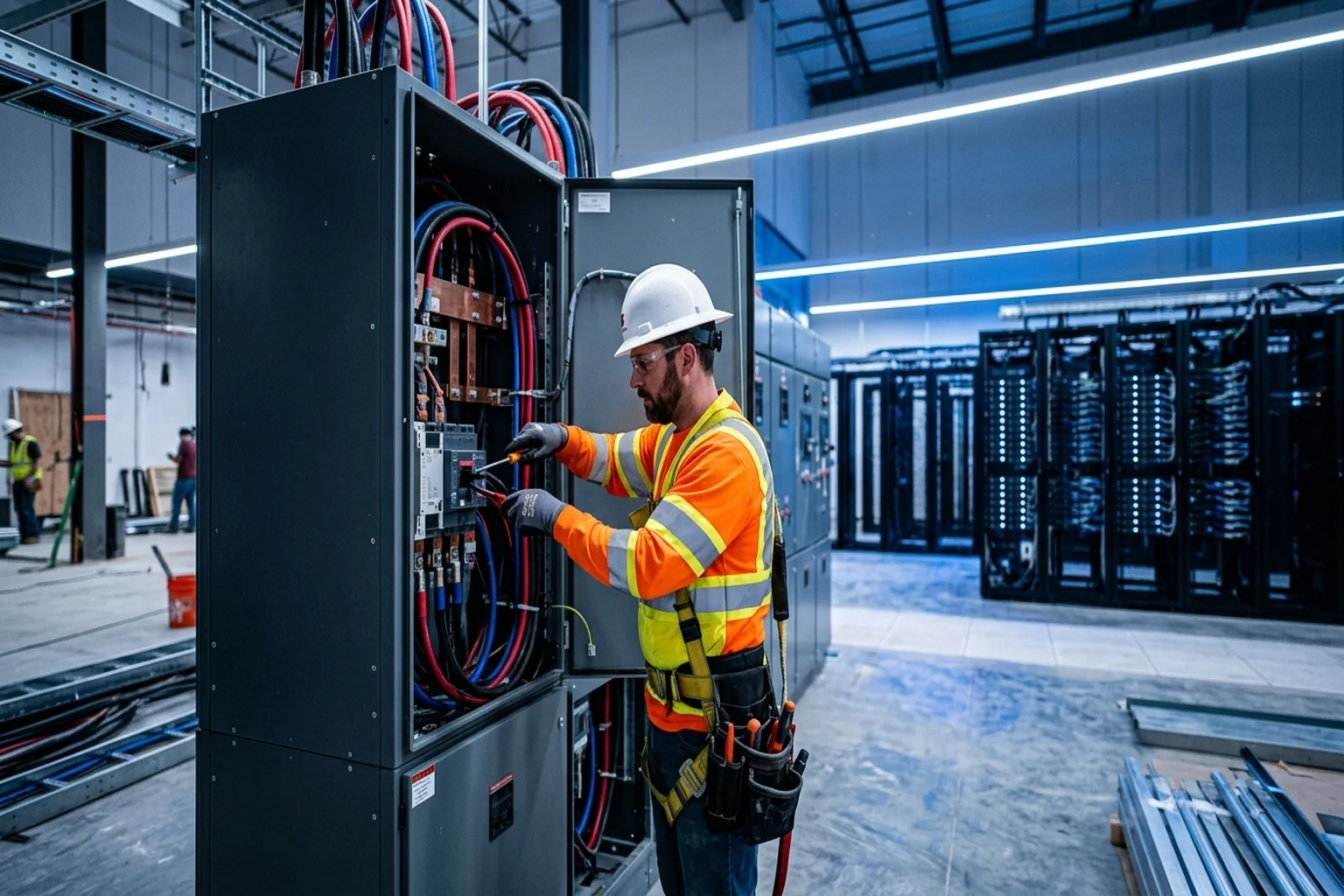
Electrical work is the single largest trade footprint in a data-center build. A single hyperscale campus can involve multiple megawatts of gear — transformers, UPS systems, switchgear, PDUs (power distribution units), bus ways, and emergency generator interlocks. Once operational, the buildings need on-staff critical facility electricians for 24/7 reliability.
Nationally, the May 2024 OEWS pegs the electrician median annual wage at $62,350 (BLS). Northern Virginia pays well above that because of prevailing-wage data-center projects and the tight IBEW Local 26 / Local 70 labor market. Electrician apprentices on data center sites can earn around $26 per hour during training, rising to roughly $106,000 per year after completion of a five-year apprenticeship, per reporting from the Loudoun data-center community (InsideNova).
See our electricians career profile for the full BLS picture.
2. HVAC / mechanical technicians
A 50 MW data hall rejects the heat of a small town. Chilled-water plants, computer-room air handlers, cooling towers, variable-frequency drives, and increasingly liquid-cooled server racks all need installation, commissioning, and preventive maintenance. The HVAC footprint per facility is huge, and the work is a natural fit for techs who want precision-mechanical work in conditioned environments rather than rooftop residential service.
National May 2024 OEWS median for Heating, Air Conditioning, and Refrigeration Mechanics and Installers is $59,810 (BLS). Data-center HVAC specialists typically earn a premium over residential service. See the HVAC mechanics career profile for career-wide data.
3. Fiber optic technicians
Every server inside a data hall is connected to at least one fiber optic cable; every campus is cross-connected by hundreds of thousands of fiber strands. Installers and splicers pull, terminate, and test fiber — often in cramped overhead trays or vertical risers — and test with OTDR equipment. Fiber work is growing fastest in the geographic ring around data-center campuses where long-haul routes terminate.
Our Fiber Optic Broadband Technician career guide covers training paths and wage ranges in more detail.
4. Controls and Building Management System (BMS) technicians
BMS technicians program and maintain the software-hardware stack that runs cooling plants, alarms, leak detection, and power distribution. This work sits at the intersection of HVAC, electrical, and IT. For trade students interested in low-voltage instrumentation or PLC programming, it is one of the most future-proof niches in data-center operations.
Related reading: Smart Home & Building Automation Careers.
5. High-voltage line workers and substation technicians
Less obvious, but huge in this market: the electrical grid that feeds the data centers. Dominion Energy is scaling transmission and substation capacity aggressively — which means line construction crews, substation electricians, and transmission-line technicians are in demand across the state. See the electrical power-line installers profile for specific numbers.
The power-grid backstory — why this is a decade-long story
Understanding the grid story is how you judge whether this boom has legs. Short version: it does.
Dominion Energy filed its 2025 Integrated Resource Plan (IRP) in October 2025 reflecting the full scale of contracted data-center demand. Three numbers matter:
- Total contracted data-center capacity: 47.2 GW — more than all of Virginia’s current electricity demand (Virginia Mercury, October 2025).
- Growth rate: Between July 2023 and July 2025, contracted capacity grew 185%.
- Peak demand in 10 years: 9 GW from data centers alone, pushing total system peak up ~25%.
To meet that load, Dominion’s plan leans on carbon-free generation — 12 GW of new solar, 3.4 GW of new offshore wind, 4.5 GW of new battery storage, plus a planned pivot toward small modular nuclear reactors (SMRs) starting in the mid-2030s (Data Center Dynamics). The practical consequence for trade workers is years of continuous transmission construction, substation buildouts, solar-plant installation, and battery-storage commissioning across the state — not just in the NoVa triangle.
Rate disputes are ongoing, and costs of the buildout are a matter of active policy debate. For students choosing a career, the relevant point is that regardless of who pays the bill, the infrastructure must be physically built — and the skilled labor demand is locked in for the next decade.
Training pipelines in Virginia — where to actually start
You don’t need to live in Leesburg to break into this market, but proximity helps. The strongest training routes:
Northern Virginia Community College (NOVA) + AWS partnership
NOVA has the deepest formal data-center training pipeline in the state. Its Information and Engineering Technologies programs cover data center operations, networking, and electrical technology — reinforced since 2023 by a $300,000 contribution from Amazon Web Services to NOVA’s Educational Foundation (InsideNova). AWS, Microsoft, Google, and Meta recruit directly from NOVA’s short-cycle programs.
IBEW electrical apprenticeships
The International Brotherhood of Electrical Workers Local 26 (covering the DC / NoVa region) and Local 70 (central Virginia) run five-year registered apprenticeships. Applicants work on real job sites from day one and take classroom training nights and weekends. Starting pay is typically 40-50% of journeyman rate and steps up each year. Non-union alternatives exist through ABC Virginia (Associated Builders and Contractors) and independent shops.
HVAC, fiber, and BMS programs at community colleges
- Tidewater Community College (TCC) — HVAC and electrical programs in Hampton Roads, aligned with the growing Richmond and Stafford data-center expansion
- Germanna Community College — HVAC and electrical programs in the Fredericksburg / Stafford corridor where I-95 data centers are being built
- J. Sargeant Reynolds Community College (Richmond) — mechatronics and industrial electricity
- Laurel Ridge Community College — electrical and HVAC in the Winchester / Shenandoah Valley corridor
For the full school list, see trade schools in Virginia and browse the top cities for trade education guide for regional context.
Veterans
Virginia’s military population makes it one of the easiest states in the country to transition from service to a skilled trade. The GI Bill covers most apprenticeship-adjacent training; several data-center employers run veteran-specific recruitment pipelines. See our Veterans GI Bill guide.
What to realistically expect — pay, housing, and the Stafford question
Northern Virginia wages for data-center-adjacent trades are strong, but the region’s cost of living is also among the highest in the country. Three realistic expectations:
- Wages. Electrician apprentices start around $26/hr on data-center sites; journeymen typically earn $45-60/hr depending on union, shift, and overtime; senior critical-facility electricians and controls specialists working 24/7 operations can clear $120,000+ with overtime. HVAC techs follow a similar curve, with the ceiling slightly lower.
- Housing. Loudoun County median home prices exceed $700,000 as of 2025. Many trade workers commute from Manassas, Winchester, Warrenton, Fredericksburg, or across the West Virginia line. Factor commute time and cost into any offer.
- The Stafford effect. The data-center expansion moving down I-95 into Stafford, Spotsylvania, and Caroline County means lower housing costs, shorter commutes, and a still-rising-wages opportunity for trades willing to work in those corridors. Stafford County in particular is the highest-growth data-center market outside Loudoun.
For a cross-state comparison of wage opportunity, see our highest-paying trade jobs by state guide.
How to get in — four concrete steps
- Pick a trade lane. Electrical has the highest absolute demand; HVAC has the largest long-tail operations opportunity; fiber is the fastest-growing specialist niche. Review each career profile on this site before committing.
- Enroll in a community-college program or registered apprenticeship. NOVA, TCC, Germanna, J. Sargeant Reynolds, and Laurel Ridge all have strong, well-priced paths. IBEW and ABC apprenticeships let you earn while learning from day one.
- Target data-center employers directly. AWS (through its Apprenticeship Program and NOVA partnership), Microsoft, Meta, Google, Equinix, and Digital Realty all hire on-site critical-facility staff. Construction-side work is most often through GCs like Turner, Holder, HITT Contracting, DPR, and Clune. IBEW signatory electrical contractors cover a large share of the union work.
- Use the trade colleges in Virginia directory to identify the closest-fit program, and see our apprenticeships explained and how to evaluate a trade school guides before applying.
The honest caveats
Three things worth naming:
- Policy and rate-class risk. The Virginia SCC, Dominion, and the state legislature are actively debating how data-center costs are allocated. Rate-class rulings and tax-treatment changes could marginally slow new-campus siting — but none of the serious proposals would stop the work that is already contracted.
- Automation inside the buildings. Data-center operators are deploying AI-driven monitoring and robotics for routine inspection tasks. This affects the ratio of ops-to-building, not the absolute need for skilled trades on commissioning, retrofit, and high-voltage work.
- Pace matters. The 9 GW peak forecast is a 10-year trajectory. Individual projects slip. Budget your career plan for a decade of opportunity rather than betting on any single campus.
Sources
- Northern Virginia Technology Council — “Virginia Data Centers Drive $40 Billion in Statewide Economic Impact” — March 2026 — https://www.nvtc.org/press-releases/new-nvtc-report-virginia-data-centers-drive-40-billion-in-statewide-economic-impact/
- NVTC / Mangum Economics — The Impact of Data Centers on Virginia’s State and Local Economies (2024 report PDF) — https://loudounpossible.com/wp-content/uploads/2025/05/2024-NVTC-Data-Center-Report.pdf
- Virginia JLARC — Data Centers in Virginia — December 2024 — https://jlarc.virginia.gov/pdfs/reports/Rpt598-2.pdf
- Prince William County — JLARC Report Summary — December 2024 — https://www.pwcva.gov/assets/2024-12/JLARC%20Report%20Summary_12-16-2024.pdf
- Virginia Mercury — “Dominion long-range projections show major energy growth” — October 2025 — https://virginiamercury.com/2025/10/22/dominion-long-range-projections-show-major-energy-growth-what-it-takes-to-fully-comply-with-vcea/
- Data Center Dynamics — “Dominion Energy outlines long-term strategy for Virginia’s power infrastructure” — https://www.datacenterdynamics.com/en/news/dominion-energy-outlines-long-term-strategy-for-virginia-power-infrastructure/
- InsideNova — “Pathways to promising data center careers” — https://www.insidenova.com/news/business/pathways-to-promising-data-center-careers/article_93f6eb0a-8497-11ee-88aa-ab8a4b8b1a3c.html
- Virginia Business — “NoVa data center development moves down I-95” — 2025 — https://virginiabusiness.com/stafford-data-center-growth-i95-2025/
- U.S. Bureau of Labor Statistics — Electricians Occupational Outlook — https://www.bls.gov/ooh/construction-and-extraction/electricians.htm
- U.S. Bureau of Labor Statistics — Heating, Air Conditioning, and Refrigeration Mechanics — https://www.bls.gov/ooh/installation-maintenance-and-repair/heating-air-conditioning-and-refrigeration-mechanics-and-installers.htm
- Virginia Works — Occupational Employment and Wage Statistics — https://virginiaworks.gov/oews/