
In 2023, CEDIA reported that a newly trained smart home installation technician earned an average of $22.10 per hour. One year later, that number jumped to $29.33 for technicians with just two years of experience — a 10% annual increase that outpaced nearly every other trade category. Behind those numbers is a U.S. professional smart home installation market that CEDIA estimates at nearly $30 billion, served by roughly 20,000 integrators who can’t hire fast enough.
This isn’t a niche anymore. It’s a full-blown trade career with defined training paths, industry certifications, and salary trajectories that rival — and in some specializations exceed — traditional electrical and HVAC work.
TL;DR
- Growing market: The U.S. professional smart home industry is valued at nearly $30 billion, with CEDIA projecting 30% average growth across categories. Source: CEDIA Market Research.
- Solid pay range: Smart home technicians earn $55,000–$70,000 on average, while building automation systems technicians average $83,619. Sources: ZipRecruiter, PayScale.
- Certification pays off: CEDIA-certified technicians earn roughly 15% more ($7,789/year) than non-certified peers. Source: CEDIA.
- Related trades are booming: Electricians (9% growth, $62,350 median) and HVAC techs (8% growth) are projected to grow much faster than average through 2034, and smart home expertise is becoming a premium add-on for both. Source: BLS.
- Multiple entry points: CEDIA certifications (CIT, IST), manufacturer training (Crestron, Control4, Lutron), trade school programs in electrical or networking, or apprenticeships through the electrical trades.
- Heads up: This field moves fast. Expect to invest in ongoing training as platforms, protocols, and standards evolve. The learning never stops — but neither does the demand.
What Smart Home and Building Automation Technicians Actually Do
The job title covers two related but distinct career tracks, and understanding the difference matters for choosing your training path.
Residential Smart Home Technicians
These technicians design, install, configure, and maintain integrated technology systems in homes. The work includes:
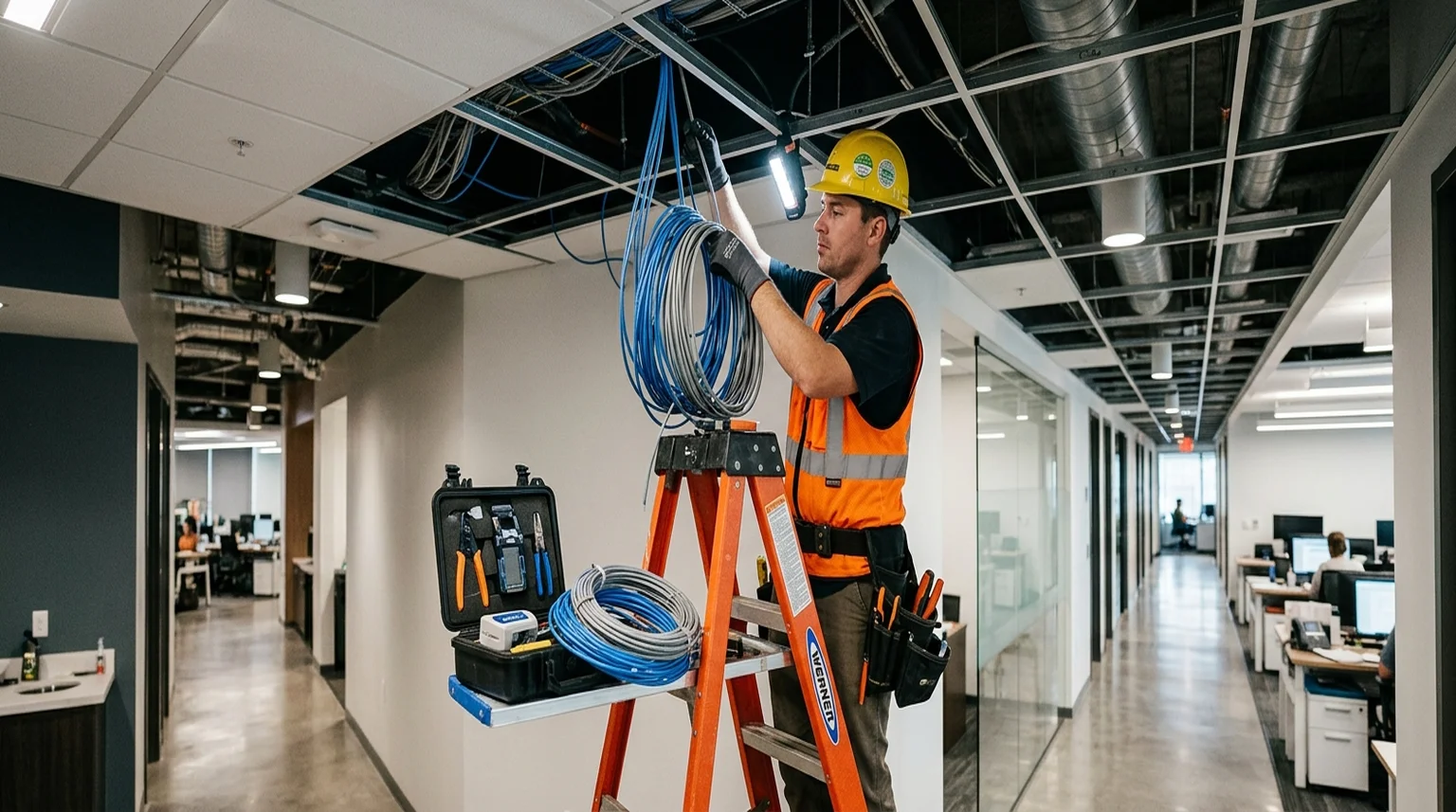
- Structured wiring and cabling — running Cat6/fiber, HDMI, speaker wire, and low-voltage cabling through walls and ceilings
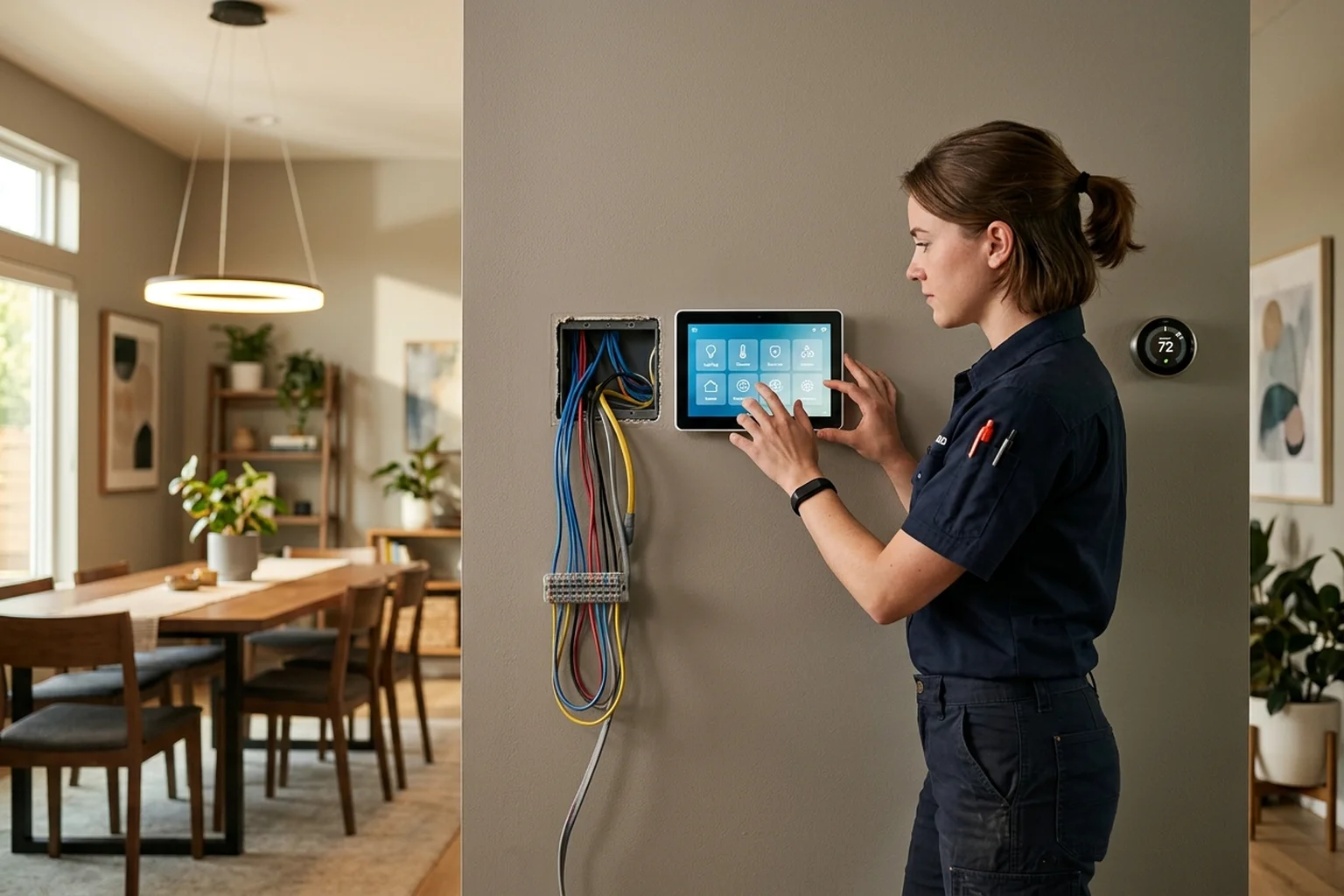
- Control system programming — configuring platforms like Control4, Crestron, Savant, or Lutron to manage lighting, shades, audio, climate, and security from a single interface
- Networking — setting up the Wi-Fi, switches, and access points that hold everything together (weak networking is the number-one cause of smart home failures)
- Audio/video integration — distributed audio, home theaters, outdoor entertainment systems
- Security and surveillance — cameras, access control, alarm integration
- Troubleshooting — diagnosing why the homeowner’s lights won’t respond at 2 a.m. (often a network issue, not a lighting issue)
The median integration firm completes about 30 projects per year with five employees, generating roughly $900,000 in annual residential revenue, according to CEDIA’s market analysis.
Commercial Building Automation Technicians
On the commercial side, Building Automation Systems (BAS) technicians work with larger-scale control systems in offices, hospitals, schools, and industrial facilities. The focus shifts to:
- HVAC controls — programming and maintaining systems that regulate temperature, humidity, and air quality across entire buildings
- Energy management — monitoring and optimizing building energy consumption, a growing priority as energy costs rise and sustainability regulations tighten
- Lighting control systems — occupancy-based and daylight-harvesting systems that reduce energy waste
- Fire and life safety integration — ensuring alarm and suppression systems communicate correctly with building management platforms
- BAS platforms — working with systems like Tridium Niagara, Johnson Controls, Honeywell, or Siemens to integrate multiple building subsystems
Commercial BAS technicians tend to earn more than residential installers — PayScale reports an average of $83,619 — reflecting the technical complexity and the stakes involved when a hospital’s HVAC or fire system goes down.
Salary and Earning Potential
Let’s look at the numbers across the spectrum of this career field.
Smart Home Technicians (Residential)
| Experience Level | Average Hourly | Approximate Annual |
|---|---|---|
| Entry-level / newly trained | $22.10 | ~$46,000 |
| 2+ years experience | $29.33 | ~$61,000 |
| Systems designer | — | $74,068 |
| Programmer | — | $71,431 |
| Project manager | — | $77,727 |
| Business owner | — | $120,265 |
Source: CEDIA 2023 Smart Home Salary and Wage Report
Building Automation Technicians (Commercial)
| Experience Level | Approximate Annual |
|---|---|
| Entry-level (0–2 years) | $55,000–$62,000 |
| Intermediate (2–4 years) | $65,700 |
| Senior (4–7 years) | $77,200 |
| Supervisory (7+ years) | $90,800 |
Sources: PayScale, Glassdoor, TriSearch
What Pushes Pay Higher
- Certifications — CEDIA certification adds an average of $7,789 per year (15.1% premium). Building automation and energy-efficiency certifications can add $8,000–$12,000 in the commercial sector.
- Platform specialization — Crestron programmers consistently command higher rates than generalists, because the learning curve is steep and the clients are high-end.
- Geographic market — Major metro areas with active construction and affluent residential markets pay more. Think Bay Area, New York, Dallas, South Florida, and the D.C. corridor.
- Dual-trade skills — Technicians who combine smart home expertise with an electrician’s license or HVAC credentials can handle the complete scope of work, making them far more valuable to employers or as independent contractors.
Why This Field Is Growing
The Market Is Massive and Expanding
The U.S. smart home market was valued at $33.26 billion in 2025 and is projected to reach $99.40 billion by 2032, a compound annual growth rate of 16.9%. Smart home device penetration has already crossed the 50% mark in U.S. households and is projected to reach 68.6% by 2027, according to Statista.
But more devices in homes doesn’t automatically mean more jobs for technicians. Here’s what does:
Complexity Creates Demand for Professionals
The consumer can buy a smart speaker and a few bulbs from Amazon. What they can’t do is integrate a whole-home lighting control system with motorized shades, a multi-zone audio system, a security platform, and an HVAC interface — all running reliably on a properly designed network. That requires a professional, and that’s where the career opportunity lives.
CEDIA estimates that roughly 20,000 integrators currently serve the U.S. market, and industry surveys consistently show that hiring qualified technicians is their biggest challenge. The industry body predicted 30% average growth across smart home categories, yet the talent pipeline isn’t keeping up.
Related Trades Are Pulling in the Same Direction
The broader skilled trades labor market reinforces this trend. The BLS projects 9% growth for electricians and 8% for HVAC technicians from 2024 to 2034 — both “much faster than average.” As our coverage of how technology is changing the trades has documented, smart systems integration is increasingly baked into these traditional roles. An HVAC company that can also install and program smart thermostats and building controls has a competitive edge. An electrician who understands structured wiring and home networking picks up jobs that a wire-only electrician doesn’t.
Commercial Buildings Are Getting Smarter Too
Energy codes are tightening. Commercial buildings are adding occupancy sensors, automated lighting, and connected HVAC controls not because it’s trendy, but because regulations and energy costs demand it. The HVAC controls sector alone projects 6–8% salary growth in 2026 for skilled technicians, outpacing most industries.
Education and Training Paths
There’s no single path into this field, which is both a strength and a source of confusion. Here are the realistic options, ranked roughly by structure and depth.
1. Trade School or Community College Programs
The most direct starting point for many people. Programs in electrical technology or computer networking and telecommunications provide foundational knowledge that transfers directly to smart home and building automation work. Look for programs that cover:
- Low-voltage wiring and structured cabling
- Networking fundamentals (TCP/IP, Wi-Fi, VLANs)
- Electrical theory and NEC code basics
- Control systems and automation principles
These programs typically run 6 months to 2 years and result in a certificate or associate degree. They won’t make you a master integrator, but they give you a foundation that employers and certification programs build on. For guidance on evaluating programs, see our guide to choosing the right trade program.
2. CEDIA Certifications
CEDIA — the Custom Electronic Design and Installation Association — is the industry’s professional body, and their certifications are the closest thing to a standardized credential in the residential smart home space. The certification ladder includes:
- CIT (Cabling and Infrastructure Technician) — Entry-level. Validates that you can perform basic infrastructure wiring for low-voltage technology systems. This is where most people start.
- IST (Integrated Systems Technician) — Mid-level. Builds on CIT with broader home automation knowledge covering system configuration, troubleshooting, and client interaction.
- RNS (Residential Networking Specialist) — Focused on the networking side, which is increasingly critical as every device in a smart home depends on a reliable network.
- ESC-D (Equipment and System Configuration Designer) — Advanced. For technicians moving into system design and specification.
Certifications are valid for three years and require continuing education to renew. CEDIA offers in-person training through programs like the Residential Bootcamp (a three-day hands-on intensive) and the newer CEDIA Connect regional education events launching across the U.S. in 2026.
3. Manufacturer Certifications
The major smart home platform vendors run their own training and certification programs:
- Crestron — The Crestron Technical Institute (CTI) offers tiered certifications for installers, programmers, and designers. Crestron is the highest-end platform, and certified programmers command premium rates. The learning curve is real — plan on significant time investment.
- Control4 — Offers dealer and technician certification through hands-on and online programs. Control4 is widely used in mid-to-upper-market residential projects and is generally considered more approachable than Crestron.
- Lutron — The Lighting Control Institute trains technicians on residential and commercial lighting and shade control systems. Lutron dominates the lighting control space, and their HomeWorks QS certification is the capstone for residential specialists.
- Networking vendors — Certifications from Ubiquiti, Ruckus, or Cisco (CCNA) are increasingly relevant, since a poorly designed network will sink even a perfectly wired smart home.
4. Electrical Apprenticeship + Smart Home Specialization
If you want maximum career flexibility, consider entering the electrical trade through a traditional apprenticeship and adding smart home / low-voltage specialization on top. Licensed electricians who also hold CEDIA or manufacturer certifications can handle both the high-voltage and low-voltage sides of a project — a combination that’s extremely marketable. The apprenticeship path takes 4–5 years, but you earn while you learn, and the journeyman license opens doors that smart home credentials alone don’t.
5. HVAC + Building Automation Controls
For the commercial building automation path, entering through HVAC training and then specializing in BAS controls is a well-worn career progression. Many BAS technicians start as HVAC mechanics and transition into controls work after gaining field experience. Platform-specific training from Johnson Controls, Honeywell, Siemens, or Tridium (Niagara Framework) adds the systems knowledge you’ll need.
What the Day-to-Day Looks Like
This isn’t a sit-at-a-desk career, but it’s also not the heavy physical labor of some trades. Here’s an honest picture.
Residential Smart Home Work
A typical week might include:
- Pre-wire day on a new construction site — running cable through studs and joists before drywall goes up, following a system design plan
- Trim-out on a house that’s nearly finished — mounting speakers, pulling cable terminations, installing keypads and touchscreens
- Programming session — sitting with a laptop configuring a Control4 or Crestron system, building scenes, testing integrations, setting up the homeowner’s app
- Service call — a client’s system isn’t responding properly. Troubleshooting often starts with the network, not the automation platform.
- Client walkthrough — training a homeowner on how to use their system. Good communication skills matter more than you’d think in this trade.
Commercial Building Automation Work
- Commissioning a new BAS installation — verifying that every sensor, actuator, and controller is communicating correctly
- Programming building schedules, setpoints, and alarm thresholds
- Preventive maintenance rounds — checking controller firmware, calibrating sensors, reviewing trend data
- Emergency response — a chiller control fault at a hospital doesn’t wait until Monday morning
- Energy optimization — analyzing building performance data and adjusting control sequences to reduce consumption
Physical and Technical Demands
You’ll work on ladders, in attics, and in equipment rooms. But the physical demands are generally lighter than electrical or HVAC field work. The harder challenge is intellectual — you need to understand networking, programming logic, and how multiple complex systems interact. Comfort with technology and a systematic troubleshooting approach matter more than brute strength.
Career Progression and Specializations
Entry Level to Expert
Installer / Technician (Years 0–2) — Cable pulling, equipment mounting, basic configuration under supervision. Earning $22–$26/hour.
Lead Technician (Years 2–5) — Running jobs independently, handling programming, managing client interactions. Earning $29–$35/hour.
Systems Designer / Programmer (Years 5–8) — Designing systems from architectural plans, advanced programming, project management. Salary: $70,000–$80,000.
Project Manager / Senior Designer (Years 8+) — Managing multiple projects, client relationships, mentoring junior techs. Salary: $78,000–$95,000.
Business Owner — Running your own integration firm. Average owner salary: $120,265 per CEDIA data, though this varies enormously with firm size and market.
High-Growth Specializations
- Networking specialist — As smart homes become more complex, the technician who can design and deploy enterprise-grade residential networks (with VLANs, QoS, and proper IoT segmentation) is increasingly the most valuable person on the team.
- Energy management and sustainability — Smart thermostats are table stakes. The real opportunity is in whole-building energy monitoring, solar/battery integration, and demand response systems.
- Commercial BAS controls — Aging building stock, tightening energy codes, and the push for net-zero buildings all drive demand for controls technicians who can modernize legacy systems.
- Voice and AI integration — Configuring natural language interfaces, predictive automation, and machine learning-driven energy optimization. This is the frontier.
Honest Trade-Offs
No career guide is worth much if it doesn’t acknowledge the downsides. Here are the real ones.
Technology churn is constant. Platforms evolve, products get discontinued, and yesterday’s integration method may not work tomorrow. You’ll need to budget time and money for ongoing training throughout your career. The certifications landscape changes too — staying current is non-negotiable.
Irregular schedules. Residential work often means evenings and weekends to accommodate homeowners’ schedules. Commercial BAS work can mean after-hours commissioning to avoid disrupting building occupants. Service calls don’t always come at convenient times.
Client expectations can be challenging. Homeowners who spent $50,000 on a smart home system expect it to work perfectly, all the time. Managing expectations and communicating clearly about what technology can and can’t do is a real skill that takes time to develop.
Licensing gaps. Unlike electricians or HVAC techs, there’s no universal state license for “smart home technician.” CEDIA certifications carry industry weight but aren’t legally required anywhere. Some jurisdictions require a low-voltage license; others don’t. This can make it harder to demonstrate credentials to clients who are used to asking “are you licensed?”
Starting pay is modest. At $22/hour entry-level, you’re earning less than first-year electrical or HVAC apprentices in many markets. The earnings trajectory is strong — but be realistic about the first couple of years.
Getting Started: A Practical Roadmap
-
Decide residential or commercial — this choice shapes your training path. Residential leans toward CEDIA certifications and manufacturer training. Commercial leans toward HVAC or electrical foundations plus BAS platform training.
-
Build your foundation — Enroll in an electrical technology or networking program at a trade school or community college. Even 6–12 months of structured education gives you a meaningful head start.
-
Get your entry-level certification — Pursue a CEDIA CIT certification or CompTIA Network+ to demonstrate baseline competence. These are achievable within your first year.
-
Find an employer or apprenticeship — Look for established integration firms (CEDIA member companies are a good starting point), electrical contractors with a smart home division, or BAS-focused HVAC companies. Hands-on experience under a skilled mentor is irreplaceable.
-
Stack certifications strategically — Add manufacturer certifications (Control4, Crestron, Lutron) as your experience grows. Each one broadens the range of projects you can handle and the premium you can charge.
-
Learn networking deeply — This is the advice that experienced integrators give most consistently to newcomers. Strong networking skills separate competent technicians from great ones.
-
Consider a dual credential — If you’re early in your career, the combination of an electrical or HVAC license with smart home specialization creates a skill set that very few people have and that the market values highly.
The smart home and building automation field sits at the intersection of the skilled trades and information technology — two sectors with strong demand and not enough workers. For prospective students who are comfortable with both a wire stripper and a command line, the career math is compelling: a growing market, rising wages, multiple entry points, and work that gets more interesting as buildings get smarter.
Sources
- CEDIA — U.S. Professional Smart Home Industry Nears $30 Billion — 2023 Market Analysis
- CEDIA — What Do Smart Home Professionals Earn? — 2023 Salary and Wage Report
- CEDIA — Smart Home Certification Programs
- Bureau of Labor Statistics — Electricians: Occupational Outlook Handbook — Accessed March 2026
- Bureau of Labor Statistics — HVAC Mechanics and Installers: Occupational Outlook Handbook — Accessed March 2026
- Bureau of Labor Statistics — Electrical and Electronics Installers and Repairers — Accessed March 2026
- Fortune Business Insights — U.S. Smart Home Market Growth & Statistics Report — 2025
- PayScale — Building Automation Systems Technician Salary — 2026
- ZipRecruiter — Smart Home Technician Salary — 2025
- Statista — Smart Home: United States Market Forecast — 2025
- TriSearch — The Complete Guide to HVAC Controls Technician Jobs — 2025