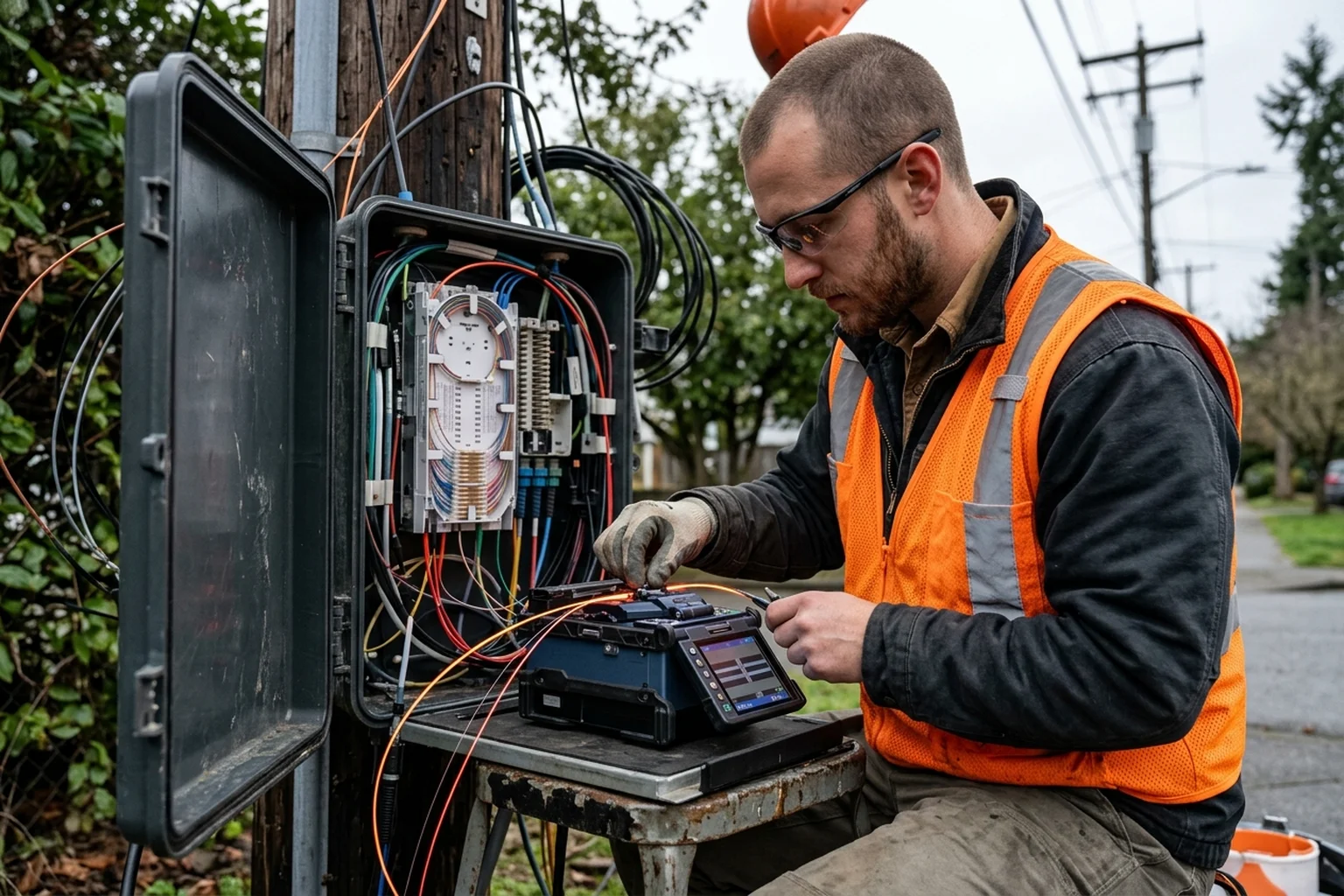

In rural Arizona, a crew of more than 40 workers is trenching through high desert to lay fiber optic cable to communities that have never had broadband. The directional drill operators on that job earn $25 to $45 an hour — nearly double the typical local wage — and the contractor still can’t hire fast enough. That scene is playing out across the country right now, in every state and territory, fueled by the largest federal investment in internet infrastructure in American history. The industry needs 178,000 workers it doesn’t have, and training programs can get you job-ready in weeks, not years.
TL;DR
- A massive workforce gap: The fiber broadband industry needs an estimated 178,000 workers through 2032 — 58,000 for new positions and 120,000 to replace retirees. Source: Fiber Broadband Association & PCCA Workforce Report (2024).
- Unprecedented federal spending: The $42.45 billion BEAD program is funding fiber deployment to every unserved and underserved community in all 56 U.S. states and territories. Source: NTIA BroadbandUSA.
- Solid pay: Fiber optic technicians earn an average of $57,818/year nationally, with experienced techs and specialists earning well above $70,000. Source: ZipRecruiter (March 2026).
- Fast entry: Unlike most trades, you can earn a Certified Fiber Optic Technician (CFOT) credential in as little as 3 to 5 days of intensive training, with costs typically between $650 and $2,000.
- Heads up: This is physically demanding outdoor work, often in trenches, on poles, or in cramped utility spaces. Weather doesn’t stop deadlines. But if you want a trade career where demand is outrunning supply by a wide margin, this is it.
Why This Field Is Exploding Right Now
Three forces are converging to create what may be the best labor market a new trade worker has seen in decades.
The BEAD Program: $42.5 Billion in Federal Broadband Funding
The Broadband Equity, Access, and Deployment (BEAD) program, funded by the Infrastructure Investment and Jobs Act, allocated $42.45 billion to connect every American to high-speed internet. All 56 states and territories received allocations, and by December 2025, NTIA had approved 29 final state deployment proposals, with more in the pipeline. This money is now flowing into construction contracts — and every one of those contracts needs workers who can handle fiber.
This isn’t a one-year burst. BEAD-funded projects will take years to build out, and the networks will need ongoing maintenance and expansion for decades after that. The Pew Charitable Trusts warned in October 2025 that worker shortages, misaligned training timelines, and inconsistent state data collection could slow the entire program — a clear signal that trained technicians have serious leverage.
Private Sector Investment Is Piling On
The federal money is only part of the story. The Fiber Broadband Association reported 11 percent growth in fiber deployment in 2025 alone, driven heavily by private sector investment. Telecom companies, utility cooperatives, and internet service providers are racing to build fiber networks in both rural and suburban markets — often ahead of BEAD funding — because fiber-to-the-home is now the competitive standard.
Data center expansion is adding fuel. Every new hyperscale data center needs high-capacity fiber connections, and the AI-driven data center construction boom is creating demand for fiber infrastructure that didn’t exist five years ago.
The Math on the Workforce Shortage
The numbers tell a clear story. A 2024 workforce report by the Fiber Broadband Association and the Power & Communication Contractors Association found:
- 58,000 new positions will be created between 2025 and 2032
- 120,000 current workers are expected to leave the field through retirement and attrition
- Combined gap: 178,000 workers
Separately, the FBA estimated the industry needs 28,000 more construction workers and 30,000 more broadband technicians immediately — just to execute current funded projects — with an additional 119,000 workers needed over the next decade to address ongoing attrition.
When an industry is short nearly 180,000 workers and has tens of billions in contracts to fulfill, wages rise and barriers to entry fall. That’s exactly what’s happening.
What Fiber Optic Technicians Actually Do
Fiber optic technicians install, splice, test, and maintain the glass fiber cables that carry internet, phone, and video signals as pulses of light. The work spans several environments and specializations.
Outside Plant (OSP) Technicians
This is where most of the current hiring is. OSP techs work outdoors — installing aerial fiber on utility poles, burying cable in trenches, pulling fiber through underground conduit, and building splice enclosures at junction points. The work is physical, weather-dependent, and often involves travel. You’ll use bucket trucks, trenchers, directional boring machines, and fusion splicers.
Premises / Inside Plant Technicians
These techs handle the “last mile” — running fiber from the street into homes and businesses, terminating cables at patch panels, installing optical network terminals (ONTs), and connecting customer equipment. This work is less physically extreme but requires attention to detail and good customer interaction skills.
Splicing Technicians
Fusion splicing — joining two glass fibers with a specialized machine that fuses them using an electric arc — is a core skill that commands premium pay. Experienced splicers can handle mid-span splices, ribbon fiber, and high-count cables (288 fibers or more). OTDR (Optical Time-Domain Reflectometer) testing and documentation are part of every splice job.
Testing and Troubleshooting
Fiber networks need systematic testing at every stage: end-to-end loss testing with an OLTS (Optical Loss Test Set), OTDR trace analysis to find faults, visual fault location, and power meter readings. Technicians who can diagnose and repair outages quickly are especially valuable to service providers who face customer SLA penalties for downtime.
Design and Engineering Support
With experience, some technicians move into network design roles — reading and creating fiber route maps, calculating loss budgets, specifying cable types, and coordinating with construction crews. This is where the career path connects to computer networking and telecommunications engineering.
Salary and Compensation
What the Data Shows
Fiber optic technician pay varies by experience, specialization, location, and employer type. Here are the benchmarks:
| Source | Metric | Amount |
|---|---|---|
| ZipRecruiter (March 2026) | National average | $57,818/year |
| BLS - Telecom Technicians (May 2024) | Median annual wage | $64,310 |
| Indeed (2026) | Average hourly rate | $26.46/hour |
| Glassdoor (2026) | Average total pay | $66,633/year |
The BLS figure of $64,310 for telecommunications technicians is the most reliable benchmark, representing the broader category that includes fiber optic work. The range is wide: entry-level techs may start in the low $40,000s, while experienced splicers, lead technicians, and those in high-cost markets earn $75,000 to $90,000+. Field reports from the current BEAD buildout indicate directional drill operators earning $25 to $45 per hour, which translates to $52,000-$93,600 annually before overtime.
What Affects Your Pay
- Specialization — Splicing technicians and OTDR testing specialists consistently out-earn general installation techs
- Location — States with aggressive broadband buildouts (Virginia, Texas, North Carolina, Arizona) and high cost-of-living metros pay more
- Employer type — Large telecom carriers (AT&T, Lumen, Frontier) and their prime contractors often pay better than subcontractors, with benefits included
- Overtime — Extremely common during buildout phases; many techs regularly work 50-60 hour weeks at time-and-a-half
- Travel willingness — Techs willing to travel to remote project sites can command per diem pay ($50-$150/day) on top of wages
- Certifications — CFOT and other FOA certifications typically add $2-5/hour over uncertified peers
Most full-time positions with established employers include health insurance, 401(k) or pension, vehicle allowance or company truck, tool budgets, and paid training.
Training and Certification
One of the biggest advantages of fiber optic work compared to other trades is the speed of entry. You don’t need a four-year apprenticeship or a two-year degree to start working — though both paths exist and can accelerate your career.
The CFOT: Your Entry Ticket
The Certified Fiber Optic Technician (CFOT) credential from the Fiber Optic Association (FOA) is the industry’s foundational certification. Two paths to earn it:
Training Route (fastest): Attend a 3-5 day intensive program at an FOA-approved school. The curriculum covers fiber optic applications, cable installation (premises and outside plant), splicing, termination, and testing. About 85% of the coursework is hands-on. Cost: typically $650 to $2,000 depending on the program and location.
Experience Route: If you have at least two years of documented field experience installing and testing fiber optic networks — including fusion splicing, multiple termination methods, and OTDR testing — you can sit for the exam directly.
The CFOT exam itself is 100 multiple-choice questions with a 70% passing threshold. It tests knowledge from the FOA Reference Guide covering technology, components, installation, and testing.
Beyond the CFOT
The FOA offers a progression of specialist certifications:
- CFOS/T — Certified Fiber Optic Specialist in Testing. Focused on OTDR analysis, loss testing, and documentation standards.
- CFOS/S — Certified Fiber Optic Specialist in Splicing. Covers fusion and mechanical splicing at advanced levels.
- CFOS/O — Certified Fiber Optic Specialist in Outside Plant. Focused on aerial, underground, and buried cable installation.
- CPCT — Certified Premises Cabling Technician. Adds copper and wireless infrastructure to your skill set — useful since many buildings still use a mix of fiber and copper.
Many training providers offer bootcamp formats that combine CFOT + CFOS/T + CFOS/S in a single five-day intensive. The New Mexico Department of Workforce Solutions, for example, offers exactly this kind of accelerated program.
BICSI Certifications
BICSI offers the Installer 2 Optical Fiber (INSTF) certification, which is well-regarded for premises cabling work. BICSI credentials tend to carry more weight with enterprise customers (hospitals, universities, corporate campuses) than with telecom carriers, so consider your target employer when choosing a certification path.
Community College and Trade School Programs
Many community colleges and technical schools now offer networking and telecommunications programs that include fiber optic training as part of a broader curriculum. These programs typically run 6 months to 2 years and may result in an associate degree or certificate. They’re a good choice if you want a broader foundation that covers copper cabling, networking fundamentals, and wireless along with fiber — or if you want financial aid eligibility.
For a deeper look at how trade certifications work across industries, see our guide to trade certifications and licenses.
Apprenticeships
Formal apprenticeship programs for fiber optic technicians are less established than in trades like electrical work, but they’re growing. Several states have registered fiber optic technician apprenticeship programs through the Department of Labor, combining paid on-the-job training with classroom instruction. The New Mexico fiber optic technician apprenticeship program is one model. If an employer offers an apprenticeship, it’s worth serious consideration — you earn while you learn. See our apprenticeships guide for what to expect from the apprenticeship model.
Career Paths and Advancement
Fiber optic work offers a clear progression from entry-level to senior technical and management roles.
Entry-Level Technician (Years 1-2) — You start as a helper or junior technician on a crew, learning cable handling, basic terminations, and tool operation under supervision. With a CFOT in hand, you can skip some of this ramp-up. Starting pay: $38,000-$48,000.
Technician / Splicer (Years 2-5) — You’re working independently or leading small crews, handling fusion splicing, OTDR testing, and customer installations. This is where most of the current demand is concentrated. Pay range: $50,000-$70,000.
Lead Technician / Crew Supervisor (Years 5-10) — Managing crews, coordinating with engineering, handling complex troubleshooting, and overseeing quality control. Pay range: $65,000-$85,000.
Senior / Specialist Roles (Years 7+) — Options include fiber network design, project management, estimating, training and instruction, and quality assurance. Some techs move into sales engineering, where deep technical knowledge combined with customer relationship skills can push total compensation above $100,000.
Business Owner — Experienced technicians with contractor licenses can start their own fiber installation businesses. With BEAD contracts flowing to small and mid-sized contractors, the timing is favorable for new entrants who can demonstrate quality work and meet bonding requirements.
The Honest Trade-Offs
This career has real advantages, but it’s not for everyone. Here’s what to weigh:
The Upside
- Speed of entry — You can be job-ready in a week of training with a CFOT
- Massive demand — 178,000-worker shortage means you have options and leverage
- Good pay for the education required — No four-year degree, no multi-year apprenticeship, yet solid middle-class wages from the start
- Long-term relevance — Fiber is the backbone of modern internet; it doesn’t become obsolete
- Geographic flexibility — Fiber is being deployed everywhere, from rural counties to major metros
The Downside
- Physical demands — You’ll be climbing poles, crawling in manholes, digging trenches, and working in extreme temperatures. This is not desk work.
- Travel — Many positions, especially during buildout phases, require extended travel away from home. Per diem helps, but weeks on the road take a personal toll.
- Weather exposure — Outdoor work continues in heat, cold, rain, and wind. Only lightning and severe storms typically stop a crew.
- Boom-and-bust risk — The BEAD buildout will eventually wind down. However, the ongoing maintenance, repair, and expansion of fiber networks will sustain long-term employment — it just may not be at today’s overtime-heavy pace.
- Physical safety — Working near traffic, at heights on poles, and in confined spaces carries real risk. Proper training and safety discipline matter.
- Career ceiling without additional education — Moving into engineering, design, or management roles eventually requires technical knowledge beyond what hands-on experience alone provides.
The skilled trades shortage is real across many fields, but fiber optics stands out because the federal funding creates a defined, multi-year demand runway that most trades don’t have.
Where Technology Is Heading
Fiber optic technology isn’t standing still, and technicians who stay current will stay in demand. Here are the trends worth watching, as part of the broader technology shifts reshaping the trades:
- Higher fiber counts — Cables with 864 and even 3,456 fibers are becoming common on trunk routes, requiring more sophisticated splicing and management skills
- Ribbon fiber — Mass fusion splicing of 12-fiber ribbons dramatically speeds up installation but requires specialized equipment training
- Bend-insensitive fiber — Newer fiber types tolerate tighter bends, changing installation techniques for indoor and MDU (multi-dwelling unit) deployments
- PON (Passive Optical Network) evolution — XGS-PON and eventually 25G/50G-PON technologies are increasing bandwidth without changing the physical fiber, but technicians need to understand the evolving electronics
- Automated testing and documentation — Cloud-connected test equipment that automatically uploads OTDR traces and generates compliance reports is becoming standard
- 5G backhaul — Every 5G cell site needs fiber connections, creating a secondary demand wave beyond residential and business broadband
The physical fiber in the ground will carry data for 25-40 years. The electronics on each end get upgraded every 5-10 years. Both facts are good for long-term career stability.
How to Get Started
If this career path looks right for you, here’s a practical action plan:
-
Research CFOT training near you. The FOA maintains a directory of approved schools searchable by state. Look for programs with high hands-on ratios and post-training job placement assistance.
-
Check community college options. Search our networking and telecommunications program directory for accredited programs that include fiber optic training. Financial aid applies to these programs.
-
Get your OSHA 10-Hour card. Most employers and contractors require it. It’s available online for under $50 and takes a day or two to complete.
-
Get a CDL if you can. A Commercial Driver’s License (Class A or B) makes you significantly more hireable for outside plant work, since you’ll be operating bucket trucks, cable trailers, and other heavy equipment.
-
Apply broadly. Major telecom carriers (AT&T, Lumen/CenturyLink, Frontier, Consolidated Communications), prime contractors (MasTec, Dycom, Quanta Services), regional ISPs, and utility cooperatives are all hiring. Job titles to search: fiber optic technician, fiber splicer, broadband technician, OSP technician, telecom installer.
-
Consider the military path. The Army, Navy, and Air Force all train cable and fiber technicians. If you’re considering military service, this MOS/rating gives you a civilian-transferable skill with immediate post-service demand.
Sources
- NTIA BroadbandUSA: Broadband Equity, Access, and Deployment (BEAD) Program — $42.45B federal broadband program details, state allocation status, and final proposal approvals.
- Fiber Broadband Association & PCCA: Broadband Market Workforce Needs — 2024 workforce study projecting 58,000 new jobs and 178,000 total worker shortage through 2032.
- Pew Charitable Trusts: Demand for Broadband Workforce Expected to Rise to Meet BEAD Requirements (October 2025) — Analysis of workforce challenges threatening BEAD program success.
- Bureau of Labor Statistics: Telecommunications Technicians Occupational Outlook Handbook — Median wage $64,310 (May 2024), projected employment trends, and 23,200 annual openings.
- The Fiber Optic Association: CFOT Certification — Requirements, exam details, and training standards for the industry’s foundational certification.
- ZipRecruiter: Fiber Optics Technician Salary (March 2026) — National average salary data and state-level comparisons.
- GovTech: With Private Investment, Fiber Broadband Deployment Is Rising — 11% fiber deployment growth in 2025 driven by private sector investment.