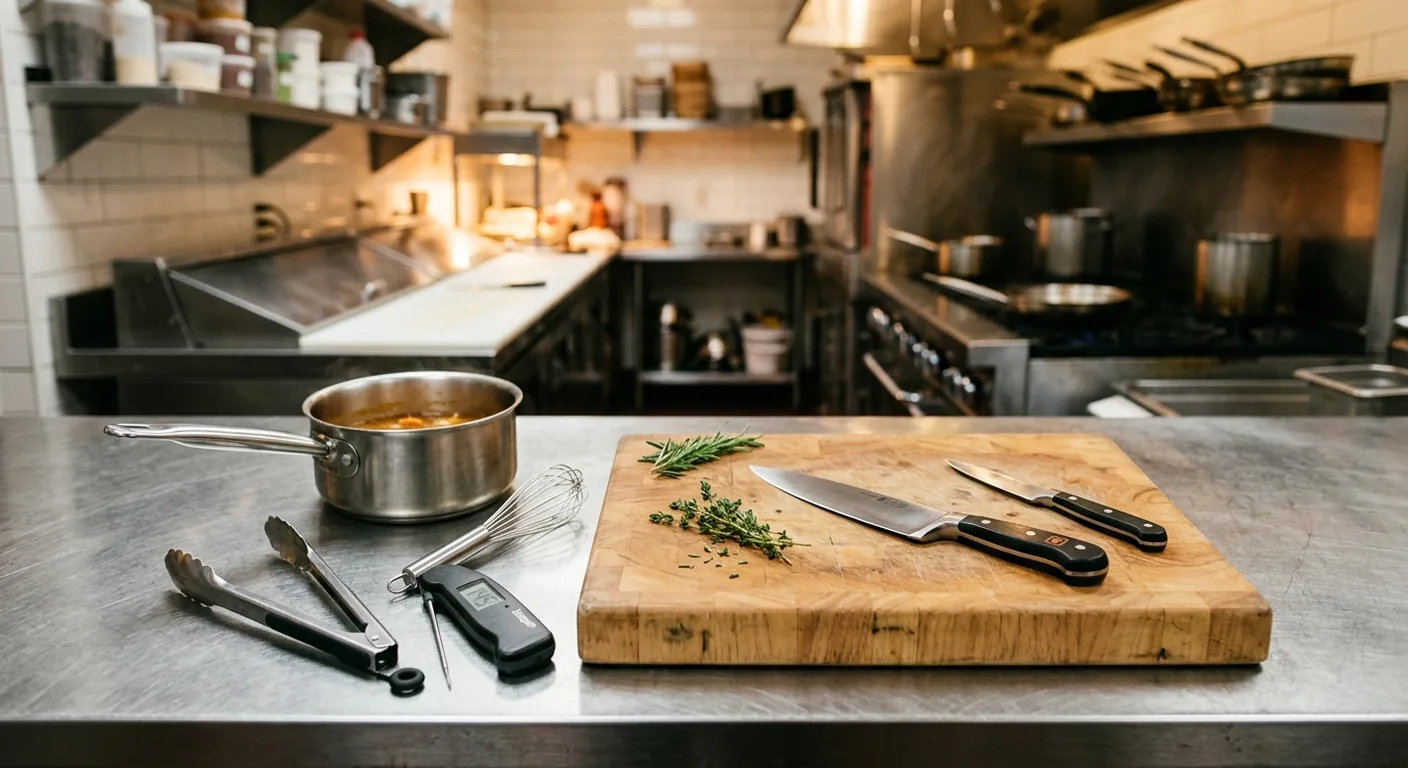

A professional kitchen is a workshop. The stove is the engine, the walk-in cooler is the warehouse, and the tools you carry in your kit are what make everything in between actually happen. Chefs who’ve been working the line for a decade can tell you exactly when they bought their first real chef’s knife, and most of them still have it.
If you’re starting a culinary arts program, that kit is where your career begins. Some schools issue a toolkit on your first day. Others hand you a list and expect you to show up equipped. Either way, understanding what you need, why you need it, and how to choose quality over hype will save you money and frustration over the next two years of training — and well beyond.
This guide breaks down the essential tools and gear for culinary arts students at every level, from the knives you’ll unwrap on day one to the cookware and safety equipment that rounds out a professional setup.
Day-One Essentials: Your Knife Kit
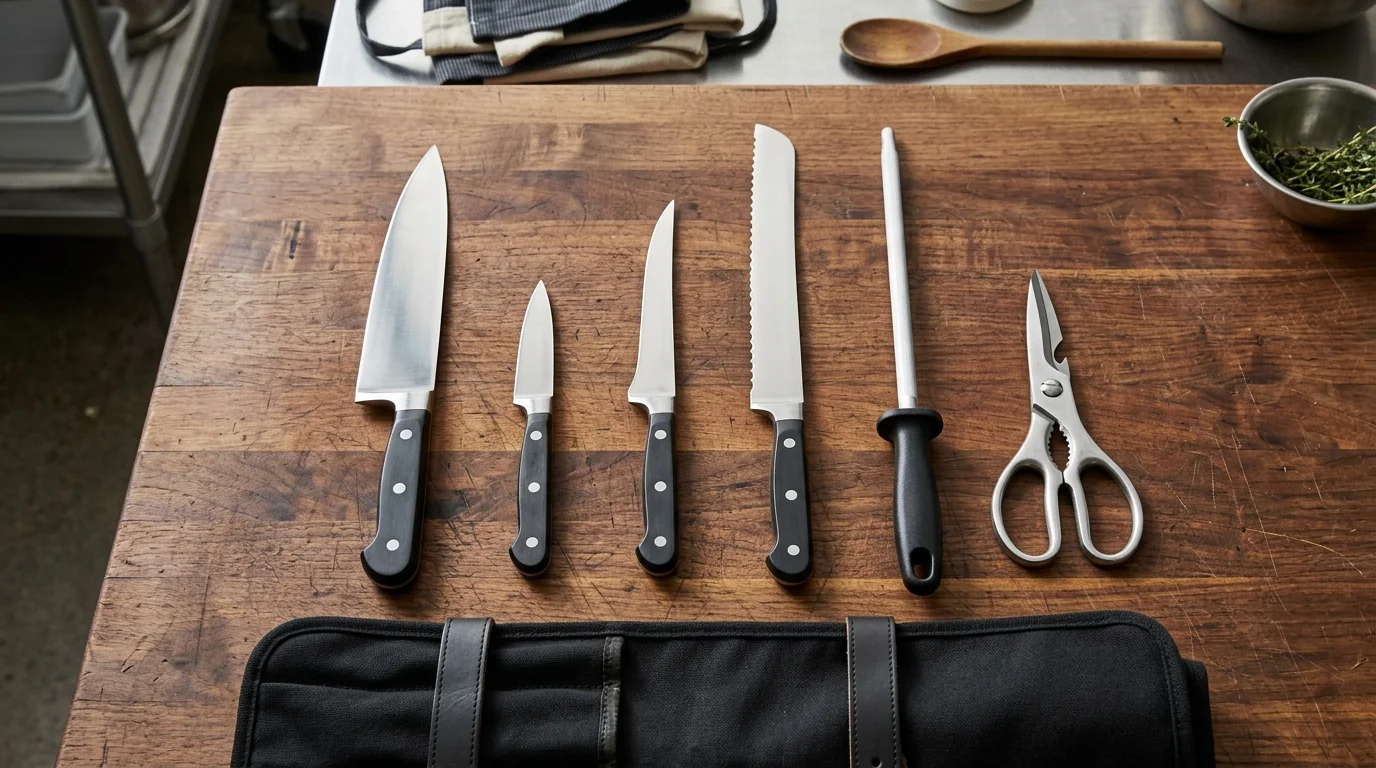
Your knives are the most personal tools in your kit. Most culinary programs start with knife skills for a reason — precision cutting is the foundation of almost every technique that follows. According to Auguste Escoffier School of Culinary Arts, a professional student toolkit contains 23 items, and the knives are the centerpiece.
Chef’s Knife (8–10 inches)
This is the tool you’ll reach for more than any other. Dicing onions, mincing garlic, breaking down vegetables, slicing proteins — an 8- or 10-inch chef’s knife handles roughly 80% of cutting tasks in a professional kitchen. Look for a blade that feels balanced in your hand (not too heavy in the blade, not too heavy in the handle), with a full tang (the metal runs the full length of the handle) and a comfortable grip. You’ll be holding this for hours.
Paring Knife (3–4 inches)
The detail knife. Use it for peeling, trimming, tourning vegetables, deveining shrimp, and any task that requires more control than a chef’s knife can provide. A good paring knife is lightweight with a thin, sharp blade.
Bread Knife (Serrated, 8–10 inches)
The serrated edge grips the crust without compressing soft bread. You’ll also use it for slicing tomatoes and leveling cake layers. Unlike your other knives, a bread knife is difficult to resharpen, so buy one with quality serration from the start.
Boning Knife (5–6 inches)
Used for separating meat from bone — breaking down whole chickens, trimming roasts, and filleting fish. The blade is thinner and more flexible than a chef’s knife, which allows it to follow the contours of bones and joints. Choose between stiff and flexible depending on the type of protein work your program emphasizes.
Honing Steel
A honing steel doesn’t sharpen your knife — it realigns the blade’s edge between sharpenings. Running your knife along a honing steel before each session keeps the edge straight and functional. Get in the habit of honing before every use. This single practice extends the time between professional sharpenings significantly.
Kitchen Shears
Strong shears handle tasks knives can’t easily do: cutting through poultry bones, snipping herbs, opening packaging, trimming pastry dough. Look for shears that come apart for cleaning — kitchen hygiene standards require it.
Hand Tools & Smallwares
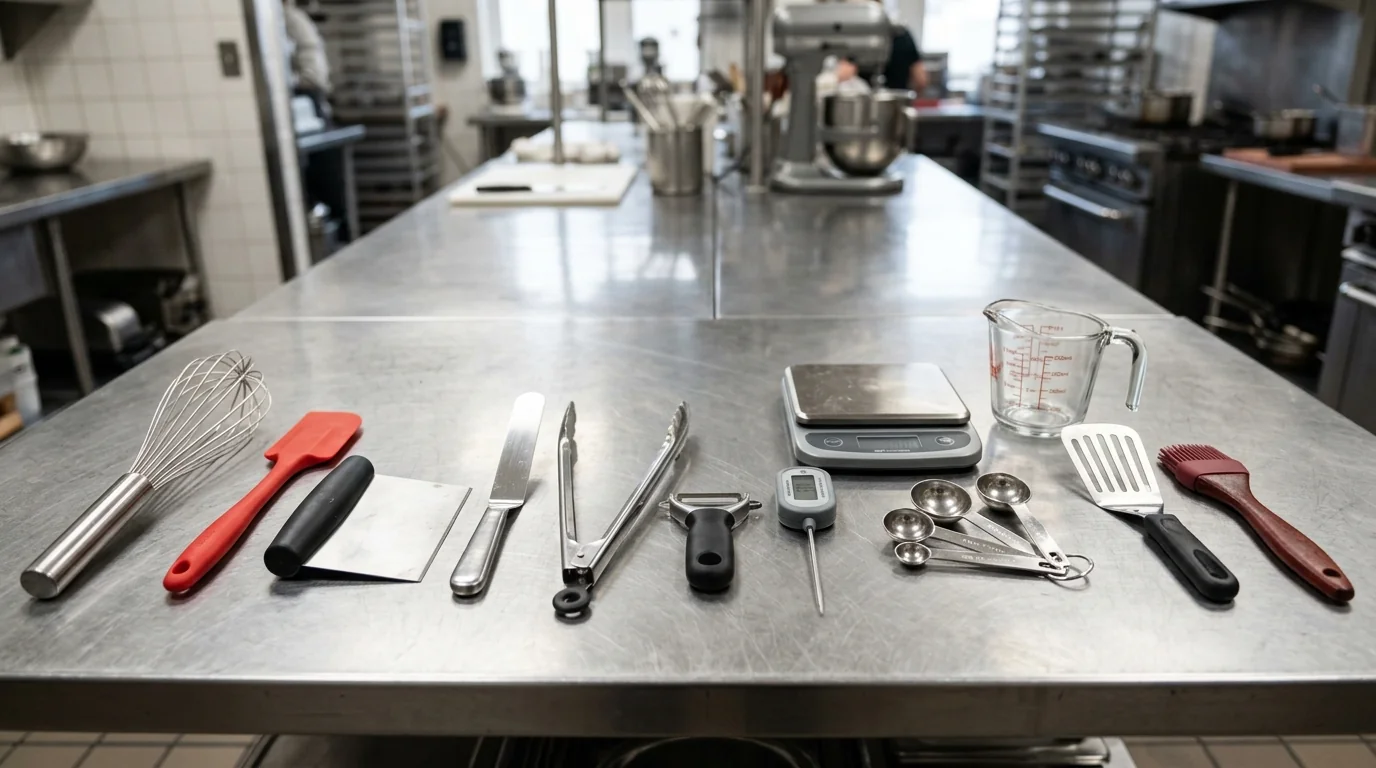
Beyond knives, your kit needs the hand tools and measuring instruments that make precise, consistent cooking possible. These are the items you’ll use every day in both practical labs and professional kitchens.
Whisks
A piano whisk (balloon whisk) is essential for incorporating air into batters, sauces, and egg preparations. If your program includes pastry work — and most baking and pastry arts programs do — you’ll use a whisk constantly. Stainless steel with a sealed handle is the standard.
Spatulas and Scrapers
A silicone (high-temperature) spatula is critical for folding batters, scraping bowls, and stirring on the stove without damaging non-stick surfaces. A bench scraper divides dough, transfers chopped ingredients, and keeps your work surface clean. An offset spatula handles frosting, plating, and flipping delicate items.
Tongs (12-inch, spring-loaded)
Tongs are an extension of your hand on the line. They flip proteins, toss pasta, plate vegetables, and move items in and out of ovens and fryers. Spring-loaded tongs with a locking mechanism are the standard. Buy two pairs.
Y-Peeler
Faster and more ergonomic than a swivel peeler for most tasks. You’ll peel hundreds of pounds of vegetables during culinary school — a good peeler reduces fatigue and waste.
Digital Pocket Thermometer
Temperature accuracy is not optional in a professional kitchen. An instant-read digital thermometer checks protein doneness, verifies holding temperatures, and confirms that food has reached safe internal temperatures. The FDA Food Code requires temperature monitoring throughout food preparation and holding. A probe that reads accurately within two seconds is standard.
Digital Scale
Baking by weight is more accurate than measuring by volume, and professional recipes are written in grams. A compact digital scale that reads in both grams and ounces (to at least 1-gram precision) is a day-one requirement.
Measuring Spoons and Cups
Even with a scale, you’ll measure liquids and small quantities by volume. Stainless steel measuring spoons and graduated liquid measuring cups round out your measurement tools.
Fish Turner
A thin, flexible metal spatula designed for lifting delicate items — fish fillets, crepes, fried eggs — without breaking them. The slotted design lets oil drain as you lift.
Pastry Brush
Used for egg washes, glazes, and basting. Silicone brushes are easier to clean and more hygienic than natural bristle.
Piping Bags and Tips
Even if your focus isn’t pastry, you’ll pipe mashed potatoes, fill deviled eggs, and decorate plates. Disposable bags are standard in most kitchens for hygiene.
Cookware & Equipment
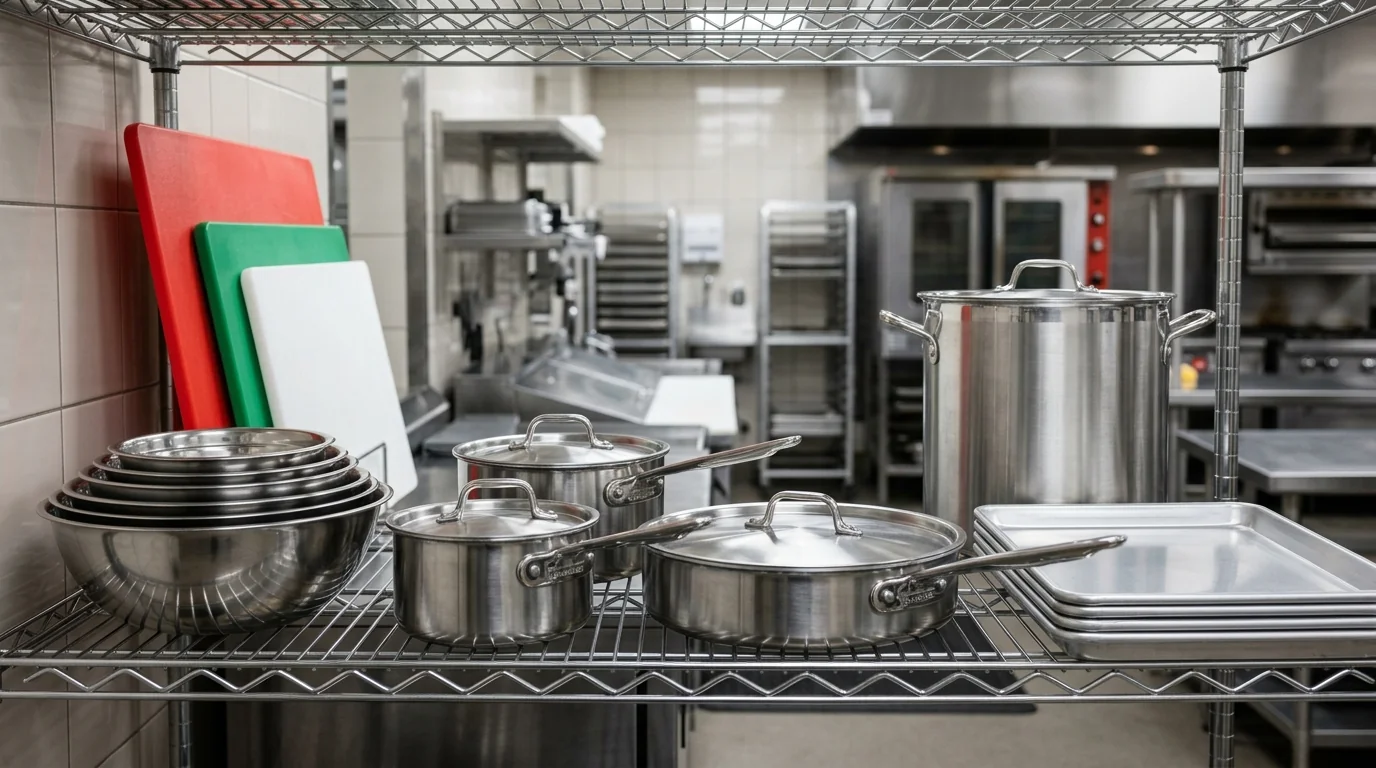
Your school’s kitchen will have commercial equipment — ranges, ovens, steam kettles, tilt skillets — but understanding core cookware matters because you’ll choose and use these pieces throughout your career.
Saucepans (1-quart and 2-quart)
For sauces, reductions, blanching small batches of vegetables, and heating liquids. Heavy-bottomed stainless steel is the professional standard — it distributes heat evenly and doesn’t react with acidic ingredients.
Saute Pan (10–12 inches)
The workhorse pan for searing, sauteing, and building pan sauces. A stainless steel saute pan with straight sides holds food and liquid better than a sloped-sided skillet. Eventually you’ll want both.
Sheet Pans (Half-sheet, 18x13 inches)
Roasting vegetables, baking cookies, toasting nuts, holding prepped ingredients — sheet pans are the most used piece of equipment in most kitchens after knives. Commercial-grade aluminum half-sheet pans are inexpensive and last indefinitely.
Stockpot (8–12 quart)
For stocks, soups, boiling pasta, and large-batch cooking. A tall, narrow shape minimizes evaporation during long simmers. Stainless steel with an aluminum or copper core base is ideal.
Mixing Bowls (Nested Set)
Stainless steel mixing bowls in graduated sizes (from 1 quart to 8 quart) handle prep, mixing, marinating, and mise en place. Stainless is preferred over glass in professional settings — it’s lighter, unbreakable, and conducts temperature change faster (useful for ice baths).
Cutting Boards
Polyethylene (plastic) cutting boards are the commercial kitchen standard because they can be sanitized in a commercial dishwasher. Color-coded boards (red for raw meat, green for vegetables, white for dairy/bread) prevent cross-contamination. Your school will likely use this system — learn it.
Safety Gear & Kitchen PPE
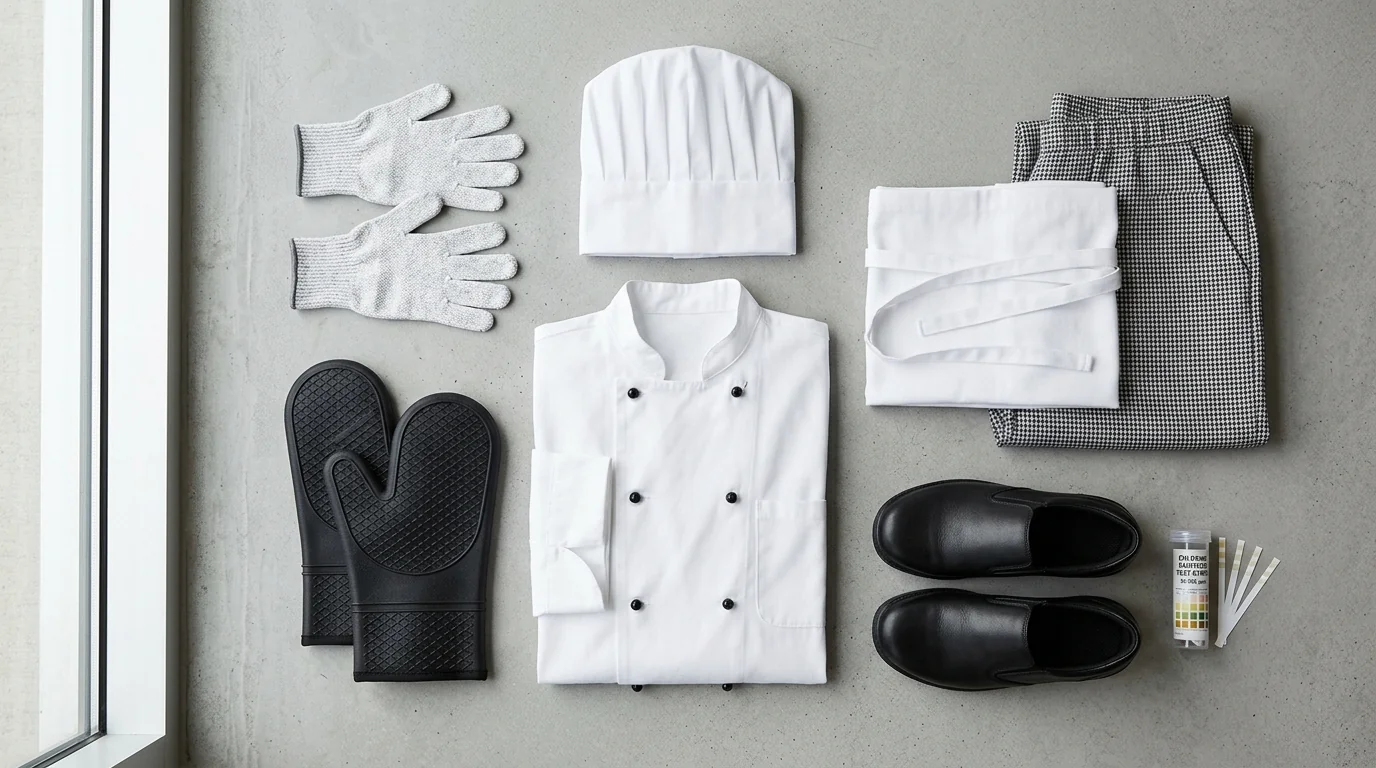
Kitchens are high-hazard work environments. According to OSHA, common kitchen hazards include hot surface burns, cuts and lacerations, equipment entrapment, electrical shocks, and even amputations from commercial equipment like slicers and grinders. Safety gear is not optional — it’s required by federal standards, and every serious culinary program enforces it.
Cut-Resistant Gloves
OSHA standard 29 CFR 1910.138(a) requires hand protection when employees are exposed to hazards such as cuts and lacerations. Cut-resistant gloves are worn when using mandolines, breaking down large proteins, and operating slicers. They’re made from woven materials like Dyneema or stainless steel mesh. They don’t replace careful technique — they’re a backup.
Oven Mitts and Pot Holders
Burns are the most common kitchen injury. Heavy-duty oven mitts rated to at least 400 degrees F protect your hands and forearms when working with hot pans, sheet trays, and oven racks. Silicone-coated mitts offer better grip than cloth alone.
Non-Slip Kitchen Shoes
Kitchen floors are wet, greasy, and slippery. Non-slip shoes with oil-resistant soles and enclosed toes are universally required in professional kitchens and culinary programs. This is the single most important piece of safety gear for preventing fall injuries. Look for shoes rated ASTM F2913 for slip resistance.
Chef’s Uniform
Most programs specify a uniform: chef coat (double-breasted, typically white), chef pants (houndstooth or black), hat or toque, and an apron. The double-breasted coat isn’t just tradition — it provides a layer of protection against hot liquids (you can reverse the flap to cover a spill), and the thick cotton absorbs minor splashes. Some programs include the uniform in tuition; others require you to purchase it separately.
Chlorine Test Strips
Listed in the Escoffier student toolkit, these verify that sanitizer solutions (used for cleaning work surfaces and equipment) are mixed to the correct concentration. Health departments and the FDA Food Code require sanitizer concentration to be within a specific range — too little doesn’t sanitize, too much is a chemical hazard.
What to Look For When Buying
The culinary equipment market ranges from cheap imports to hand-forged artisan pieces. For students, the sweet spot is somewhere in the middle. Here’s how to evaluate what you’re buying.
Knife Steel Types
The steel your knife is made from determines how sharp it gets, how long it stays sharp, and how easy it is to maintain.
- High-carbon stainless steel is the most common choice for professional kitchen knives. It sharpens well, holds an edge reasonably, and resists rust. This is where most culinary students should start.
- Carbon steel takes a sharper edge than stainless and is favored by many experienced chefs, but it requires more care — it will rust and develop a patina if not dried and oiled after use.
- German-style blades (wider, heavier, slightly curved) are durable and forgiving. Good for rocking cuts on a board.
- Japanese-style blades (thinner, harder, sharper) excel at precision work but are more brittle and chip more easily if used on hard ingredients like frozen food or bone.
Handle Ergonomics
You’ll hold your chef’s knife for hours at a time. The handle should fit your hand comfortably without requiring a death grip. Handles come in various shapes (D-shaped, oval, round) and materials (POM plastic, pakkawood, micarta, rubber). There’s no universal “best” — try before you buy if possible.
NSF Certification
NSF International maintains over 75 standards for food equipment. Key standards include NSF/ANSI 2 (food equipment materials and design), NSF/ANSI 4 (commercial cooking equipment), and NSF/ANSI 8 (powered food preparation equipment). NSF-certified equipment meets requirements for cleanability, material safety, and construction quality. When buying items like cutting boards, thermometers, and smallwares, look for the NSF mark — it means the item was designed for commercial food environments.
Commercial-Grade vs. Home-Grade
Home kitchen equipment is designed for light, intermittent use. Commercial-grade equipment is built for sustained, daily professional use. The differences show up in material thickness, handle construction, heat tolerance, and durability. For items you’ll use in a professional setting after graduation — knives, tongs, thermometers, and sheet pans — buy commercial grade from the start. For items you’ll mostly use in school labs (where the school provides the heavy equipment), home-grade cookware is fine for personal practice at home.
Budget Guide
What you’ll actually spend depends on whether your program provides a toolkit (many do, included in tuition or as a separate kit fee) or requires you to purchase your own.
Starter Kit: $300–$500
This covers the essentials for your first term: a quality chef’s knife, paring knife, bread knife, honing steel, kitchen shears, Y-peeler, spatulas, tongs, whisk, thermometer, digital scale, measuring tools, and a knife roll or bag. At this level, you’re buying reliable mid-grade tools — good enough for school, functional enough to teach you what matters, and replaceable without heartbreak if you damage something while learning.
This is the right budget for most students entering cooking programs who want dependable equipment without overspending before they know their specialization.
Mid-Level Kit: $500–$900
Adding boning and fillet knives, an offset spatula set, a complete pastry toolkit (piping bags, tips, bench scraper), a professional thermometer, and higher-quality cookware for home practice. At this range, you’re choosing tools you expect to keep for several years and developing preferences about blade profile, handle material, and tool brands.
Professional Setup: $900+
A full professional setup includes Japanese or premium European chef’s knives, a complete knife roll with 8–12 pieces, professional-grade cookware, specialized tools for your area of focus (pastry, butchery, garde manger), high-end safety gear, and a quality knife bag or case. Chefs who’ve been working for a few years typically have $1,500–$3,000 invested in their personal kit. You build to this level over time — don’t feel pressured to start here.
School-Provided vs. Self-Purchased
Many accredited culinary programs include a student toolkit in tuition costs. This typically covers the basics — a knife set, thermometer, and essential hand tools. The quality of school-issued kits varies. Some programs partner with professional-grade manufacturers and provide excellent starter kits. Others issue budget-grade tools that you’ll want to upgrade within a year. Before buying your own kit, check exactly what your program provides.
Tool Care & Maintenance
Professional tools last for years — sometimes decades — when they’re properly maintained. Here’s how working chefs take care of their gear.
Honing vs. Sharpening: Know the Difference
Honing (using your honing steel) straightens the blade’s edge, which bends with use. It doesn’t remove metal. Sharpening (using a whetstone or professional sharpening service) actually grinds the blade to create a new edge. You should hone before every use and sharpen every 2–4 months depending on how heavily you use the knife. Learning to sharpen on a whetstone is a valuable skill — many culinary programs teach it — but a professional sharpening service is a reasonable alternative, typically costing $5–$15 per knife.
Knife Storage
Never throw knives loose in a drawer. The blade edges bang against each other and other utensils, dulling them quickly and creating a cut hazard when you reach in. Use a knife roll, magnetic strip, or blade guards. In a professional kitchen, your knife roll travels with you.
Cookware Seasoning and Care
Carbon steel pans require seasoning — building up a layer of polymerized oil that creates a natural non-stick surface. Stainless steel doesn’t need seasoning but should be cleaned properly (warm water, mild soap, soft sponge — not steel wool unless you need to remove a serious burn). Never put a hot pan directly into cold water; thermal shock can warp the base.
Cutting Board Maintenance
Plastic cutting boards should be run through a commercial dishwasher (or sanitized with a bleach solution at home) after every use. Replace them when they develop deep grooves that can’t be sanitized — those grooves harbor bacteria.
Thermometer Calibration
Digital thermometers drift over time. Calibrate yours regularly using the ice-water method: fill a glass with crushed ice and water, insert the probe, and confirm it reads 32 degrees F (0 degrees C). Most professional digital thermometers have a calibration adjustment.
Start Your Culinary Career
Good tools are a starting point, not a destination. The real question is what you do with them — and that comes down to training, practice, and finding the right program.
The culinary industry is large and still growing. The Bureau of Labor Statistics reports that chefs and head cooks earn a median salary of $60,990 per year, with 7% job growth projected from 2024 to 2034 and approximately 24,400 openings each year across roughly 197,300 positions. The National Restaurant Association projects $1.55 trillion in restaurant industry sales for 2026 with a workforce of 15.8 million — and the industry is actively looking for trained talent.
If you want a deeper look at what the career path looks like — from line cook to executive chef, what the realistic earning trajectory is, and how culinary school compares to working your way up — read our full guide on culinary arts career opportunities.
Ready to explore training options? Browse culinary arts programs to find accredited schools in your area, or explore baking and pastry arts programs if your interest leans toward the pastry side of the kitchen.
The kitchen rewards people who show up prepared. That starts with knowing your tools.
Sources
- Bureau of Labor Statistics — “Chefs and Head Cooks: Occupational Outlook Handbook” — https://www.bls.gov/ooh/food-preparation-and-serving/chefs-and-head-cooks.htm
- Auguste Escoffier School of Culinary Arts — “Essential Professional Chef Tools” — https://www.escoffier.edu/blog/value-of-culinary-education/essential-professional-chef-tools/
- OSHA — “Kitchen Equipment Safety: Food Services” — https://www.osha.gov/etools/hospitals/food-services/kitchen-equipment
- FDA — “Food Code 2022” — https://www.fda.gov/food/fda-food-code/food-code-2022
- NSF International — “Food Equipment Standards” — https://www.nsf.org/nsf-standards/standards-portfolio/food-equipment-standards
- National Restaurant Association — “2026 State of the Restaurant Industry” — https://restaurant.org/research-and-media/research/research-reports/state-of-the-industry/