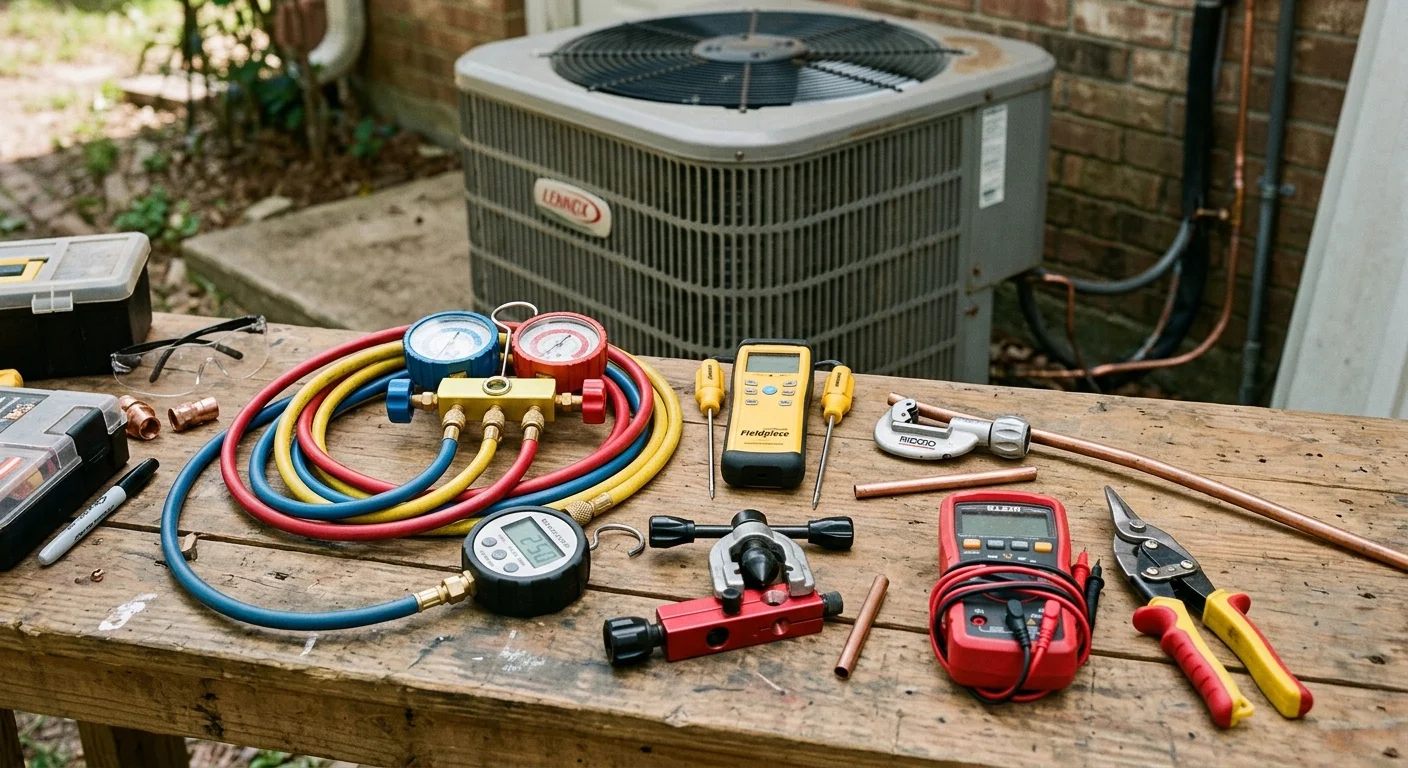
Open any seasoned HVAC technician’s van and you’ll find a highly personal collection of gear. There’s a dedicated spot for the manifold gauge set, a tray for the refrigerant leak detector, and a corner where the vacuum pump lives strapped in with a bungee cord. Everything has a place because on a hot August day with four service calls stacked up, you can’t afford to spend ten minutes digging through a pile of gear trying to find a flaring tool.
If you’re starting out in HVAC — through a trade school program, a union apprenticeship, or on-the-job training — building that organized, functional kit takes time and real money. The good news is you don’t need everything at once. HVAC tools break down into a clear progression: what you need from day one, what you add as the work gets more complex, and what a fully equipped professional carries after a few years in the field.
This guide walks through each stage, explains what to look for when you’re shopping, and gives you an honest picture of what it costs. The goal isn’t to point you toward specific brands — it’s to give you the knowledge to make good decisions no matter where you’re buying.
Day-One Essentials
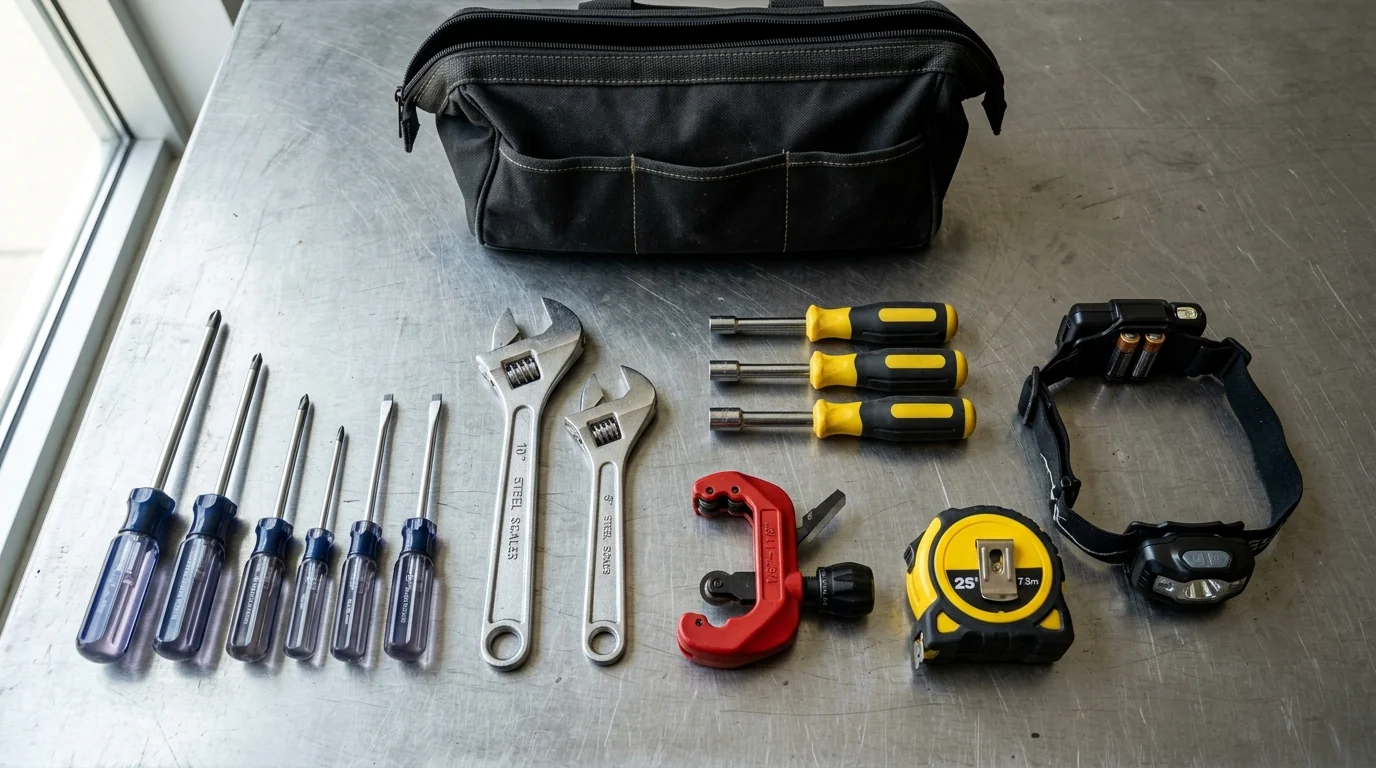
Your first week in an HVAC program or apprenticeship won’t have you pulling refrigerant or commissioning new systems. But you will need a solid set of hand tools from the start, and showing up without them signals to an instructor or foreman that you’re not ready to be taken seriously.
Screwdrivers
A combination set with multiple Phillips and flathead sizes covers most panel access, electrical connections, and equipment housings you’ll encounter. HVAC work involves a lot of fasteners in tight spaces, so a set that includes short-handle options is worth having. At minimum: #1 and #2 Phillips, medium and large flathead.
Adjustable Wrenches
Two sizes — a 6-inch and a 10-inch — handle most HVAC fitting work. You’ll tighten service valves, Schrader cores, and refrigerant line connections regularly. Wrenches with a smooth jaw adjustment (not sticky or slipping) are much easier to work with when you’re hanging upside-down inside an air handler.
Nut Drivers
HVAC panels are held on with hex-head sheet metal screws, and grabbing a nut driver is faster and easier than a screwdriver on those. A set with 1/4”, 5/16”, and 3/8” covers the sizes you’ll see constantly.
Tube Cutter
This is one of the more trade-specific hand tools you’ll use early. A tube cutter scores and cuts copper refrigerant lines cleanly without leaving burrs that can damage compressor valves. Get a cutter designed for the line sizes common in residential and light commercial work (typically 1/4” to 7/8”). A deburring tool that attaches to the cutter or comes with the set saves a lot of fumbling.
Tape Measure
A 25-foot tape handles most measuring tasks. HVAC techs use it for duct runs, equipment clearances, and line set routing.
Flashlight or Headlamp
You will be working inside air handlers, crawlspaces, attics, and mechanical rooms where there is very little natural light. A quality LED headlamp that leaves your hands free is worth more than a standard flashlight for most of this work.
Tool Bag or Hard Case
How you organize your tools from the start sets a habit. A sturdy canvas bag or a stackable hard case system keeps gear sorted and protected in transit. Some programs and apprenticeships will specify what to use — follow that first.
Power Tools & Specialty Equipment
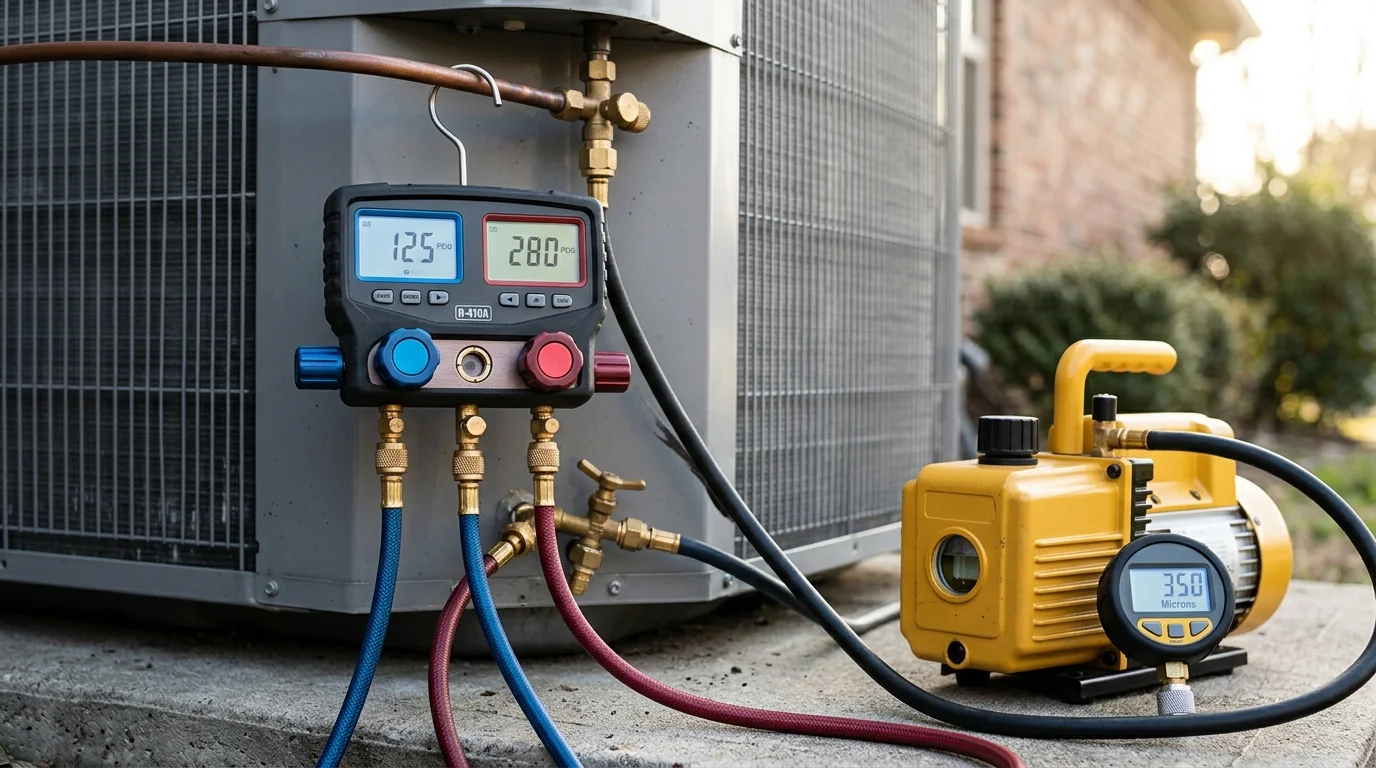
Once you move past basic installation assist and start running your own service calls or installation work, you’ll need tools that handle refrigerant systems directly. These are the items that separate a capable HVAC tech from someone who just carries hand tools.
Manifold Gauge Set
The manifold gauge set is the central diagnostic tool of HVAC work. It connects to the refrigerant circuit and measures suction and discharge pressures, letting you diagnose problems like low refrigerant charge, compressor issues, and restriction in the system. Digital manifold gauges have become the standard in professional shops — they display pressure, temperature, and saturation values simultaneously, and many calculate superheat and subcooling automatically, which removes a significant source of human error. You’ll use this on nearly every service call.
Vacuum Pump
Before a system is charged with refrigerant, air and moisture have to be evacuated from the refrigerant circuit. That’s what a vacuum pump does. A poor evacuation leads to moisture contamination, acid formation in the oil, and premature compressor failure — so this tool isn’t optional. Look for a pump with a two-stage design (more thorough evacuation than single-stage) and check the CFM (cubic feet per minute) rating, which determines how quickly it pulls down a system. Pair your vacuum pump with a digital micron gauge to verify you’ve actually achieved a deep enough vacuum before charging.
Refrigerant Leak Detector
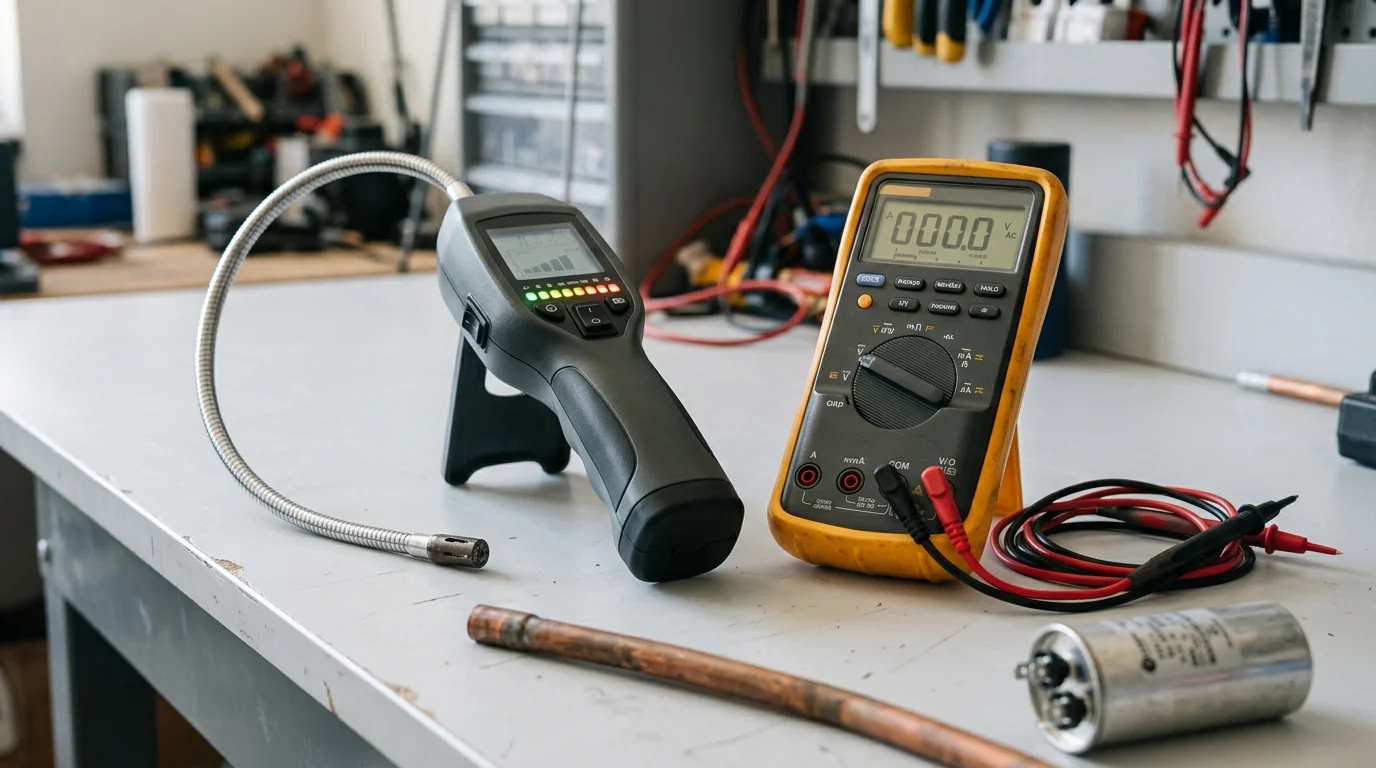
Refrigerant leaks cost customers money, damage the environment, and under EPA Section 608 regulations, technicians are legally required to repair leaks above certain thresholds. An electronic leak detector lets you pinpoint leaks by sensing refrigerant concentration in the air. Infrared and heated diode sensors are the two most common types — infrared detectors tend to have fewer false positives and are preferred by many techs for residential work. Ultrasonic detectors are also available and work well for finding large leaks in noisy environments.
Digital Multimeter
HVAC systems are electrical systems as much as they are refrigerant systems. You’ll test capacitors, contactors, run and start windings on motors, and control board signals constantly. A digital multimeter that handles AC/DC voltage, resistance, continuity, and capacitance covers most diagnostic work. True RMS models give more accurate readings on variable-frequency drives and variable-speed equipment, which is increasingly common in modern systems.
Manometer
A manometer measures gas pressure in a system — used when working on furnaces, gas lines, and combustion equipment. For HVAC technicians who work on both cooling and heating equipment (which is most of them), a digital manometer that measures inches of water column (WC) is a standard diagnostic tool for checking gas pressure at the manifold and burner.
Thermometer
Temperature measurement is a constant in HVAC work: checking supply and return air temperatures, measuring temperature rise across a heat exchanger, verifying refrigerant saturation. A digital thermometer with thermocouple probes lets you take accurate readings from multiple points. Infrared (non-contact) thermometers are also useful for spotting hot spots on electrical components without touching them.
Cordless Drill/Driver
Used for drilling through framing, driving sheet metal screws, and mounting equipment. A cordless drill with at least two battery packs lets you keep working while one charges. Get a step bit set — you’ll use it for sheet metal work regularly.
Flaring Tool
When you’re connecting copper refrigerant lines and need to create a leak-proof flare fitting, a flaring tool is what you reach for. A properly made flare creates a tight seal; a poor one leaks refrigerant. Flaring tools that hold the copper tubing securely and have a positive-stop mechanism produce more consistent results than basic threaded-screw types.
Safety Gear & PPE
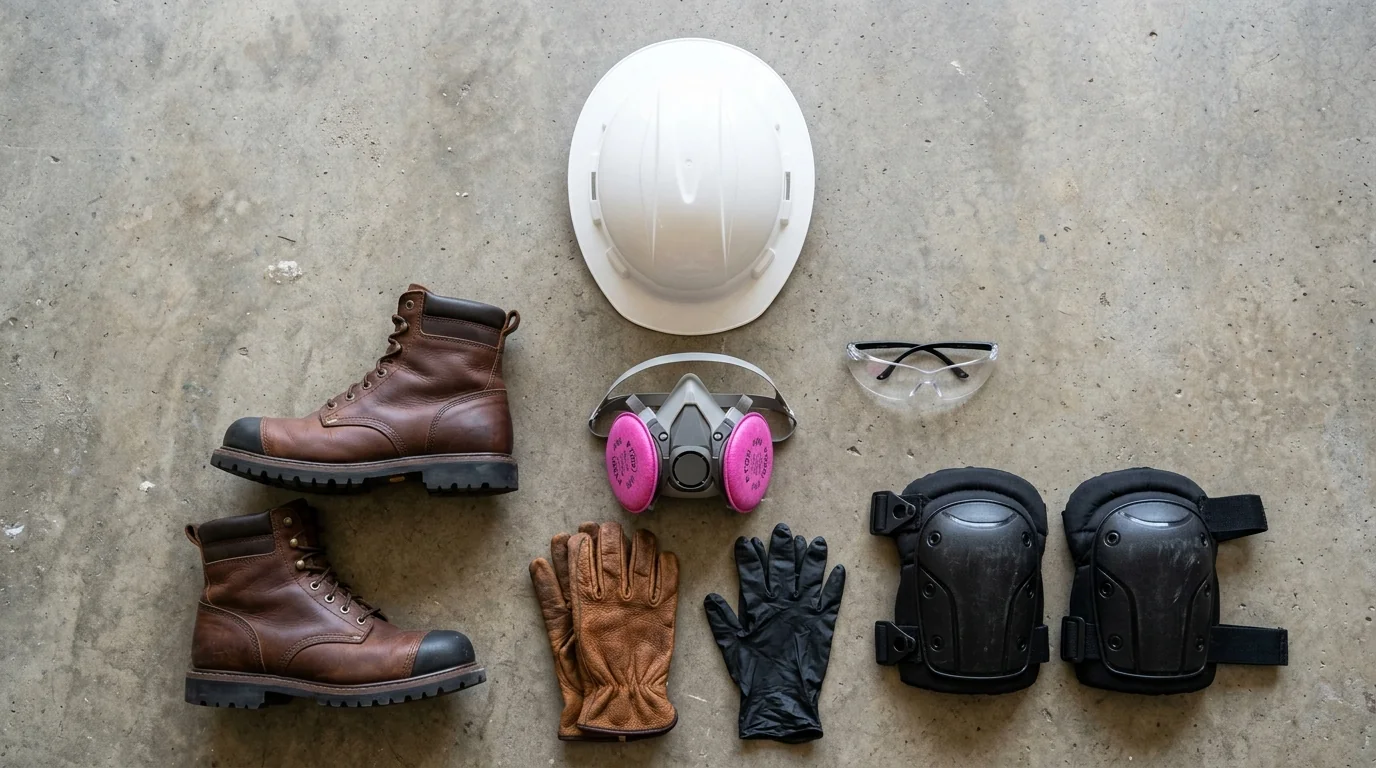
HVAC technicians work with electrical systems, refrigerants under pressure, combustion equipment, and in physically challenging environments like attics and rooftops. The PPE requirements reflect that range of hazards.
Safety Glasses
ANSI Z87.1-rated safety glasses are required on virtually every job site and are non-negotiable. You’ll be working with pressurized refrigerant lines, using drill bits, and working in areas where debris can fall. Keep a spare pair — they get scratched, lost, and sat on.
Work Gloves
Different HVAC tasks call for different gloves. General-purpose work gloves protect your hands during sheet metal work and installation. For refrigerant handling, you need chemical-resistant gloves — refrigerants like R-410A can cause frostbite on skin contact because of rapid decompression. For electrical work, rated insulated gloves are appropriate. According to OSHA’s PPE guidelines, employers are required to provide appropriate gloves based on the specific hazard — but owning the right types yourself means you’re always prepared.
Respirator
Most residential and light commercial HVAC work doesn’t require a respirator, but attic work in older homes can expose you to fiberglass insulation particles, mold, and rodent waste. A half-face respirator with P100 filters is what most experienced techs keep in the van. For brazing or soldering copper, proper ventilation and eye protection are more important, but a respirator is still a smart precaution in confined spaces.
Steel-Toed Boots
HVAC equipment is heavy. Units, condensers, and air handlers get dropped and shifted, and steel-toed boots are standard on any job site where you’re around heavy equipment. Electrical hazard (EH) rated boots add a layer of protection during electrical work. Look for a boot that also has good ankle support — rooftop and crawlspace work is hard on ankles.
Knee Pads
Not glamorous, but your body will thank you. HVAC technicians spend significant time kneeling next to condensers, crouching under air handlers, and working at floor level inside mechanical rooms. Quality knee pads reduce wear over a long career.
Hard Hat
Required on commercial and new construction job sites. On residential calls it’s often optional, but a hard hat is good practice any time you’re working in an attic with low rafters or a mechanical room with overhead hazards.
What to Look For When Buying
The tool market for HVAC is large and ranges from cheap imports to professional-grade equipment that’ll outlast your career. Here’s what actually matters by category.
Manifold Gauge Set
What it does: Connects to a refrigerant system to measure suction and discharge pressures, enabling diagnosis of refrigerant charge, system capacity, and component performance.
Key features to compare: Digital vs. analog (digital displays are more readable and often calculate superheat/subcooling automatically), refrigerant compatibility (make sure the gauges support the refrigerants you work with — R-410A, R-32, and R-454B are increasingly common as the industry transitions), connection type (standard 1/4” flare vs. quick-connect fittings), and quality of hoses (heavier gauge hoses resist kinking and cracking better in temperature extremes).
Price range: $80–$250 for analog sets; $200–$600+ for digital manifold sets. Digital is worth the investment if you plan to work in HVAC long-term.
Vacuum Pump
What it does: Evacuates air and moisture from a refrigerant circuit before charging, preventing contamination and system damage.
Key features to compare: Two-stage vs. single-stage design (two-stage pulls a deeper vacuum), CFM rating (higher CFM means faster evacuation on larger systems), oil sight glass (easy to check oil condition without disassembly), handle and carrying design (you’ll move this constantly), and whether it includes an isolation valve.
Price range: $80–$200 for single-stage entry-level pumps; $180–$400 for quality two-stage models.
Refrigerant Leak Detector
What it does: Detects refrigerant in the air to locate leaks in a system.
Key features to compare: Sensor type (infrared vs. heated diode — infrared has fewer false positives; heated diode is responsive but can degrade with heavy use), sensitivity setting (adjustable sensitivity is useful in high-refrigerant-concentration environments), response time, and audible/visual alert options.
Price range: $50–$150 for heated diode detectors; $150–$400 for infrared models.
Digital Multimeter
What it does: Measures AC/DC voltage, current, resistance, continuity, and capacitance.
Key features to compare: True RMS capability (more accurate on variable-speed equipment), CAT rating (CAT III or CAT IV for work around electrical panels), capacitance measurement (essential for testing run capacitors on HVAC motors), display readability in low-light conditions, and auto-ranging vs. manual.
Price range: $30–$60 for a capable apprentice-level model; $100–$250 for professional-grade true RMS meters.
Tube Cutter
What it does: Cuts copper refrigerant tubing cleanly without crushing the tube or leaving burrs.
Key features to compare: Size range (make sure it covers the tubing diameters you’ll work with), cutting wheel hardness (harder wheels stay sharp longer), smoothness of the feed mechanism, and included deburring tool.
Price range: $15–$50. Mid-range cutters from reputable tool suppliers last years with light maintenance.
Flaring Tool
What it does: Creates flared ends on copper tubing for leak-proof flare fittings.
Key features to compare: Positive-stop mechanism (ensures consistent flare depth), bar quality (holds tubing firmly without slipping), compatibility with SAE flare sizes common in HVAC, and ease of use in tight spaces.
Price range: $40–$120. Ratchet-style flaring tools produce more consistent results than basic screw-type versions and are worth the extra cost.
Thermometer with Probes
What it does: Measures air and surface temperatures at multiple points for diagnostic work.
Key features to compare: Probe types (thermocouple probes for air measurement, pipe clamp probes for line temperatures), temperature range and accuracy, number of simultaneous inputs, and response time.
Price range: $30–$100 depending on the number of probes and accuracy spec.
Safety Glasses
Key features to compare: ANSI Z87.1 rating (required), wraparound coverage, anti-fog coating (very useful when moving between hot and cool environments), scratch-resistant lens, and comfort for extended wear.
Price range: $5–$25. Buy several pairs.
Budget Guide
HVAC tool costs are real, and it’s worth going in with clear expectations so you’re not caught off guard.
Apprentice Starter Kit: $400–$800
This covers the hand tools you’ll need from day one: screwdrivers, nut drivers, adjustable wrenches, a tube cutter, tape measure, headlamp, and a quality work bag or case. Add a basic digital multimeter and a pair of safety glasses. At this budget level, you’re buying reliable mid-grade tools — solid enough for training and early apprenticeship work. Most HVAC programs and apprenticeships will publish a required tool list — that list is your starting point, not a suggestion.
Adding Specialty Refrigerant Tools: $500–$1,200 additional
A manifold gauge set, vacuum pump, and refrigerant leak detector are the core additions as you move into refrigeration work. These are bigger investments than hand tools, and it’s worth spending a bit more here — a vacuum pump that doesn’t pull a deep vacuum or a leak detector full of false positives will make your work harder, not easier. Add a digital micron gauge to verify your vacuum depth.
Professional Setup: $2,500–$5,000+
A fully equipped professional HVAC technician carries all of the above at a higher quality tier, plus additional tools: a digital manifold with Bluetooth data logging, a quality infrared camera for spotting refrigerant or electrical issues without disassembly, a combustion analyzer for heating equipment, a full PPE kit, and a van-organized system for keeping gear accessible. Costs in this range also include tools for specific work categories like commercial refrigeration or building automation.
The apprentice and early journeyman years are when you learn what you actually use every day vs. what sounded useful in a catalog. Build deliberately and let the work tell you what gaps exist in your kit.
Tool Care & Maintenance Tips
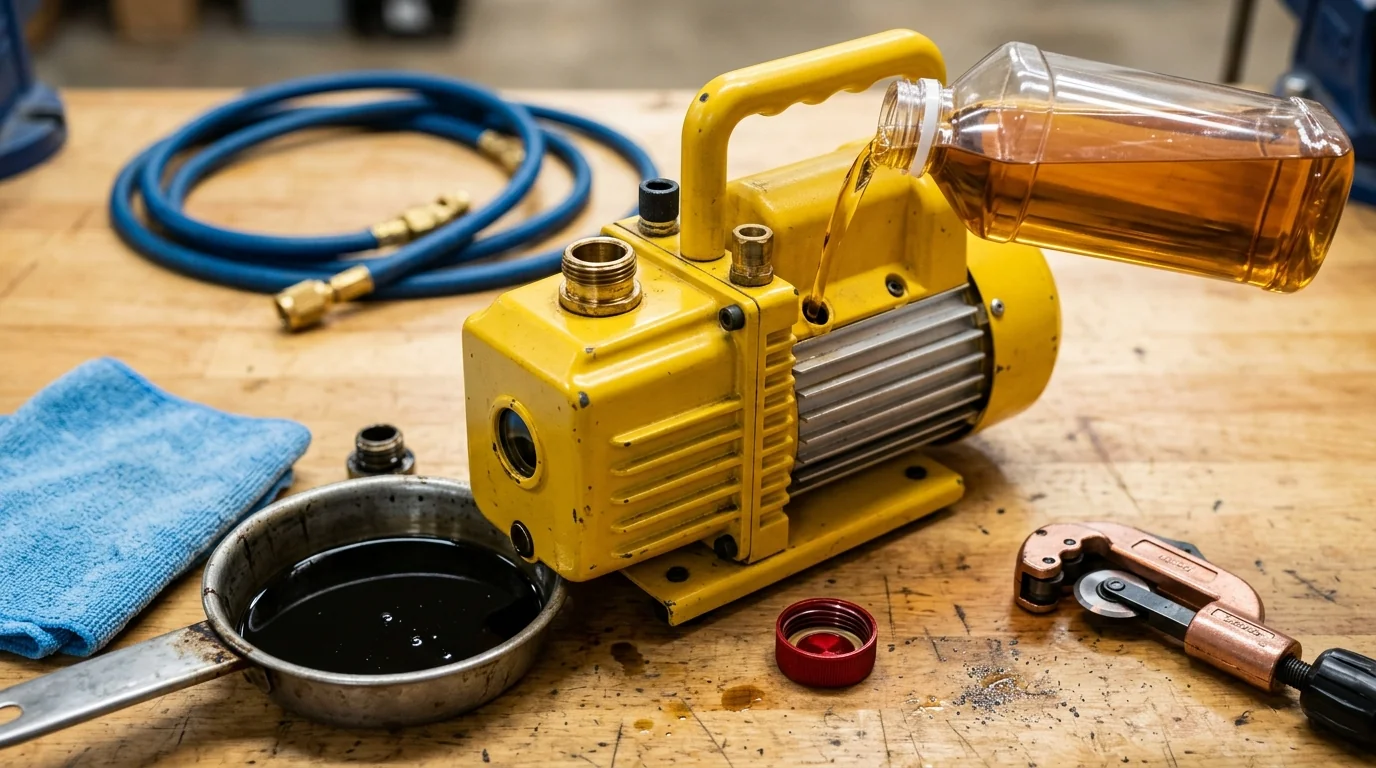
Good HVAC tools last years when they’re maintained properly. Neglected tools fail at the worst times and cost money to replace.
Change vacuum pump oil regularly. Oil in a vacuum pump absorbs moisture from the systems you evacuate. Contaminated oil makes the pump less effective and eventually damages it. Change the oil after every deep evacuation, or at minimum every few uses depending on how contaminated the systems you work on tend to be. Fresh oil is cheap; a rebuilt vacuum pump is not.
Calibrate and verify your gauges. Manifold gauges that read incorrectly lead to incorrect refrigerant charges, which leads to callbacks. Digital manifold gauges can be verified against a known reference; if yours is consistently off, it needs service or replacement.
Store refrigerant hoses coiled, not kinked. Refrigerant hoses that are coiled tightly or kinked at the same spot repeatedly crack at those points. Keep them coiled loosely and away from sharp edges in your van.
Inspect leak detector sensors regularly. Heated diode sensors degrade with use, especially if they get exposed to high refrigerant concentrations repeatedly. Follow the manufacturer’s recommendations for sensor replacement intervals — a detector with a worn sensor gives you false confidence.
Protect electronic tools from heat. Digital manifolds, multimeters, and leak detectors left in a closed van in summer heat degrade faster. Store them in a cooler spot when possible, or use an insulated bag.
Keep flaring and cutting tools clean. A gritty tube cutter wheel leaves burrs even when it’s still sharp. Wipe down the cutting wheel and feed mechanism after each use. Replace the cutting wheel when it starts leaving rough cuts rather than trying to extend its life on your refrigerant lines.
Inspect electrical cords and probe leads. Cracked insulation on multimeter probes is both a measurement accuracy problem and a shock hazard. Replace leads when you see cracks, fraying, or exposed conductor.
Start Your HVAC Career
Having the right tools is the starting point, not the destination. If you’re still working out whether HVAC is the right trade for you — what the day-to-day work actually looks like, what a technician earns at different experience levels, and how the licensing path works state by state — read our full guide on HVAC career opportunities.
If you’re trying to decide between an apprenticeship and a trade school program, our apprenticeships explained article covers how both paths work and what to expect from each. And if you’re early in the process of picking a program, how to evaluate a trade school gives you a framework for comparing your options.
HVAC is a trade that rewards people who pay attention to detail and take their tools seriously. Knowing your equipment before you walk onto a job site is a good place to start.
Sources
- OSHA — “Personal Protective Equipment” — https://www.osha.gov/personal-protective-equipment
- HVACR Career Connect NY — “HVAC & Refrigeration Safety: Personal Protective Equipment (PPE)” — https://hvacrcareerconnectny.com/hvac-refrigeration-safety-personal-protective-equipment-ppe/
- EPA — “Section 608 of the Clean Air Act: Stationary Refrigeration” — https://www.epa.gov/section608
- Getjobber — “HVAC Tools List: 30+ Essential Tools for HVAC Work (With Prices)” — https://www.getjobber.com/academy/hvac/top-hvac-tools/
- BTrained HVAC Training — “How to Build Your HVAC Tool Kit on a Budget as a Student” — https://btrained.net/hvac-articles/how-to-build-your-hvac-tool-kit-on-a-budget-as-a-student
- Summit College — “11 Essential Tools for HVAC Technicians” — https://summitcollege.edu/gear-up-for-success-essential-tools-for-hvac-technicians/