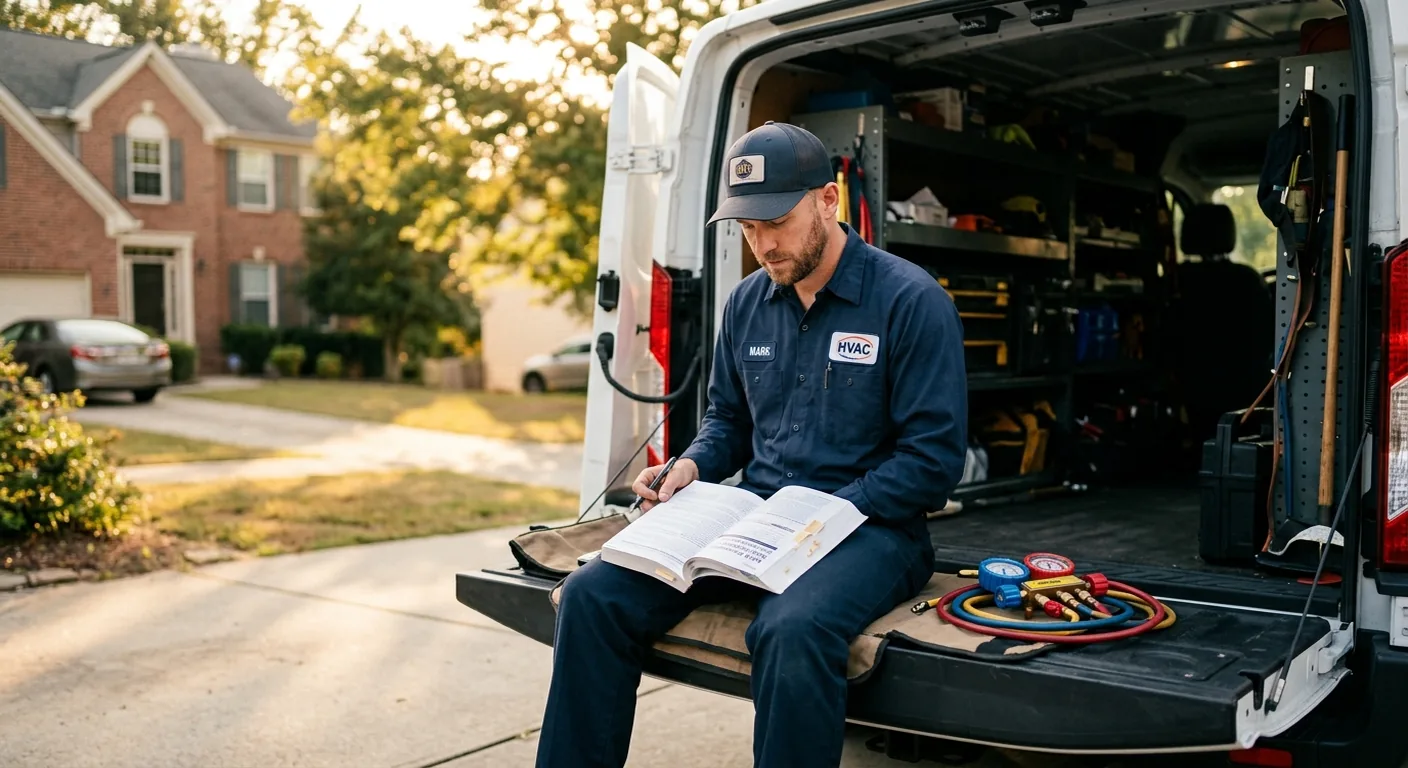

A new HVAC apprentice walks out of a 9-month program with an EPA 608 card in his pocket and two job offers in his email. The first is a residential service tech role at a big regional comfort-systems company: $24/hour starting, on-call rotation every fourth week, ride-along training for 90 days, and a clear ladder to “comfort advisor” — a sales-overlay role that can earn six figures in a hot housing market. The second is a commercial maintenance helper at a national mechanical-services firm: $26/hour, no after-hours rotation in the first year, blueprint training, exposure to chillers and rooftop units (RTUs), and a posted track to building automation systems (BAS) controls — where senior techs in the same company top out around $48/hour.
Both are real jobs. Both are good first jobs. They lead to very different careers, very different paychecks, and very different rates of burnout. This guide walks the actual pay differential between the two sides of the industry, the on-call and overtime profile that drives most exits, the controls specialty that has become the highest-paid niche in the trade, and how a new HVAC tech should think about which side to pick.
If you’re earlier in the credentialing path, start with our how to become an HVAC technician guide. This article assumes you have an EPA 608 universal certification or are about to and you’re choosing a specialty.
TL;DR
- Median annual wage for heating, A/C, and refrigeration mechanics and installers was $59,810 in May 2024, with the top 10% above $91,020. Source: BLS Occupational Outlook Handbook.
- Commercial premium. Industry pay surveys put the average commercial HVAC technician at roughly $11,000/year above the average residential tech — about $65,000 vs $54,000. Senior commercial techs in mechanical-services firms can clear $78,000+. Sources: Housecall Pro Commercial HVAC Salary Guide and ServiceTitan HVAC Technician Salary Guide.
- BAS controls is the top of the ladder. Building automation specialists routinely earn $45–$60+/hour, with experienced ones hitting $80,000–$110,000+ in major metros. Source: HVAC Career Map — Building Automation Systems Technician.
- The industry is short ~110,000 technicians, a 38% gap between open positions and available workers; ~70% of turnover is voluntary, and ~60% of techs under 45 say they may leave field service entirely. Source: ServiceTitan HVAC Technician Shortage Report.
- Residential burns out faster because of higher customer-service intensity, sales-pressure overlays, on-call rotations, and seasonal peak load (heat-call hell in July, no-heat hell in January). Source: MeasureQuick — HVAC Technician Burnout: The Support System That Doesn’t Exist.
- Employment growth is projected at 9% from 2024 to 2034, much faster than the all-occupations average. Both sides are hiring; the choice is which side you survive in. Source: BLS OOH.
The Two Worlds, Cleanly Defined
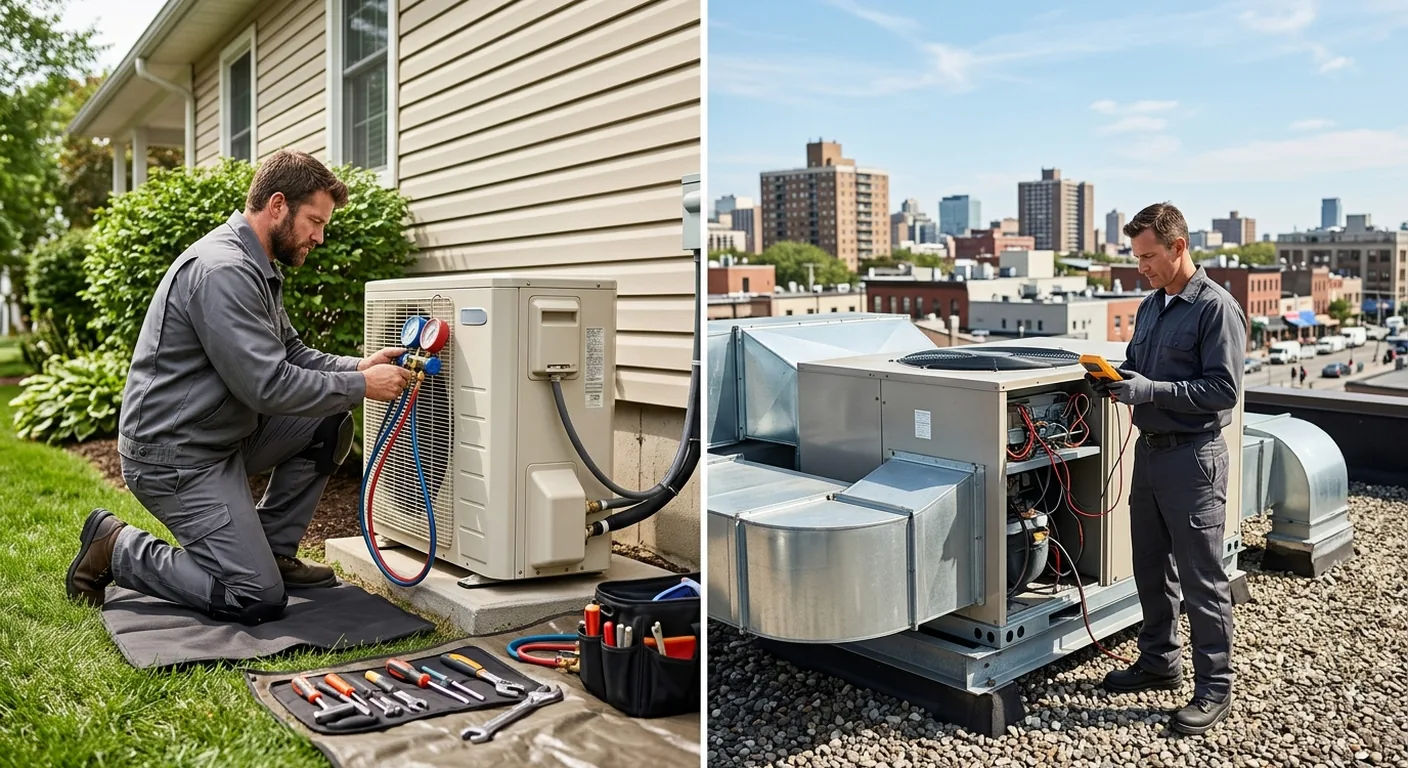
Most “commercial vs residential HVAC” arguments online conflate equipment, customer type, and employer type. The cleanest split is by customer and equipment.
Residential HVAC
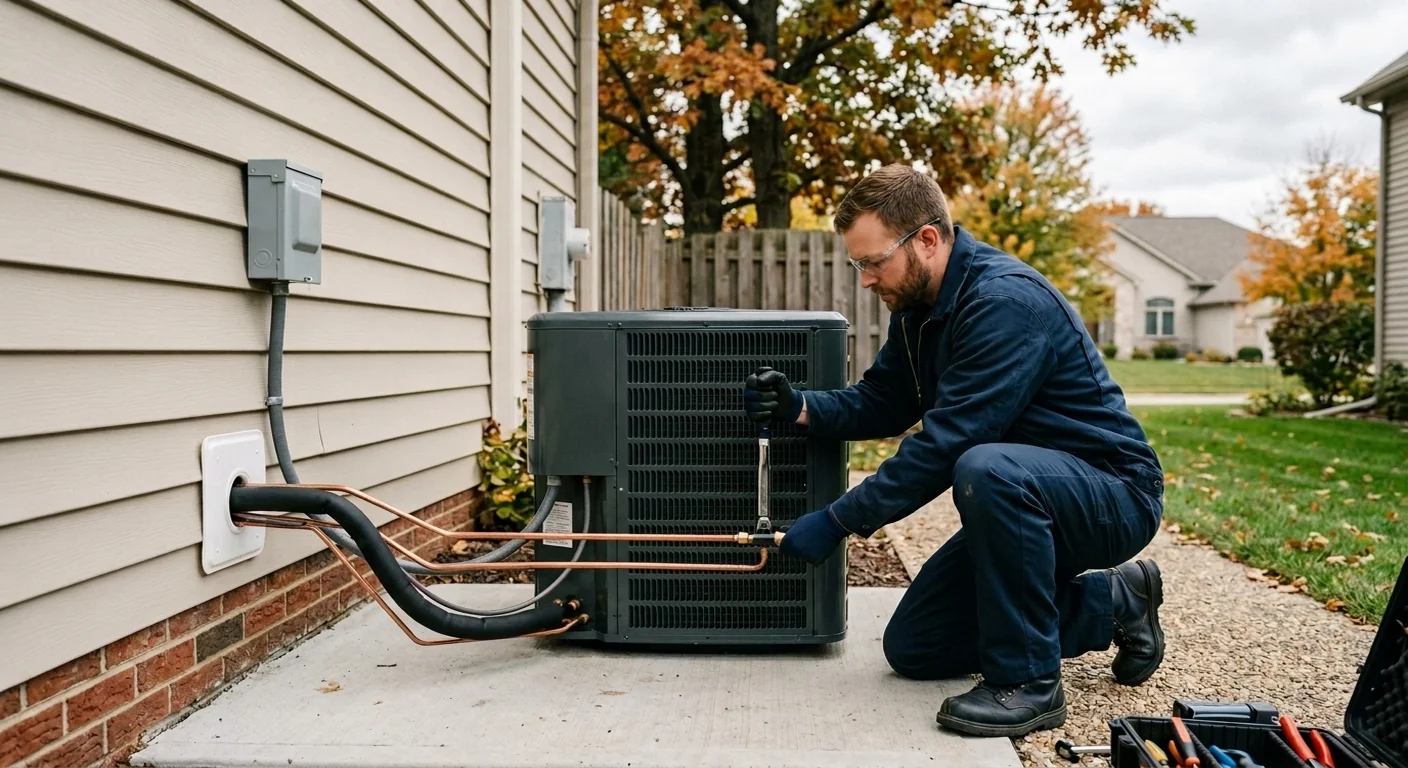
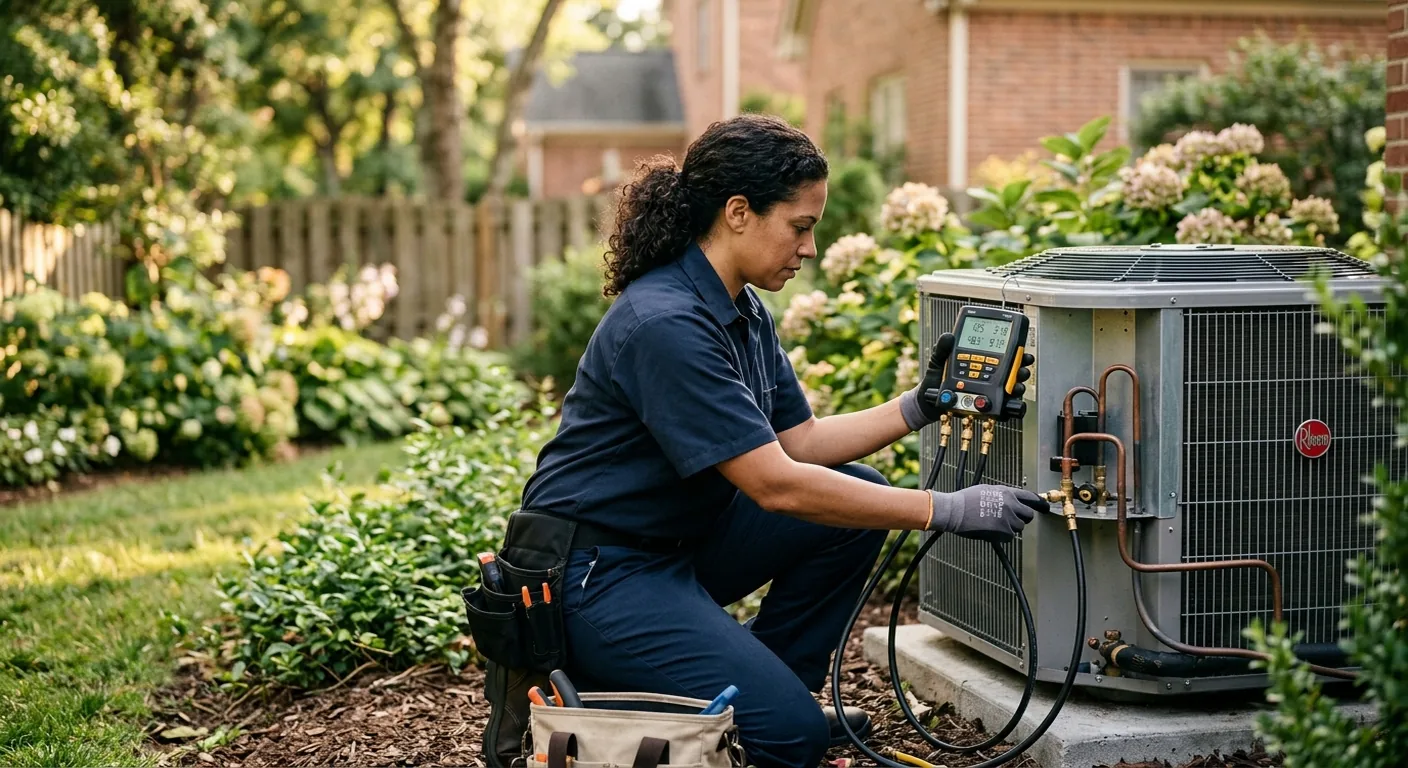
You service equipment in single-family and small multi-family homes. Typical equipment:
- 2–5 ton split-system air conditioners
- Furnaces (gas, electric, oil)
- Heat pumps (single-stage, two-stage, variable-speed inverter mini-splits)
- Mini-split ductless heads
- Heat-pump water heaters and indirect-fired tank water heaters
- Indoor air quality accessories (whole-home humidifiers, ERVs, UV lights)
The customer is the homeowner. Service calls are unscheduled emergencies (no cooling, no heat) on the operations side, and replace-or-repair quotes on the sales side. Most residential HVAC techs work for small-to-mid-size local contractors, regional comfort-systems chains (One Hour Heating & Air, Service Experts, Aire Serv), or franchised operations like Bryant or Trane factory dealers.
Commercial HVAC
You service equipment in offices, retail buildings, schools, hospitals, hotels, restaurants, light industrial, and big-box stores. Typical equipment:
- Packaged rooftop units (RTUs), 5–50+ tons
- Split systems with multi-zone evaporator coils
- Chillers (air-cooled and water-cooled, screw and centrifugal)
- Boilers (commercial gas-fired, modular, condensing)
- Variable-air-volume (VAV) systems with reheat coils
- Computer-room air conditioners (CRACs) and precision cooling
- Walk-in refrigeration in restaurants and grocery
- Cooling towers, pumps, and hydronic loops
- Building automation systems (BAS) — Tridium, Distech, Schneider, Honeywell, Johnson Controls
The customer is a property manager, facilities manager, or third-party building engineer. The work is dominated by planned maintenance contracts (PMs), with breakdown service as a smaller share. Employers are mechanical-services firms (EMCOR, Comfort Systems USA, Linc Service), national property-services companies (CBRE, JLL, Cushman & Wakefield in-house teams), institutional employers (universities, hospitals, government), and union locals (UA-affiliated mechanical contractors).
The two worlds use the same EPA 608 refrigerant license and similar fundamentals, but they diverge after the first year on the job.
The Pay Picture
The headline numbers, sorted by source.
National Median (BLS)
The Bureau of Labor Statistics OEWS publishes the only audit-grade wage data for the trade. May 2024 figures for SOC 49-9021:
- Median annual wage: $59,810
- Median hourly wage: $28.76
- 10th percentile (entry): $39,130
- 90th percentile (senior): $91,020
These are blended across residential and commercial. BLS reports industry-level breakouts on the OEWS detailed pages but does not split residential vs commercial as a single field — you have to triangulate from industry codes. Building equipment contractors (NAICS 23822, where most residential work sits) pay below the all-industry median. Wholesale trade and mechanical-services firms (where commercial work concentrates) pay above it.
Commercial Premium
Industry pay surveys are more granular. Housecall Pro’s 2026 Commercial HVAC Salary Guide reports an average commercial HVAC tech wage of about $31/hour ($65,448/year), vs an average residential rate of $54,228/year — roughly an $11,000 difference. Glassdoor’s commercial HVAC technician dataset reports a higher average ($78,081/year) reflecting senior techs in major metros. The gap shows up consistently across data sources.
Why the premium:
- Equipment complexity. Chillers, controls, and large-tonnage RTUs require specialized training, and that training is paid for in shop time.
- Year-round revenue. Residential service has a deep summer-and-winter peak with shoulder-season slumps. Commercial PM contracts run 12 months, so commercial techs stay on continuous payroll instead of going home early in October.
- Union density. A meaningfully larger share of commercial techs are unionized (UA, IBEW dual-cards on controls). Union wage scales for journey-level mechanical mechanics in major metros run $45–$70/hour total package including pension and health.
BAS Controls — The Top of the Ladder
Building automation systems (BAS) controls is the highest-paying specialty in the trade. The HVAC Career Map and the Green Buildings Career Map both list BAS as a destination role with significant earning potential above journey-level. Recent posted ranges:
- BAS technician journey level: $40–$55/hour, $80,000–$110,000/year all-in
- BAS controls programmer / senior BAS engineer: $55–$75+/hour, $115,000–$150,000/year
The BAS premium exists because the work spans HVAC, electrical, networking, and software. Modern controls deployments are essentially small distributed-systems IT projects layered over mechanical equipment — Tridium Niagara programming, BACnet/IP networks, MQTT brokers, and increasingly, integrations with cloud building-management platforms. Controls techs who can read a sequence of operations and push code to a JACE controller and speak to a facilities VP earn rates that look like junior software engineering rates — because in practice they’re doing similar work.
There is no equivalent specialty in residential HVAC. The closest residential analog is “comfort advisor” or “in-home sales consultant” — a sales-overlay role that can hit six figures with high commission but is structurally a sales job, not a tech job.
The Hours Question — Who Burns Out Faster
The pay gap is real, but pay isn’t why most techs leave the trade.
The Industry-Wide Number
The HVAC industry is roughly 110,000 technicians short — a 38% gap between open positions and available skilled workers, per ServiceTitan’s HVAC Technician Shortage analysis. About 70% of turnover is voluntary, and 60% of techs under 45 say they may leave field service entirely. MeasureQuick’s burnout coverage and Contracting Business — Preventing Burnout Builds Better HVAC Businesses document the same pattern: it’s not the work itself, it’s the schedule, the customer-pressure, and the lack of support.
The Residential Profile
Residential HVAC is harder on the body and the calendar.
- Heat waves and cold snaps drive 12-hour days. During July’s first 100°F week, a residential service tech might run 10–12 calls per day (vs 5–6 in shoulder season), with a 7am start and an 8pm finish. The same pattern hits in January. Source: BLS OOH work-environment narrative.
- On-call rotations. Most residential service shops run a one-in-four or one-in-five on-call week. A weekend on-call call usually pays a 2–4 hour minimum at 1.5x or 2x the regular rate, but it also kills the weekend. Source: Oxmaint — HVAC On-Call Technician Scheduling.
- Customer intensity. Homeowners are paying out-of-pocket for an emergency, often in distress. Most residential techs are also the salesperson for replacement quotes, which means they carry the diagnostic load and the close-rate metric.
- Attics and crawl spaces. Residential equipment lives where most people don’t go — 130°F attics in summer, frozen crawl spaces in winter, often accessed from a ladder while carrying refrigerant gauges.
The phrase that surfaces repeatedly in the MeasureQuick burnout writeup is “mentally exhausted” — particularly from techs in the residential service segment.
The Commercial Profile
Commercial HVAC has its own hazards but a different rhythm.
- Most work is scheduled. Planned-maintenance contracts run during business hours with predictable monthly visits per site. Emergency calls happen, but they’re a smaller share of the week.
- On-call exists but rotates more thinly. A commercial service contractor with 30 techs may have a single tech on call per night, so the rotation is one-in-thirty rather than one-in-four.
- Heights, electrical hazards, and refrigerant volume. Commercial RTUs live on flat roofs (fall hazard), chillers run hundreds of pounds of refrigerant (containment risk), and many commercial systems are 480V three-phase (arc-flash hazard). Personal protective equipment requirements are stricter and shop safety culture is generally more developed.
- Less customer-facing intensity. You’re talking to a property manager or facilities engineer, not a panicked homeowner. The conversations are more transactional and far less emotionally loaded.
The trade-off: commercial work is more physically demanding (rooftops, ladders, weight) but less emotionally and scheduling-demanding. For most techs that translates to lower burnout per year, even if the body wears at a similar rate.
Numbers and Schedules That Add Up
A residential service tech running ten calls a day in summer at $250–$400 average ticket is generating $2,500–$4,000 per day for the company, of which they take home a flat hourly + spiff commissions structure. A commercial PM tech running 4–6 sites a day on a contract is generating less daily revenue per site but on a fixed-price contract — the company’s economics don’t depend on each call closing a sale. That difference shapes the pressure on the tech.
The Skills Mix
The first 12 months of either path looks similar — refrigeration cycle, electrical fundamentals, EPA 608 compliance, basic equipment operation. The mid-career skills diverge sharply.
Residential Skill Stack
- Diagnostic flowchart fluency on common residential brands (Carrier, Trane, Goodman, Lennox, Rheem, York)
- Refrigerant transitions — particularly the R-410A → R-454B / R-32 changeover that landed in 2025
- Heat-pump fluency, especially cold-climate heat pumps (see our heat pump installer careers writeup for the IRA-driven demand picture)
- Static pressure and ductwork sizing (Manual D / Manual J / Manual S)
- Customer-facing diagnostics, sales presentations, financing forms
- IAQ sales (humidifiers, ERVs, air-purification accessories)
Commercial Skill Stack
- Multi-stage RTU diagnostics, economizer fault-finding
- Chiller fundamentals (water-cooled vs air-cooled, screw vs centrifugal vs absorption)
- Boiler fundamentals (low- and medium-pressure, hydronic loop balance)
- Pneumatic and DDC controls — increasingly DDC only as buildings retrofit
- BACnet, Modbus, and Tridium Niagara graphical programming
- Blueprint reading, mechanical schedule interpretation, sequence-of-operations reading
- Refrigeration system commissioning, leak rate compliance (EPA Section 608 refrigerant management thresholds for systems >50 lb charge)
- Variable-frequency drive (VFD) configuration and troubleshooting
A commercial tech who layers in BAS controls fluency in years 3–6 typically clears the BAS specialty income jump described above. A residential tech who layers in business and sales fluency in years 3–6 typically moves into a comfort-advisor or service-manager role — a different but real income jump.
The Career Ladder
Residential Ladder
- Apprentice / install helper — $16–$22/hour, ride-along training
- Install tech — $22–$30/hour, runs equipment swaps
- Service tech — $25–$35/hour, troubleshoots calls solo
- Senior service tech — $32–$42/hour, handles toughest diagnostics
- Comfort advisor / sales — $50–$120K base + commission, $100–$200K possible in hot markets
- Service manager — $70–$110K, runs a team of 6–20 techs
- Owner / GM of a comfort-systems franchise — variable, $150K–$500K+ depending on market
Most residential techs cap out around step 4 and either move into sales or open a small contracting shop. The trade-off is autonomy and earning ceiling vs the tech work itself.
Commercial Ladder
- Apprentice — $18–$25/hour, mechanical-contractor entry
- Journey-level mechanic — $30–$45/hour (non-union), $45–$70/hour total package (union)
- Senior service tech — chiller / RTU / refrigeration specialist, $40–$55/hour
- BAS controls technician — $45–$60/hour, $90–$120K
- BAS controls programmer / engineer — $55–$75+/hour, $115–$150K+
- Service manager — $90–$130K, runs commercial-service team
- Project manager / mechanical estimator — $100–$160K, runs new-construction or retrofit projects
The commercial ladder is wider — there are more lateral specializations (refrigeration, controls, water-source heat pumps, kitchen exhaust, healthcare HVAC) — and the top of each rung is generally higher. The trade-off is a slower climb, more required certification (NATE, EPA 608 universal, OSHA 30, sometimes a state journeyman card), and more geographic concentration in major metros.
For a deeper look at the certification ladder that supports either side, see our EPA 608 certification guide. For where this work sits in the broader skilled-trades labor market, see the heating, air conditioning, and refrigeration mechanics career profile.
Which to Pick Out of School
A clean decision framework.
Pick residential if:
- You want to be running calls solo within 6–12 months (faster autonomy).
- You’re in a small or mid-sized market without significant commercial-services employer presence.
- You’re considering eventual ownership of a small contracting shop.
- You’re comfortable with customer-facing sales and want the comfort-advisor income ceiling.
- You’d rather work alone in a customer’s home than on a roof or in a mechanical room with a crew.
Pick commercial if:
- You’re in a major metro (top 50) where mechanical-services firms, hospitals, universities, and union locals concentrate.
- You’d rather learn chillers, controls, and refrigeration than deal with homeowners’ billing decisions.
- You want the BAS controls income ladder to be available in years 3–6.
- You want predictable daytime hours and a less brutal on-call rotation.
- You’re considering a long-term career in field service rather than ownership.
A reasonable hybrid: spend 12–24 months in residential to build raw diagnostic speed (residential service runs more equipment per week than commercial PM does), then move to a commercial mechanical-services firm with a controls track. Several union apprenticeships, especially UA-affiliated mechanical-services locals, use this exact pattern: a year or two in basic install/service, then assignment to a commercial controls or specialty crew. The reverse path (commercial → residential) is rarer because residential employers value commercial chiller and controls fluency less than commercial employers value residential speed.
For a comprehensive labor-market view, the HVAC career opportunities overview and best HVAC schools pages cover the credentialing and program side. To browse accredited programs in your state, start with our trade college directory.
Sources
- U.S. Bureau of Labor Statistics — Occupational Outlook Handbook: Heating, Air Conditioning, and Refrigeration Mechanics and Installers — May 2024 wage and outlook — bls.gov/ooh/installation-maintenance-and-repair/heating-air-conditioning-and-refrigeration-mechanics-and-installers.htm
- U.S. Bureau of Labor Statistics — Occupational Employment and Wage Statistics: 49-9021 Heating, Air Conditioning, and Refrigeration Mechanics and Installers — bls.gov/oes/current/oes499021.htm
- Housecall Pro — Commercial HVAC Salary Guide 2026: State-by-State Breakdown — housecallpro.com/resources/commercial-hvac-technician-salary
- ServiceTitan — HVAC Technician Salary Guide for 2026, State-by-State — servicetitan.com/blog/hvac-technician-salary
- ServiceTitan — HVAC Technician Shortage: Causes, Impacts, Strategies — servicetitan.com/blog/hvac-technician-shortage
- HVAC Career Map — Building Automation Systems Technician — hvaccareermap.org/jobs/building-automated-systems-technician
- Green Buildings Career Map — Building Automation Systems Technician — greenbuildingscareermap.org/jobs/building-automation-systems-technician
- MeasureQuick — HVAC Technician Burnout: The Support System That Doesn’t Exist — measurequick.com/hvac-technician-burnout-the-support-system-that-doesnt-exist
- Contracting Business — Preventing Burnout Builds Better HVAC Businesses — contractingbusiness.com/columns/the-first-word/article/55310849/preventing-burnout-builds-better-hvac-businesses
- Glassdoor — Commercial HVAC Technician Average Salary & Pay Trends 2026 — glassdoor.com/Salaries/commercial-hvac-technician-salary-SRCH_KO0,26.htm