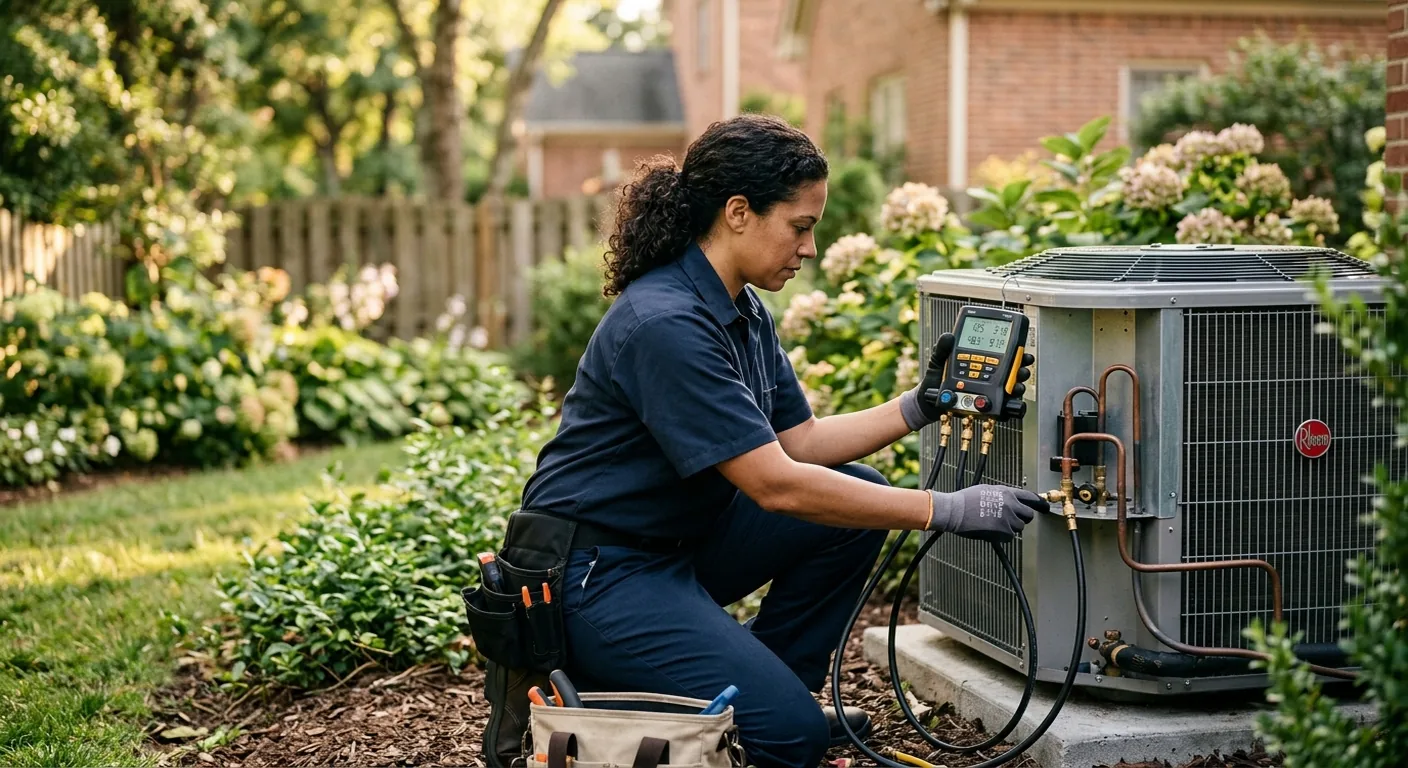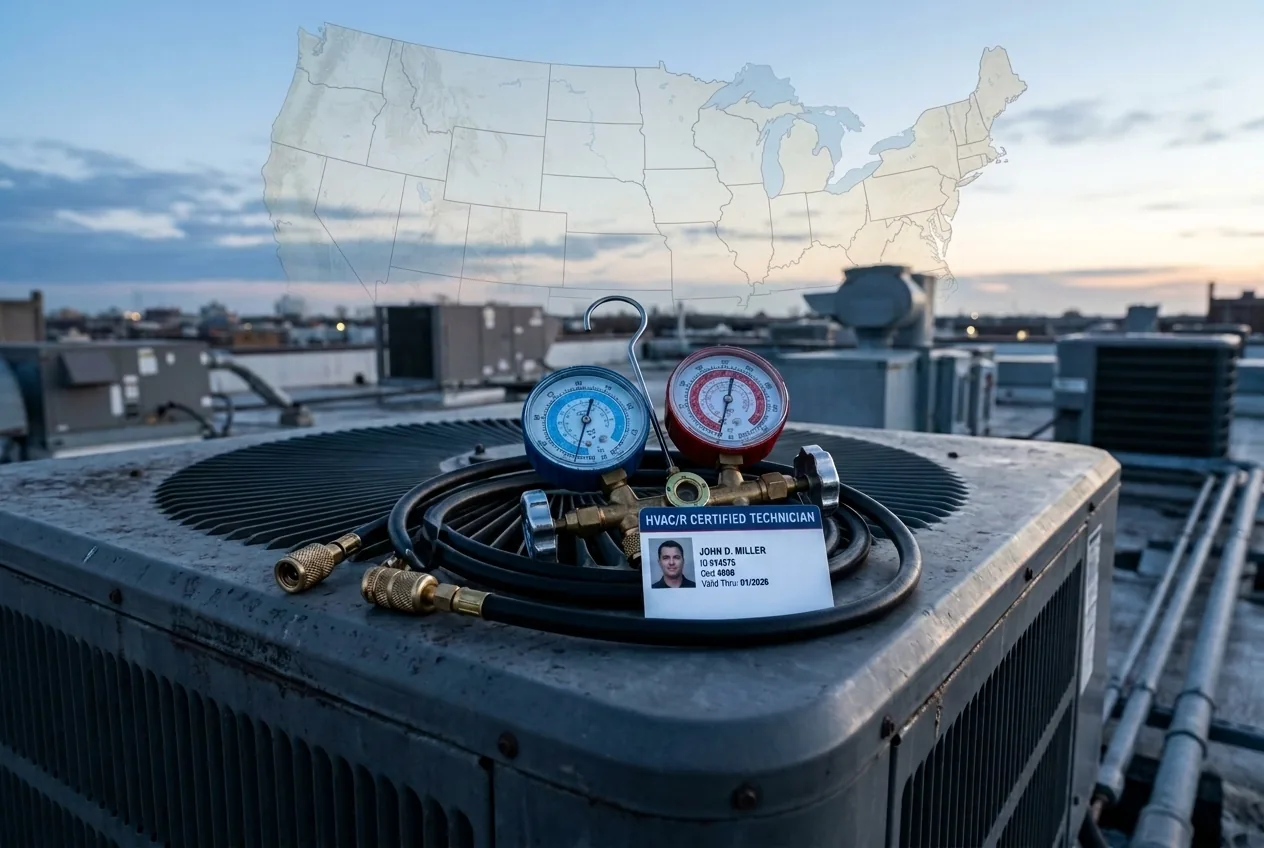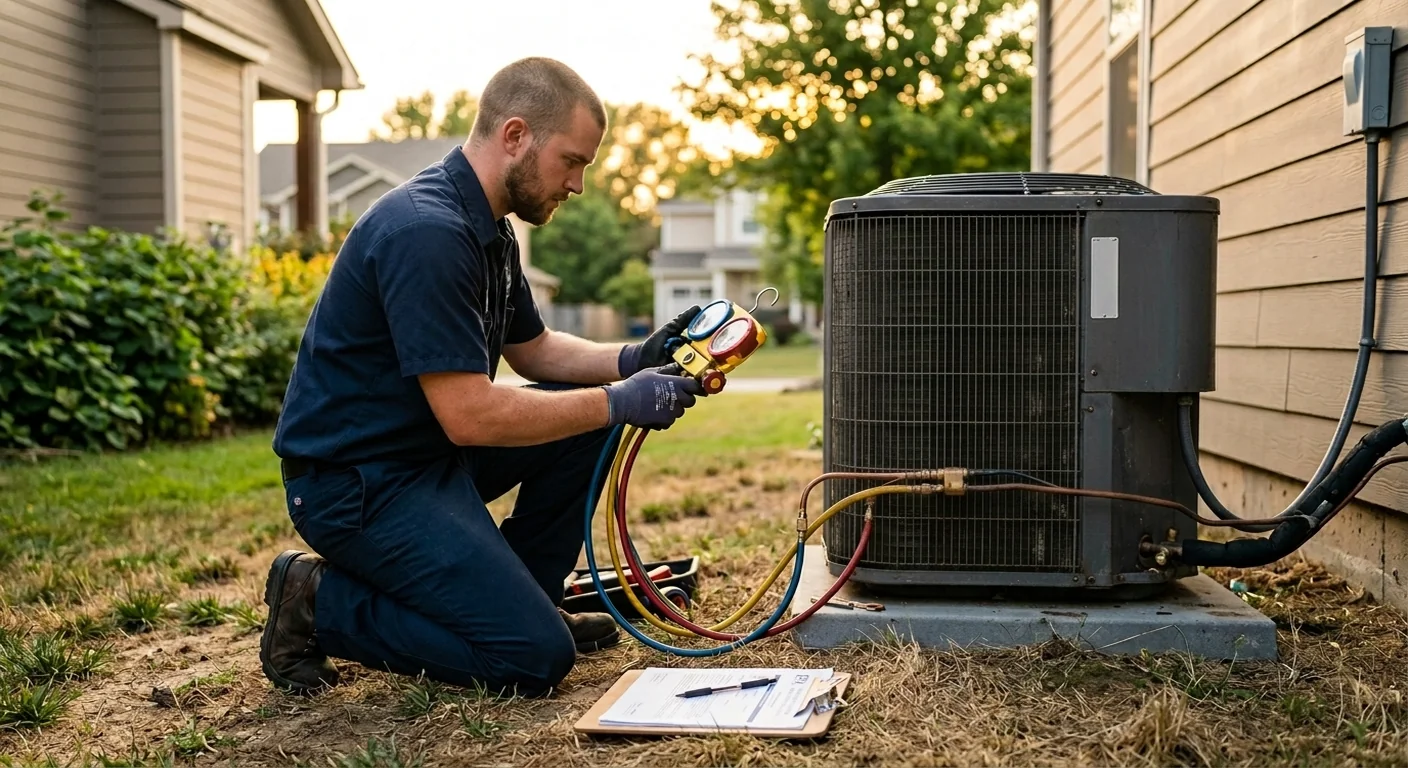

You cannot legally open a refrigerant line in the United States without an EPA Section 608 certification. This isn’t a state license, an industry credential, or a “nice to have” — it’s a federal rule under the Clean Air Act, and the U.S. Environmental Protection Agency’s Section 608 technician certification requirements make it a precondition for buying refrigerant, recovering refrigerant, and servicing virtually every air-conditioning, refrigeration, or heat-pump system in the country.
The credential is also the cheapest, fastest, and most permanent certification in the HVAC trade: pass the exam once and you are federally certified for life. The rule is simple. The Type structure is what trips people up.
This guide walks the four Types — I, II, III, and Universal — in plain language: what each one legally lets you work on, how the exam is structured, why Universal certification has a special proctoring rule, what it costs, where to test, and what to actually study before you walk in.
Why EPA 608 Exists
Section 608 of the Clean Air Act regulates the use, recovery, and disposal of ozone-depleting and high-global-warming-potential refrigerants — including HFCs like R-410A, R-134a, and R-32, plus legacy and transitional refrigerants. The EPA’s enforcement reach covers anyone who “maintains, services, repairs, or disposes of” stationary appliances containing regulated refrigerant.
The certification is per-technician, not per-company. Your employer cannot transfer their certification to you. You hold yours. You can move between employers, states, and even careers and re-enter the trade without retesting.
There is one small but important boundary: EPA’s Section 609 is a separate certification for servicing motor vehicle air conditioning. If you only work on cars, 609 is the right credential. If you work on residential, commercial, or refrigeration systems — anything that doesn’t sit on wheels — 608 is what you need.
The Four Types in One Table
| Type | What it covers | Equipment examples |
|---|---|---|
| Type I | Small appliances containing 5 lbs of refrigerant or less, manufactured with a fully assembled refrigerant circuit | Window AC units, domestic refrigerators and freezers, dehumidifiers, water coolers, vending machines, packaged terminal AC (PTAC) units |
| Type II | High-pressure and very-high-pressure appliances (except small appliances and motor-vehicle AC) | Residential split-system AC, residential and light-commercial heat pumps, packaged rooftop units, supermarket refrigeration racks, R-410A / R-32 / R-454B systems |
| Type III | Low-pressure appliances | Centrifugal chillers (R-123, R-1233zd), large building-cooling systems |
| Universal | Core + Type I + Type II + Type III | Any regulated appliance |
Pick the wrong Type and you are technically not authorized to recover or service that equipment, even if you are physically capable of doing the work. Many techs who tested only for Type II early in their careers discover this when their first commercial-chiller call comes in.
The Core Exam — and Why It Is Different
Every EPA 608 candidate takes a Core exam in addition to the Type exams they want. Core covers the regulatory framework: ozone depletion, the Montreal Protocol, refrigerant phaseouts, recovery and recycling rules, leak repair requirements, recordkeeping, and refrigerant safety basics.
Per the ESCO Institute Section 608 program, each section of the EPA 608 exam contains 25 questions, and a candidate must answer 18 correctly — a 70% passing threshold — to earn certification on that section. You can pass Core and one Type while failing another Type, and you only have to retake the section you failed.
The Proctored-Core Rule for Universal
This is the rule that surprises new techs and is worth memorizing.
The Type I exam is the only section that may be taken via an online open-book format. Type II, Type III, and the Core exam must be proctored. Critically, if you want Universal certification, your Core exam must specifically be a proctored Core — even if you already passed an open-book Core for Type I separately.
In practice this means:
- If you only need Type I (working on small appliances), you can take an online open-book exam and you are done.
- If you need Type II or Type III, your Core and your Type exam are both proctored.
- If you want Universal, plan a single proctored sitting that covers Core + I + II + III.
The proctoring requirement isn’t an obstacle — it’s typically a 2–3 hour testing block at a community college, trade school, or training-center proctoring site. But you need to schedule a proctored seat from the start. People who pass an open-book Core and later try to add Type II discover they cannot upgrade to Universal without re-sitting Core under a proctor.
Cost and Where to Test
Three EPA-approved organizations administer the bulk of 608 testing in the country:
- ESCO Institute — partners with most HVAC trade schools and community colleges; the most common testing route for tech-school students.
- Mainstream Engineering — operator of EPATest.com and a long-standing EPA-approved certifier; both online open-book Type I and proctored testing options.
- Refrigeration Service Engineers Society (RSES) — administers proctored 608 testing through its 200+ chapters nationwide, oriented toward working professionals.
Other EPA-approved providers exist (the agency maintains a published list), but those three cover most candidates.
Realistic costs:
| Format | Typical cost |
|---|---|
| Online open-book Type I only | $20–$30 |
| Proctored Core + one Type | $50–$80 |
| Proctored Core + I + II + III (Universal) | $80–$150 |
| Retake of a single failed section | $10–$30 |
Most HVAC trade school and community college HVAC certificate programs include 608 prep and a proctored testing session in tuition. If your program does not, budget around $100 for a Universal sitting.
EPA 608 Does Not Expire
Per EPA rule, Section 608 certification is lifetime. It does not need renewal, continuing education, or any periodic refresher. Pass once and the credential travels with you.
This matters for two reasons:
- Career flexibility. Techs who leave HVAC for a few years and return don’t need to retest. The certification remains valid.
- The math on Universal. If Type II is enough today and you’ll never touch a chiller, the open-book or proctored Type II is fine. But if you might ever work on small appliances or low-pressure chillers in your career — and that’s most techs — testing Universal once is a one-time $30–$70 upgrade that you never have to revisit. The cost-benefit on Universal almost always favors getting it the first time you sit.
What to Actually Study
The exam is multiple choice and the question pool is well-known. Most candidates pass with 20–30 hours of focused study spread across two to three weeks. Trade-school students taking 608 at the end of a certificate program typically need less because the curriculum has already covered most of the material.
The breakdown by section:
Core (regulatory)
The single highest-yield section to study. Topics:
- Stratospheric ozone, ozone depletion potential (ODP), and global warming potential (GWP)
- Clean Air Act refrigerant rules
- Refrigerant recovery, recycling, and reclamation distinctions
- Leak rate thresholds (currently 10% for refrigeration, 20% for residential — verify current rule before testing)
- Recordkeeping and disposal rules
- Major refrigerant categories: CFC, HCFC, HFC, HFO
The questions are mostly definitional. If you can confidently distinguish recovery from recycling and reclamation, name the major refrigerant categories, and recite the basic leak repair timeline, you can pass Core.
Type I (small appliances)
- Definition of “small appliance” (5 lbs refrigerant or less, factory-charged sealed system)
- Recovery requirements for small appliances
- Use of system-dependent vs self-contained recovery devices
- Proper disposal of small appliances and the “final RCRA disposer” rule
The shortest section. Most experienced techs pass it cold.
Type II (high-pressure)
- Pressure-temperature relationships for common high-pressure refrigerants
- Recovery techniques for high-pressure systems
- Refrigerant leak detection methods (electronic, soap bubble, fluorescent tracer, ultrasonic)
- Service/repair requirements for HCFC-22 retrofits and the R-410A → R-32 / R-454B transition
- Non-condensable purging
The longest study list. Practical service experience helps a lot here.
Type III (low-pressure)
- Centrifugal chiller fundamentals
- Vacuum measurement and dehydration on low-pressure systems
- Triple evacuation and rupture-disk safety considerations
- Refrigerant management on chillers
The smallest tech population takes Type III seriously, but it’s the easiest section to pass with focused study because the question pool is narrow.
Most candidates use a paid prep package from ESCO, Mainstream, or a tech-school study guide. There are also free practice tests online — those are useful for gauging readiness, not for primary study.
Common Mistakes
1. Taking online Type I only and assuming you can upgrade later without re-sitting Core. You can — but only via a proctored Core. Plan for proctored from the start if Universal is the eventual goal.
2. Studying Core casually because “regulations are boring.” Core is the section most candidates fail. Eighty percent of the question pool is Core regulatory definitions. Take it seriously.
3. Ignoring the R-410A → R-32 / R-454B transition. New residential equipment is shifting away from R-410A. Type II questions increasingly cover the new lower-GWP refrigerants. Make sure your study guide is current to 2025/2026 — not a 2018-era PDF you found online.
4. Confusing 608 with 609. 608 is for stationary equipment. 609 is for motor vehicle AC. Mobile HVAC and heavy-truck cab AC sit in 609 territory. If your work crosses both categories (some fleet-service techs), get both.
5. Letting your employer pay for it without holding a copy of your card. The certification is per-technician. Always keep a personal copy of your certification card. If you change employers, you need it on hand.
How EPA 608 Fits Into the Bigger Path
EPA 608 is the federal credential. It is not the only HVAC certification you’ll want to add over a career.
- NATE certification — voluntary, but the industry-standard quality signal employers look for after year 2 or 3. Costs $150–$250 and renews every 2 years. Covers a Core plus a chosen specialty (Air Conditioning, Heat Pump, Gas Heating, Commercial Refrigeration, etc.). For a fuller breakdown of how NATE fits into a tech’s pay trajectory, see how to become an HVAC technician.
- State HVAC license — required for individual technicians in some states (CA, AZ, TX, NC, FL, VA among others) and required for contractors in most. State licensing rules vary widely; check your specific state’s rules before counting on a credential pathway.
- Manufacturer-specific credentials — Carrier, Trane, Lennox, Daikin, Mitsubishi, and others run brand-specific service training, often required for warranty work on their equipment. These typically come once you’re employed by a dealer-network shop.
Of these, EPA 608 is the only one that is federally mandated, that costs less than $100, and that lasts a lifetime. Take it first, take it once, and aim for Universal.
Practical Path: Test-and-Done in Two Weeks
If you’re aiming to walk in with EPA 608 Universal as a credential before applying for a first HVAC job, the realistic schedule:
| Step | Time | Cost |
|---|---|---|
| Buy an ESCO or Mainstream Universal study guide | Day 1 | $20–$50 |
| Self-study Core + Type I + II + III | 20–30 hours over 2 weeks | — |
| Take a free or paid online practice test | Day 12–14 | $0–$30 |
| Schedule a proctored Universal exam | Day 14 | — |
| Sit Universal proctored exam | Day 14–21 | $80–$150 |
| Receive certification card | 1–4 weeks after | — |
Total out-of-pocket: roughly $100–$230 for a lifetime federal credential.
Where to Go From Here
The 608 is a gate, not a destination. Once you have it, the path forward typically runs through one of three on-ramps:
- A trade school certificate program — see best HVAC schools for IPEDS-ranked options
- A registered apprenticeship — see apprenticeships explained for how the union and non-union pipelines work
- An entry-level service helper role with a contractor that puts you through 608 prep on the job
For the full credentialing roadmap from EPA 608 through journeyman pay, see how to become an HVAC technician. For the broader career outlook, HVAC career opportunities. For an aggregated directory of training programs, see the HVAC program directory.
The EPA 608 is the single highest leverage credential in the trade per dollar and per hour of study. It does not expire, the cost is modest, and Universal is rarely the wrong call. Test once, test for everything, and never have to think about it again.
Sources
- U.S. Environmental Protection Agency — “Section 608 Technician Certification Requirements” — Official federal refrigerant handling rules — https://www.epa.gov/section608/section-608-technician-certification-requirements
- U.S. Environmental Protection Agency — “Section 609 Technician Training and Certification Programs” — Distinction between 608 (stationary) and 609 (motor vehicle AC) — https://www.epa.gov/mvac/section-609-technician-training-and-certification-programs
- ESCO Institute — “Section 608 EPA Certification” — Exam structure, 25-question/18-correct passing threshold, proctored vs online format rules — https://www.escogroup.org/training/epa608.aspx
- U.S. Bureau of Labor Statistics — “Heating, Air Conditioning, and Refrigeration Mechanics and Installers” Occupational Outlook Handbook — May 2024 wage and employment data — https://www.bls.gov/ooh/installation-maintenance-and-repair/heating-air-conditioning-and-refrigeration-mechanics-and-installers.htm
- North American Technician Excellence (NATE) — “NATE Professional Certification Exams” — Specialty exam list and renewal cycle — https://natex.org/technician/take-an-exam/nate-certification-exams