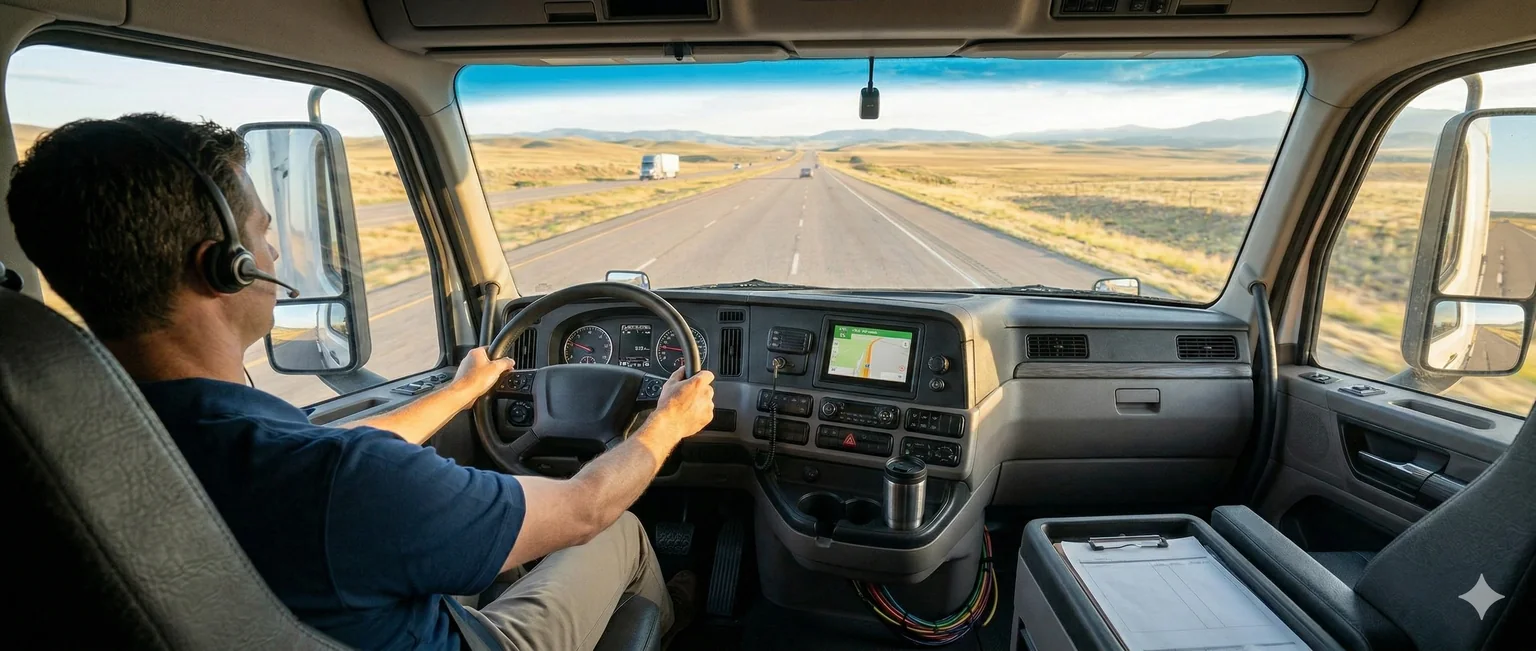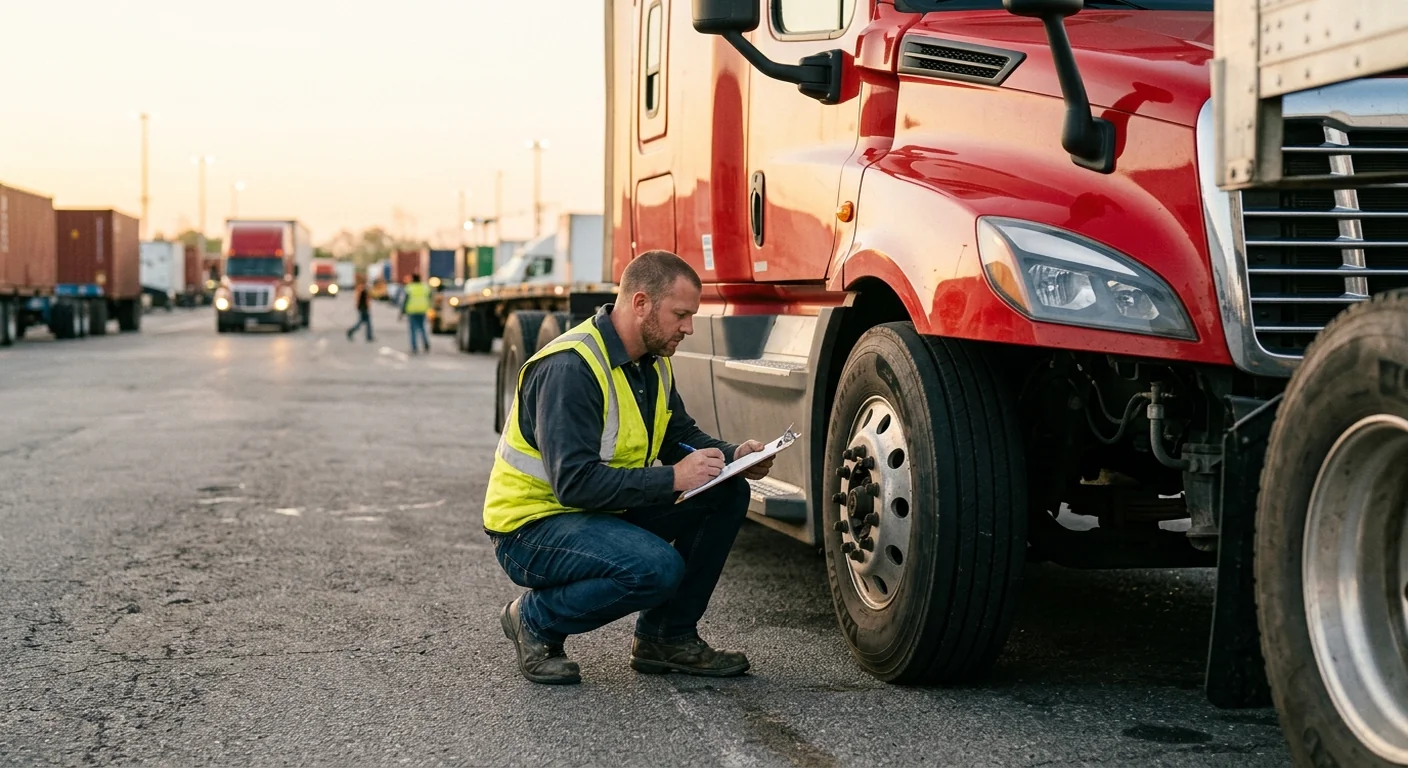

Truck driving is the fastest skilled-trade entry in the country. There’s no apprenticeship, no multi-year journeyman path, and no state license stacked on top of a federal one. You complete a federally-mandated training program, pass a skills test, and you’re working — typically within 3 to 8 weeks of starting. The BLS Occupational Outlook Handbook lists the May 2024 median wage at $57,440, 4% projected employment growth through 2034, and roughly 237,600 openings every year — one of the largest absolute hiring numbers of any single occupation in the U.S. economy.
What trips most aspiring drivers up isn’t the test or the training. It’s the early decision about how to train — paying $5,000+ for a private CDL school vs accepting paid training from a carrier that comes with a 1–2 year employment contract — and the lifestyle decision about what kind of freight you want to haul. This guide walks the full path: baseline requirements, getting your Commercial Learner’s Permit, the ELDT training requirement, the skills test, what you earn at each stage, and the realistic math on going owner-operator.
Step 1: Meet the Baseline Requirements
The fixed gates are tighter than most trades, because the federal government regulates the qualification process directly through the FMCSA and DOT:
- Age: 21 or older for interstate (across-state-line) driving and any hazardous materials hauling. 18 to 20 is allowed for intrastate-only driving in most states, with limited freight types.
- Driver’s license: A valid state driver’s license in good standing. Excessive moving violations or a suspended license will disqualify you.
- DOT physical: A medical exam by a DOT-certified medical examiner, valid for up to 24 months. Vision (20/40 corrected, color vision for traffic signals), hearing, blood pressure, blood sugar, and disqualifying conditions like uncontrolled epilepsy or insulin-dependent diabetes (with some federal exemption pathways) are checked.
- Driving record: No DUI/DWI in the prior 1–3 years for most carriers; some carriers are stricter and look back further. No serious moving violations (reckless driving, leaving the scene of an accident).
- Drug screening: Federally mandated pre-employment testing plus random testing throughout your career via the FMCSA Drug & Alcohol Clearinghouse.
- English proficiency: Required by federal regulation — you must be able to read road signs, complete logs, and communicate with officials.
A felony record doesn’t automatically disqualify you, but specific freight types (hazmat, tanker, government contracts, port access) have additional background-check requirements. Disclose honestly on applications.
Step 2: Get Your Commercial Learner’s Permit (CLP)
Before you can train behind the wheel, you need a Commercial Learner’s Permit from your state DMV. The CLP application requires:
- Knowledge tests: A general knowledge exam plus tests for any endorsements you want (air brakes, combination vehicles, doubles/triples, tankers, hazmat, passenger, school bus). Most Class A applicants take general knowledge + air brakes + combination at minimum.
- Identity and residency documents: Standard DMV requirements plus proof of legal U.S. presence.
- DOT physical certificate: Submitted to the state DMV.
The CLP costs $10–$100 depending on state, is typically valid for 180 days, and can be renewed once for another 180 days. With a CLP you can drive a commercial vehicle on public roads only when accompanied by a fully licensed CDL holder in the front seat.
You usually have to hold your CLP for at least 14 days before you’re allowed to take the CDL skills test.
Step 3: Choose Your Training Pathway
This is the pivotal decision and is where most of the financial outcome over your first two years gets decided.
Under the FMCSA Entry-Level Driver Training (ELDT) regulation, effective February 7, 2022, every first-time Class A or Class B applicant — and anyone adding S (school bus), P (passenger), or H (hazmat) endorsements — must complete training from a provider listed on the FMCSA Training Provider Registry before sitting for the skills test. There is no longer a “study the manual and walk into the DMV” pathway. To skip the registry lookup, we maintain state-by-state directories of every registry-listed school that accepts the public — see, for example, CDL schools in Texas, Ohio, or Georgia.
You have three real options:
Private CDL School (Community College or Standalone)
Independent CDL schools and community college programs run 3 to 6 weeks full-time for Class A. Tuition typically runs $3,000 to $10,000, with total cost (fees, lodging if you travel for school, living expenses) often reaching $9,000+. Community college programs are usually on the lower end and may qualify for federal financial aid via Pell grants or Workforce Investment Act funding; standalone schools often don’t.
Pros: You’re free to take any job after graduation. No employment contract. Cons: You pay up front. Job placement after a private school is your responsibility — most schools have hiring relationships with carriers but don’t guarantee placement.
Company-Sponsored Paid Training
Most large carriers — Schneider, Roehl, Werner, Knight, Swift, C.R. England, USA Truck — run their own CDL training programs registered with the FMCSA Training Provider Registry. The structure typically is: you arrive at a training terminal, complete classroom theory and behind-the-wheel training over 3 to 8 weeks, and graduate as a hired driver from that carrier.
Schneider, for example, runs a 5- to 7.5-week paid CDL apprenticeship program. Roehl Transport’s paid on-the-job training takes about 3 weeks; trainees are W-2 employees from day one, paid roughly $616 per week, with lodging and most meals covered.
The catch: paid training comes with an employment contract, typically 12 to 24 months. If you leave early, you’re on the hook for the prorated training cost — usually $3,000–$7,000.
Pros: No tuition out of pocket. Paid during training. Guaranteed first job. Cons: You’re locked into a specific carrier for 1–2 years. If the carrier’s lanes, freight type, or home time don’t suit you, you eat the buyout or stay until the contract clears.
Several carriers also offer tuition reimbursement instead of (or in addition to) paid training — Roehl reimburses up to $6,000 for qualifying CDL school graduates, and Melton Truck Lines reimburses up to $10,000. If you complete a private CDL school first, this can effectively zero out your tuition cost over your first year of work.
Workforce Programs and Apprenticeships
A growing number of registered apprenticeship programs for truck driving exist through state workforce boards, the U.S. Department of Labor’s Apprenticeship.gov, and some carrier partnerships. These programs typically combine paid OJT with classroom hours and may be funded through Workforce Innovation and Opportunity Act (WIOA) money, GI Bill benefits for veterans, or state grants.
For the broader funding landscape — Pell grants, WIOA funding, GI Bill, employer reimbursement — see our guide on financing trade school.
Step 4: Complete ELDT Theory and Behind-the-Wheel Training
The FMCSA’s ELDT curriculum is standardized at the federal level. It splits into two components:
Theory (knowledge) instruction covers 30+ specific topics: basic operation, safe operating procedures, advanced operating procedures (skid recovery, jackknifing, distracted/aggressive driving), vehicle systems, fueling, post-crash procedures, hours of service, and others. The curriculum requires demonstrated mastery — you must score at least 80% on a written assessment to complete the theory portion.
Behind-the-wheel (BTW) training splits into range and public road skills. The federal regulation explicitly does not require a minimum number of hours for BTW; instead, completion is based on the instructor’s documented assessment that you can perform each required maneuver proficiently. In practice, BTW typically runs 40–60 hours for Class A applicants, with skill checks across pre-trip inspection, basic vehicle controls (alley dock, parallel park, straight-line back), and on-road driving.
Theory and BTW can be delivered by separate registered providers; both must be on the FMCSA Training Provider Registry, and both submit your training certification to FMCSA before you can sit for the skills test.
Step 5: Pass the CDL Skills Test
The CDL skills test is administered by your state DMV (or a state-authorized third-party tester) and consists of three parts, taken in the same vehicle:
- Pre-trip inspection — verbally walk through and demonstrate inspection of the tractor, trailer, and air brake system. Roughly 60–90 minutes.
- Basic vehicle control — alley dock, parallel park (driver-side and passenger-side), and straight-line back, demonstrated on a closed range with strict scoring on encroachments and pull-ups.
- Road test — 30–60 minutes of public-road driving with the examiner scoring lane control, signaling, intersection handling, gear selection, and hill/grade management.
Total skills test cost is $50–$300 depending on the state and whether you use a third-party tester. Most states allow two or three attempts before requiring re-training.
Once you pass, you’re a Class A CDL holder. Most states allow you to add endorsements (hazmat, tanker, doubles/triples) by passing additional knowledge tests; hazmat additionally requires a TSA security threat assessment background check.
What You Earn at Each Stage
BLS data for May 2024: median $57,440, top 10% over $76,000. But within the trade, pay is heavily stratified by experience, freight type, and route. Here’s a realistic earnings curve for a typical OTR (over-the-road) Class A driver path:
| Stage | Timeline from start | Typical pay | Annual range |
|---|---|---|---|
| Trainee (paid CDL training) | Weeks 1–8 | ~$500–$700/week | $4,000–$5,500 in training |
| Solo company driver, first year | Year 1 | $0.40–$0.55/mile (or salary equiv.) | $50,000–$70,000 |
| Solo company driver, year 2–3 | Year 2–3 | $0.55–$0.70/mile | $65,000–$85,000 |
| Senior / specialty company driver | Year 3+ | $0.65–$0.85/mile + bonuses | $75,000–$110,000 |
| Owner-operator (leased to carrier) | Year 2+ (after experience requirement) | $1.30–$1.80/mile gross | $80,000–$140,000 net (after expenses) |
| Owner-operator (own authority) | Year 5+ | $2.50–$4.00/mile gross | $100,000–$180,000+ net |
| Tanker / hazmat / heavy haul specialist | Year 3+ | Premium pay | $80,000–$130,000+ |
| Local / dedicated route (home daily) | Any | $25–$35/hr or salary | $55,000–$90,000 |
(The mileage rates above are typical for the 2024–2025 OTR market. Pay-per-mile rates in 2025 generally range $0.55–$0.75/mile for company drivers, with the top end going to senior solo drivers and specialty freight.)
The most important compensation variable in your first two years is miles, not rate per mile. A new driver at a high-mileage carrier (10,000+ miles/month) can out-earn a more experienced driver at a low-mileage carrier even at a lower per-mile rate. Watch the carrier’s actual average miles per month for first-year drivers, not just the headline pay-per-mile number.
For the broader career picture across trucking — including freight types, demographics, and industry trends — see our guide on truck driving career opportunities.
Step 6: Choose Your Freight Type
OTR (over-the-road) is the default starting point for most new Class A drivers because the high-mileage carriers run the largest training programs. But once you have 6–24 months of experience, you can branch into freight types with better lifestyle or pay:
- Regional — typically 500–800 mile lanes, home weekly or every 5 days. Pay roughly the same as OTR; lifestyle is meaningfully better.
- Dedicated — same lane, same customer (e.g., a manufacturer’s plant to a distribution center). Predictable schedule, often home daily or 3–4 nights a week.
- Local / city P&D (pickup and delivery) — home every night. Lower mileage, often hourly pay or salary. The trade-off: more loading/unloading work and tighter time windows.
- LTL (less-than-truckload) — operating a hub-and-spoke network for FedEx Freight, Old Dominion, ABF, etc. Often unionized (Teamsters at YRC/Yellow legacy carriers) with strong pension and benefits.
- Tanker — liquid bulk (food-grade, fuel, chemicals). Premium pay, requires N (tanker) endorsement. Specialized loading skill.
- Flatbed / heavy haul / oversize — premium pay for tarping, securement, and oversize-load handling. Physically demanding.
- Hazmat — H endorsement required (TSA background check, additional knowledge test). Adds 5–15% pay across most freight types.
- Auto hauler — among the highest-paid OTR specialties; requires patience for slow loading/unloading and high-value cargo handling.
Step 7: Optional — Going Owner-Operator
The owner-operator path is where the largest income upside in trucking sits — and where the largest financial trap is. Industry estimates put owner-operators earning anywhere from $80,000 to $200,000+ net, with gross revenue often well over $300,000, but the reality depends entirely on which path you take.
Lease-purchase programs offered by carriers: The carrier “leases” you a truck and deducts payments, insurance, fuel, and maintenance from your settlements. The pitch is “be your own boss in 12 months.” The reality, for most drivers in most years, is that the deductions consume the entire revenue uplift, and you end up earning the same as a company driver while carrying the legal and tax burden of self-employment. Be skeptical.
Buying or financing your own truck and leasing on to a carrier: You buy a used Class 8 tractor (typically $40,000–$120,000 used), lease on to a carrier under their authority and insurance, and run their freight at a percentage split (typically 65–80% of line haul) or a per-mile rate. Realistic net after fuel ($0.50–$0.70/mile), maintenance ($0.10–$0.15/mile), insurance ($8,000–$15,000/year), permits, IFTA, and truck payments lands at $80,000–$140,000 for most operators.
Operating under your own authority: You apply for your own DOT and MC numbers, secure your own insurance (typically $12,000–$25,000/year), and find your own freight via load boards and direct shippers. The revenue upside is meaningfully higher (you keep 100% of line haul), but you take on the load of running a business: dispatch, billing, collections, compliance, and marketing. Successful single-truck operators with their own authority routinely net $120,000–$180,000+, with the catch that 6+ months of experience plus business and financial discipline are required to make it work.
The honest framing: don’t go owner-operator until you have at least 18–24 months of company driving experience, you’ve watched what successful owner-operators in your network actually earn (not what marketing pitches claim), and you have an emergency fund of at least $20,000 for the first major repair.
Timeline and Cost Summary
| Path | Time to first paycheck | Out-of-pocket cost |
|---|---|---|
| Private CDL school + job hunt | 6–10 weeks | $3,000–$10,000 tuition + DMV fees |
| Company-sponsored paid training | 3–8 weeks | ~$0 (sometimes refundable deposit) |
| CDL school + tuition-reimbursing carrier | 6–10 weeks | $3,000–$10,000 up front, refunded over 12 months on the job |
| Workforce / WIOA / GI Bill funded | Varies | Often $0 if eligible |
CLP knowledge testing: $10–$100. CDL skills test: $50–$300. DOT physical: $80–$150 (often paid by hiring carrier). Endorsements (H, N, T, P, S): $10–$100 each plus TSA background check for hazmat.
Three Mistakes That Slow People Down
1. Picking a CDL school not on the FMCSA Training Provider Registry. Under the ELDT rule, a school that isn’t TPR-registered cannot legally certify your training. If your school can’t show you their TPR listing, walk away — no certified training means no skills test eligibility.
2. Signing a paid-training contract without reading the buyout schedule. Carrier-sponsored training contracts typically prorate the buyout. Some prorate evenly over 12 months ($500/month forgiven); others backload the forgiveness so you owe nearly the full amount even after 9 months. Read the math before you sign — and assume you might want to switch carriers within the first year.
3. Going owner-operator on month 13 because your training contract just cleared. The single biggest financial mistake in trucking is jumping into a lease-purchase or owner-operator program with under 18 months of experience. The math doesn’t work without enough experience to negotiate decent freight rates, and the truck payment doesn’t pause if your lane gets disrupted.
Where This Path Leads
The trucking career has well-defined long-term branches:
- Senior solo company driver — the most common career end-state; six-figure earnings achievable in specialty freight, hazmat, or heavy haul
- Local/regional driver, home daily — lower top-end pay, but a sustainable lifestyle that more drivers transition into after their OTR years
- Owner-operator (leased) — middle of the income range, less business-overhead burden than own-authority
- Owner-operator (own authority) — top of the income range, with the trade-off of being a small-business operator
- Trainer / driver instructor — many experienced drivers move into ELDT or in-cab training roles for added pay and reduced highway time
- Driver manager / fleet manager / safety / dispatcher — office-based progression in a large carrier
- Independent fleet owner — one truck becomes two, then five; some of the most successful trucking businesses started with a single owner-operator who gradually hired
- Mechanic / technician transition — drivers who enjoy the equipment side often pick up diesel mechanic skills and shift to the maintenance side
For training programs specifically, see the aggregated CDL truck driving program directory. For the broader career picture across the field, see our guide on truck driving career opportunities.
Trucking’s training pipeline is the shortest of any well-paid skilled trade in America. It takes weeks, not years; it can cost zero out of pocket through a paid-training carrier or be covered by WIOA/GI Bill funding for those who qualify; and it ends with a portable license that’s recognized in every state. The decisions that matter aren’t whether to enter — they’re which training pathway to take, which freight type fits your life, and when (or whether) to take the owner-operator step.
Sources
- Heavy and Tractor-Trailer Truck Drivers — U.S. Bureau of Labor Statistics, Occupational Outlook Handbook — May 2024 wage and employment data — https://www.bls.gov/ooh/transportation-and-material-moving/heavy-and-tractor-trailer-truck-drivers.htm
- FMCSA — Entry-Level Driver Training (ELDT) regulation, effective February 7, 2022 — https://www.fmcsa.dot.gov/registration/commercial-drivers-license/entry-level-driver-training-eldt
- FMCSA Training Provider Registry — Applicability and provider listing — https://tpr.fmcsa.dot.gov/Drivers/Applicability
- FMCSA — ELDT Curriculum Summary (theory + behind-the-wheel topics) — https://tpr.fmcsa.dot.gov/content/Resources/ELDT-Curriculum-Summary.pdf
- Roehl Transport — CDL Truck Driving Schools and Cost — Paid 3-week OJT model and tuition reimbursement up to $6,000 — https://www.roehl.jobs/driving-jobs/cdl-truck-driving-schools/cdl-school-cost
- Schneider — Paid CDL Training (5–7.5 week paid CDL apprenticeship program) — https://schneiderjobs.com/truck-driving-jobs/inexperienced/paid-cdl-training