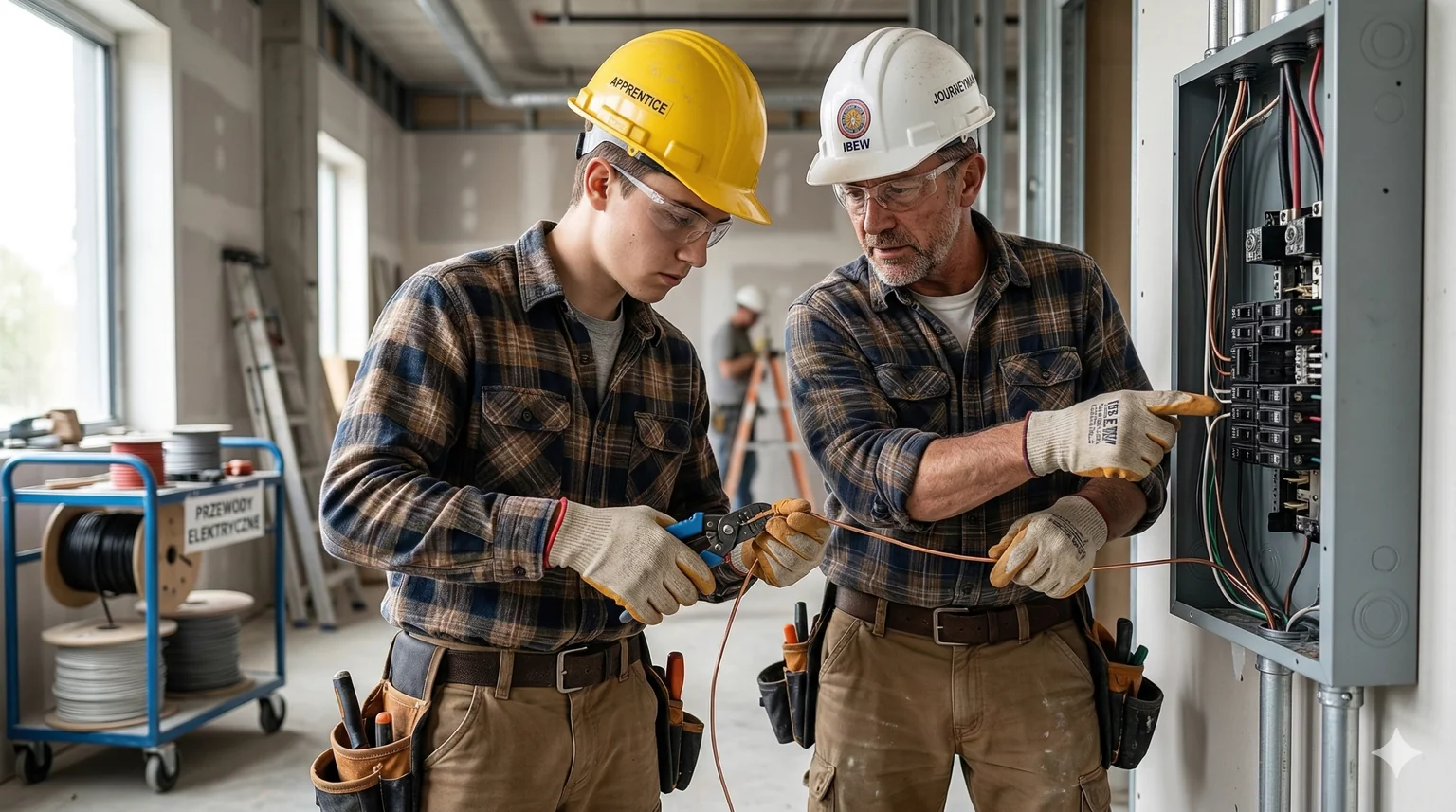

IBEW Local 134 in Chicago receives more than 1,000 applications a year for roughly 200 apprentice spots, and in recent peaks has fielded over 4,000 — figures the IBEW reported in March 2025. That’s a 5%–20% acceptance rate depending on the year, comparable to a moderately selective university. The bigger Locals in Los Angeles, New York, and the Bay Area are similar.
The good news is that the process is structured, scorable, and largely the same Local to Local. If you understand how the four-step funnel actually works and where score points are won and lost, you can move yourself a long way up the ranked list with steady preparation. This guide is specifically about the IBEW/NECA Inside Wireman pipeline — the most common track and the one most applicants think of when they talk about “going union” in the electrical trade.
What “Inside Wireman” Means and Why It’s the Most Competitive IBEW Track
The IBEW runs several apprenticeships through joint NECA-IBEW training centers — Inside Wireman, Residential Wireman, Outside Lineman, and Telecommunications/VDV. Inside Wireman is the commercial and industrial electrical trade — installing power, lighting, controls, and systems in non-residential buildings — and it’s the most-applied-to of the IBEW programs.
Per the Electrical Training Alliance, the Inside Wireman apprenticeship requires a minimum of 8,000 hours of on-the-job training plus structured classroom instruction, typically delivered over four to five years. At completion you receive a federally recognized Certificate of Completion and are eligible to sit for your state’s journeyman electrician license exam. Your apprentice wage is set as a percentage of the journeyman scale that increases as you complete training phases — commonly around 40%–50% in the first period and rising toward 80%–90% by the final year, with the exact percentages set by the local collective bargaining agreement.
That outcome is the reason the funnel is competitive. The end of the pipeline is one of the better-paying skilled trade careers in the U.S., with no tuition cost to the apprentice. That economic case explains the 1,000+ annual applications at large Locals.
Step 1: Pick the Right Local
The single most underweighted decision in the application process is which Local to apply to. Locals are not interchangeable. They differ on:
- Intake structure — annual cohort, biennial cohort, or continuous rolling intake
- Indenture cadence — May/June only, twice yearly, or as work appears
- Ranked list validity — one year or two
- Re-test waiting period — typically 90 days or six months
- Acceptance rate — driven by local construction pipeline and applicant volume
- Geographic jurisdiction — how far you’d have to travel for work once dispatched
The pattern that holds across most major-metro Locals: heavy applicant volume, slower dispatch, longer effective wait times, but more contracts available once you’re working. Mid-size Locals in growing secondary cities often have shorter waits and faster initial dispatch, with comparable journeyman wages adjusted for cost of living.
Three pieces of information will tell you most of what you need about a given Local before applying:
- The intake calendar — when is the next window, and how often does it open?
- The indenture history — how many apprentices were indentured in the last cycle?
- The list validity period — one year or two?
Most JATC websites publish the first and third openly. The second sometimes requires a phone call. The federal Apprenticeship Job Finder is a useful starting point for locating Locals and contractors near you, but the per-Local detail comes from the JATC directly.
For a broader comparison of how Locals work and why the wait varies so much, see our guide on how apprenticeships actually work.
Step 2: The Application Itself
Basic eligibility for IBEW Inside Wireman is set centrally by the Electrical Training Alliance, and individual Locals add their own requirements on top.
Standard requirements (Electrical Training Alliance):
- At least 18 years old
- High school diploma, GED, or Associate degree (or higher)
- One full year of high school algebra with a passing grade, or one post-high-school algebra course
- Valid driver’s license (most Locals — for jobsite mobility)
- Drug test and physical exam (most Locals)
- Background check (most Locals)
The algebra requirement is the most-often-overlooked. If your high school transcript shows Algebra 1 completed but with a low or failing grade, or you skipped it, expect to be asked for documentation of an equivalent course before you’re scheduled for the test. A community college Intermediate Algebra course satisfies this in most jurisdictions.
A few Locals also require or weight pre-apprenticeship coursework, military electrical experience, or documented industry-related work. None of these are required to apply, but all of them move your interview score up later.
Step 3: The NJATC Aptitude Test
The IBEW Aptitude Test Battery, administered by the Electrical Training Alliance, is the gating screen at almost every IBEW Local. The test is a binary qualifier — pass it and you advance to the interview; fail it and you wait out the re-test period before you can try again.
Format (per the NECA-IBEW Electrical Training Center):
- Algebra and Functions: 33 questions in 46 minutes
- Reading Comprehension: 36 questions in 51 minutes
- No calculator is permitted on the math section
- No penalty for guessing — every blank costs you, so answer everything
Scoring:
The test is reported on a stanine scale of 1 to 9. Most Locals require a minimum stanine of 4 to qualify for an interview, though some accept a 3 and a few require a 5. Because the cutoff is “qualifying” rather than published, aiming for a 7 or 8 puts you well clear of the gate and signals seriousness.
Re-test waiting periods:
- NIETC requires three months between attempts.
- The Electrical Training Alliance national guidance is “a full three (3) months (90 days) must elapse before you may retake the test.”
- The IBEW 294-NECA JATC requires six months.
Result timeline:
Test scoring is handled by an independent facility, and results typically arrive at the training center two to four weeks after you test. If you qualified, you’re scheduled for an interview approximately one month after your test date.
A complete preparation guide with section-by-section content and an 8-week study plan is in our apprenticeship aptitude test prep article.
Step 4: The Interview — Where Your Rank Is Actually Set
If the aptitude test is a pass/fail gate, the interview is where the pool of qualifying candidates gets sorted into a ranked list. This is the highest-leverage step in the process and the one most candidates underprepare for.
Format (per NIETC):
- A panel of 4 to 10 representatives from the IBEW Local, the NECA-IBEW training center, and the National Electrical Contractors Association
- A roughly 10-minute interview window
- Four or five interview questions covering background, motivation, and trade-related experience
Scoring categories (IBEW 294 JATC) typically break into three:
- Character and attitude — punctuality, dress, presentation, demeanor under questioning
- Work experience — trade-adjacent jobs, helper or laborer work, military electrical or construction experience
- Education and training — coursework, certifications, math/science grades
Each panelist scores you on a 0–100 scale; scores are averaged for the final number. That average determines where you fall on the ranked list.
What separates strong interviews from average ones:
- Show up early, dressed for a job interview, not for a job site. Slacks and a button-down are correct; suit and tie is not necessary but doesn’t hurt; jeans and work boots will cost you.
- Have a credible answer to “why this Local.” The panel knows when you’re applying to ten Locals at once. Have a specific reason for theirs.
- Bring documented evidence of every relevant experience — class transcripts, OSHA cards, work history with names of supervisors, anything that turns a self-reported claim into a verifiable one.
- Don’t oversell. Panelists hear hundreds of “I’m a hard worker who shows up on time.” Specific, verifiable beats general and enthusiastic every time.
The interview score is where the difference between a #5 and a #205 list position comes from. Two candidates with identical aptitude scores can finish 100 list positions apart based on a 10-minute conversation.
Step 5: The Ranked List and Indenture
Once your scores are in, you’re placed on the Local’s eligibility list in descending order of total score. Indenture follows that order: when the Local has work to dispatch, the next name on the list is offered the slot.
List validity is one or two years depending on the Local. The Electrical Training Alliance and NIETC use a two-year validity window. The IBEW 294 JATC uses a one-year window. Once the validity expires, you must re-apply and re-test.
Indenture timing depends entirely on the Local’s work picture. The IBEW 294-NECA JATC’s published guidance is representative: “Applicants are generally indentured in May or June of each year, but again, this will vary depending on the work picture. The number of applicants accepted into the program will vary from year to year, based on the amount of work in the area.”
In practice, this produces three common outcomes:
- Top-quartile scorers in active markets: Indentured within 3 to 9 months
- Middle-of-the-list scorers in active markets: Indentured 9 to 18 months in, often in the next cohort
- Anywhere on the list in soft markets: May age off the list without an indenture offer
This is why being well above the qualifying floor on the aptitude test, and walking into the interview prepared, matters more than the binary “did I pass.” The Local’s work picture is outside your control. Your list position is not.
What to Do If You Don’t Get an Offer
Two common scenarios. Different responses for each.
You qualified on the test but didn’t reach the top of the list
You can’t reapply during the validity period — the IBEW will simply tell you the existing list still applies. The productive use of that time:
- Build trade-adjacent work experience (a non-union electrical helper job, a construction laborer job)
- Complete a pre-apprentice or community-college electrical program
- Earn certifications that add interview score weight: OSHA 10/30, First Aid/CPR — see our trade certifications and licenses guide
- Re-apply at the next cycle with a meaningfully stronger profile
You didn’t qualify on the test
You’re locked out of re-testing for 90 days at most Locals, six months at some. The clearest move during that window is structured preparation. The aptitude test is studyable; most candidates who fail it on a first attempt and then prepare seriously for two months pass on the retake.
Either way: consider parallel paths
The Inside Wireman track is one route to a journeyman license. It’s not the only one. Independent Electrical Contractors (IEC) and Associated Builders and Contractors (ABC) run parallel non-union apprenticeships in most states, with shorter waits and lower selectivity but typically lower pay scales. Our union vs non-union trades guide lays out the tradeoffs.
Some IBEW Locals are now actively building bridges for applicants who don’t make the apprentice list. Local 134 in Chicago, in coordination with about 20 NECA signatory contractors, runs a manufacturing-side hiring pathway that funnels apprentice-track applicants into related electrical manufacturing roles. The October 2024 job fair drew 300 attendees and produced 25 hires, per the IBEW. Ask your Local whether a similar program exists.
How Long Should You Plan For?
A realistic Inside Wireman application timeline, end-to-end:
| Phase | Typical duration |
|---|---|
| Preparation (algebra refresher + aptitude test prep) | 6–12 weeks |
| Application window opens to test scheduled | 4–8 weeks |
| Test taken to results received | 2–4 weeks |
| Results to interview scheduled | 4 weeks |
| Interview to ranked list placement | 2–4 weeks |
| Ranked list to indenture (median list position, active market) | 6–12 months |
| Total: application start to indenture | 9–18 months |
The apprenticeship itself then runs four to five years. Total time from “I started preparing” to “I’m a licensed journeyman” is realistically five to six years. That’s longer than many trade-school programs, but you’re earning a wage the entire time and exit with no tuition debt.
How often do IBEW Locals accept applications?
It varies by Local, and it’s the single most important thing to check before you plan your timeline. Some large-market Locals take applications on a rolling or monthly basis; many others open an application window quarterly or only once or twice a year. The cadence is published on each Local’s JATC website — and as covered in Step 1, it should factor into which Local you apply to in the first place. If your nearest Local’s window just closed, applying to a neighboring Local within commuting distance is often faster than waiting for the next cycle.
What does an IBEW apprentice make?
Apprentices are paid a percentage of the Local’s journeyman wage rate, typically starting around 40–50% and stepping up every year (or every completed period of hours and coursework) until you reach full scale at journeyman. Because the percentage is tied to each Local’s negotiated rate, first-year pay differs a lot by market — but in every market it’s a real wage with benefits from day one, which is what separates the apprenticeship path from paying tuition at a trade school.
For prospective applicants weighing the Inside Wireman path against trade school, see our comparison of the best IBEW/NECA electrician schools and our breakdown of how apprenticeships actually work.
The Strategic Summary
If you take only the practical implications:
- Pick the Local before you apply. Intake cadence, list validity, and current work picture vary widely.
- Apply at the start of the window. Late applications sometimes miss test scheduling for that cycle.
- Aim for a stanine 7 or 8, not a 4. Getting on the list isn’t the goal — getting indentured is.
- The interview is where rank is set. Treat it like a job interview for a $200,000 job, because over a 30-year career, that’s what it is.
- Have a parallel plan. A pre-apprentice program, a non-union backup, or relevant work experience all keep your career moving while the IBEW list resolves.
Sources
- IBEW.org — “Chicago Local Expands Opportunities for Apprentice Applicants” — March 14, 2025 — https://ibew.org/chicago-local-expands-opportunities-for-apprentice-applicants/
- NECA-IBEW Electrical Training Center (NIETC) — “Preparing for the Aptitude Test and the Interview” — https://nietc.org/applicants/preparing-to-apply/preparing-for-the-aptitude-test-and-the-interview/
- Electrical Training Alliance — “Applying for Apprenticeship” — https://www.electricaltrainingalliance.org/SamplePage/ApplyingforApprenticeship
- Electrical Training Alliance — “Apprenticeship Training” — https://www.electricaltrainingalliance.org/training/apprenticeshipTraining
- IBEW 294-NECA JATC — “The Process” — https://www.ibew294-neca.org/the-process
- South Texas IBEW JATC — “Interview Overview” — https://www.sotxjatc.org/interview-overview.html
- U.S. Government Accountability Office — “Apprenticeship: Earn-And-Learn Opportunities Can Benefit Workers and Employers” (GAO-25-107040) — April 28, 2025 — https://www.gao.gov/products/gao-25-107040
- Apprenticeship.gov — Apprenticeship Job Finder — https://www.apprenticeship.gov/apprenticeship-job-finder