
If you want a career in healthcare, you will run into the same wall almost everyone does: programs and employers want to see patient-care experience, but you need experience to get the experience. A nursing program asks for documented hands-on hours. An employer prefers candidates who have already been at a bedside. And you are standing there with neither, wondering where the first door is.
Volunteering is the door. It is the one form of real, supervised patient contact you can get before you enroll, before you pass a certification exam, and before anyone has hired you. Done well, it tells admissions committees and hiring managers that you have stood in a clinical setting, talked with patients and families, and chosen this path with your eyes open. It also tells you something just as important: whether caregiving work is actually what you thought it would be.
This guide is for students headed into nursing, medical assisting, phlebotomy, home health, and other caregiving fields. It covers what counts as patient-care experience, why hospice volunteering is one of the most accessible starting points, and how to find a program near you anywhere in the country.
TL;DR: Key Takeaways
- Patient-care experience is increasingly expected, not optional. Some nursing programs set a specific bar — the University of Washington School of Nursing asks for a minimum of 100 hands-on hours — though requirements vary widely by program.
- Volunteering is the one form of supervised patient contact you can get before you enroll or certify. It builds the communication and bedside skills employers screen for, and it lets you test-drive the work before you pay tuition.
- Hospices are uniquely open to volunteers because federal law requires it: Medicare-certified hospices must use volunteers for at least 5% of their total patient-care hours (42 CFR 418.78). That means they actively recruit, train, and structure roles for newcomers.
- You do not need a certification to start. Hospice and hospital volunteer programs provide their own orientation and training; many accept volunteers as young as 15 or 16.
- You can find a program anywhere. Medicare’s Care Compare tool lists hospices by location, and almost every hospital and nursing home runs a volunteer services office.
Why patient-care experience matters before you start
There are three reasons to get patient contact early, and only one of them is about your application.
It de-risks the biggest decision you are about to make. Healthcare training costs money and time. Before you commit, it helps enormously to know that you can be present with a sick or frightened person without freezing, without burning out, and without losing the steadiness that patients need. A few weeks of volunteering answers a question that no brochure can: can I actually do this work?
It builds the skills that get people hired. The clinical tasks — taking vitals, drawing blood, charting — are taught in your program. What is rarely taught, and always valued, is the human side: listening, reading a room, staying calm, explaining things to a worried family member. These are the exact qualities a medical assistant or nursing assistant is judged on day to day, and they are best learned by doing.
Some programs require it on paper. This is where students get tripped up, because the bar is not uniform. The University of Washington School of Nursing, for example, asks applicants for “a minimum of 100 hours of hands-on healthcare experience in one setting.” Many other programs ask for nothing formal at all, and community-college allied-health programs often have open enrollment. The lesson is not “you need exactly 100 hours.” It is: check the specific programs you are targeting, because some will count your volunteer hours and some will require them.
What actually counts (hands-on vs. shadowing)
Not all healthcare experience is treated equally. Admissions reviewers and employers draw a line between observing care and participating in it.
Hands-on, direct patient contact is the gold standard. This includes paid roles such as certified nursing assistant, medical assistant, home health aide, phlebotomist, or emergency department technician — and it includes volunteer roles where you are present with patients: feeding, repositioning, companionship, transport, comfort care.
Shadowing and observation — following a nurse or physician on rounds — has value for understanding a profession, but it is passive. If a program asks for “hands-on” or “direct care” hours, shadowing usually will not satisfy the requirement on its own.
The practical takeaway: when you choose a volunteer role, ask whether it puts you in contact with patients or behind a desk. Both help, but direct contact is what carries the most weight and teaches you the most.
Why hospice volunteering is a standout option
Of all the volunteer paths into healthcare, hospice is one of the most accessible and one of the most overlooked. There is a structural reason for that, and it is worth understanding.
Hospices are required by federal law to use volunteers. Under the Medicare Conditions of Participation, a Medicare-certified hospice must “provide day-to-day administrative and/or direct patient care services in an amount that, at a minimum, equals 5 percent of the total patient care hours of all paid hospice employees and contract staff” (42 CFR 418.78). The same regulation requires hospices to recruit and retain volunteers, train them, and use them in defined roles under supervision.
No other Medicare provider has a rule like this. Hospitals and nursing homes welcome volunteers, but hospices depend on them and are measured on it. For a student, that translates into something rare: an organization that wants you there, has a training program ready, and has thought carefully about where a newcomer fits.
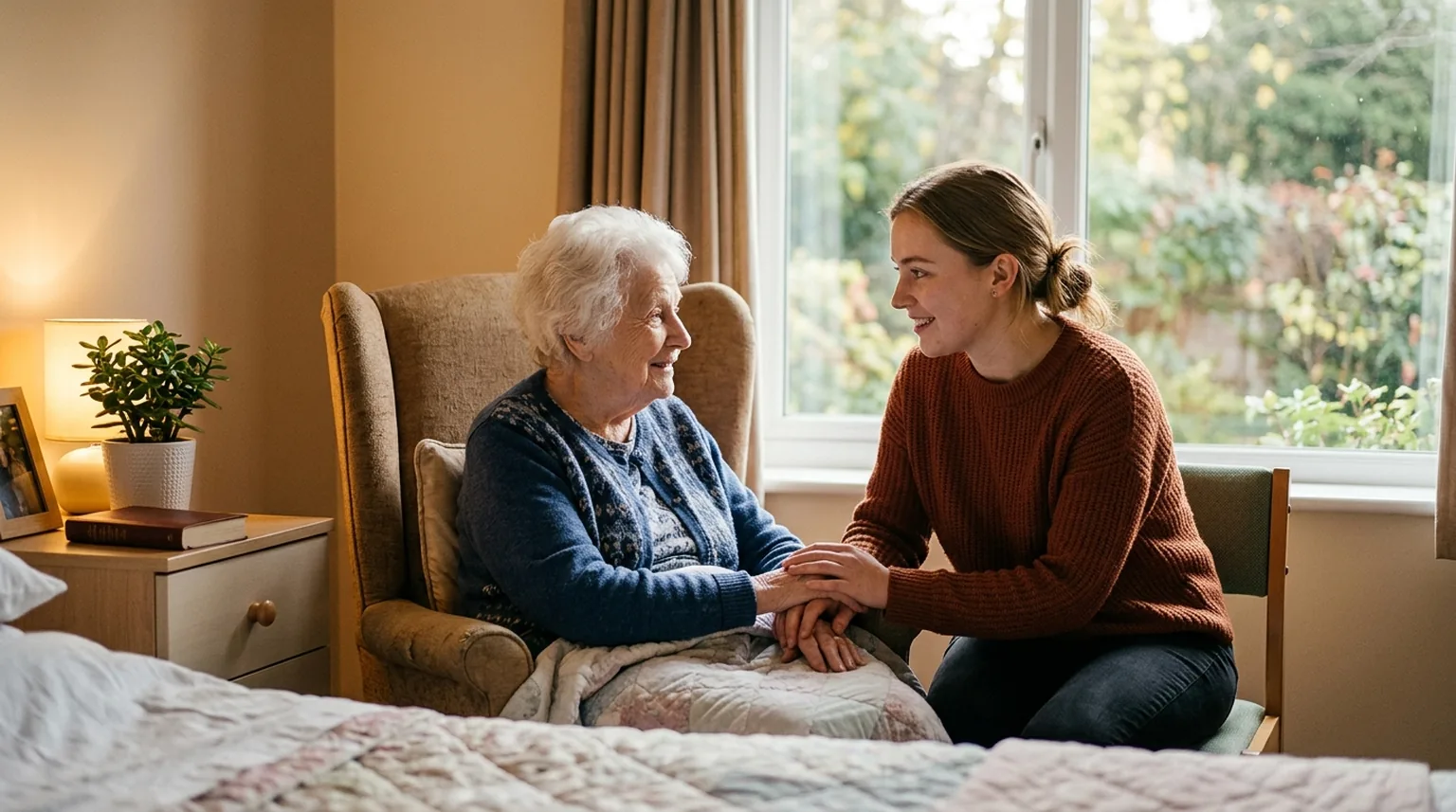
You do not need a credential to begin. The hospice provides orientation and training itself. You learn how an interdisciplinary team works — nurses, aides, social workers, chaplains, and physicians coordinating around one patient — and you practice the comfort-focused communication that defines good end-of-life care.
An honest word about the work. Hospice means being present with people at the end of life, and with families during a hard passage. It is emotionally heavy, and it is not for everyone at every stage of life. That is not a reason to avoid it. It is a reason to go in informed — and if you discover that this particular setting is not for you, that self-knowledge is itself a valuable result. Many students find the opposite: that being useful in a difficult moment is exactly the confirmation they needed.
A real example: High Pointe House / Tufts Medicine Care at Home
To make this concrete, here is one publicly documented program. High Pointe House in Haverhill, Massachusetts is the hospice residence of Tufts Medicine Care at Home, and it runs a volunteer training class that is open to the community.
According to the program’s public training-class page, volunteers complete a four-week training at no cost, must be at least 16 years old, and can serve in several roles: visiting and providing companionship to patients in the hospice house, helping with greeting and administrative tasks, or supporting in the kitchen. There is also a community option — visiting patients in their own homes, nursing homes, and residential settings across the region. Specialty volunteers contribute things like Reiki, massage, or pet therapy.
If you want to learn more about a program like this, contact the organization’s volunteer services office through its public channels — for Tufts Medicine Care at Home, that is the Volunteer Services Department at VolunteerManager@tuftsmedicine.org. (This is offered here purely as a real-world illustration of how these programs are structured; it is not an endorsement, and TradeColleges.org has no affiliation with the organization.)
The point of the example is the shape of the opportunity — structured training, a low age threshold, real patient contact, and a clear way in — because that shape repeats at hospices and hospitals across the country.
How to find a program near you (anywhere in the U.S.)
You do not need to be near any particular facility. Patient-care volunteer roles exist in nearly every community. Here is where to look.
Hospices. Use Medicare’s official Care Compare hospice locator to find Medicare-certified hospices near you, then visit each one’s website or call and ask for volunteer services. Because of the federal requirement described above, most will have an active program.
Hospitals. Almost every hospital runs a volunteer services office. Requirements are typically modest but specific — St. David’s Medical Center, for instance, asks volunteers to be at least 15 and to commit to a few hours a week for six months. Expect age minimums in the 15–16 range and a stated weekly commitment.
Nursing homes and assisted-living communities. These settings often need companionship and activity volunteers and tend to have flexible schedules.
Free and community clinics, the Red Cross, and hospital auxiliaries round out the options if you want variety or a non-end-of-life setting.
What to expect when you apply. Patient-care volunteering involves vulnerable people, so the intake is more involved than signing up for a one-day event. Plan for an application, an interview, a background check, and often a TB test or proof of immunizations, followed by an orientation or training course and a minimum time commitment. None of this is a barrier — it is the same screening every healthcare worker goes through, and completing it is itself a small head start on your career paperwork.
Turning volunteer hours into a healthcare career
Volunteering is most valuable when you treat it as the first rung of a ladder, not a one-off. A few habits make the difference.
Log your hours. Keep a simple record of dates, setting, role, and supervisor. If you later apply to a nursing or allied-health program that counts patient-care hours, you will have documentation ready instead of reconstructing it from memory.
Collect references. A supervisor who watched you show up reliably and handle patients with care is exactly the recommender admissions committees and employers trust most.
Map your experience to a credential. Use what you learn to choose your next step. If the bedside work energized you, nursing assistant or medical assistant training is a fast, fundable route into paid clinical work — and the field is growing quickly. The Bureau of Labor Statistics projects medical assistant employment to grow 12% from 2024 to 2034, much faster than the average for all occupations, with a 2024 median wage of $44,200. If lab work appealed to you more, phlebotomy is a short certificate program leading to a $43,660 median wage.
For more on building from here, see our guides to the fastest-growing trade careers, trade careers with the shortest training, and the medical assistant career path.
Is it right for you? An honest gut-check
Before you commit, run through a few questions honestly:
- Can you handle the emotional weight? Especially in hospice, you will be near serious illness and loss. Some people find meaning in it; some find it too much right now. Both answers are fine.
- Can you keep the commitment? Most programs ask for a set number of hours over several months. Patients and staff come to rely on you, so only sign up for what you can sustain.
- Are you eligible? Check the age minimum (often 15–16) and be ready for the background check and health screening.
- What do you want out of it? Direct patient contact teaches the most and counts the most. If your goal is hands-on hours for an application, choose a role that actually puts you with patients.
If the answers point you forward, you are in a strong position. You will have real experience, real references, and a clear-eyed sense of whether this work is yours to do.
Next steps
- Pick a setting. Decide whether you want hospice, hospital, nursing home, or clinic, and whether you can handle end-of-life work right now.
- Find programs near you. Start with the Medicare hospice locator or your local hospital’s volunteer services page.
- Apply and complete training. Budget time for the background check and orientation.
- Log everything so your hours and references are ready when you apply to a program or job.
Getting experience before you have a credential feels like a paradox, but it is not. The healthcare system is built to welcome volunteers, and in the case of hospice, it is required to. Walk through that door, and you will not be a student wondering whether you can do this work. You will be someone who already has.
Sources
- U.S. Bureau of Labor Statistics — Occupational Outlook Handbook — “Medical Assistants” (median wage $44,200, 12% projected growth 2024–34) — 2025 — https://www.bls.gov/ooh/healthcare/medical-assistants.htm
- U.S. Bureau of Labor Statistics — Occupational Outlook Handbook — “Nursing Assistants and Orderlies” (median wage $39,430) — 2025 — https://www.bls.gov/ooh/healthcare/nursing-assistants.htm
- U.S. Bureau of Labor Statistics — Occupational Outlook Handbook — “Phlebotomists” (median wage $43,660, 6% projected growth 2024–34) — 2025 — https://www.bls.gov/ooh/healthcare/phlebotomists.htm
- Centers for Medicare & Medicaid Services — Electronic Code of Federal Regulations — “42 CFR 418.78: Conditions of Participation — Volunteers” (5% volunteer requirement) — current as of 2026 — https://www.ecfr.gov/current/title-42/chapter-IV/subchapter-B/part-418/subpart-C/subject-group-ECFR74797288a614803/section-418.78
- Tufts Medicine Care at Home — “Care at Home Volunteer Training Class” (four-week training, age 16+, High Pointe House) — https://www.tuftsmedicine.org/about-us/events/care-home-volunteer-training-class
- University of Washington School of Nursing — “Undergraduate Healthcare Experience” (100-hour hands-on experience guidance) — 2025 — https://nursing.uw.edu/wp-content/uploads/2025/08/Undergraduate-Healthcare-Experience.pdf
- U.S. Centers for Medicare & Medicaid Services — Medicare Care Compare, Hospice search — https://www.medicare.gov/care-compare/?guidedSearch=Hospice