
A data-driven ranking for prospective plumbers.
Choosing a plumbing school is the most consequential decision a prospective plumber makes before their first day on a job site. The program you pick shapes how fast you finish, whether you walk out ready to sit for a licensing exam, and which contractors take your resume seriously. This ranking uses IPEDS data on completion, retention, and plumbing program focus. It’s a comparison of which schools are actually producing plumbing graduates at quality and scale in 2026 — not a list of the biggest names.
TL;DR
- Median pay: $62,970/year as of May 2024 per the BLS Occupational Outlook Handbook.
- Projected growth: 4% from 2024–2034, with roughly 44,000 annual openings — most driven by retirements, not expansion. Source: BLS OOH.
- Two real paths in: a trade-school program or a registered apprenticeship. Most plumbers do some of both.
- Top 10 plumbing schools are listed below, scored on completion rate, retention, program focus, and program scale.
The plumbing career in 2026 by the numbers
All of the figures below come from the BLS Occupational Outlook Handbook for Plumbers, Pipefitters, and Steamfitters, under SOC 47-2152.
| Metric | Value |
|---|---|
| Median Annual Pay (May 2024) | $62,970 |
| Projected Job Growth (2024–2034) | 4% (about average) |
| Annual Job Openings | ~44,000 |
| Total Employment (2024) | 504,500 |
| Occupation Code | SOC 47-2152 |
The headline growth rate of 4% understates the opportunity. The BLS notes that most of those ~44,000 yearly openings come from workers retiring or leaving the trade, not from new positions — so the demand is real even though the percentage looks modest. For the full career outlook and licensing breakdown, see our plumbing career opportunities article.
Why plumbing demand holds up
Plumbing is one of the most recession-resistant trades in the country, for three plain reasons.
The work can’t be offshored or automated away. A burst pipe, a failed water heater, or a new building’s rough-in needs a licensed human on site. That insulates the trade from the forces hollowing out other career paths.
The workforce is aging out. Like most construction trades, plumbing skews older, and the steady stream of retirements is what keeps those ~44,000 annual openings flowing. New entrants aren’t replacing a shrinking field — they’re backfilling one that can’t recruit fast enough.
Licensing creates a moat. Because most states require a licensed journeyman or master plumber to pull permits, the supply of qualified plumbers is capped by how many people complete training and pass exams. That scarcity is what pushes the top 10% of plumbers above $105,150 a year, per the BLS.
The top 10 best plumbing schools in the US (2026)
The ranking below uses the same IPEDS scoring as our national plumbing rankings, which score every plumbing-granting institution on four weighted factors: completion rate (25%), retention rate (20%), trade productivity (35%), and trade scale (20%). Trade productivity measures how central plumbing is to a school’s output, and trade scale captures raw plumbing graduate volume. Together they surface schools genuinely focused on plumbing rather than schools with a small plumbing track bolted onto a large catalog.
#1 Thaddeus Stevens College of Technology — Lancaster, PA
A public technical college with a 73.6% completion rate — the 99th percentile among plumbing-granting schools — and 75% retention. In-state tuition runs about $9,000. Thaddeus Stevens is built around hands-on trades, and it shows in how many students actually finish.
#2 Fox Valley Technical College — Appleton, WI
A large public college (over 10,000 students) that still posts a 64.1% plumbing completion rate and 80% retention at roughly $4,386 in-state tuition. Strong outcomes at a low price point and real scale.
#3 Northwest Technical College — Bemidji, MN
A small, focused public school in northern Minnesota with a 47.2% completion rate and 74% retention. Tuition is about $5,896. Its size keeps the plumbing track central rather than peripheral.
#4 Waukesha County Technical College — Pewaukee, WI
A mid-size Wisconsin public college with 46.1% completion, 78% retention, and ~$4,386 in-state tuition. A dependable, affordable option in a state with deep manufacturing and construction demand.
#5 Northwest Kansas Technical College — Goodland, KS
A small public technical college posting a 62.7% completion rate and the highest retention on this list at 84%. Its tight focus on applied trades is exactly what the methodology rewards.
#6 Pennco Tech-Bristol — Bristol, PA
A private trade school with a 72% completion rate — strong on finishing. One honest caveat: its reported first-year retention is low (around 31%), which can reflect short, fast-track program structures but is worth asking about directly during a campus visit.
#7 Hennepin Technical College — Brooklyn Park, MN
A large public college in the Minneapolis metro with 73% retention and about $5,341 in-state tuition. Its 36.3% completion rate is more modest, but its metro location means abundant apprenticeship and employer connections.
#8 Northwood Technical College — Rice Lake, WI
A public Wisconsin college with a 60.3% completion rate, 80% retention, and ~$4,524 tuition. Consistent across every metric — a safe, well-rounded pick.
#9 North Dakota State College of Science — Wahpeton, ND
A public college with 79% retention and roughly $4,997 in-state tuition. A strong regional option for the northern plains, where energy and construction work keeps plumbers busy.
#10 Atlanta Technical College — Atlanta, GA
A public college with the lowest tuition on this list (about $2,400 in-state) in a major metro market. Completion sits at 38.3%, but the price and location make it a high-value entry point for Southeast students.
A note on reading this list: completion and retention rates reflect a school’s full student body, not just its plumbing track, and program size varies a lot. Where IPEDS listed the same institution twice under merged reporting, we counted it once. Use the ranking to build a shortlist, then verify the specifics — apprenticeship placement, licensing-exam pass rates, equipment — with each school directly.
Trade school vs. apprenticeship: the two real paths
There isn’t one way to become a plumber, and the best programs often blend both.
The apprenticeship path lets you earn while you learn. The United Association (UA) — the largest plumbing and pipefitting union — runs registered apprenticeships that combine paid on-the-job work with classroom instruction over roughly five years, graduating apprentices with about 10,000 hours of on-the-job training and 1,230 classroom hours. Entry typically requires being 18, having a high school diploma or GED, and passing an aptitude test. The appeal is obvious: you collect a paycheck and benefits the whole time and finish without student debt.
The trade-school path front-loads the classroom and lab work, usually in a one-to-two-year certificate or associate program. It can get you job-ready faster and is often a smoother route into an apprenticeship, since many programs feed directly into local employers. The schools ranked above are this path.
Most plumbers end up doing some of each — a school program to build fundamentals, then a registered apprenticeship to log the supervised hours licensing requires. For a step-by-step walk through both routes, see how to become a plumber.
What to look for in a plumbing program
Beyond the ranking, four things separate a program worth your tuition from one that just sells seats:
- Recognized curriculum. Look for NCCER accreditation. NCCER’s four-level plumbing curriculum is built to the U.S. Department of Labor’s apprenticeship standards, and many union and non-union apprenticeships accept its credential as a first step — meaning your coursework counts toward the next stage instead of being repeated.
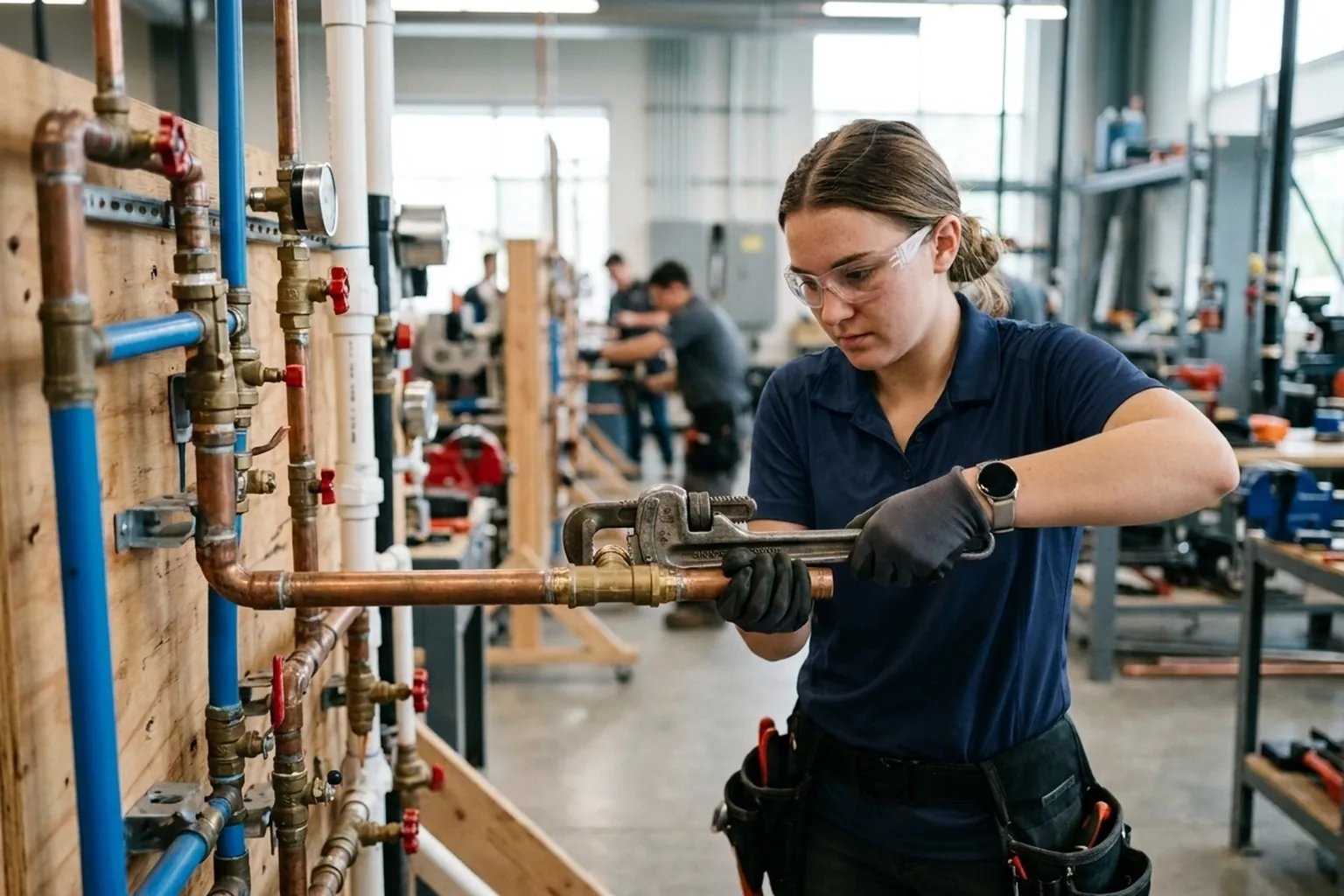
- Hands-on hours. Plumbing is a physical craft. Ask how much of the program is lab and shop time versus lecture, and what equipment students actually train on.
- Licensing alignment. Confirm the program’s hours and curriculum count toward your state’s apprenticeship or journeyman requirements. A certificate that doesn’t move you toward a license is a detour.
- Job placement. The best programs maintain relationships with local contractors and apprenticeship committees. Ask for placement rates and which employers hire their graduates.
Licensing and what plumbers earn
Plumbing is a licensed trade in most states, and pay climbs with each rung of the ladder. Apprentices typically start at a percentage of the journeyman wage and get scheduled raises as they log hours. Once licensed as a journeyman, you can work independently; a master plumber license lets you pull permits, run jobs, and eventually own a business.
The pay reflects that progression. Per the BLS, the lowest 10% of plumbers earned under $40,670 in May 2024 — roughly where apprentices sit — while the median was $62,970 and the top 10% cleared $105,150. The plumbers at the top of that range are usually masters running their own crews or working specialized commercial and pipefitting niches. If pipe systems for large buildings interest you, the related pipefitter and steamfitter path often pays at the higher end.
Where to start
Pick two or three schools from the ranking that are within reach geographically and financially, then contact each one. Ask the four questions above — curriculum accreditation, hands-on hours, licensing alignment, and placement — and ask whether their program feeds into a registered apprenticeship near you. The right answer to “what happens after I graduate?” should be a specific, local one.
Plumbing won’t be automated, won’t be offshored, and won’t run out of demand while the current workforce retires. A program that gets you licensed efficiently is one of the most reliable returns on a year or two of training in the trades today.
Sources
- U.S. Bureau of Labor Statistics — Occupational Outlook Handbook — “Plumbers, Pipefitters, and Steamfitters” — May 2024 data — https://www.bls.gov/ooh/construction-and-extraction/plumbers-pipefitters-and-steamfitters.htm
- United Association of Journeymen and Apprentices of the Plumbing and Pipe Fitting Industry — “UA Apprenticeship” — accessed June 2026 — https://ua.org/apprenticeship/
- NCCER — “Plumbing” craft curriculum catalog — accessed June 2026 — https://www.nccer.org/craft-catalog/plumbing/
- tradecolleges.org — National plumbing program rankings (IPEDS completion, retention, and program-focus data) — https://tradecolleges.org/rankings/best-trade/plumbing