
Search “best massage therapy schools” and you’ll get ranked lists of brand names. That framing is backwards. Massage therapy is a state-licensed profession, and the program that’s “best” is the one whose accreditation and clock hours line up with the state where you actually intend to work. A nationally famous school that doesn’t meet your state board’s hour requirement is worthless to you; a modest community college program that does is exactly what you need.
This guide skips the rankings and gives you the framework professionals actually use: what accreditation means, how to match a program to your state, and the handful of questions that separate a school worth your tuition from one that isn’t.
First, the demand picture is real. The BLS Occupational Outlook Handbook reports 168,000 massage therapists employed, a median wage of $57,950, and 15 percent projected job growth from 2024 to 2034 — more than four times the average across all occupations, adding roughly 25,900 jobs over the decade. The opportunity is there. The trick is getting credentialed efficiently.
What “Accredited” Actually Means — Three Different Things
The word “accredited” gets used loosely in massage school marketing. There are three distinct layers, and they do different jobs for you.
COMTA — The Specialized Standard
The Commission on Massage Therapy Accreditation (COMTA) is the only accreditor dedicated specifically to massage therapy and esthetics education, and it’s recognized by both the U.S. Department of Education and the Council for Higher Education Accreditation (CHEA). COMTA evaluates a program against competencies built for this field — anatomy, kinesiology, hands-on technique, clinical reasoning, and ethics — rather than generic educational benchmarks.
COMTA accreditation is not legally required to get licensed. But it’s the strongest single signal that a program’s curriculum was reviewed by people who understand the trade. If a school carries it, that tells you something the brochure can’t.
Institutional / Regional Accreditation
This is accreditation of the whole institution by an agency recognized by the Department of Education. It’s the layer that governs federal financial aid eligibility — Pell Grants and federal loans only flow to students at institutionally accredited schools. A community college with massage programming almost always has this; a small private massage institute may or may not.
State Board Approval — The One That’s Legally Required
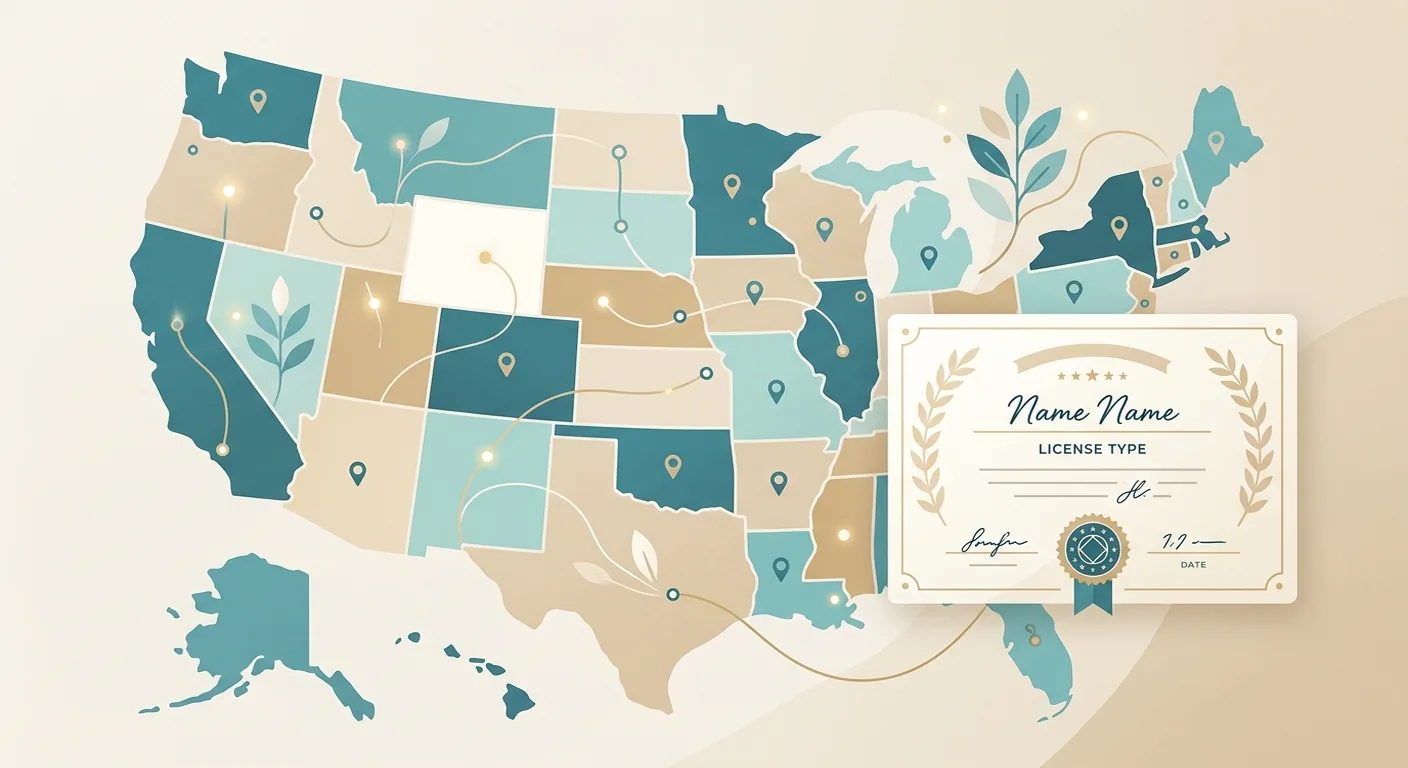
This is the layer that actually matters for licensure. Every regulated state maintains a list of board-approved massage programs, and graduating from an approved program is a prerequisite to sit for the licensing exam. A school can be famous, COMTA-accredited, and beautifully reviewed — but if your state board hasn’t approved its curriculum and hour count, completing it won’t make you eligible to practice there.
The order of importance for most students is: state approval first (non-negotiable), institutional accreditation second (if you need aid), COMTA third (a quality signal that strengthens both).
What a Strong Program Teaches
A program that prepares you for a real career — not just an exam — covers more than how to give a relaxing massage. According to the BLS, coursework in a quality program includes the sciences (anatomy, physiology, kinesiology, and pathology), hands-on technique across multiple modalities, and the business and ethics content you’ll need whether you take a spa job or build a private practice.
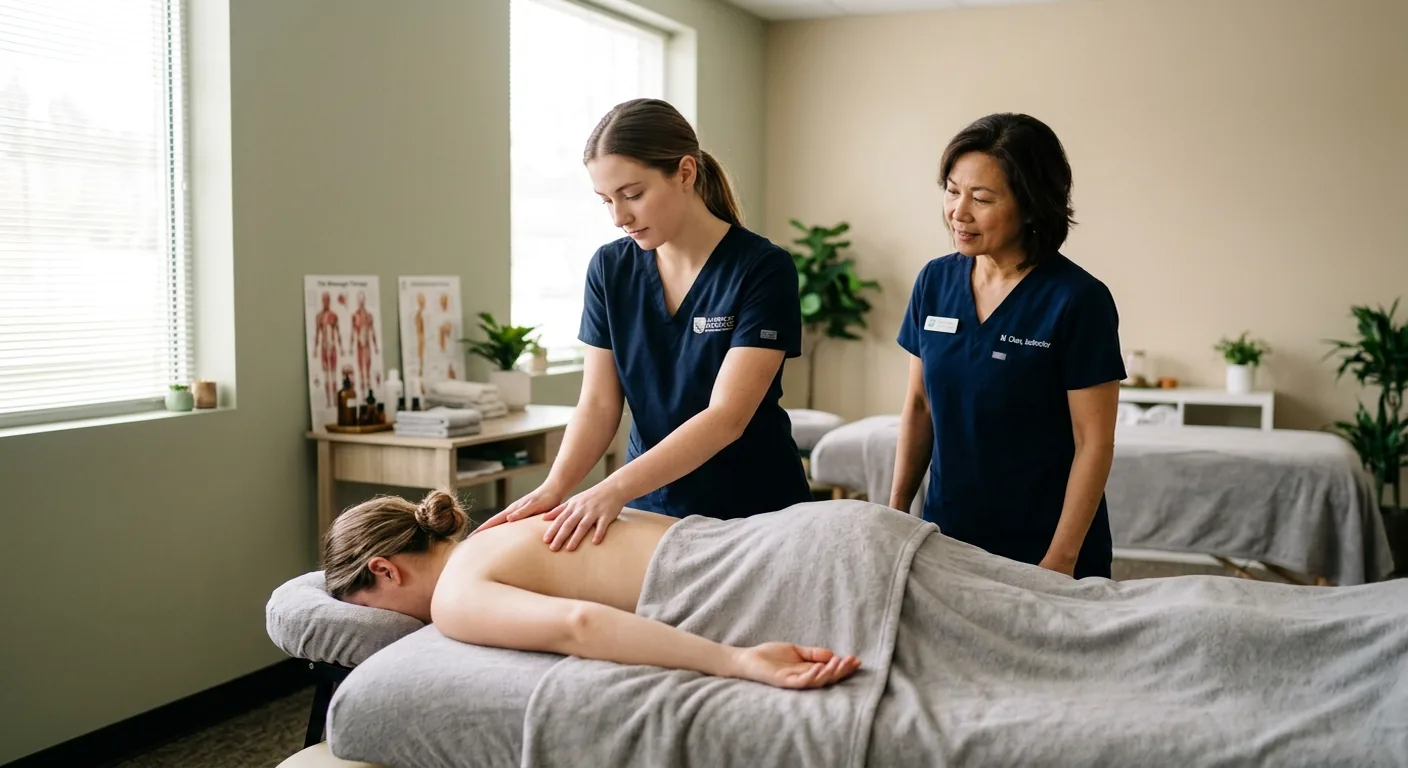
The single most important component to scrutinize is the supervised clinic: hours spent working on real members of the public under instructor oversight, not just practicing on classmates. Clinic hours are where technique becomes skill, and a program light on them produces graduates who pass the exam but freeze on their first paying client.
Hours and Cost: Match the Program to Your State
Here’s where most “best school” lists fail you. State training requirements range from 500 to 1,000 hours of board-approved education, and the number that matters is your target state’s, not the national average. Per the Federation of State Massage Therapy Boards (FSMTB), the spread is wide:
- 500 hours — Texas, Florida, Georgia, Virginia, and others (the lower, faster-to-complete tier)
- 600–650 hours — Illinois, Ohio, Pennsylvania, Massachusetts, Colorado
- 750 hours — Connecticut, Maryland, New Hampshire
- 1,000 hours — New York and Nebraska (the highest tier)
Most full-time programs run 6 months to a year. A 500-hour program in Texas can finish in roughly six months; a 1,000-hour New York program takes about twice as long. If there’s any chance you’ll relocate, train to the higher standard — it’s far easier to qualify in a low-hour state with a 750- or 1,000-hour education than to add hundreds of hours after the fact. We break down every jurisdiction’s exact requirements in our massage therapy license requirements by state guide.
On cost: tuition varies enormously, from a few thousand dollars at a community college to well over $15,000 at a private institute, and the sticker price doesn’t track program quality reliably. Because length drives cost, a 1,000-hour program will run more than a 500-hour one for the same per-hour rate. Compare total cost — tuition, fees, supplies, and exam prep — not just the headline number, and check whether the school’s institutional accreditation makes you eligible for aid. Our guide to financing trade school covers Pell Grants and institutional scholarships in detail.
What to Verify Before You Apply
Treat the school’s claims as a starting point and confirm each of these directly — by phone, in writing, or against your state board’s website:
- Is the program on your state board’s approved list? Confirm it against the board itself, not the school’s marketing. This is the one that can’t be skipped.
- Does its hour count meet the state where you’ll practice? A 500-hour program doesn’t make you eligible in a 1,000-hour state.
- What is the school’s MBLEx pass rate? The MBLEx is the standard licensing exam in most jurisdictions. Reputable schools track and will share their pass rate; a number well below average — or a refusal to share one — is a red flag.
- How many supervised clinic hours with real clients? Ask for the specific number and how it’s structured.
- Is it COMTA-accredited or institutionally accredited? The first signals curriculum quality; the second governs financial aid.
- What’s the total cost, all-in? Tuition plus fees, table, linens, oils, and exam fees.
For a broader framework that applies to vetting any trade program, see how to evaluate a trade school.
Beyond Licensure: A Quality Signal Worth Knowing
The MBLEx and your state license are the entry credential. The National Certification Board for Therapeutic Massage and Bodywork (NCBTMB) offers Board Certification (BCTMB) — a voluntary credential that sits above entry-level licensure and requires a current license, a separate board exam, and a background check. You don’t need it to start working, but schools that prepare students toward it tend to teach to a higher bar. If a program mentions BCTMB preparation, that’s a signal in its favor.
Bottom Line
There is no universal “best” massage therapy school. There’s the program that’s approved in your state, meets its hour requirement, has a strong MBLEx pass rate and real clinic hours, and fits your budget. Get those four right and the brand name is irrelevant.
Start by deciding where you’ll practice, pull that state’s requirements, and then filter programs against them. You can browse accredited massage therapy programs and compare them against your state’s rules, and read more about the day-to-day career, pay, and specializations in our guide to becoming a massage therapist.
Sources
- U.S. Bureau of Labor Statistics — “Massage Therapists” — Occupational Outlook Handbook — Modified August 28, 2025 — https://www.bls.gov/ooh/healthcare/massage-therapists.htm
- Commission on Massage Therapy Accreditation (COMTA) — https://www.comta.org/
- Federation of State Massage Therapy Boards (FSMTB) — “Regulated States” — https://fsmtb.org/regulated-states/
- Federation of State Massage Therapy Boards (FSMTB) — “MBLEx” — https://fsmtb.org/mblex/
- National Certification Board for Therapeutic Massage & Bodywork (NCBTMB) — “Board Certification” — https://ncbtmb.org/board-certification/